How to Implement a Skills Framework Across Your Organisation
Quick answer: A skills framework is a structured system that maps the specific skills, knowledge and behaviours required for each role in an organisation, replacing static job descriptions with measurable proficiency levels. Building one typically takes 3–4 months and involves defining core categories, setting proficiency levels, gathering frontline input, and mapping roles to skills. Organisations that adopt skills-based practices are significantly more likely to retain high performers and reduce reliance on costly external hiring.
The traditional job description is failing modern businesses. When you hire someone based on a static list of duties, that document becomes obsolete the moment your operational strategy shifts. Research from the World Economic Forum’s Future of Jobs Report projects that 44% of workers’ core skills will change within five years. If your company still manages talent based on job titles rather than underlying capabilities, you’re planning for a workforce that no longer exists.
To stay agile, HR leaders are shifting from rigid job titles to a skills-based approach to workforce planning, built around a skills framework (also called a competency framework).
A skills framework gives you a universal language to measure what your workforce can actually do, identify critical gaps, and build fair, data-driven progression paths. This guide walks through exactly how to design, build and deploy one, without drowning in spreadsheets.
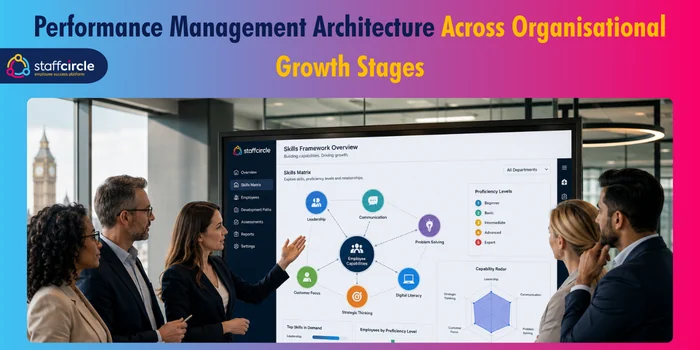
What Is a Skills Framework and Why Does Your Business Need One?
A skills framework is a structured model that identifies the specific skills, knowledge and behaviours required for employees to perform their roles successfully. Instead of vaguely stating that a manager needs to be “good at communication,” the framework breaks down exactly what effective communication looks like at the junior, mid and senior levels.
What Should a Skills Framework Include?
A complete skills framework should define not only the technical abilities employees need but also the behaviours and knowledge that contribute to success in each role.
Most organisations include:
- Core competencies shared across the business
- Role-specific technical skills
- Leadership capabilities
- Behavioural competencies
- Clear proficiency levels
- Evidence required to demonstrate each level
- Learning recommendations for progression
Together, these components create a consistent way to evaluate employees across departments while supporting career growth and business objectives.
The Business Case for a Skills Framework
If your executive team views mapping skills as a theoretical HR exercise, they are missing the financial impact. Implementing a universal framework solves three critical business problems:
- Targeted Learning and Development (L&D): Without a framework, L&D budgets are often wasted on generic training platforms that employees never use. A framework allows you to pinpoint exact capability gaps and spend your training budget precisely where the business needs it.
- Internal Mobility and Retention: Deloitte research shows that organisations adopting skills-based practices are 98% more likely to retain high performers. When employees can see exactly which skills they need to acquire to earn a promotion, they stay and develop rather than leaving for a minor salary bump elsewhere.
- Equitable Performance Reviews: Vague appraisal criteria lead to biased reviews. A framework anchors performance conversations in objective criteria. Did the employee demonstrate Level 3 Data Analysis this quarter? Yes or no.
Skills Framework vs Competency Framework
The terms are often used interchangeably, but there is a subtle distinction.
| Skills | Competencies |
|---|---|
| Specific learned abilities | Behaviours, judgement and application |
| Easy to test and measure | Demonstrated through performance |
| Examples include Excel, Python, budgeting | Examples include leadership, adaptability, decision-making |
Modern organisations typically combine both into a single workforce capability framework that measures technical expertise alongside behavioural effectiveness.
Step-By-Step: Building a Competency Framework from Scratch
Creating a framework can feel overwhelming, especially for mid-market businesses. The key is to start small, align with business strategy, and avoid building a taxonomy so complex that managers refuse to use it.
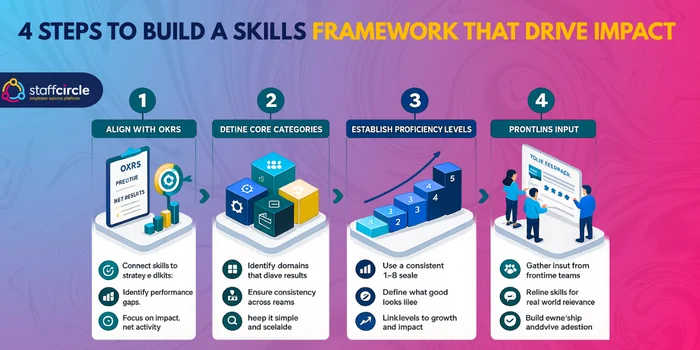
Step 1: Align with Organisational OKRs
Your framework must serve the business strategy. Look at your company’s Objectives and Key Results (OKRs) for the next three years. If you are a logistics firm aiming to automate your warehouses, your framework must heavily weight digital literacy, automation troubleshooting and change management.
Step 2: Define the Core Categories
Do not lump every capability into one massive list. Divide your framework into clear categories:
- Core Competencies: Behaviours required by everyone in the company, from the warehouse floor to the C-suite (e.g. Safety Compliance, Adaptability).
- Functional/Technical Skills: Role-specific abilities (e.g. Python programming, forklift operation, financial forecasting).
- Leadership Competencies: Skills required for those managing people or strategic projects (e.g. conflict resolution, strategic delegation).
Step 3: Establish Clear Proficiency Levels
A skill is useless if you cannot measure it. Establish a consistent grading scale across the business. Avoid subjective terms like “Good” or “Excellent.” Instead, define what the employee can accomplish independently.
| Level | Title | Behavioural Definition |
|---|---|---|
| 1 | Beginner | Needs direct supervision. Understands basic concepts. |
| 2 | Intermediate | Executes routine tasks independently. Requires help with edge cases. |
| 3 | Advanced | Handles complex problems autonomously. Optimises existing processes. |
| 4 | Expert | Sets the standard. Teaches others and designs new strategies. |
Step 4: Gather Input from the Frontline
Do not build this in an HR silo. Interview high-performing employees and line managers. Ask them: “What specific actions separate a good performer from a great performer in your department?” Documenting these real-world behaviours ensures the framework reflects the actual reality of the job, not just a theoretical HR textbook.
How Long Does It Take to Build a Skills Framework?
The timeline depends on the size and complexity of the organisation, but most businesses can implement a practical framework in a few months.
| Stage | Typical Timeline |
|---|---|
| Business planning and stakeholder alignment | 1–2 weeks |
| Identify competencies and skills | 2–4 weeks |
| Define proficiency levels | 1–2 weeks |
| Validate with managers | 2 weeks |
| Map roles to skills | 2–4 weeks |
| Pilot with one department | 4–6 weeks |
| Organisation-wide rollout | Ongoing |
How to Map Roles to Skills and Competencies
Once your framework is built, you must attach it to your actual workforce. This is called role mapping.
Start by defining the “Skill Profile” for every role in the business. For example, a Customer Success Manager (CSM) does not just need “Customer Service.” They might need:
- De-escalation Strategy (Level 3)
- CRM Data Entry (Level 2)
- Product Technical Knowledge (Level 3)
The Baseline vs. Target Rule
When mapping roles, you are establishing the Target Profile (the ideal state required to do the job perfectly).
Next, managers assess their employees against this target to establish a Baseline Profile. If the CSM role requires Level 3 De-escalation Strategy, but the current employee operates at Level 2, you have successfully identified a skill gap. This delta between the Baseline and the Target is the foundation of continuous performance management.
Common Mistakes When Building a Skills Framework
Even well-designed frameworks can fail if they are too difficult to maintain or disconnected from day-to-day work. The most successful organisations keep their frameworks practical, measurable and aligned with business goals.
Common mistakes include:
- Building hundreds of competencies before validating the framework with managers
- Using vague descriptions like “excellent communication” instead of measurable behaviours
- Treating the framework as an annual HR exercise rather than a living system
- Failing to update technical skills as business priorities evolve
- Ignoring input from frontline employees
- Measuring employees against inconsistent standards across departments
A simple framework that managers actually use will deliver more value than an overly detailed model that sits unused.
Using StaffCircle’s Skills Framework and MCPx AI Integration
Managing skills across hundreds or thousands of employees using spreadsheets quickly becomes unmanageable. Static documents become outdated as roles evolve, employees gain new capabilities and business priorities shift.
StaffCircle replaces manual spreadsheets with a dynamic, digital skills framework that integrates competency management, career pathways, employee development and workforce planning into a single platform. Skills remain connected to employees, roles, reviews, learning and succession planning, making them easier to maintain and use throughout the employee lifecycle.
Accelerating Framework Creation with StaffCircle AI and MCPx
Creating a competency framework from scratch can take weeks or months of defining roles, mapping skills and establishing career pathways.
StaffCircle’s AI-powered Competency Framework Generator helps accelerate this process by identifying base roles, generating competency frameworks, suggesting career pathways and enriching existing role and skill data. Administrators can generate an initial framework, review the AI-generated recommendations, edit where necessary, and publish the framework once it reflects the organisation’s requirements. The generated framework remains in draft form until approved, ensuring HR teams retain complete control over the final structure.
Alongside these capabilities, StaffCircle’s MCPx AI extends AI-powered assistance across the platform, enabling organisations to interact with HR data more efficiently and support administrative workflows using natural language.
Mobile Access for Every Employee
A skills framework only delivers value when employees can access it regularly.
Because StaffCircle is built as a Progressive Web App (PWA), employees can securely access their development information from desktop computers, tablets or smartphones. This makes competency development accessible to both office-based and frontline workers, allowing employees to review skills, development plans and career pathways regardless of where they work.
Skills Management Inside Microsoft Teams
Many organisations already use Microsoft Teams as their primary collaboration platform. StaffCircle integrates directly with Teams so managers and employees can complete performance management activities without constantly switching applications.
Managers can conduct check-ins, manage reviews, provide feedback linked to competency frameworks, monitor objectives and support employee development from within Microsoft Teams. This helps embed skills development into regular conversations rather than treating it as a separate HR exercise.
Skills Gap Analysis: Turning Your Framework into Action
Creating a skills framework is only the first step. The real value comes from understanding where capability gaps exist and using that information to guide workforce decisions.
Individual Development
A skills framework provides managers with objective evidence when discussing employee development. Rather than giving vague feedback, managers can identify the specific competencies required for progression and build personalised development plans around measurable skill improvements.
For example, an employee aiming for a senior role may need to strengthen leadership, stakeholder management or technical expertise before becoming promotion-ready. These requirements become visible through competency assessments and can be incorporated into development goals, learning plans and regular performance conversations.
Departmental Workforce Planning
At the departmental level, aggregated skills data helps HR and business leaders understand capability across teams.
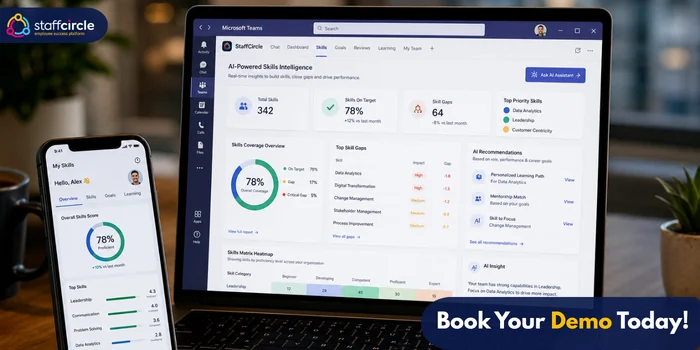
StaffCircle provides skills dashboards, reporting and Power BI integration, enabling organisations to identify areas where skills shortages may affect future projects, compliance or operational performance. Instead of discovering capability gaps after a project begins, leaders can identify them early and plan targeted learning, recruitment or redeployment strategies.
Organisation-Wide Talent Decisions
Skills intelligence also supports long-term workforce planning.
When organisations identify critical capability gaps, leadership can decide whether it is more effective to develop existing employees or recruit externally. By comparing workforce capabilities against future business requirements, organisations can identify internal mobility opportunities, support succession planning, and make more informed talent investment decisions.
This approach enables businesses to maximise existing talent while reducing unnecessary recruitment costs and strengthening workforce resilience.
Final Thoughts
A well-designed skills framework gives your organisation a clear understanding of the capabilities it has today and the skills it needs for tomorrow. It creates fairer performance reviews, supports employee development, improves succession planning and helps leaders make informed workforce decisions. However, the real value comes from keeping the framework accurate, accessible and integrated into everyday work rather than treating it as a static HR document.
With a platform like StaffCircle, businesses can automate skills management, identify capability gaps faster, and turn workforce data into meaningful action. Book a demo today to see how StaffCircle can help you build a future-ready workforce.
FAQ
What is a skills framework?
A skills framework is a structured model that defines the specific skills, knowledge and behaviours employees need to succeed in their roles. It measures employees against clear proficiency levels rather than vague job titles.
What’s the difference between a skills framework and a competency framework?
A skills framework focuses on specific, measurable abilities like Python programming, financial modelling or machine operation. A competency framework is broader, combining those skills with behaviours and judgement, such as leadership, adaptability and decision-making. Most modern organisations combine both into a single framework.
How long does it take to build a skills framework?
Most organisations can build and pilot a practical framework in 3–4 months. This typically includes 1–2 weeks for stakeholder alignment, 2–4 weeks to identify competencies, 1–2 weeks to define proficiency levels, 2 weeks to validate with managers, 2–4 weeks to map roles, and 4–6 weeks to pilot the framework with one department before a wider rollout.
How often should a skills framework be updated?
Treat it as a living system rather than an annual exercise. Technical skills should be reviewed whenever new systems, tools or strategic initiatives are introduced. Behavioural competencies change less often but should still be revisited periodically to ensure they remain aligned with business goals.
Do small businesses need dedicated software to manage a skills framework?
Not necessarily. Organisations with fewer than 50 employees and relatively stable roles can often start with a spreadsheet-based framework. As headcount and role complexity increase, spreadsheets become harder to maintain because of version control issues, inconsistent data and disconnected performance data. That’s when dedicated platforms become more valuable.
Can AI help build a skills framework?
Yes. AI tools can analyse job descriptions, identify common competencies, suggest proficiency levels and flag emerging skills based on role data. Human review is still essential to ensure the framework reflects the organisation’s goals, culture and real-world requirements rather than generic templates.
How often should employees be assessed against the framework?
Most organisations assess skills during quarterly or biannual performance conversations. Technical competencies are typically updated whenever priorities, responsibilities or tools change.
Which industries benefit most from skills frameworks?
Nearly every industry benefits from a skills framework. Healthcare, manufacturing, retail, logistics, finance, technology, education, professional services and the public sector all use skills frameworks to support workforce planning, employee development and succession planning.
Related articles
See StaffCircle in action
Book a personalised demo and see how StaffCircle drives performance, engagement and development.