How to conduct performance reviews
A performance review is conducted in five stages: confirm the standards being judged, gather evidence from goals and feedback, draft and calibrate the ratings, run a timed meeting where the employee speaks first, and close the loop by agreeing goals and development actions with dates.
Key facts
- Only 14% of employees strongly agree the reviews they receive inspire them to improve, Gallup found.
- Managers spend around 210 hours a year on performance management activities, CEB research reported.
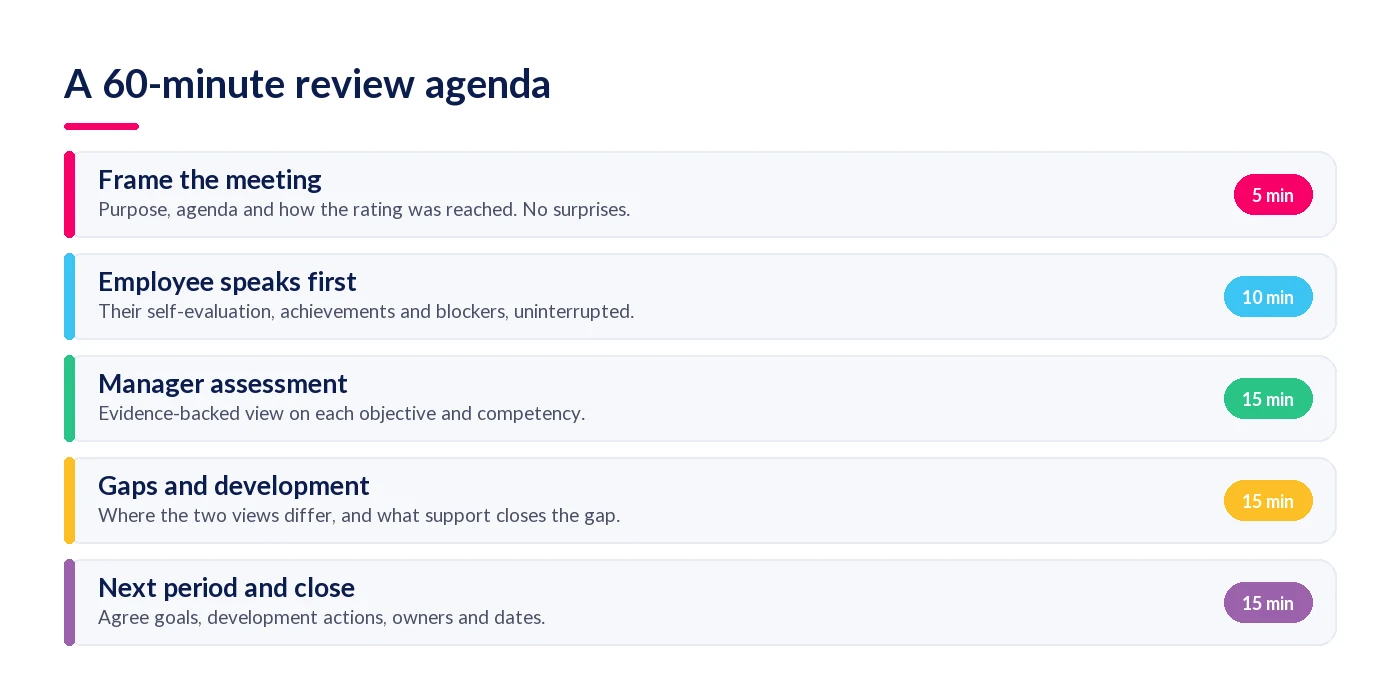
- A workable 60-minute agenda: 5 minutes framing, 10 employee, 15 manager, 15 gaps, 15 next period.
- Four of the five stages happen before the meeting. Quality is decided in preparation.
- No rating should be new information to the employee on review day.
How to do a performance review?
Treat the review as a five-stage process, not a single meeting: set the standard, gather the evidence, draft and calibrate, hold the conversation, then close the loop. The meeting is stage four of five, which is why so many reviews feel thin — most of the quality is decided in the three stages before anyone sits down. Each stage below has an owner and a timing relative to review day.
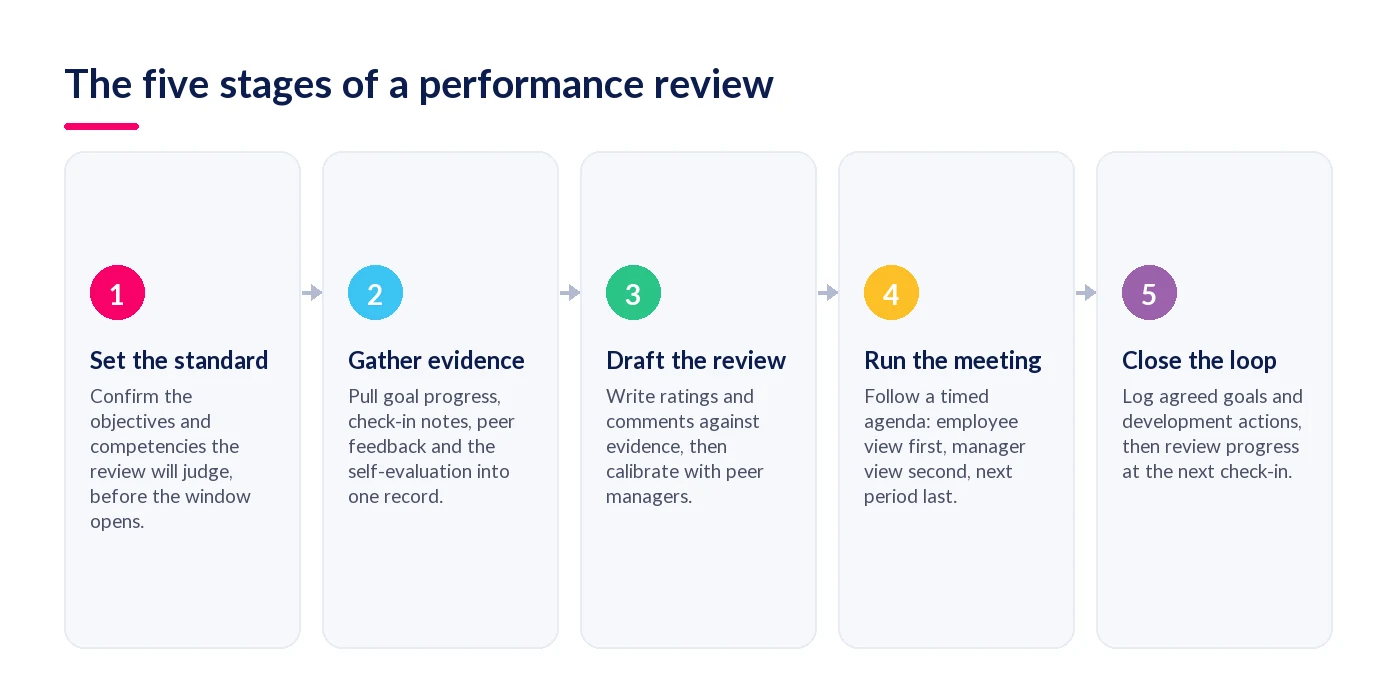
- Set the standard, four weeks out. Confirm exactly what the review judges: the objectives agreed at the start of the period, the competencies attached to the role, and the wording of the rating scale. Publish that wording to managers and employees at the same time. If objectives were never written down, say so and rate against the competencies only — inventing retrospective targets is what makes a review feel arbitrary.
- Gather the evidence, two weeks out. Pull goal progress, one-to-one notes, project outcomes, peer or customer feedback and the employee's self-evaluation into one place. Ask for the self-evaluation before you draft your own view, not after, so their evidence can genuinely change your assessment instead of just confirming it. Sending out our guide to preparing for a performance review with the invite noticeably raises the quality of the self-evaluations you get back.
- Draft and calibrate, one week out. Write your assessment against the evidence, objective by objective, then compare ratings with the other managers at your level before anything is shared. Calibration is the only reliable defense against one manager's "meets expectations" being another manager's "exceeds" — and it is the difference between a rating you can explain and one you can only assert.
- Run the meeting to a timed agenda. Sixty minutes, employee's view first, your assessment second, the gap between the two third, and next period last. Give the rating early rather than saving it for the end; a person waiting for a verdict is not listening to anything else you say.
- Close the loop within five working days. Log the agreed objectives, development actions, owners and dates, share the written record, and put the first progress check in the calendar. A review that ends without a dated next action is where the value leaks away.
What does a performance review agenda look like?
A 60-minute review splits into five timed segments: 5 minutes to frame the meeting, 10 for the employee's own account, 15 for your assessment, 15 on gaps and development, and 15 to agree the next period. The timings matter because unstructured reviews reliably overrun on the past and run out of time for the future — which is the half that changes anything.
| Minutes | Segment | What happens | Who leads |
|---|---|---|---|
| 0–5 | Frame the meeting | State the purpose, the agenda, the rating scale and how you reached your view. Confirm what is decided here and what is not. | Manager |
| 5–15 | Employee's view first | They walk through their self-evaluation: progress against each objective, what went well, what did not, what got in the way. You take notes and ask questions only to clarify. | Employee |
| 15–30 | Manager's assessment | Your view objective by objective, then competency by competency, each with the evidence behind it and the rating attached. | Manager |
| 30–45 | Gaps and development | Where the two accounts differ, and why. Agree what support, training or scope change closes the gap. | Both |
| 45–60 | Next period and close | Agree three to five objectives, development actions, owners and dates. Summarize back in the employee's words, then confirm who writes it up. | Both |
| 60 | Total | Half the meeting on the period just gone, half on the period ahead. | — |
Two variants of the same shape work for other slot lengths. For a 45-minute review: 5 framing, 8 employee, 12 manager, 10 gaps, 10 next period. For a 90-minute review of a senior or complex role: 10 framing, 15 employee, 20 manager, 25 gaps and development, 20 next period. The closing segment is the one most often rushed, and it is the one that decides whether anything changes: our worked examples of good goals for a performance review are written to be checkable at the next review rather than restated. Keep the order fixed even when you shorten it — the employee-first sequence is what stops the meeting becoming a verdict delivered at someone.
What to say in a performance review?
Say what you observed, when it happened, and what effect it had — then stop and let the other person respond. Reviews go wrong on language more often than on substance: a manager who has done the evidence work still loses the room by opening with a judgment instead of an example. These are the four moments that decide how the conversation goes.
Opening. "This is a 60-minute review of the last six months against the four objectives we agreed in February. I have written my assessment and I will share the ratings today. I want to hear your view of each objective first, because if your evidence changes my view I would rather change it now than defend it."
Positive feedback that is worth having. Name the behavior, the evidence and the effect: "You rewrote the onboarding pack in March. New-hire questions to the service desk dropped by about a third the following quarter. That is the piece of work I would point at if someone asked me what good looks like in this role."
Critical feedback. Same structure, no cushioning sandwich: "In the April and June releases, the test plan arrived the day before go-live rather than a week before, so QA had no time to push back. The effect was two rollbacks. I have rated this objective as partly met. What was happening from your side?"
When the employee disagrees. Do not relitigate on the spot. "That is a genuinely different reading of the same period. Tell me which evidence I have missed, and give me until Friday to look at it — if you are right, the rating changes." A rating you are willing to revisit with evidence is stronger, not weaker.
Writing those comments down is a separate skill from saying them out loud. Our guide to writing a performance review has more than fifteen worked comment examples by competency area, each shown as a weak version and a strong rewrite. If you want the longer version of the whole process — question banks, rating-scale wording and manager scripts — the Ultimate Guide to Performance Reviews works through each stage in more depth.
How often should performance reviews happen?
Twice a year formally, with a monthly or six-weekly check-in in between. Annual-only cycles are still the most common pattern — Gallup found 48% of employees are reviewed annually and 26% less often than that — and they force a manager to summarize twelve months from memory, which is exactly how recency bias gets into a rating. The formal review should be a summary of conversations that already happened, not the first one.
The frequency evidence is unusually clear. Gallup reports that 80% of employees who received meaningful feedback in the past week are fully engaged, and that people are 3.6 times more likely to strongly agree they are motivated to do outstanding work when their manager gives daily rather than annual feedback. The formal review does not have to carry that load on its own — and it cannot.
If you are deciding the cadence for the first time, our explainer on what an appraisal is covers the different review types and what each one is for,. The wider design questions — cycles, scales, calibration, who sees what — are covered in our guide to building a performance management system.
What makes a performance review fail?
Five failure modes account for most bad reviews, and all five are process problems rather than personality problems. Gallup found only 29% of employees strongly agree their reviews are fair and 26% that they are accurate, so the base rate here is poor — worth knowing before you conclude your own process is unusually broken.
- No agreed standard. Objectives were never written down, or the rating scale means different things to different managers. Fix: publish the scale wording and the objectives at the start of the period, not the end.
- Recall instead of evidence. The manager writes from memory, so the last six weeks outweigh the first six months. Fix: a running record of check-ins, goal progress and feedback that the review draws from.
- No calibration. Ratings are internally consistent for each manager and incomparable across managers. Fix: a calibration session before anything is shared.
- Surprise ratings. A "partly met" that has never been raised in a one-to-one is a management failure disclosed as an employee failure. Fix: raise it when it happens.
- No follow-through. Development actions are agreed and never revisited, which teaches everyone that the exercise is ceremonial. Fix: dated actions with owners, checked at the next one-to-one.
The admin load is what usually breaks the follow-through: 210 hours a year of manager time, in the CEB research reported by SHRM, is a lot of time to spend on a process nine in ten managers say they are dissatisfied with. Most of that time goes on chasing, formatting and re-entering things the organization already knows, which is the part worth automating first.
Getting this right is mostly discipline, not sophistication: publish the standard, keep a running record, calibrate before you deliver, run the meeting to the clock, and make sure something dated happens afterwards. To see how StaffCircle handles that cycle end to end, look at performance management and development.
Frequently asked questions
How long should a performance review meeting be?
Sixty minutes suits most roles, split into five timed segments so the future gets as much airtime as the past. Simple, single-objective roles can work in 45 minutes. Senior or cross-functional roles need 90. Anything under 30 minutes rarely leaves room for the employee to be heard at all.
Who should attend a performance review?
The employee and their direct manager, and nobody else by default. A second manager attends only where the role is genuinely shared, where a formal capability process has started, or where the employee asks for a companion. Anyone else in the room changes what the employee is willing to tell you.
What should you not say in a performance review?
Avoid comparisons with named colleagues, comments on personality rather than behavior, and vague praise with no example attached. Never introduce a serious concern for the first time in a review. And do not promise a promotion or pay rise you have not already had approved.
How do you conduct a performance review for the first time?
Write your assessment a week early, then read it back asking one question of every sentence: what is the evidence, and would the employee recognize it? Rehearse the opening and the hardest rating out loud. Book 60 minutes, follow the agenda, and take notes rather than defending.
Should performance reviews be linked to pay?
They can be, but hold the pay conversation separately and a few weeks later. Once money is on the table people stop discussing development honestly and start negotiating the rating. Keep the review focused on evidence and next period, then let the pay decision reference it.
Related articles

See StaffCircle in action
Book a personalised demo and see how StaffCircle drives performance, engagement and development.