How to prepare for a performance review
The best preparation for a performance review is a single written page you bring with you: your progress against each objective, three achievements with numbers attached, one gap you have already started fixing, and one specific request. Write it two weeks before the meeting rather than the night before.
Key facts
- Only 47% of employees strongly agree they know what is expected of them at work, Gallup found.
- Bring one page: objectives, three quantified achievements, one gap, one request.
- Start two weeks out. Most people forget their best work from months one to four.
- If you disagree with a rating, ask for time and evidence. Do not argue live.
- Keep the pay conversation separate from the performance conversation.
What should you do before a performance review?
Work through five things in the two weeks before the meeting: reread the objectives you were set, build an evidence list covering the whole period, write your own one-page summary, complete the self-evaluation properly, and rehearse the two conversations you are dreading. The single biggest gain comes from the evidence list, because almost nobody remembers their own first quarter without one. It is also worth checking that you and your manager agree on the standard at all: in Gallup’s Q2 2025 data, only 47% of employees strongly agree they know what is expected of them at work.
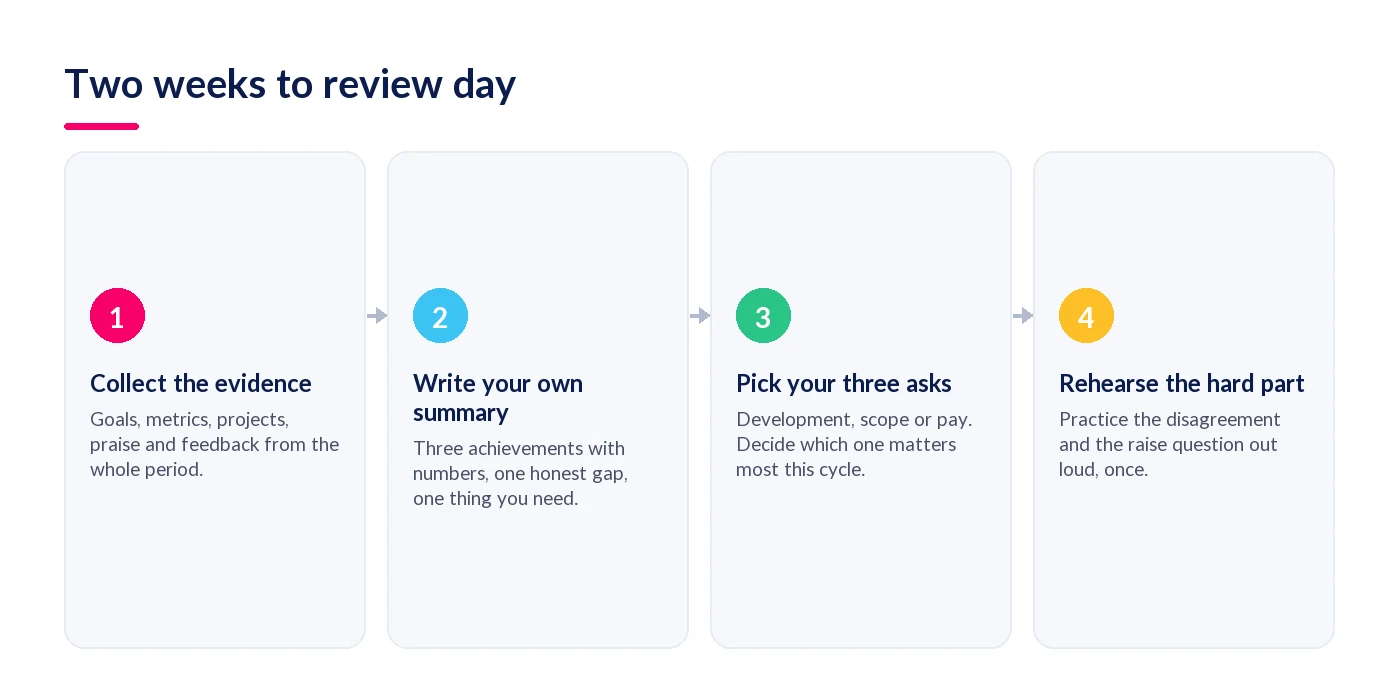
- Reread your objectives and your last review. Start with what you were actually measured on, in the words it was written in, plus any development actions agreed last time. If objectives were never written down, say so early and propose the three or four things you believe you were accountable for, so the meeting is not judged against a standard nobody recorded.
- Build an evidence list for the whole period. Go back through your calendar, sent items, project boards, chat mentions and metrics month by month. Write down results, numbers, dates and anyone who thanked you. Ten minutes per month beats an hour of trying to remember, and it corrects the recency bias that otherwise costs you your early wins.
- Write your one page. Progress against each objective, three achievements with a number or a named beneficiary each, one gap you own with what you are already doing about it, and one specific request. This is the page you bring, and the page your manager quotes from if it is good.
- Complete the self-evaluation on time. Managers often draft their assessment after reading it, so a self-evaluation submitted late has zero influence on your rating. Our guide to writing a self-evaluation works through a full example, including how to describe a weakness without damaging yourself.
- Rehearse the two hard moments. Say your disagreement out loud once, and your development or pay request out loud once. Both come out badly when improvised, and both come out fine on the second attempt.
What to bring to a performance review?
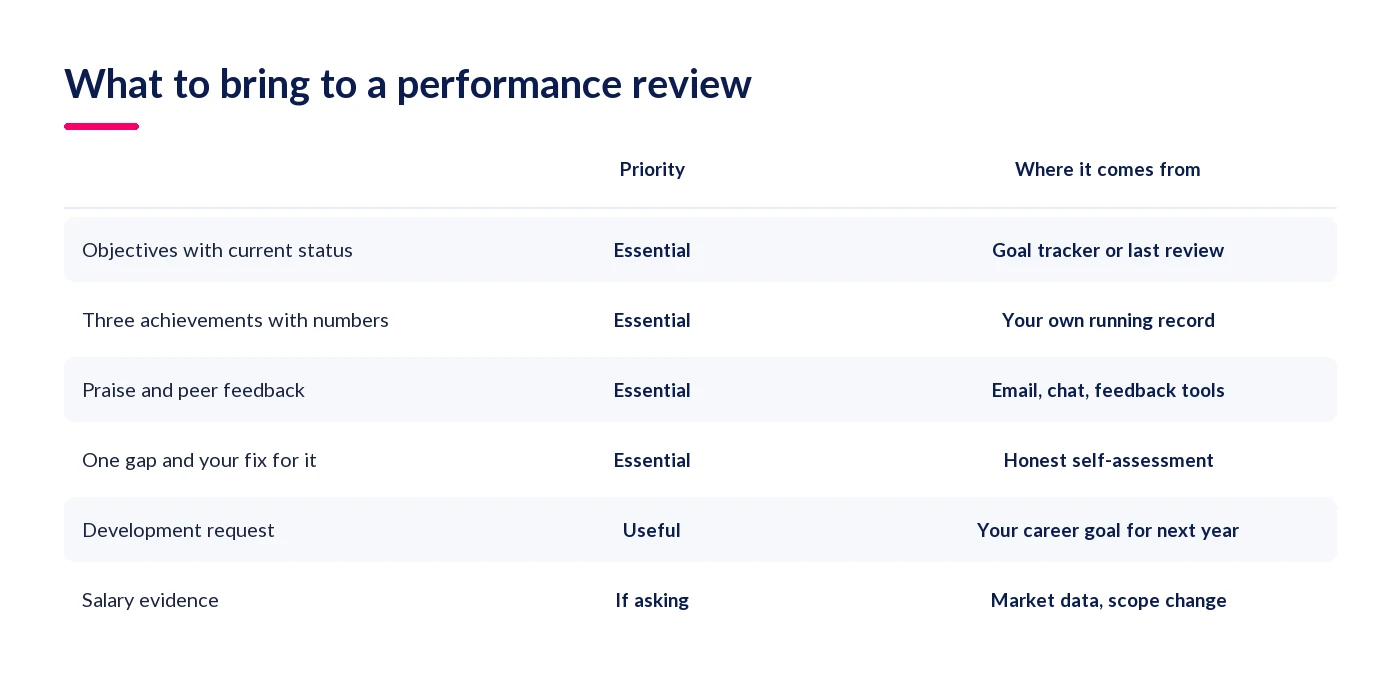
Bring your one page, your evidence list behind it, and your questions. Everything in the table below is either something you will be asked about or something you want on the record — and the last two rows are the ones people leave at home and then regret.
| What to bring | Why it matters | Where the evidence comes from |
|---|---|---|
| Each objective and its current status | The review is judged against these, so state them before anyone else has to | Goal tracker, last review, your objectives document |
| Three achievements with numbers | A quantified claim survives the meeting; a general one does not | Your own running record, metrics, project outcomes |
| Evidence from the first half of the period | Counters recency bias, which usually works against you | Calendar, sent items, project boards, month by month |
| Praise and peer feedback | Third-party evidence carries more weight than self-assessment | Email, chat messages, customer notes, feedback tools |
| One gap and your fix for it | Naming it first makes you credible on everything else | Honest self-assessment, feedback you have had |
| Your questions for your manager | Turns a verdict into a two-way conversation | What you need to know about scope, priorities, progression |
| One development request | Reviews are the moment budget and scope get allocated | Your career goal for the next year or two |
| Salary evidence, if you are asking | Scope change and market data, not effort or tenure | Published salary ranges, your changed responsibilities |
What to say in a performance review as an employee?
Lead with evidence, keep it to outcomes rather than effort, and answer the question you were asked. Most reviews start by inviting you to give your own account of the period, and that opening is the most valuable two minutes you get — it frames everything your manager says afterwards. Use these as starting points and put your own numbers in.
Opening your own account. “I had four objectives. Two are complete, one is on track, and one slipped — I will come to that. The thing I am most pleased with is the reporting rebuild, because it cut the weekly run from three hours to twenty minutes and freed up about a day a month for the team.”
Describing something that went wrong. “The CRM cleanse did not land. I underestimated how much of the data needed manual checking, and I did not flag that early enough. What I have changed since is that I now raise a slippage risk at the fortnightly check-in rather than waiting until the deadline is at risk.”
When you are asked what support you need. Be specific enough to be actionable: “Two things. I would like to shadow the pricing meetings for a quarter, because I keep hitting the edge of what I can decide alone. And I need a decision on who owns the supplier data, because that ambiguity cost us three weeks this year.”
Asking your own questions. Good ones: what would move me from this rating to the next one, in behavior rather than adjectives? Which of my objectives matters most to you next year? What is the one thing you would have me stop doing? Reviews are one of the few scheduled moments you can ask those directly.
It also helps to know what your manager has been asked to do — the evidence they should have gathered, the agenda they should be following, and why the rating should not be new information. Our guide to conducting performance reviews sets out that process, and what an appraisal is explains how the different review types differ in purpose. If your organization runs development reviews as well, what a PDR is covers that variant.
How to respectfully disagree with a performance review?
Disagree with the evidence, not the rating, and ask for time rather than settling it live. Say clearly that you see it differently, name the specific evidence you think is missing, and propose a short follow-up once your manager has looked at it. Ratings do get changed this way; they almost never get changed by arguing in the room.
A form of words that works: “I want to say I see this objective differently, and I would rather do it properly than react now. My reading is that the delivery date moved twice for reasons outside the team, and the revised date was met. Can I send you the timeline and the two change requests, and we pick this up on Thursday?”
Then follow four rules. Keep it to one or two disputed points — disputing everything reads as denial and costs you the point you would have won. Put it in writing, briefly and factually, within a couple of days. Separate the rating from the process: if you were never told about a problem until review day, that is a fair thing to raise on its own. And if the rating stands, ask precisely what evidence would change it next period, then get that in writing too.
How to ask for a raise during performance review?
Raise it at the end, briefly, and treat it as opening a separate conversation rather than closing one. In most organizations the person opposite you cannot approve pay in the room and the budget cycle is already set, so the goal is a specific commitment: what evidence is needed, who decides, and when. Base the ask on scope and market rate, never on effort or tenure.
Something like: “Before we finish, I want to flag pay. My role has changed this year — I picked up the reporting workload in June and I now run the supplier reviews, which were not in the original scope. Published ranges for that scope sit above where I am. I am not expecting an answer today. What evidence do you need, and when is the decision made?”
Three things to avoid: comparing yourself to a named colleague’s salary, making it conditional in a way that sounds like a threat, and letting it consume the development half of the meeting. If the answer is no, get the criteria and the date. A no with a date is progress; a no with a vague “let us revisit” is the same conversation again next year.
If you want the manager-side view of how the whole cycle is meant to run — agendas, rating scales and the calibration that sits behind your rating — the Ultimate Guide to Performance Reviews is a useful read before you go in.
Frequently asked questions
How far in advance should you prepare for a performance review?
Two weeks is the sweet spot. It gives you time to work back through the whole period month by month, which is where forgotten evidence lives, and to complete the self-evaluation before your manager drafts their assessment. A day or two only gives you your most recent work, which rarely tells the full story.
What questions should you ask your manager in a performance review?
Ask what specific behavior would move you to the next rating, which objective matters most next period, what you should stop doing, and what a realistic next step in your career looks like from here. Each one produces something actionable, unlike asking generally how you are doing.
What should you not say in a performance review as an employee?
Avoid blaming named colleagues, comparing your pay to someone else, or claiming credit for work you supported rather than led. Do not dispute every point you disagree with; pick the one or two that matter. And avoid promising improvements you have no plan to deliver.
What happens if you disagree with your rating after the meeting?
Put your case in writing within a few days: the objective, the evidence you believe was missed, and what you are asking for. Most employers have an appeal route in the policy. If the rating stands, ask what specific evidence would change it next period and get that confirmed in writing.
How do you prepare for a performance review with a new manager?
Assume they have limited visibility of your first months and bring more evidence than usual, including praise and peer feedback from before they arrived. Offer a short written summary in advance. It is also the right moment to agree how you will work together and what they will measure next period.
Related articles
See StaffCircle in action
Book a personalised demo and see how StaffCircle drives performance, engagement and development.