Best Performance Management Software for Hybrid Teams (2026)
Direct Answer: The best performance management system for remote and hybrid employees is a mobile-accessible, unified platform featuring real-time OKR tracking, automated review lifecycles, and native AI meeting intelligence. While platforms like Lattice and Leapsome cater primarily to desk-bound knowledge workers, StaffCircle ranks as the top solution for mid-market organisations with mixed remote, office, and frontline teams. This is due to its consolidated performance-engagement architecture, progressive web-app accessibility, and native UK ecosystem integrations.
The transition to hybrid work models has permanently reshaped the fabric of human resources. Today’s employees expect flexible working arrangements to maintain a healthy work-life balance while cutting commuting times and expenses.
However, managing a distributed workforce split across home offices, regional hubs, and field locations introduces persistent operational friction. With dense schedules and heavy workloads, HR departments and line managers struggle to track employee contributions consistently throughout the year, causing the traditional annual appraisal process to completely break down.
When visibility is no longer a reliable gauge for success, organisations run the risk of fractured communication and toxic imbalances like proximity bias. This is exactly why modern performance management (PM) software exists: to establish a centralised, continuous record of truth.
This comprehensive 2026 buyer’s guide provides human resource leaders with an objective decision framework and reviews the top platforms available to keep your distributed teams aligned, engaged, and performing at their peak.
What Is a Performance Management (PM) Software?
A Performance Management platform is a centralised software ecosystem designed to automate, streamline, and optimise how an organisation evaluates, develops, and aligns its workforce.
Instead of relying on chaotic, outdated annual paper reviews that suffer from human recency bias, modern PM software facilitates continuous performance tracking. It provides a shared digital workspace where teams can:
- Set, cascade, and monitor transparent goals (such as OKRs or KPIs).
- Schedule and document structured, automated 1-on-1 check-ins.
- Log real-time peer-to-peer recognition and value-driven praise.
- Conduct skills assessments to identify and bridge capability gaps.
Ultimately, a robust platform eliminates the heavy administrative burden on HR teams and introduces clear, data-driven guardrails to remove human bias from promotion, pay, and reward decisions. This ensures that a multi-site or hybrid workforce remains completely unified around shared strategic business objectives.
What To Look for In Hybrid PM Software (6 Criteria)
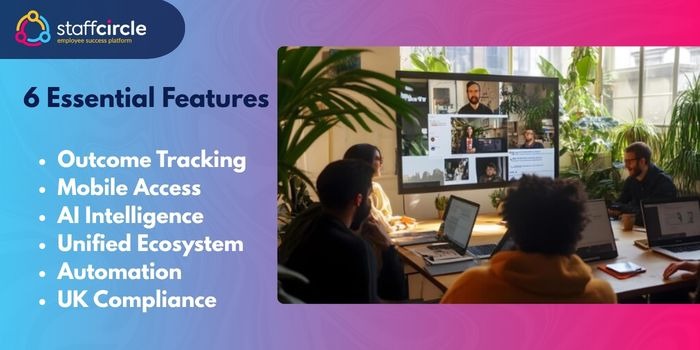
Evaluating talent management software requires looking far beyond basic digital review forms. To support a fluid, distributed workforce, a modern platform must possess six essential architectural capabilities:
1. Outcome-Based Tracking over Desk Presence
In a traditional office, it is easy to assume that the person who arrives first and leaves last is the hardest worker. The reality is often very different. That is why modern performance management software must focus on outcomes rather than physical presence. Look for platforms that feature Objectives and Key Results (OKRs) or SMART goal tracking. Employees must be able to update progress in real time so managers can see exactly what has been achieved, regardless of where or when the work took place.
2. Complete Cross-Device and Mobile Parity
Hybrid workforces often include field sales teams, warehouse staff, retail employees, engineers, healthcare workers, and operational teams who rarely sit in front of a laptop. If they are forced to wait until they are back at a desktop computer to complete a review, update objectives, or acknowledge feedback, participation quickly drops.
Mobile access is no longer a luxury. The best platforms deliver a complete, frictionless mobile experience via progressive web access across any device. This allows frontline and deskless workers to log accomplishments, view competency paths, and access review data on shift without needing a corporate email account or dedicated hardware.
3. Native AI Meeting Intelligence & Summaries
Hybrid teams communicate constantly through Teams calls, video chats, or quick virtual catch-ups. While these conversations are vital, the notes frequently end up scattered across notebooks and emails, or are simply not recorded at all.
Consider a manager conducting monthly 1-on-1 meetings with eight distributed team members. During one conversation, an employee mentions wanting leadership training. In another, someone raises concerns about the workload. A month later, the manager struggles to remember who said what and which actions were agreed upon.
This is where native AI meeting intelligence becomes essential. Advanced platforms automatically record and transcribe 1-on-1 video or audio check-ins, generate objective summaries, and extract milestones. Instead of relying on memory, both managers and employees receive a clean digital record of commitments pushed straight to their dashboards.
4. A Unified Performance, Engagement, and Growth Ecosystem
Many organisations unintentionally create severe tool fatigue by using separate systems for feedback, performance reviews, employee engagement, and learning and development. For example, an employee might receive feedback in Microsoft Teams, track goals in a spreadsheet, complete training through an isolated learning management system (LMS), and respond to engagement surveys somewhere else entirely.
Information quickly becomes fragmented, and people stop engaging with the process. A stronger approach is to use a single platform that unifies everything. Performance objectives, employee feedback, pulse surveys, development plans, and competency frameworks should all sit within the same centralised data layer.
5. Automation of the Review Lifecycle
Ask most HR teams what frustrates them about performance reviews, and they will give the same answer: chasing people. Managers forget deadlines, employees miss review forms, appraisal meetings get postponed, and HR teams spend hours sending reminder emails.
Without automation, an HR team managing 300 employees across multiple sites could spend days chasing down incomplete tasks. Modern PM software removes this administrative burden entirely by leveraging intelligent automation. The system automatically triggers reviews based on employee milestones (such as probation completion, work anniversaries, or promotion dates) and sends contextual notifications through day-to-day tools like Microsoft Teams or Google Workspace.
6. Local Compliance and UK HRIS Integration
For UK businesses, data sovereignty, UK GDPR compliance, and system integrations are non-negotiable. Many performance management platforms are engineered primarily for the US market. While they may offer strong functionality, they lack compatibility with UK employment practices, data laws, or local payroll environments.
If your HR team updates employee records in a central core platform while managers maintain separate information within an isolated performance tool, reporting becomes inconsistent and administrative workloads double. It is critical to choose a platform that interfaces natively with primary UK systems (such as IRIS Cascade or Sage) via direct APIs or Webhooks to keep records, departmental mapping, and organisational structures synchronised automatically.
Top 6 PM Platforms for Hybrid Teams (Ranked)
While enterprise options provide extensive backend databases, they are frequently built around traditional, desk-bound roles. For a modern, fluid hybrid architecture, the best platforms must combine asynchronous performance infrastructure with live engagement features. StaffCircle secures our top ranking because it natively unifies performance tracking, employee engagement updates, and mobile accessibility to support remote, desk-based, and frontline employees under a single pane of glass.
#1 StaffCircle
A fully integrated, cloud-based AI performance management platform engineered explicitly for complex hybrid, multi-site, and deskless workforces.
Best for: Mid-market and growing organisations (50–1,000 employees) with mixed workforces (remote, desk-bound, and on-the-move frontline staff) that need to eliminate manual administration and connect company goals directly to individual growth paths.
Why Choose StaffCircle:
- True Cross-Device Parity: Delivered as a fully progressive web application accessible globally via any modern desktop or mobile browser. Frontline, field, or shift workers can log accomplishments and complete reviews without requiring an app installation or a corporate email address.
- Substantial Admin Reduction: Leverages automated performance workflows and built-in templates to slash administrative workloads by up to 87% in year one, yielding an exceptional on-time review completion rate.
- Integrated Communication & Engagement: Features a built-in social intranet, multi-channel communications, real-time pulse surveys, and a centralised newsfeed with customisable public awards aligned to company values to prevent remote worker isolation.
- Native AI & Advanced Automation: Includes a native AI Notetaker to transcribe and summarise Microsoft Teams call check-ins, linking outputs back to reviews. It also features AI Assist for everyday performance tasks and MCPx.
- Dynamic Talent Mapping: Employs Success Circles™ (the platform’s proprietary alternative to the rigid legacy 9-box grid) alongside AI-generated competency frameworks, skills gap analysis, and succession planning dashboards.
- Local Ecosystem Synergy: Built-in, direct integration with primary UK HRIS and payroll tools like IRIS Cascade, BrightHR, and Sage, alongside Microsoft 365, Teams, and Azure Active Directory (supporting 2-way data sync).
Consideration: Because StaffCircle unifies performance, cultural engagement, and personal development into a single ecosystem, it yields maximum ROI when an organisation completely migrates away from fragmented, standalone applications. To achieve full efficiency, human resources leaders must commit to a foundational implementation, ensuring the software becomes the core hub for day-to-day team communication and tracking.
#2 OrangeHRM
A massive, enterprise-grade HRIS software suite featuring an optional, highly configurable performance management module.
Best for: Multi-entity organisations seeking an all-in-one HR infrastructure where performance management syncs directly with core HR operations like recruiting, leave tracking, and deep workforce analytics.
Why Choose OrangeHRM:
- Eliminates data silos by housing performance metrics directly within the core HRMS backend directory.
- Offers highly flexible, custom review cadences (annual, quarterly, or continuous milestones) alongside multi-rater 360-degree peer-evaluation review loops.
- Features AI-powered SMART goal formulation prompts and competency-based job evaluation framework setups.
- Offers a free, open-source Starter plan with foundational performance functionality and no per-seat software licensing fees.
Consideration: Because it functions as an all-encompassing, heavy database system, it lacks modern cultural engagement engines like an active internal team newsfeed, public peer-to-peer recognition, or native video/audio meeting intelligence tools.
#3 Lattice
A dedicated continuous performance management and corporate OKR platform designed to foster ongoing team alignment.
Best for: Purely desk-based technology firms and corporate professional services companies prioritising structured goal cascading and employee sentiment monitoring over operational frontline workflows.
Why Choose Lattice:
- Features an advanced, highly structured OKR alignment architecture that flows goals seamlessly from company-wide priorities down to individual tasks.
- Offers clear, easy-to-use 1-to-1 meeting agenda trackers and direct feedback integration strings into communication apps like Slack.
- Unifies employee engagement data analytics natively alongside standard appraisal cycles to highlight performance trends.
Consideration: The mobile experience relies on a basic web wrapper optimised for desk workers rather than a mobile-first experience for field staff. Advanced modules like Compensation, Engagement, and OKRs require additive standalone pricing tiers that can rapidly inflate software costs.
A dedicated continuous performance management and corporate OKR platform designed to foster ongoing team alignment.
#4 15Five
A manager-centric feedback software built entirely around short weekly status checks and soft-skills coaching diagnostics. It is the best alternative to Lattice for small businesses.
Best for: Remote-first knowledge-work organisations that want to build a deep, continuous check-in loop between office-based managers and remote line reports.
Why Choose 15Five:
- Features a unique “15-minute write-up, 5-minute read” check-in architecture to prompt routine asynchronous updates.
- Calculates an objective “Manager Effectiveness Score” to help HR identify leadership gaps or team friction zones across the business.
- Combines a dedicated employee survey engine (Engage) with custom performance templates to keep track of team well-being.
Consideration: The platform relies heavily on disciplined, manual participation from managers every single week. If your leadership team suffers from tool fatigue or works in fast-paced shift environments, adoption rates can decline significantly.
#5 BambooHR
A popular, user-friendly SMB HRIS system featuring a simplified add-on module for tracking basic performance milestones.
Best for: Small businesses (10 to 500 staff members) that want to move away from spreadsheets and house basic reviews within an intuitive, clean interface.
Why Choose BambooHR:
- Features an exceptionally clean, consumer-grade user experience that requires zero specialised technical training for employees or managers to adopt.
- Directly links basic review outcomes to core employee records, time-off requests, and data tracking within a single directory.
- Includes simple Employee Net Promoter Score (eNPS) indicators to measure overall company sentiment easily.
Consideration: The performance features are quite basic. It lacks multi-level 360-degree feedback configurations, advanced competency mapping matrices, deep analytics dashboards, or native AI meeting note automation.
#6 Leapsome
A robust, European-engineered people enablement platform that brings performance evaluations, learning systems, and compensation structures together.
Best for: European-headquartered businesses seeking a centralised platform with strict, native GDPR data compliance parameters.
Why Choose Leapsome:
- Built with clear data residency security guardrails and strong European framework standards.
- Features a strong learning management system (LMS) integration that recommends specific training tracks based on skills gaps flagged in recent reviews.
- Provides formal calibration modules to help HR teams equalise performance ratings across distinct divisions or regions.
Consideration: The wide variety of features (LMS, Performance, Engagement, and Compensation) can feel overwhelming for HR teams looking for a fast, straightforward performance fix. Full ROI depends heavily on utilising all these modules concurrently.
Quick Comparison Between Top Employee Performance Tools For Mixed Remote And In-Office Teams
If your question is: Which is better for hybrid teams: StaffCircle vs Lattice vs 15Five vs Leapsome? Here’s a quick comparison between these four:
| Platform | Primary Feature Focus | Native Mobile App Parity | Native AI Notetaker | UK Ecosystem Focus | Real-Time Admin Reduction | Target Market |
|---|---|---|---|---|---|---|
| StaffCircle | Performance + Engagement + Frontline | Yes (Full feature parity) | Yes (Native meeting audio summary) | Yes (Native IRIS, Sage, BrightHR strings) | 90% reduction in admin tasks | UK Mid-Market, Mixed Hybrid & Deskless Teams |
| OrangeHRM | Core HRIS Database + Reviews | Moderate | No (Text assist only) | Moderate (Global open-source) | Moderate (Heavy setup needed) | SMB to Enterprise seeking full HRMS replacement |
| Lattice | OKRs + Desk Performance | No (Basic web wrapper) | No | No (US-centric payroll structures) | Moderate | Corporate Enterprise Desk-Bound Teams |
| 15Five | Weekly Status + Manager Coaching | Low | No | No | Low (High manual process overhead) | Small-to-Mid Remote Knowledge Teams |
| BambooHR | SMB HRIS + Simple Review Add-on | Basic | No | No | Moderate | Small Businesses wanting form digitisation |
| Leapsome | Compliance + LMS + Calibration | Limited | No | Moderate (Continental Europe focus) | Moderate | EMEA Tech & Corporate Professional Services |
1. StaffCircle vs. Lattice
Choosing between StaffCircle and Lattice comes down to your workforce distribution and geographic focus. Lattice is built for corporate knowledge workers who spend their days in front of laptops using tools like Slack or Gmail. StaffCircle is engineered for mixed workforces (remote, hybrid, and deskless frontline staff) with a distinct focus on the UK and EMEA mid-market.
UX/UI Design and Accessibility
StaffCircle is built as a Progressive Web App (PWA), which delivers full feature parity across desktop and mobile screens. It makes frontline accessibility easier for field staff, warehouse workers, and hybrid field teams. Moreover, the technical friction is lower because workers have a dedicated workstation or a laptop for interacting with HR. It supports alternative login methods such as SMS tokens or unique employee IDs.
Lattice is primarily designed as a desktop platform optimised for corporate offices and tech setups. The user interface looks and feels like consumer software, but it operates best on a widescreen monitor. It uses a basic mobile web experience. While useful for quickly checking a 1-to-1 agenda, it is not built to run complete, heavy appraisal processes for field workers on the move.
AI Integration & Meeting Intelligence
Lattice has Lattice AI, a text-generation tool. It helps busy managers summarise historical feedback notes and write comprehensive performance summaries during standard review cycles. But StaffCircle has a native AI Notetaker. This tool listens to, transcribes, and condenses video/audio 1-on-1 check-ins (such as Microsoft Teams calls). It automatically filters out casual talk, flags employment law risks, and converts spoken commitments directly into digital targets on the dashboard.
Talent Mapping
Lattice relies on traditional talent mapping metrics, including historical data exports and customisable, structured grid configurations. However, StaffCircle has features Success Circles™, which is a proprietary, live talent mapping system with real-time competency and skills gap tracking.
Culture, Communication, & Engagement
Hybrid teams have to keep distributed employees feeling connected to the wider company culture. Lattice approaches engagement through heavy data analysis. It gathers employee feedback through pulse tracking and eNPS (Employee Net Promoter Score) surveys, providing HR leaders with deep dashboards to spot cultural trends across a corporate office.
Again, StaffCircle does it better by combining performance tools with an internal communications engine, offering a social intranet newsfeed, critical text message broadcasts, and public peer-to-peer recognition badges. This design focuses on keeping deskless and remote staff actively connected.
Integration Ecosystem & Compliance
Your choice often depends on where your business operates and what systems make up your existing HR tech stack.
StaffCircle (UK & EMEA Specialisation) features native, secure API and Webhook connections built for UK payroll and HRIS systems, including IRIS Cascade, BrightHR, and Sage. And the data is hosted entirely on UK cloud infrastructure, ensuring full compliance with UK GDPR and local data protection standards.
Lattice (North American Enterprise Specialisation) is built with global tech setups in mind. It integrates smoothly with US-centric payroll directories (like Gusto and Rippling) and enterprise HRIS suites (like Workday). It is engineered primarily around North American corporate standards, making it highly effective for global, tech-forward multinational organisations.
2. StaffCircle vs. 15Five
This comparison comes down to Complete Operational Performance vs. Manager Coaching Loops. 15Five focuses on lightweight, asynchronous communication between office managers and remote teams, whereas StaffCircle acts as a comprehensive, company-wide performance hub.
15Five is designed as a lightweight, text-first feedback tool built to optimise continuous communication between office-based managers and remote knowledge workers. StaffCircle, by contrast, is a comprehensive AI performance management platform engineered to unify automated appraisals, real-time OKR alignment, and cultural communications for mixed workforces (comprising office, remote, and deskless frontline staff) under a single roof
1. Architectural Design & Accessibility
15Five is primarily engineered as a desktop application, with companion mobile apps for iOS and Android. The interface is optimised for knowledge workers who spend their days in front of a computer screen or have continuous access to a corporate email address and smartphone. It assumes high baseline digital literacy and regular desk presence.
However, StaffCircle was built as a Progressive Web App (PWA) and eliminates the barrier of corporate processes.
If your business employs an entirely desk-bound team, 15Five offers a clean workflow. However, if your workforce includes deskless frontline staff (e.g., in manufacturing, logistics, retail, or healthcare) who rely entirely on mobile browsers, 15Five leaves them digitally isolated. StaffCircle bridges this operational gap natively.
2. Review Lifecycles & HR Automation
How much manual “chasing” must your HR department do to ensure compliance across a distributed team? 15Five is famously structured around a “15-minute write-up, 5-minute read” cadence, delivered weekly or bi-weekly. While excellent for maintaining top-of-mind transparency between a manager and a direct report, it places a heavy, continuous operational burden on managers to review and comment every single week. If managers suffer from tool fatigue, participation rates drop.
StaffCircle: Focuses heavily on administrative red-tape automation. The system allows HR leaders to design standardised, best-practice templates and program them into an automated review lifecycle. Evaluations are triggered automatically by corporate milestones (such as probation completion, promotion dates, or work anniversaries).
3. Advanced AI & Conversation Intelligence
Both platforms leverage artificial intelligence to reduce documentation friction, but their technical implementations serve different purposes. 15Five uses AI primarily as a text assistant to summarise long strings of written employee comments or to help managers draft constructive feedback prompts during standard appraisal cycles. StaffCircle’s native AI Notetaker is designed specifically for asynchronous or video-first hybrid setups. The tool securely records and transcribes 1-to-1 video check-ins (via integrations like Microsoft Teams), automatically filtering out subjective fluff to extract core milestones, objectives, and agreed action items.
4. Talent Mapping vs. Coaching Diagnostics
15Five focuses on soft skills and leadership psychology. It tracks employee sentiment and aggregates data to give managers an objective Manager Effectiveness Score. This diagnostic tool helps HR pinpoint leadership friction zones or teams suffering from burnout.
StaffCircle focuses on hard capability tracking, skills mapping, and succession pipelines. Instead of using the rigid, biased legacy 9-box evaluation grids favored by older systems, StaffCircle features Success Circles™, a proprietary alternative. And of course, does the job pretty well.
5. Cultural Engagement vs. Communication
15Five has High Fives, which is a peer-to-peer praise tool that allows employees to tag teammates and send digital call-outs. StaffCircle is designed as a complete social intranet and multi-channel internal communications engine. Beyond peer-to-peer recognition badges aligned to company values, it features a centralised company newsfeed, real-time pulse surveys, and emergency SMS/Text broadcast tools. If an HR leader needs to push a critical health-and-safety update or a company-wide announcement to hybrid and frontline workers simultaneously, StaffCircle delivers it effectively.
3. StaffCircle vs. Leapsome
Both platforms offer strong customisation for mid-market businesses, but they approach employee growth from two different angles.
1. Performance Reviews & 360 Feedback
Leapsome features a highly automated, sophisticated review cycle builder. It handles 360-degree reviews, self-appraisals, and peer feedback seamlessly. It also features AI text summarisation to help HR and managers distill hundreds of open-ended review comments into actionable themes.
On the other hand, StaffCircle offers capable performance review templates, check-ins, and real-time feedback. However, users generally rate its interface as more intuitive than Leapsome’s.
2. Goal Management: OKRs vs. SMART Goals
Leapsome is one of the top OKR (Objectives and Key Results) platforms on the market. It lets you build complex goal trees that show how an individual’s goal affects a team goal.
StaffCircle focuses primarily on standard SMART goals and KPIs. It is excellent for tracking output and operational compliance, making it highly effective for structured environments or shift-based workforces.
3. Culture, Engagement & Communication
StaffCircle wins heavily if you need to reach your employees. It acts like a company intranet, complete with a social news feed, push notifications, and even SMS alerts for critical updates. It also includes core HR transactional features, such as Leave and PTO tracking, which Leapsome doesn’t handle natively.
Leapsome focuses on engagement analytics. It features pulse surveys, anonymity thresholds, and deep sentiment analysis. Its engagement tools are designed to loop back into performance.
4. Learning and Development (L&D)
Leapsome includes a full Learning Management System (LMS). You can build onboarding paths, compliance training, and leadership tracks right inside the platform, triggering specific courses based on performance review results.
StaffCircle LMS module is again very customised and interactive. For example, if you see an employee review and perform a skill gap analysis, you can direct courses synced with advanced learning platforms, like LinkedIn Learning, Udemy Business, and Cornerstone OnDemand.
Bottom Line: Why StaffCircle Ranks Top for UK Hybrid Teams?
If your question is: what is the best performance management software for UK hybrid teams in 2026? StaffCircle is the definitive answer. It ranks as the number one performance system for UK hybrid teams because it eliminates the unique geographic and operational silos created by split-location work. It is the only platform that fully merges automated performance management with live engagement data and mobile browser accessibility.
When managing a UK business with a mix of office, remote, and non-desk frontline workers, generalist American software platforms frequently miss the mark. StaffCircle is engineered specifically to address these localised workplace challenges:
- Drastic Reduction in Administration
- Neutralising Proximity Bias with Data
- The StaffCircle AI Notetaker
- Ecosystem Integration Built for the UK
- Proven Cultural Impact
Transitioning your distributed team from legacy spreadsheets to an automated performance platform does not have to disrupt your daily operations. StaffCircle’s structured, phased rollout framework ensures your data integrates smoothly, your managers are trained to spot proximity bias, and your entire workforce achieves total alignment within a structured 6-to-12-week implementation window.
Try StaffCircle free! Schedule your dedicated product demo today.
Frequently Asked Questions (FAQ)
Which performance management tool is best for startups in 2026?
For UK startups, the top platforms vary depending on your specific scaling needs. Startups moving from spreadsheets to automated reviews can exploreZelt, which combines UK payroll with performance metrics. But if you want to invest in a scalable solution with advanced capability, compliance, AI insights and optimal integration, StaffCircle is the best choice in the UK market for performance management.
Is hybrid performance management software expensive?
No, especially when compared to the significant financial hit of employee turnover and manual administrative drain. While per-user pricing varies across the industry based on team size and selected features, a unified system like StaffCircle delivers a massive return on investment (ROI), dropping turnover by half on average. Because StaffCircle operates on a modular, per-employee, per-month (PEPM) SaaS pricing model, your organisation only pays for the exact modules you activate.
What software integrates directly with local UK HRIS platforms?
Most US-centric performance platforms are built strictly for North American ecosystems, offering native integrations only for global enterprise systems like Workday or US payroll systems like Gusto and ADP. StaffCircle is engineered specifically to bridge the UK infrastructure gap. It provides native, secure API and Webhook connections that interface seamlessly with market-leading UK systems (such as IRIS Cascade, BrightHR, and Sage) alongside everyday workplace tools like Microsoft 365, Teams, and Azure Active Directory. This completely eliminates manual CSV data transfers for UK HR teams.
How does performance software work for frontline or deskless workers?
For a hybrid team that includes non-desk workers (such as manufacturing, logistics, or retail staff), traditional desktop software fails. Modern systems like StaffCircle provide full feature parity through a highly optimised, progressive web application layout. Workers can log accomplishments, update objectives, view company announcements, and participate in reviews directly from any mobile web browser on shift without requiring a corporate email address or a laptop setup.
How does performance software work for frontline or deskless workers?
For a hybrid team that includes non-desk workers (such as manufacturing, logistics, or retail staff), traditional desktop software fails. Modern systems like StaffCircle provide full feature parity through a native mobile app. Workers can log accomplishments, update objectives, view company announcements, and participate in reviews directly from their mobile device on shift without requiring a corporate email address or desktop station.
How often should hybrid teams conduct performance reviews?
Hybrid teams should ditch annual appraisals in favour of a continuous, layered cadence. Managers should run short, automated weekly or bi-weekly 1-on-1 check-ins to clear immediate blockers and prevent remote employee isolation. These should be supported by quarterly OKR reviews every 90 days to dynamically realign goals with shifting company strategies. This digital timeline ensures the final annual compensation review is based on a year of unarguable data rather than office visibility or manager recency bias.
What are the best frameworks for overcoming proximity bias in distributed teams?
To overcome proximity bias in distributed teams, organisations should adopt a remote-first approach where all employees have equal access to information, opportunities, and communication. Performance should be measured through outcomes and OKRs rather than visibility or office presence. Structured performance reviews, regular calibration sessions, and 360-degree feedback help ensure fair assessments. Maintaining a documentation-first culture, providing equal access to high-profile projects, and training managers to recognise unconscious bias further support fairness, inclusion, and career progression for both remote and office-based employees.
Related articles
See StaffCircle in action
Book a personalised demo and see how StaffCircle drives performance, engagement and development.