10 Ways Performance Platforms Power Continuous Feedback
Annual performance reviews have become one of the most widely disliked administrative tasks in corporate history. Managers dread writing them, employees dread reading them, and human resource leaders spend weeks chasing missing forms. Yet, for decades, businesses continued to run these annual evaluations simply because they didn’t have an alternative structure.
These are the exact reasons why we designed StaffCircle. As of 2026, StaffCircle is helping HR leaders and managers in different industries to reduce up to 90% of admin work.
According to Gallup, only 2% of Fortune 500 HR leaders believe their current performance management system motivates employees to improve. And only 14% of employees strongly agree that their performance reviews inspire them to improve.
When it comes to annual appraisals, employees are often notified of their skill gaps and productivity loss. But wouldn’t it be better if they get real-time, continuous feedback and keep working on it? This way, companies will profit from a good retention rate and employees with career & skill development.
It’s the core concept of StaffCircle to provide the agility and adaptiveness organisations need, especially the ones with a hybrid work model and frontline workers.
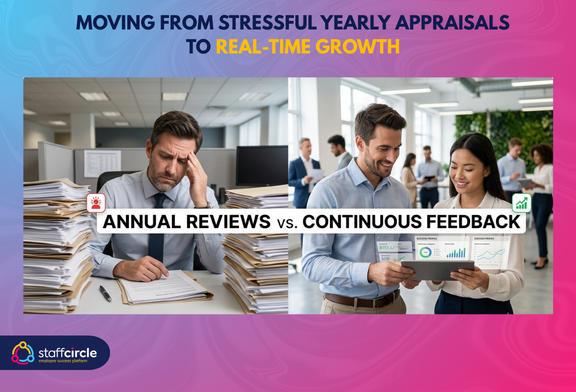
How Performance Platforms Drive Continuous Feedback?
Performance platforms like StaffCircle enable continuous feedback by replacing rigid, annual evaluations with a continuous, automated workflow of pulse surveys, objective tracking, and real-time communication tools.
Instead of waiting for an annual review, these digital systems embed feedback directly into an employee’s daily workspace (such as Microsoft Teams or Google Workspace). The platform automatically triggers 1-on-1 agendas, tracks real-time progress on Objectives and Key Results (OKRs), and gathers multi-source peer feedback continuously.
This creates a live, objective “success profile” that helps managers coach their teams in real time, reducing administrative workloads while protecting employee engagement.
Why Annual Reviews Are Failing—and What Replaces Them
So, what’s wrong with the annual reviews? Why are 95% of managers dissatisfied with their organisation’s performance review system?
Traditional annual performance reviews typically follow a fixed, once-a-year process where a manager evaluates an employee’s performance over the previous 12 months. The review is often tied to salary increases, bonuses, promotions, or development plans. But these annual reviews are failing due to the reasons below:
- Non-Flexible Goal Setting: Nowadays, company strategies change quarterly, if not monthly. An objective set in January is often completely irrelevant by June. Annual reviews force managers to evaluate staff against outdated targets, which leaves employees feeling confused and disconnected from the big picture.
- Minimal Feedback During the Year: Many organisations provide little formal feedback until the annual review. Employees may not know they’re underperforming or excelling until months later.
- Recency Bias and Subjectivity: Human beings naturally remember recent events much more clearly than things that occurred months ago. If an employee performs exceptionally well for nine months but slips up on a project in month eleven, an annual review will almost always focus heavily on that recent mistake. This subjectivity breeds resentment and damages workplace trust.
- No Burnout Tracking: According to sector data, fewer than 20% of employees raise structural issues or signs of burnout before looking for a new role. If you take employee feedback once a year, you will consistently find out an employee is unhappy only after their resignation letter lands on your desk.
Key Statistics:
- Only 20% of employees worldwide were engaged at work in 2025, the lowest level since 2020, costing the global economy an estimated $10 trillion in lost productivity. (Source: Gallup)
- 61% of managers and 72% of employees do not trust their organisation’s performance management process. (Source: Deloitte)
- Around 58% of HR and business leaders believe performance management is more important now than ever before. (Source: Sage)
- Employees who receive weekly feedback instead of annual reviews are 5.2 times more likely to say they receive meaningful feedback. (Source: Gallup)
- Highly engaged teams achieve 23% higher profitability, 18% higher sales productivity, and 78% lower absenteeism than disengaged teams. (Source: Gallup)
- Highly engaged organisations experience 21% lower turnover in high-turnover organisations and 51% lower turnover in low-turnover organisations. (Source: Gallup)
- 85% of employees say they feel more engaged when leaders communicate transparently. (Source: SHRM)
- Managers spend approximately 10% of their working year on performance management activities, while employees spend around 40 hours annually on review-related tasks. Source: (Gartner | reported in Darwinbox)
- Only 6% of organisations say they are effectively using data and evidence to improve performance management while building employee trust. Moreover, fewer than one in three employees believe performance reviews are very fair and equitable. (Source: Deloitte)
- 87% of Millennials and 73% of Gen Z consider career development opportunities an important factor when choosing an employer. (Source: SHRM)
What Replaces It? The Continuous Performance Loop
I guess we have enough reasons why your current annual feedback system is outdated. Now, if your question is what’s the best alternative, I would definitely talk about an agile and continuous feedback system. Being a CEO myself, I can guarantee its effectiveness. This model spreads talent conversations out across the year into manageable touchpoints: weekly or bi-weekly operational 1-on-1s, monthly pulse check-ins, and quarterly strategic growth reviews.
But how do you perform real-time feedback? Well, of course, you need a platform or tool to do that. And that tool is StaffCircle, a next-generation HR software.
What is Continuous Feedback?
Continuous feedback is an ongoing process where managers, peers, and employees exchange regular performance conversations throughout the year instead of relying on annual reviews.
Annual Reviews vs. Continuous Feedback
| Annual Reviews | Continuous Feedback |
|---|---|
| Once a year | Weekly |
| Subjective | Real-time |
| Manual | Automated |
| Backward-looking | Continuous |
| Delayed coaching | Instant coaching |
10 Ways Modern Performance Software Enables Continuous Feedback
Before we begin, I would like to tell you that switching to a continuous feedback system isn’t that easy. Many HR management and employee engagement tools you find are either too complex, too expensive, or too inefficient. Moreover, it’s difficult to maintain manually.
Now, how does modern performance software support continuous feedback?
To answer this question, I’ll tell you with reference to our proprietary tool, StaffCircle. It is one of the best modern performance management systems trusted by various organisations, including Rolls-Royce SMR, UK Government Investments, Levin, and Harvey Nichols.
It solves everything by replacing manual friction with intelligent automation, real-time updates, and continuous evaluation of team communication. Here are 10 ways the platform makes continuous feedback sustainable and effective:
1. Automated 1-on-1 Cadences & Agenda Guardrails
When business gets busy, both managers and employees don’t have time and energy to conduct 1-on-1 check-ins.
StaffCircle automates recurring one-to-one meetings by enabling managers to schedule regular check-ins with built-in reminders, structured templates, and guided agendas. Conversations are linked to employee objectives, performance reviews, feedback, and development plans, ensuring discussions stay focused on priorities and progress.
StaffCircle’s AI Notetaker can automatically capture meeting notes, action items, and outcomes, updating employee records without manual administration. This structured approach promotes consistent coaching, improves accountability, reduces missed follow-ups, and ensures every one-to-one conversation delivers meaningful, measurable outcomes.
2. Live OKR and Metric Integration
Feedback is most effective when it is tied to objective data. Performance platforms connect daily task execution directly with individual and company-wide OKRs. When an employee logs progress on a key result, their success profile updates instantly. This allows managers to provide immediate feedback based on verified outcomes rather than subjective impressions.
StaffCircle supports live OKR and metric integration by connecting objectives, key results, employee performance, engagement, and development data into a single platform. Progress updates are captured automatically through ongoing check-ins, feedback, reviews, and employee activities, giving leaders real-time visibility into goal achievement.
Custom dashboards, reporting APIs, Power BI integration, webhooks, and Microsoft 365 connectivity provide up-to-date metrics without manual spreadsheets. This enables HR and leadership teams to monitor performance trends, identify risks early, and make faster, data-driven decisions based on continuously updated workforce insights.
3. Native Communication Integrations (Teams, Slack, Workspace)
Forcing employees to log into a separate, isolated HR system just to record a goal update introduces friction that hurts adoption. Modern software embeds feedback check-ins straight into the tools your staff already use daily.
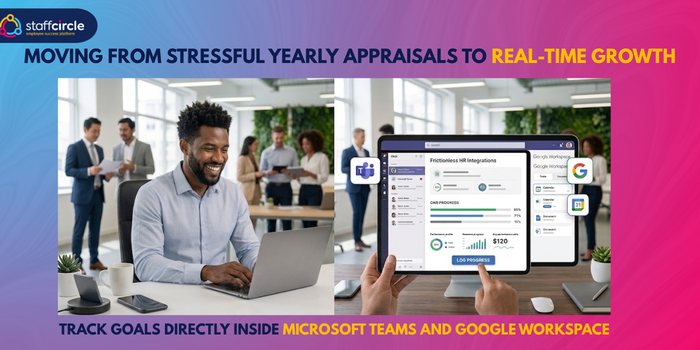
StaffCircle provides native communication integrations with Microsoft Teams and Google Workspace, while also supporting workflow automation through Zapier to connect with Slack and thousands of other business applications.
Employees can create objectives, schedule reviews, exchange feedback, approve leave, and receive reminders directly within Teams. Google Workspace integration synchronises user accounts, enables single sign-on (SSO), and keeps employee data updated automatically.
Zapier allows organisations to trigger Slack notifications, automate workflows, and connect StaffCircle with existing communication tools without coding.
4. Continuous 360-Degree Peer Feedback
A direct supervisor only sees a small fraction of an employee’s day-to-day contributions. Performance platforms allow team members to request and log real-time peer reviews from cross-functional colleagues at any point during a project, capturing a balanced, multi-perspective view of performance throughout the year.
StaffCircle is more like a social platform for your company. It brings all the workforce of your company to one platform for continuous 360-degree peer feedback. This allows employees, managers, and colleagues to share feedback throughout the year instead of waiting for annual reviews.
Feedback is layered into employee profiles alongside objectives, performance reviews, recognition, and engagement data, creating a complete view of individual performance. Managers can automate feedback requests, track participation, and use real-time insights to identify strengths, development needs, and achievements.
This continuous approach reduces bias, encourages regular coaching, and supports more accurate performance and development decisions.
5. AI Meeting Intelligence & Automated Summaries
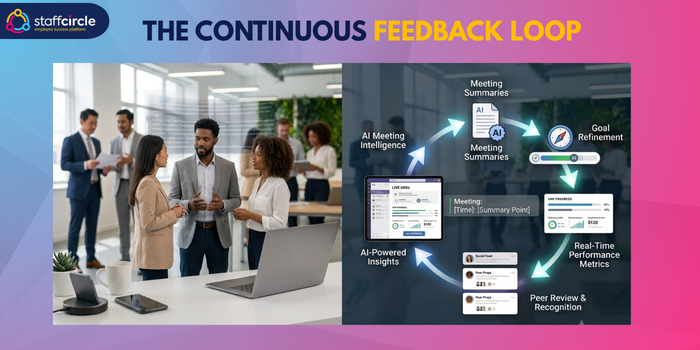
Critical development targets and action points discussed during video check-ins can easily get forgotten if they aren’t written down. Advanced platforms feature built-in toolsthat securely transcribe 1-on-1 calls.
In StaffCircle, you get an AI-powered Notetaker which automatically records, transcribes, and summarises meetings, eliminating manual note-taking and follow-up tasks. After each meeting, it generates a structured, whiteboard-style summary highlighting key discussion points, decisions, action items, engagement levels, and sentiment.
The AI also updates relevant one-to-ones, performance reviews, interviews, and HR records automatically, reducing duplicate work. Built-in risk analysis helps HR identify potential employment law concerns during sensitive conversations, while summaries are instantly shared with attendees to improve accountability, alignment, and documentation.
6. Real-Time Sentiment & eNPS Tracking
Continuous feedback is a two-way street. Modern HR platforms deploy automated, short pulse surveys at regular intervals to track employee sentiment across areas like manager support, tool friction, and workload. This live data aggregates into real-time Employee Net Promoter Scores (eNPS), letting HR pinpoint shifting morale trends immediately.
StaffCircle tracks employee sentiment in real time by combining eNPS surveys, pulse surveys, sentiment analysis, engagement metrics, continuous feedback, and workplace interactions within a single platform.
Leaders can monitor engagement trends through live dashboards, identify declining morale early, and measure how employees respond to company initiatives. Rather than relying on annual engagement surveys, StaffCircle continuously updates insights as new feedback is received, enabling HR and managers to address concerns quickly, improve employee experience, strengthen retention, and support data-driven workforce decisions.
7. Values-Driven Public Peer Recognition
Workplace culture can easily degrade in distributed or multi-site workforces. Here, a platform like StaffCircle offers a social feed that makes it easy for employees to send public shout-outs and digital badges to colleagues.
StaffCircle enables values-driven public peer recognition through company-wide awards, recognition notifications, and continuous feedback linked to organisational values and employee achievements. Colleagues and managers can recognise contributions as they happen, making appreciation visible across the organisation rather than limiting it to formal reviews. Recognition becomes part of each employee’s performance profile alongside goals, feedback, and development records. This ongoing, transparent approach reinforces desired behaviours, strengthens company culture, boosts employee engagement, and gives leaders real-time insight into individuals consistently demonstrating organisational values.
8. Full Feature Parity via Progressive Web Apps (PWA)
Traditional HR software often leaves out deskless, field, and frontline shift workers because it requires a desktop computer or corporate email to log in.
StaffCircle delivers full feature parity through its Progressive Web App (PWA), accessible via any mobile web browser. It gives employees and managers access to the same core performance, engagement, and development tools available on desktop. Users can update objectives, complete reviews, provide feedback, recognise colleagues, access learning plans, view dashboards, and receive real-time notifications from any device. The PWA requires no separate app store installation, works across operating systems, and helps remote, desk-based, and frontline employees stay connected, ensuring consistent user experiences and productivity wherever they work.
9. Predictable Flight-Risk Analytics
Employees rarely quit without warning; their engagement data almost always shifts first. StaffCircle predicts turnover risk by continuously analysing performance, engagement, development progress, feedback, recognition, succession readiness, and other workforce signals collected across the platform. Instead of relying on isolated surveys or manager assumptions, it combines real-time employee data with dashboards, Success Circles™, and custom reporting to identify patterns that may indicate disengagement or retention risks. HR leaders can spot vulnerable employees early, investigate contributing factors, and take proactive actions such as targeted development, coaching, or career progression to improve retention and workforce stability.
10. Live Data Feeds for C-Suite Strategy
When human resource data lives on scattered spreadsheets, building an accurate company-wide talent strategy is incredibly difficult.
StaffCircle automatically collects workforce data from performance reviews, OKRs, employee engagement, development plans, feedback, and HR activities into real-time dashboards. Executives can access custom reports through Power BI, APIs, reporting webhooks, and Microsoft 365 integrations, providing a single source of truth for strategic decision-making. Automated reporting highlights workforce trends, retention risks, succession readiness, productivity, and performance metrics, enabling leaders to monitor organisational health, forecast future needs, and make faster, evidence-based business decisions.
StaffCircle’s Continuous Feedback Features: A Walkthrough
Annual feedback cycles are no longer enough to support today’s fast-moving workplaces. Employees want timely guidance, managers need better visibility into performance, and HR teams require reliable data to make informed decisions. StaffCircle replaces delayed, one-off reviews with a continuous feedback system that keeps conversations active throughout the year.
Here’s a walkthrough of how StaffCircle’s continuous feedback features work.
1. Give Feedback Anytime
StaffCircle allows managers, peers, and employees to exchange feedback whenever meaningful work happens instead of waiting for formal review periods.
Feedback can be shared after:
- Completing a project
- Meeting an important milestone
- Customer interactions
- Team collaboration
- Coaching conversations
- One-to-one meetings
This creates a steady flow of performance information rather than relying on memories from months ago.
2. Layered 360-Degree Feedback
Rather than collecting feedback from just a line manager, StaffCircle supports continuous 360-degree feedback across the organisation.
Input can come from managers, team members, cross-functional colleagues, direct reports and employees themselves. Because feedback is gathered throughout the year, organisations build a more balanced picture of employee performance while reducing recency bias.
3. Link Feedback to Goals and Objectives
Feedback is not stored in isolation.
StaffCircle connects comments directly to:
- SMART objectives
- OKRs
- Individual goals
- Development plans
- Performance reviews
Managers can immediately see whether employees are progressing towards business objectives instead of reviewing disconnected notes.
4. Automatic Review Preparation
Traditional performance reviews often require managers to search through emails, documents, and notes.
StaffCircle automatically collects feedback over time, making review preparation much faster.
When review season arrives, managers already have historical feedback, goal progress, recognition, coaching conversations, development activities. Everything is stored within the employee profile.
5. Continuous Recognition
Feedback is not only about identifying improvement areas.
StaffCircle also encourages positive recognition through company-wide acknowledgements, awards, and appreciation.
Employees receive recognition as achievements happen, helping reinforce positive behaviours and increase engagement.
6. Real-Time Visibility for Managers
Managers can monitor feedback activity through dashboards instead of manually tracking conversations.
They can identify:
- Employees receiving frequent recognition
- Individuals who may need additional support
- Teams with low engagement
- Skill development opportunities
- Coaching requirements
Because information updates continuously, managers can act early rather than waiting for quarterly or annual reviews.
7. AI-Powered Meeting Support
StaffCircle’s AI Notetaker strengthens continuous feedback by automatically recording one-to-one meetings, performance conversations, interviews, and HR discussions.
The system records meetings, produces transcripts, creates structured summaries, captures action items, and updates employee records automatically. This reduces manual administration while ensuring important feedback is never lost.
8. Employee-Owned Progress Updates
Employees can actively participate by updating their own objectives, tracking progress, and contributing to ongoing conversations.
This creates shared accountability between managers and employees instead of making performance management a one-sided process.
9. Better Reporting for HR
Continuous feedback generates valuable workforce data.
StaffCircle combines feedback with engagement, performance, development, and objective tracking to produce real-time reports.
HR teams can identify high-performing employees, skill gaps, development needs, future leaders, flight risks, and engagement trends. Custom dashboards, reporting APIs, and Microsoft Power BI integration make these insights available without relying on spreadsheets.
10. Better Decisions Throughout the Year
Because feedback is collected continuously, organisations no longer depend on annual snapshots.
Instead, leaders can make informed decisions about promotions, development plans, succession planning, performance improvement, employee recognition, and workforce planning. The result is a more accurate, transparent, and proactive performance management process.
How to Move from Annual to Continuous Reviews in 60 Days
Shifting from a legacy appraisal model to a continuous framework doesn’t have to cause widespread operational disruption. You can manage this transition smoothly over a 60-day window.
Days 1 to 20: Audit Data and Set Your Baseline
- Consolidate Your Software: Locate all the places your performance data currently lives (including spreadsheets, Word documents, and forms) and work to centralise them.
- Establish a Monthly Pulse: Launch a simple, recurring monthly pulse check focused on three baseline markers: manager support, alignment of expectations, and tool availability.
- Train Your Management Team: Run brief training sessions for department heads to explain why the business is moving away from annual ratings and how to lead supportive, developmental conversations.
Days 21 to 40: Standardise 1-on-1 Check-ins and Set Clear OKRs
- Deploy Standard Templates: Implement a uniform 1-on-1 check-in format across the company that prompts employees to flag operational blockers before the meeting begins.
- Align Key Objectives: Transition from broad, annual performance descriptions to quarterly, measurable Objectives and Key Results (OKRs) logged directly within your performance software.
- Connect Key System Integrations: Integrate your performance software with daily communication channels like Microsoft Teams or Google Workspace to make participation as frictionless as possible.
Days 41 to 60: Automate Workflows and Review Trends
- Automate Milestone Workflows: Set up automated triggers for key employment milestones, such as probation tracking deadlines and work anniversaries.
- Launch Peer Recognition Feeds: Turn on your public culture feeds and encourage employees to call out and celebrate peer contributions.
- Analyse Early Data Patterns: Review your first full dashboard metrics to identify teams facing high workload stress or dropping goal velocities, and deploy targeted manager support plans.
(Kindly Add internal linking to the image: https://www.staffcircle.com/book-web-demo/)
Frequently Asked Questions (FAQs)
How often should feedback be given? What tools support it?
Feedback should follow a regular, multi-layered rhythm to keep communication consistent without causing meeting fatigue. Short operational check-ins should happen weekly or bi-weekly, broad organisational sentiment should be captured via monthly pulse surveys, and deeper professional growth planning should happen quarterly.
Platforms like StaffCircle support this rhythm by providing automated survey schedules, built-in review templates, and native integrations with daily communication hubs like Microsoft Teams.
Will continuous feedback overwhelm my managers with administration?
No, a well-implemented platform actually does the opposite and simply automates most of the things. Legacy annual reviews create huge administrative logjams because managers have to spend hours trying to recall and write up twelve months of performance data from scratch.
Continuous platforms automate the scheduling, send out notifications, and use AI features to capture notes and track goal progression in real time, reducing total performance management admin by up to 90%.
Can we keep our core HRIS if we buy a performance platform?
Absolutely. Most mid-market organisations use a best-of-breed software architecture. Your core HRIS remains your stable database of record for payroll, compliance, and contracts, while a dedicated performance management platform connects via APIs to manage dynamic daily touchpoints like OKRs, feedback, and engagement.
How do we get frontline or shift workers to use feedback software?
To engage frontline and non-desk workers, you must remove the requirement for a corporate desktop or dedicated email address. Using a platform that offers full feature parity through a mobile Progressive Web App (PWA) allows field and shift employees to log updates, read company updates, and complete pulse surveys right from a mobile web browser while on shift.
What is the exact ROI (Return on Investment) of switching to continuous feedback software like StaffCircle?
Switching to StaffCircle delivers direct financial returns by slashing administrative workloads and protecting talent retention. Companies using the platform experience an average 57% lower employee turnover rate and a 20% reduction in staff absenteeism. By replacing manual spreadsheet tracking with automated workflows, the software reduces performance administration time by up to 90%. This rapid shift increases overall new hire engagement by 74%, allowing mid-market businesses to recover their initial software investment quickly through saved recruitment and onboarding costs.
How do I configure the API or Zapier integration for StaffCircle?
You can easily connect StaffCircle to your existing payroll, HRIS, or productivity tools using its built-in integration suite. To establish a connection, log into your administrator dashboard and locate the developer settings to generate your secure API token. For standard automated tasks, you can use the platform’s native Zapier connector by searching for StaffCircle as your target application. Once selected, paste your unique API token to authenticate the account, then map your custom data fields to trigger automated updates between tools like Microsoft Teams, Slack, or Google Workspace.
Is the AI Notetaker GDPR compliant?
Yes, StaffCircle’s native AI Notetaker is fully GDPR compliant. The tool operates within highly secure, regional Microsoft Azure data centers that maintain strict ISO 27001 and SOC 2 certifications. All meeting recordings, transcripts, and action points are protected using AES 256-bit encryption at rest and TLS 1.2 in transit. The platform uses zero-data-retention processing, meaning your private conversations are never used to train external language models. Administrators retain absolute control over access permissions, data segregation, and automated deletion schedules to guarantee total data privacy.
How does StaffCircle compare to competitors like Lattice, 15Five, or Culture Amp?
While Lattice focuses on enterprise analytics, 15Five emphasises weekly coaching, and Culture Amp dominates employee engagement surveys, StaffCircle stands out by uniting performance and workplace communication for mixed workforces. It bridges the gap between office staff and frontline workers through mobile web parity, ensuring deskless employees do not feel disconnected. StaffCircle combines continuous pulse surveys, automated review cadences, and robust OKR tracking into a single hub. This comprehensive framework eliminates the need to pay for multiple software programs to manage internal operations and cultural alignment.
How do we manage severe underperformance or disciplinary tracks using continuous feedback?
Continuous feedback provides an objective framework for managing severe underperformance by replacing surprise annual ratings with transparent documentation. When a staff member falls behind, managers can instantly launch a Performance Improvement Plan track linked to clear, short-term Objectives and Key Results. Because the platform records every weekly 1-on-1 discussion, automated progress update, and AI-summarised meeting log, it compiles a complete timeline of performance history. This automated audit trail provides human resources teams with concrete data to validate necessary disciplinary paths while ensuring fair support.
What mistakes should organisations avoid when implementing continuous feedback?
One common mistake is replacing annual reviews with frequent meetings that lack purpose or structure. Feedback should always be specific, timely, and connected to measurable goals. Organisations should also avoid relying only on manager opinions, ignoring employee recognition, failing to follow up on agreed actions, or introducing new processes without proper manager training. Technology should simplify the process rather than create additional administrative work.
Is continuous feedback suitable for small businesses?
Yes. Small businesses can benefit significantly from continuous feedback because they often have limited HR resources. Automating one-to-one scheduling, feedback collection, goal tracking, and performance reporting reduces administrative work while helping managers support employee growth. Starting with regular check-ins and simple goal tracking allows smaller organisations to build an effective performance culture without adding unnecessary complexity.
What challenges do organisations face when moving away from annual reviews?
The biggest challenges include resistance to change, inconsistent manager participation, unclear expectations, outdated HR processes, and concerns about increased workloads. Many organisations also struggle to replace spreadsheet-based systems with digital platforms. These challenges can be reduced through manager training, phased implementation, clear communication, and performance management software that automates routine administrative tasks.
Related articles
See StaffCircle in action
Book a personalised demo and see how StaffCircle drives performance, engagement and development.