How to write a performance review
A performance review is written objective by objective, with every comment built from three parts: the behavior you observed, the dated evidence that proves it, and the effect it had. Write the evidence first and the rating second, then check the finished review for the same length, tone and specificity you gave everyone else.
Key facts
- Only 26% of employees strongly agree their performance reviews are accurate, Gallup found.
- Every comment needs three parts: the behavior, the dated evidence, the effect.
- Write the evidence before the rating; a rating written first recruits evidence to fit it.
- Comment length usually varies by rater, not by performer. Compare yours side by side.
- Eighteen worked examples below, each as a weak version and a strong rewrite.
How do you write a performance review?
Write it in four passes rather than one: an evidence pass, a rating pass, a wording pass and a fairness pass. Doing all four at once is what produces the review everyone recognizes — a page of adjectives with a rating attached and nothing anybody can act on. Each pass takes a fraction of the time if the one before it is finished properly.
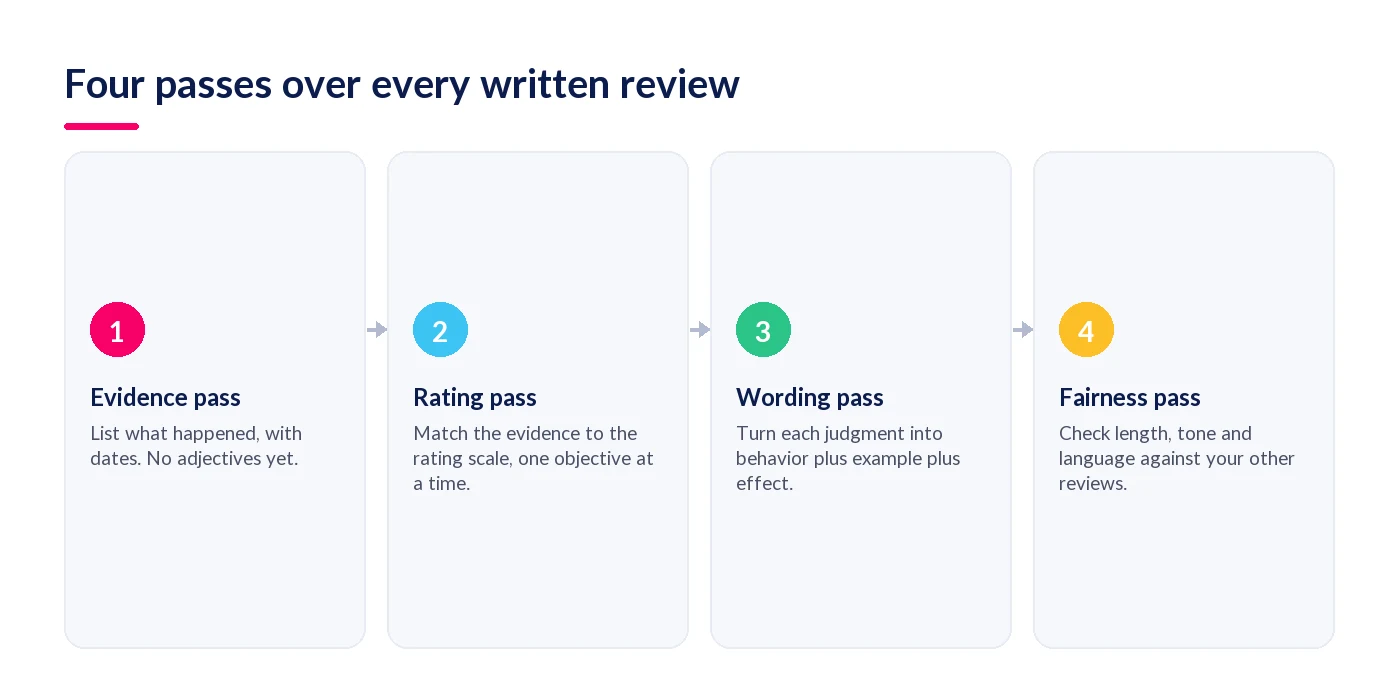
- Evidence pass. Under each objective and each competency, list what actually happened, with dates and numbers. No adjectives yet, and no ratings. Pull from goal progress, one-to-one notes, project outcomes, peer feedback and the self-evaluation. If a line has no date and no number, it is an impression rather than evidence, and it belongs in the conversation rather than the written review.
- Rating pass. Take each objective in turn and match its evidence to the rating-scale wording, on its own, before you form a view of the person overall. Ratings assigned top-down from a general impression are how one weak quarter becomes a weak year, and how one strong project hides two missed commitments.
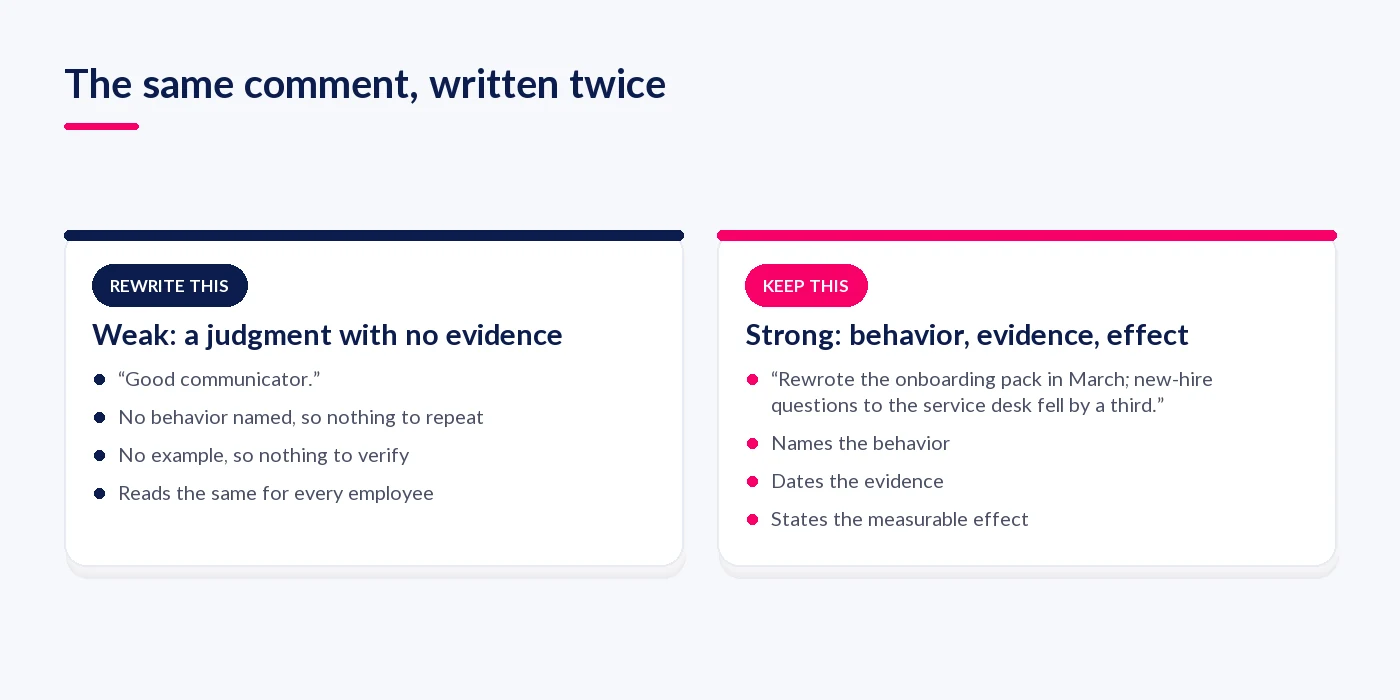
- Wording pass. Turn every judgment into behavior plus evidence plus effect. “Good communicator” becomes “rewrote the onboarding pack in March; service-desk questions from new starters fell by about a third.” This is where the review becomes useful to the person reading it, because it names something they can repeat or stop.
- Fairness pass. Read your reviews side by side. Are they the same length? Is the language about behavior in all of them, or personality in some? Have you written “confident” about one person and “abrasive” about another doing the same thing? Then calibrate with peer managers before anything is shared.
What should a performance review comment include?
Three things: the behavior, the evidence, and the effect. A comment with only the first is a label, a comment with only the second is a log, and a comment with only the third is a result nobody can repeat. Put all three in one or two sentences and the comment survives being read by the employee, their next manager and a tribunal. Gallup found only 26% of employees strongly agree their reviews are accurate, and missing specificity is most of that gap.
Two more rules worth holding to. First, write about the work, not the person: “the test plan arrived the day before go-live” rather than “is disorganized”. Second, never write a criticism the employee is hearing for the first time. A review is a summary of conversations that already happened — if it contains news, the gap is in your one-to-ones, and our guide to conducting performance reviews covers the cycle that prevents it.
What are some performance review comment examples?
Below are eighteen worked examples, organized by competency area. Each row shows a comment as it usually gets written, and the same comment rewritten with the behavior, evidence and effect in it. The dates and numbers are illustrative — the point is the shape of the sentence, which you can lift directly and fill with your own evidence.
| Competency area | Weak version | Strong rewrite |
|---|---|---|
| Communication | “Good communicator.” | “Rewrote the onboarding pack in March. New-hire questions to the service desk fell by roughly a third in the following quarter.” |
| Communication — upward | “Keeps me informed.” | “Flagged the supplier delay in week two rather than at the deadline, which gave us time to re-sequence the build and hold the launch date.” |
| Collaboration | “Works well with others.” | “Ran the joint planning session with Finance in May that ended the duplicate reporting between the two teams.” |
| Collaboration — friction | “Sometimes clashes with the design team.” | “In both design handovers this period, feedback came by email after sign-off rather than in the review session, and both changes then had to be reworked.” |
| Accountability | “Reliable.” | “Hit all twelve monthly close deadlines this year, including the two months the team was a person down.” |
| Accountability — missed commitments | “Needs to be more organized.” | “Three of the eight client reports were submitted after the agreed date this period, each time without telling the client in advance.” |
| Problem solving | “Strong problem solver.” | “Traced the recurring billing error to the currency rounding rule and fixed it at source, closing out a ticket type that had been generating about fifteen cases a month.” |
| Problem solving — surface fixes | “Firefights well.” | “Clears individual tickets quickly, but the same three root causes recurred all year and no diagnosis was raised for the underlying process.” |
| Customer focus | “Customers like them.” | “Held both escalated accounts through the April outage. Both renewed, and one named them unprompted in the renewal call.” |
| Quality and attention to detail | “Attention to detail could be better.” | “Four of the twenty pricing sheets issued this quarter needed corrections after release, all of them in the discount column.” |
| Leadership and coaching | “Good with the team.” | “Took two new starters through their first month. Both were handling calls unsupervised by week three, against a normal ramp of six weeks.” |
| Leadership — delegation | “Micromanages.” | “Reviewed and rewrote most of the team’s client emails before they went out this period, which slowed responses and gave the team little chance to improve their own drafts.” |
| Adaptability | “Flexible.” | “Picked up the reporting workload when the analyst left in June, learned the tooling in three weeks and kept the weekly pack on schedule throughout.” |
| Initiative | “Shows initiative.” | “Proposed and built the shared handover checklist the whole shift now uses. Nobody asked for it.” |
| Development and learning | “Keen to learn.” | “Completed the data analysis certificate in April and applied it immediately to the churn review, which is now the standard monthly report.” |
| Workload management | “Busy, sometimes stretched.” | “Carried the migration project and the day-to-day queue from February. The queue stayed inside its service level; the migration slipped five weeks, which we should have resourced differently.” |
| Values and behavior | “Lives the values.” | “Raised the safety near-miss in the March walkaround even though it involved their own crew, which is exactly what the standard asks for.” |
| Overall — a weak year | “Disappointing year.” | “Two of four objectives met, one partly met, one not met. The CRM cleanse has now moved twice; we agreed on 3 September that it is the single priority for next quarter.” |
Read down the right-hand column and one thing stands out: none of the strong versions could be copied into somebody else’s review. That is the test. If a comment would fit any member of your team, it is not yet a comment about the person in front of you. For the phrasing to use out loud on the day — and a timed meeting agenda — the Ultimate Guide to Performance Reviews pairs with this list.
How to write your own performance review?
Write your own review the same way a good manager writes theirs: group your evidence under each objective or competency you are rated on, attach a number, date or named beneficiary to every claim, and finish with one honest gap and one specific request. Managers usually draft after reading your version, so the evidence you supply frequently becomes the evidence in the final review.
Two things to avoid: listing tasks instead of outcomes, and hedging your best work into invisibility. “Helped with the reporting project” is worth less than “rebuilt the weekly sales report, cutting the run from three hours to twenty minutes.” Our step-by-step guide to writing a self-evaluation works through a full worked example, and what an appraisal is explains how the two documents fit together in the wider cycle.
How do you write a review for someone who is underperforming?
Stay factual, name the standard, and separate the pattern from the person. Write what the expectation was, what happened, how often, and what has already been discussed and when. Then state plainly what happens next and by when. What you must not do is soften the written record while raising it verbally — that is the combination that leaves you with no usable history six months later.
Useful structure: expectation, evidence, effect, what has been discussed, what happens next. For example: “The standard is a completed test plan a week before go-live. In the April and June releases it arrived the day before, and both releases were rolled back. We discussed this on 12 May. From this month, test plans are reviewed at the sprint planning meeting, and I will check in weekly until three consecutive releases go out on plan.” That paragraph is fair, specific and still usable if the issue does not improve.
The next-period objectives matter just as much as the assessment of the last one. Our examples of good goals for a performance review are written so both people can check them without a debate, which is what makes a recovery plan work.
None of the above is difficult, but it is slow when the evidence is scattered across a spreadsheet, an inbox and someone’s memory. StaffCircle customers report 96% on-time review completion once goal progress, feedback and check-in notes sit in one record that the review is written from — see performance management and development for how that works in practice.
Frequently asked questions
How long should a written performance review be?
Two or three paragraphs per objective, plus a short overall summary — usually one to two pages. Length is not the measure of care, and unequal length across your team is a fairness problem in itself. If a section runs long, it is usually because evidence is missing and adjectives are filling the gap.
What words should you avoid in a performance review?
Avoid personality labels such as abrasive, difficult, arrogant or emotional, and vague intensifiers such as always, never and consistently when you have one example. Avoid comparisons with named colleagues. Replace each with the specific behavior, when it happened, and what followed from it.
How do you write a performance review for a high performer?
Be as specific about strength as you would be about a problem, and name what you want repeated. Then write the harder half: the stretch, the gap that is now the limiting factor, and what scope or support would grow it. Generic praise gives a strong performer nowhere to go next.
Can you use AI to write a performance review?
AI is useful for turning your evidence into clear sentences, and for checking tone and length consistency across a team. It cannot supply the evidence, and a review generated without it reads as generic because it is. Keep a human decision on every rating and every word that reaches the employee.
How do you write a performance review comment about attitude?
Do not rate attitude; rate the observable behavior you would otherwise call attitude. Instead of “negative attitude in meetings”, write what happened: “in three of the last four planning meetings, concerns were raised after decisions were made rather than during the discussion.” That version can be discussed, evidenced and changed.
Related articles


See StaffCircle in action
Book a personalised demo and see how StaffCircle drives performance, engagement and development.