Good goals for a performance review
A good goal for a performance review is one sentence both people can check at the next review: a named action, a measure or observable standard, a date, and the place the evidence will come from. Three to five goals per person per period is the working range for most roles.
Key facts
- A goal is checkable when it names an action, a measure, a date and an evidence source.
- Three to five goals per person. Beyond five, nothing is genuinely a priority.
- Only three in 10 employees strongly agree their manager involves them in goal setting, Gallup found.
- Those employees are four times more likely to be engaged than everyone else.
- Keep stretch goals explicitly outside the rating, or people stop attempting them.
What are good goals for a performance review?
A good goal passes one test: read it out at the next review and both people immediately agree whether it happened. That requires four elements — the action, the measure or observable standard, the date, and where the evidence comes from. Miss the measure and you get an argument; miss the evidence source and you get two people quoting different numbers.
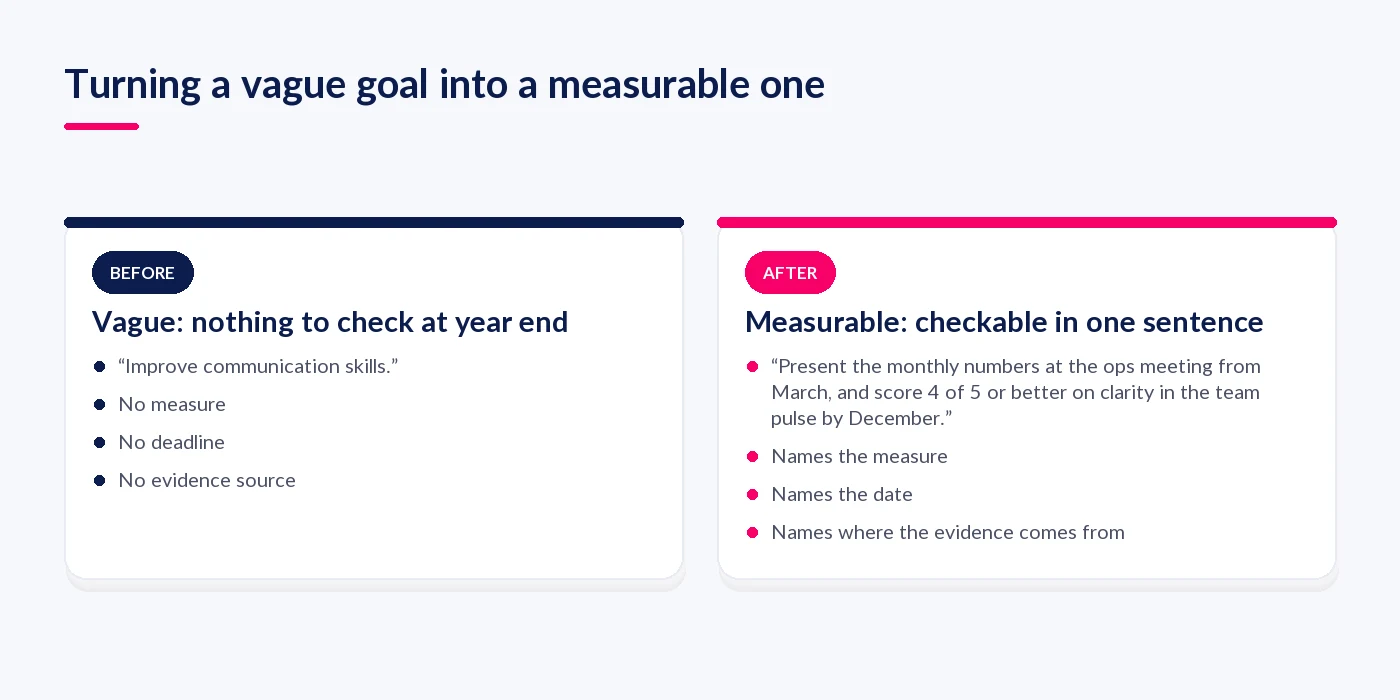
Not every goal should be a number. Behavior goals matter just as much in roles where output is shared or hard to isolate, and they can still be observable: “raises delivery risks at the fortnightly check-in rather than at the deadline” is checkable by both people even though nothing is being counted. What a goal cannot be is an adjective — “improve communication” and “be more proactive” are topics, not goals, and they are the two most common entries on a review form.
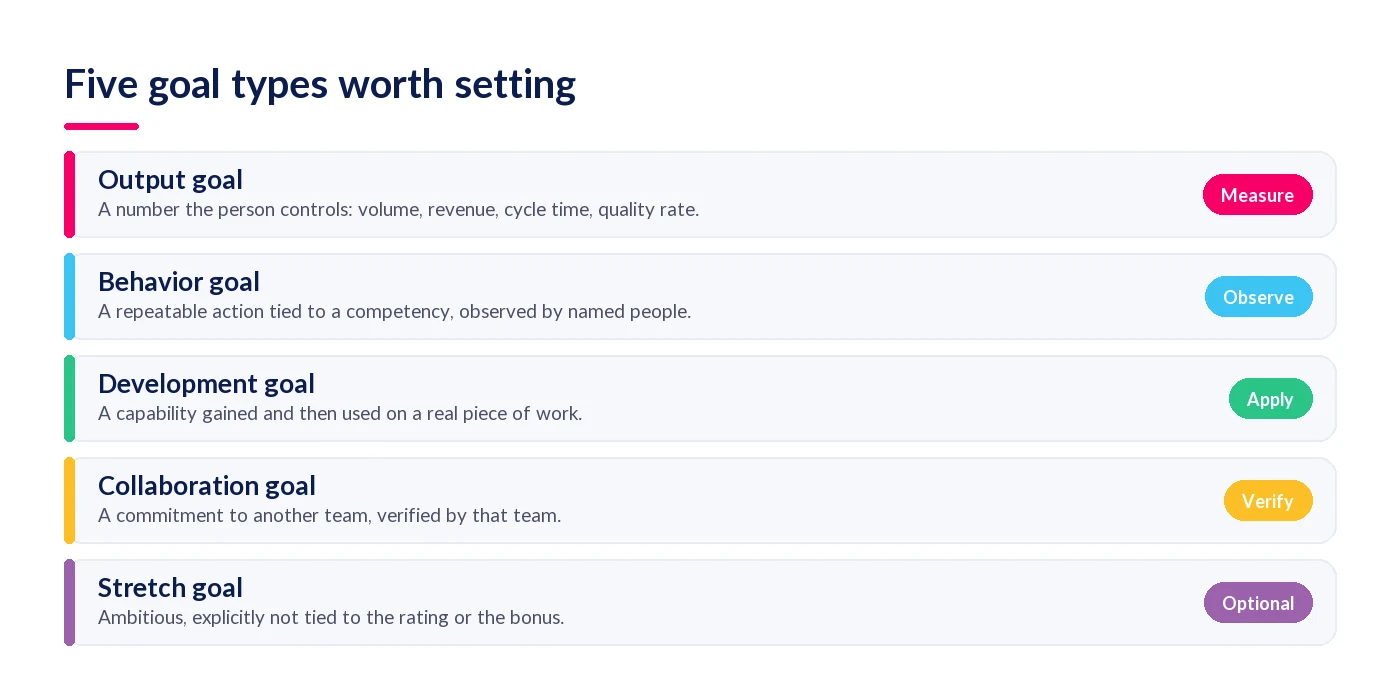
There are five goal types worth having in the mix, and most people need three of them rather than five of one.
What are some examples of measurable performance review goals?
Below are eighteen worked examples organized by competency area and role type, each written so it can be checked rather than debated. The numbers and dates are illustrative; the sentence shape is the transferable part. Where a goal would sit with an employee who is already meeting expectations, it is written at the level of a genuine step up rather than a restatement of the job description.
| Area or role | Example goal | Where the evidence comes from |
|---|---|---|
| Communication | “Present the monthly numbers at the operations meeting from March onward, and score 4 out of 5 or better on clarity of updates in the December team pulse.” | Meeting record plus pulse survey result |
| Written communication | “Bring average client update emails under 200 words while keeping the same information, reviewed on a sample of ten at the June one-to-one.” | Sampled emails reviewed with manager |
| Collaboration | “Agree a single shared source for supplier data with Finance by 30 April and retire the duplicate spreadsheet by 31 May.” | Written sign-off from the Finance lead |
| Customer service | “Resolve 80% of tier-one tickets without escalation by the end of Q3, from a baseline of 62%.” | Ticket system report |
| Sales — pipeline | “Add $400k of qualified pipeline in the manufacturing segment by 31 December, including at least twelve first meetings.” | CRM pipeline report |
| Sales — method | “Run discovery to the agreed framework on every new opportunity, with five calls reviewed per quarter scoring three or better on all four sections.” | Call reviews with the sales manager |
| Operations and manufacturing | “Reduce changeover time on line 2 from 45 minutes to 30 by 30 September, measured as the shift average.” | Line data, monthly shift averages |
| Quality | “Take pricing-sheet corrections after release from four per quarter to zero by Q4, introducing a second-pair check before issue.” | Correction log |
| Finance | “Close the monthly accounts within five working days every month from April, with no more than one exception across the year.” | Close calendar and month-end log |
| Software engineering | “Take the release rollback rate from two in twelve to zero by year end by having the test plan reviewed at sprint planning.” | Release records |
| Project delivery | “Deliver the warehouse migration by 31 October within the approved budget, publishing a written status every Friday.” | Project plan, budget report, status log |
| People management | “Hold a documented one-to-one with each of your six reports at least monthly, and complete all six reviews before the cycle deadline.” | One-to-one records and review completion |
| People development | “Have a written development plan agreed with each report by 31 May, each naming one capability and one real piece of work to practice it on.” | Signed development plans |
| Data and reporting | “Replace the manual weekly sales report with an automated version by 31 July, cutting preparation from three hours to under thirty minutes.” | Before-and-after timing, delivered report |
| Learning and development | “Complete the data analysis certificate by 30 June and use it on the quarterly churn review, presenting findings to the leadership team in July.” | Certificate plus the presented review |
| Compliance and safety | “Keep every required certification in date, and report all near-misses within 24 hours, audited at the quarterly walkaround.” | Certification record and near-miss log |
| Frontline and deskless | “Complete the shift handover checklist on every shift, with spot checks showing 95% completion by Q4.” | Spot-check results |
| Adaptability | “Cross-train on the second production line and be signed off to cover it unsupervised by 30 September.” | Sign-off by the line supervisor |
Notice what none of these say: improve, increase awareness of, take more ownership of, be more visible. Every one names a thing that either happened or did not by a date. If you want the same treatment applied to the comments you write about the past period, our guide to writing a performance review has eighteen weak-versus-strong comment examples in the same format. The wider mechanics of setting objectives are in what SMART objectives are.
How many goals should someone have in a review period?
Three to five. Fewer than three and the review has almost nothing to judge; more than five and the list stops functioning as a set of priorities, because when everything is a goal the person simply works on whatever is loudest. For a six-month cycle, three is usually right; for twelve months, four or five.
Who writes them matters as much as how many. Gallup found that only three in 10 employees strongly agree their manager involves them in goal setting, and that those employees are four times more likely to be engaged than everyone else. In practice the best version is a draft each: the employee proposes what they think the priorities are, the manager brings the ones the business needs, and the final set is agreed in the review meeting itself. Our guide to conducting performance reviews puts fifteen minutes of the agenda aside for exactly that.
Why do performance review goals fail?
Goals fail for four predictable reasons: nobody can measure them, nobody owns the dependency, nobody looks at them until the next review, or they were quietly impossible from the start. Only the first is a writing problem — the other three are management problems that better wording will not fix.
- No measure and no evidence source. The goal reads as a topic. Fix: add the number or the observable standard, plus where it will be checked.
- A dependency the person does not control. A goal that needs another team’s budget or a system that does not exist yet is a plan, not a goal. Fix: either name and secure the dependency, or rewrite it as the part the person genuinely controls.
- No check-in between reviews. A goal reviewed once at the end is a lottery ticket. Fix: put it on the monthly one-to-one agenda, so a slipping goal gets help while there is still time.
- Stretch goals wired to the rating. If missing an ambitious goal lowers the rating, people set safe ones instead. Fix: say explicitly which goals are stretch and rate the attempt, not the outcome.
One more failure mode worth naming: the goal that is simply the job description restated. “Answer support tickets” is the job. “Resolve 80% of tier-one tickets without escalation, from a baseline of 62%” is a goal. If a goal would be equally true for anyone in that role in any year, it is not going to change anything.
For the full cycle — goal setting, rating scales, calibration and the conversation itself — the Ultimate Guide to Performance Reviews covers each stage in more depth, and what an appraisal is explains where goal setting sits among the different review types.
Goals only work when they stay visible between reviews. To see how StaffCircle keeps objectives, progress and evidence attached to each person rather than in a spreadsheet nobody reopens, look at performance management and development.
Frequently asked questions
Should performance review goals be tied to pay?
Some can be, but not stretch goals and not goals with dependencies outside the person’s control. Where pay is linked, say so when the goal is set rather than at the review, and keep the pay conversation as a separate meeting. Otherwise people negotiate the wording instead of doing the work.
What is the difference between a goal and an objective?
In practice the words are used interchangeably in reviews. Where organizations distinguish them, an objective is the outcome to be achieved and goals are the specific, measurable commitments underneath it. What matters far more than the label is whether the sentence names a measure, a date and an evidence source.
Can you change a performance review goal mid-year?
Yes, and you should when the business changes underneath it. Record what changed, when, and who agreed it, so the review judges the goal that was actually in force. What causes problems is silent drift — a goal everyone has stopped working toward but nobody has formally retired.
What are examples of development goals for a performance review?
A development goal names a capability and the real work it will be practiced on: complete a certificate by June and apply it to the quarterly churn review; shadow three pricing meetings and then lead one by September; get signed off to cover the second production line unsupervised by 30 September.
What is a stretch goal, and should it affect the rating?
A stretch goal is deliberately ambitious enough that missing it is a reasonable outcome. Mark it as stretch when it is set and rate the attempt rather than the result. Tie stretch goals to ratings or bonuses and people will simply set easier ones next period, which defeats the purpose.
Related articles

See StaffCircle in action
Book a personalised demo and see how StaffCircle drives performance, engagement and development.