What tier-one contractors ask about competence
The questions tier-one contractors ask about competence are narrower than most suppliers expect: what level is this person at, who assessed them, what evidence sits behind it, and what was the position on the date the work was done. A training matrix and a reassuring answer fail all four.
Key facts
- Tier-one audits ask historical questions, not questions about today.
- Assurance is usually sought before an order is placed, not afterwards.
- A named assessor against each sign-off is the most frequently checked detail.
- CDM 2015 makes the appointer check competence, so the question flows downhill.
- The questions arrive before BS 8670-2 is published, not after.
Why are tier-one contractors auditing competence now?
Because the duty sits on them and the evidence sits with you. In England, regulation 11E of the Building Regulations 2010 requires whoever appoints a designer or contractor to take all reasonable steps to satisfy themselves the appointee is competent, and regulation 8 of CDM 2015 imposes a comparable duty UK-wide. Neither can be discharged by hoping. So the question is passed down the contract chain.
Two things have sharpened it. The Building Safety Act 2022 put a Gateway submission and a competence declaration between a project and its start date in England, which turns supply-chain competence into a programme risk rather than a paperwork risk. And we are increasingly seeing architects and specifiers name particular manufacturers in Gateway submissions rather than describing a generic product — which means the named manufacturer’s competence management becomes part of somebody else’s submission. That is a market observation from our own conversations rather than a published statistic, but it is the mechanism behind the timing. Our plain-English explainer on BS 8670-2 covers why the commercial pressure is arriving ahead of the standard itself.
What do tier-one contractors actually ask?
The questions are consistent, and there are about seven of them. What varies is how quickly a supplier runs out of answers. Below is the set we see most often, why each one is being asked, and what an answer that closes the question looks like rather than deferring it.
| The question | What they are really testing | What a good answer looks like |
|---|---|---|
| “How do you define competence for each role?” | Whether a written standard exists at all, or competence is a judgement made ad hoc | A profile per function covering skills, knowledge, experience and behaviours, at a stated level, version-controlled |
| “Who assessed this person, and when?” | Whether sign-off is attributable to a named individual competent to judge the work | A named assessor and a date against every validation, retrievable per person in minutes |
| “What is this person not allowed to do?” | Whether scope limits exist, or seniority is being treated as competence | Scope recorded on the profile, with departures escalating to a named subject-matter expert |
| “What level was this person at when the work was done?” | Whether you hold a point-in-time record or only a current snapshot | The historical position produced without reconstruction from email or memory |
| “How do you know competence is still current?” | Whether revalidation is scheduled or happens when somebody notices | Triggers and expiry dates set at sign-off, with alerts before anything lapses |
| “Who signs off a product substitution?” | Whether substitution is treated as a design decision or a procurement one | Named individuals at the level authorised to approve a departure from tested use |
| “What happens when your named expert leaves?” | Whether competence sits in a system or in one person’s head | A maintained role register, with a successor named before the departure, not after |
Nothing in that list is technically difficult. What makes it hard is that the answers live in five places: a spreadsheet, a training provider’s portal, somebody’s inbox, an induction pack and an individual’s memory. The BS 8670-2 readiness checklist is the fastest way to find out how many of the seven you could answer this week.
What does a good answer look like?
A good answer is specific, attributable and dated, and it takes about the same number of words as a bad one. The difference is not eloquence; it is whether the underlying record exists. Compare two responses to the same opening question, which is almost always some version of “how do you manage competence?”
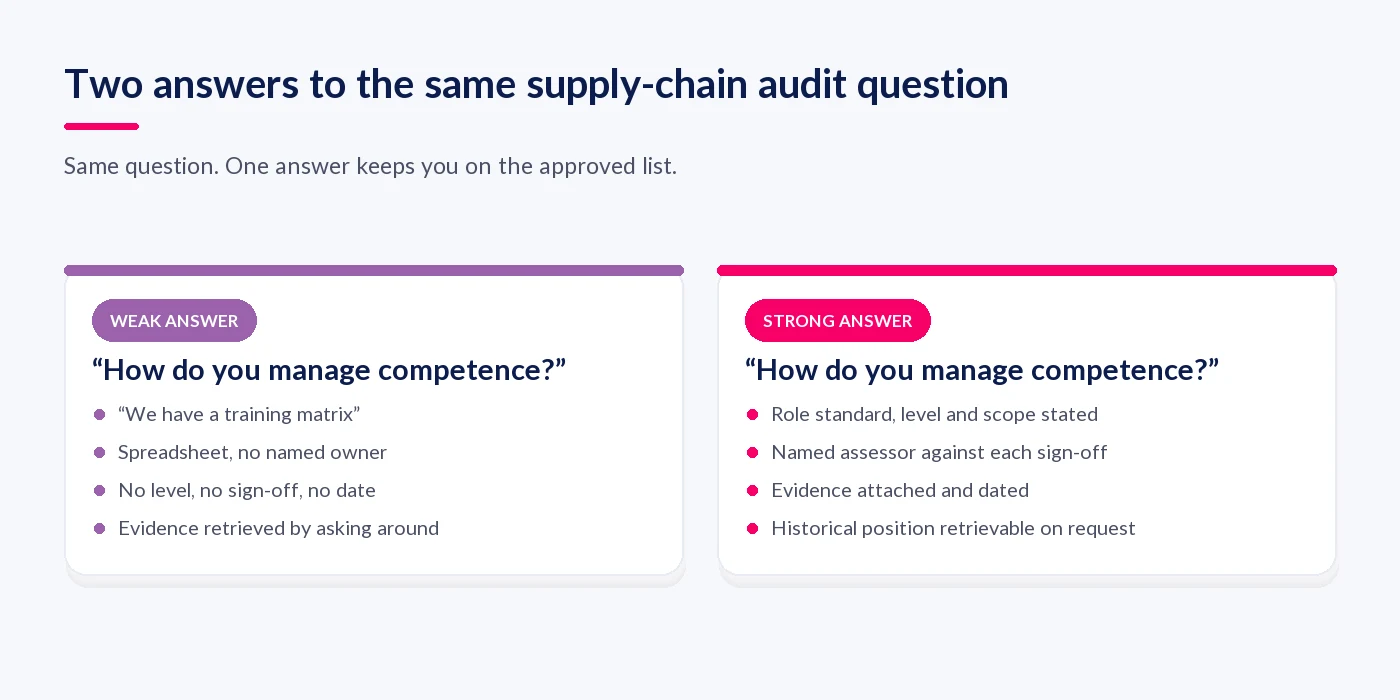
The weak answer is not dishonest. It is what a firm says when the information genuinely exists but cannot be assembled at speed. Auditors have heard it many times and treat it as a negative finding, because a record that takes a fortnight to produce cannot support a decision that is being made this week. From working with fire protection manufacturers like Siderise, the pattern we see is that the firms who convert an assurance request into an order are the ones who can produce a dated, signed position while the auditor is still in the room.
Which suppliers get asked for what?
The depth of questioning tracks how close a supplier sits to a safety-critical decision. Installers and systems firms are asked about individuals; merchants are asked about process; designers and specifiers are asked about both, because their selections carry design responsibility. Nobody in the chain is exempt any more, which is a genuine change from three years ago.
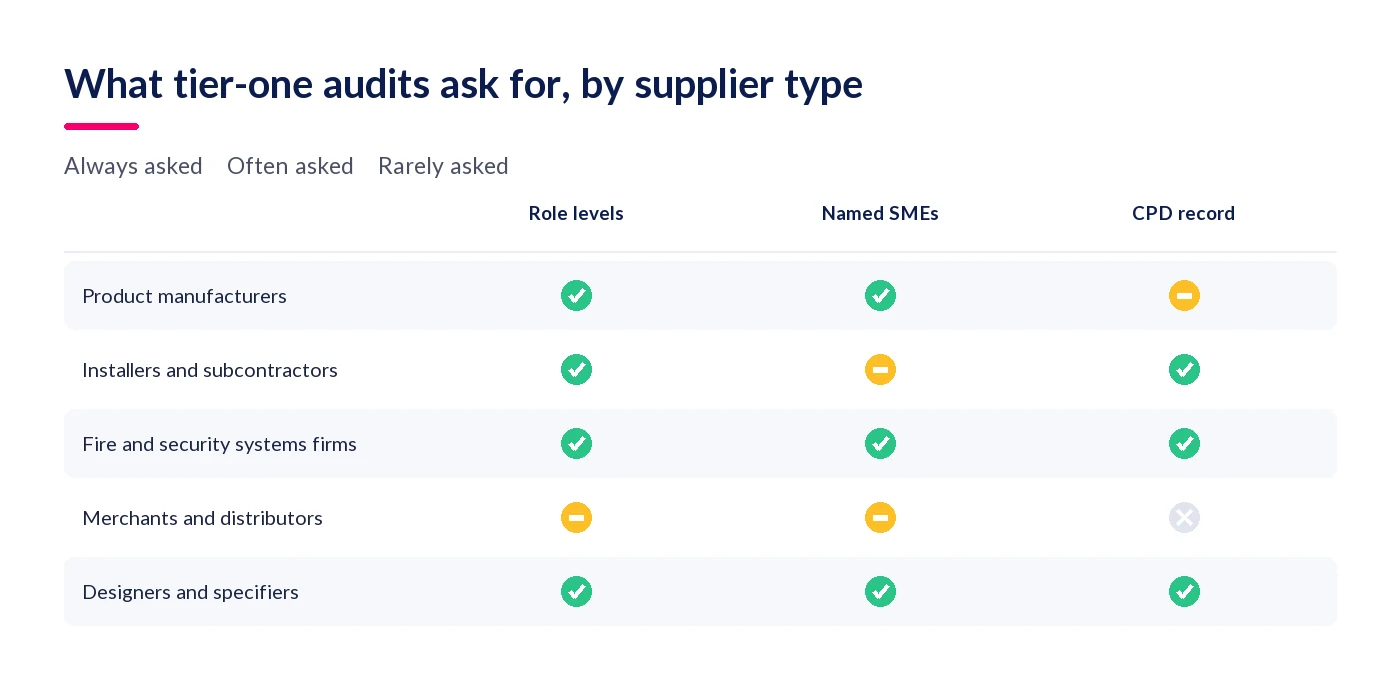
Two practical notes. Manufacturers are increasingly asked about their marketing and technical support functions, not only their production staff, because published product information is where a misunderstanding starts. And merchants and distributors are asked about the trade counter, where the line between relaying information and giving advice gets crossed several times a day. Our guide to what BS 8670-2 means for HR sets out where those functions land on the competence scale.
How do you get ready for a supply-chain audit?
Rehearse the historical question, because that is the one that fails. Pick a real project, a real person and a real date, and try to produce the level they held, the scope they worked within, who assessed them and what evidence was attached. Time it. Whatever that takes is what the audit will feel like.
From there the sequence is short. Write a profile per function rather than per job title. Get a named assessor against every sign-off. Record scope, not just level. Set the revalidation trigger at the moment of award, which is covered in our guide to competence validation and revalidation. And keep every superseded position rather than overwriting it, which is the same discipline the golden thread imposes on building information and the reason evidencing competence for a Gateway submission works months after the fact.
This article is general guidance, not legal or regulatory advice. What a specific customer asks for depends on the project, the building and your role in the chain. Verify the requirements in your own contracts and tender documents before relying on them.
If you want those seven answers to exist in one place, StaffCircle’s competence management software for construction holds the level, the scope, the assessor and the date against every person.
Frequently asked questions
Can we pass a supply-chain competence audit with a spreadsheet?
Sometimes, for a small team in one discipline. It fails on the historical question, because a spreadsheet overwrites the position it replaces and rarely records who assessed anyone or what scope they worked within. Auditors treat an answer that takes days to assemble as a finding in itself.
Do tier-one contractors require BS 8670-2 compliance?
They cannot, because the standard is not published yet and will be a code of practice rather than a certification scheme. What they do require is the evidence the standard will describe: role-level competence, named sign-off, recorded scope and a retrievable history. Preparing for one prepares you for the other.
Who usually runs the audit on the supplier side?
Whoever picks up the request, which is the underlying problem. It typically arrives with sales or the bid team, who then need role profiles from HR, technical detail from engineering and dates from three systems. Firms that answer well have decided in advance who owns each part.
What happens if we fail a competence audit?
Rarely an outright removal. More often a conditional approval, a request to resubmit, or quiet exclusion from the next enquiry without a stated reason. The commercial damage is hard to see precisely because it is not announced, which is why the first sign is often a pipeline that has thinned.
Does this apply to suppliers outside England?
Yes, in commercial terms. The Gateway regime and the golden thread duty are England-specific, but CDM 2015 applies UK-wide and tier-one contractors run one supply-chain assurance process rather than four. A supplier working in Glasgow and Manchester is asked the same competence questions in both.
Related articles



See StaffCircle in action
Book a personalised demo and see how StaffCircle drives performance, engagement and development.