What is BS 8670-2 and what does it mean for HR?
The BS 8670-2 standard is the forthcoming British Standard setting core criteria for competence in working with construction products and product information. It sits alongside BS 8670-1:2024, which covers building safety competence generally. For HR, it converts a legal duty of competence into role profiles, dated assessments and evidence you must be able to produce on request.
Key facts
- BS 8670-1:2024 is published. Part 2, covering construction products, is still in development.
- Part 2 addresses anyone working with construction products or product information.
- In England, competence is already a legal duty under the Building Regulations 2010.
- The Building Safety Regulator became a standalone public body on 27 January 2026.
- BS 8670-2 is a code of practice, not a licence: nobody issues you a pass.
What is BS 8670-2?
BS 8670-2 is the second part of the BS 8670 series of British Standards on building safety competence. The Construction Products Association, which is leading its development, gives the full title as “Competence frameworks for the built environment – Part 2: Core criteria for construction product competence – Code of practice”, and describes its audience as anyone writing competence frameworks for people who work with construction products or product information. Part 1, BS 8670-1:2024, was published by BSI and covers the core criteria for building safety competence across all building work.
The distinction between the two parts matters. Part 1 asks whether a person is competent to do the work. Part 2 asks whether a person is competent to make, specify, sell, install or describe the products that work uses. Both sit on the same underlying logic that came out of Dame Judith Hackitt’s independent review of building regulations and fire safety: products do not fail on their own, and a compliant product installed by someone who misread the test evidence is not a safe building.
When will BS 8670-2 be published?
Part 2 has not been published. It is in formal development through BSI, with industry briefings pointing to a publication window around 2027 and a public consultation on the draft having run during 2026. We are deliberately not quoting a firm date here, because the only date that will matter is the one printed on the standard, and BSI development timetables move.
That is less of a problem than it sounds, because nothing about your preparation depends on the publication date. The evidence a customer audit asks for — who was competent, at what level, on which date, signed off by whom — is the same evidence the standard will ask for. Firms already being audited by tier-one contractors are being asked for it now, which is the subject of our guide to what tier-one contractors ask about competence.
Who does BS 8670-2 apply to?
BS 8670-2 is aimed at every organisation whose people touch a construction product or the information that describes it. On the Construction Products Association’s account of the scope, that spans manufacturers, testers and assessors, merchants and distributors, installers, and the designers and specifiers who choose products in the first place. It is broader than most people expect: a marketing team publishing a performance claim is working with product information, and so is a trade counter assistant answering a question about substitution.
It is also worth being precise about force. BS 8670-2 will be a code of practice. It is not itself law, and there is no certificate at the end of it. Its teeth come from two directions: the statutory competence duties described below, and commercial pressure from customers who will not place an order without assurance. Our plain-English explainer on BS 8670-2 goes further into what the standard says and why the commercial pressure is arriving ahead of publication.
What does BS 8670-2 mean for HR?
For an HR or people function, BS 8670-2 is a documentation problem with a deadline attached. The standard describes what competence looks like; somebody has to hold the role profiles, run the assessments, keep the sign-off, and retrieve the position on any past date. In most 50 to 1,000-person construction and fire businesses there is no full-time competence manager, so that work lands on HR by default.
Here is the mapping, requirement by requirement. This is the part almost no guidance sets out, because it crosses the line between a technical standard and a people process.
| What the standard expects | What the people function has to produce | Where the evidence sits |
|---|---|---|
| A competence framework for each role | A profile naming the skills, knowledge, experience and behaviours the role needs, at a stated level | Role standard, version-controlled |
| Assessment against that framework | A validation review for each post-holder, with the assessor named rather than anonymous | Assessment record, dated |
| Limits on what a person may decide | The level and scope recorded against the person, never inferred from job title or seniority | Individual competence record |
| Competence maintained over time | Revalidation triggers, expiry dates and continuing professional development for flagged roles | Revalidation schedule |
| A route for questions beyond a person’s level | A named subject-matter expert for each high-risk role, kept current as people leave | Role register |
| Evidence available on request | The position exactly as it stood on a date somebody else chooses | Point-in-time record |
The last row is the one that breaks spreadsheets, and it is worth reading our note on competence validation and revalidation before you design anything. If you want the readiness questions in a single page, the BS 8670-2 readiness checklist covers them without the reading.
How do the A to E competence levels work?
The draft standard consulted on during 2026 uses a five-level scale, A to E, running from a subject-matter expert who can approve a departure from a product’s tested use down to a person who relays product information verbatim under supervision. Two features of the scale matter more than the level names. Levels attach to functions rather than job titles, and seniority is explicitly not competence.
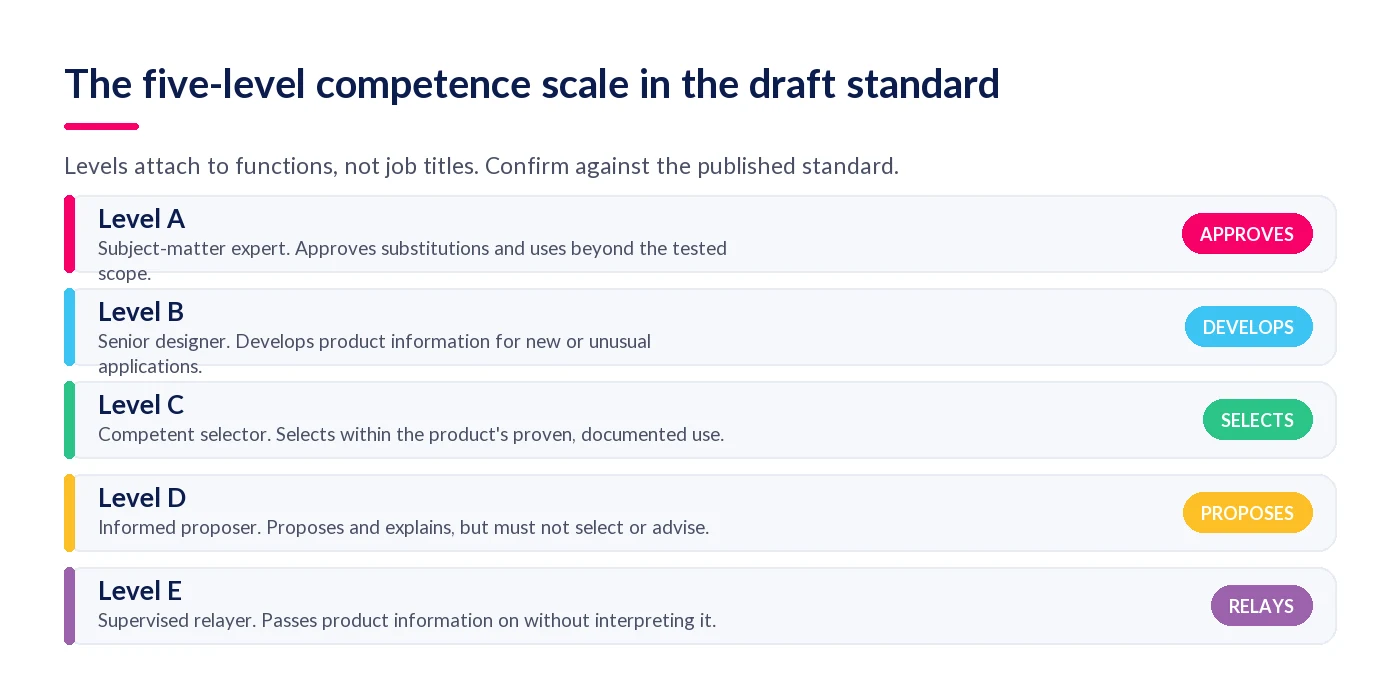
Because Part 2 is not published, treat the level definitions as the shape of the standard rather than its final text. What will not change is the underlying structure: the same competence expressed at a widening radius of responsibility. That is the same pattern any good competency framework uses, which is why organisations that already run one have much less work to do here. Our breakdown of SKEB — skills, knowledge, experience and behaviours shows how the four elements sit inside a single level.
Is competence already a legal duty, or only a standard?
In England, competence is already a legal duty and has been since 1 October 2023, entirely separately from BS 8670-2. Part 2A of the Building Regulations 2010 requires that anyone carrying out design or building work has, in the regulations’ own words, “the skills, knowledge, experience and behaviours necessary” to do it, or the organisational capability if they are an organisation.
The relevant provisions are worth reading in the original. Regulation 11F sets the general competence requirement, regulations 11G and 11H apply it to principal designers and principal contractors, and regulation 11E requires whoever appoints them to take all reasonable steps to satisfy themselves the appointee is competent. Regulation 11Q(4) spells out the behaviours: complying with requirements, refusing to do non-compliant work, cooperating with others, and declining work beyond your capability. Alongside that, regulation 8 of CDM 2015 has required skills, knowledge and experience of designers and contractors UK-wide since 2015.
So BS 8670-2 is not creating the duty. It is giving the industry a common way to describe and evidence a duty that already exists under the Building Safety Act 2022.
Does BS 8670-2 apply outside England?
BS 8670-2 is a British Standard, so it is written as a UK-wide reference point rather than an England-only one. The statutory machinery around it is not UK-wide, and this is where a lot of published guidance quietly goes wrong. The duty-holder and competence provisions in Part 2A, the Gateway regime and the golden thread duties are all England-specific.
Scotland runs a separate system under the Building (Scotland) Act 2003, with its own definition of a high-risk building and its own compliance plan manager role rather than English Gateways. Wales and Northern Ireland have their own building regulations regimes. What does run right across the UK is the commercial thread: CDM 2015, third-party certification schemes such as FIRAS and BAFE, the Code for Construction Product Information, and CSCS cards. A supplier working in Glasgow and Manchester is asked the same competence questions in both.
One more caveat, and it is a real one. This article is general guidance, not legal or regulatory advice. Which duties bite, and to what depth, depends on the specific building, your duty-holder role and the Gateway involved. Verify the requirements for your own project before you rely on them.
If you would rather hold the role profiles, levels and dated sign-off in one place, StaffCircle’s competence management software for construction is built for exactly that record.
Frequently asked questions
Is BS 8670-2 mandatory?
No. BS 8670-2 will be a code of practice, not law, and no regulator will require certification against it. The pressure to comply is commercial and legal from a different direction: tier-one customers audit competence management before placing orders, and in England the Building Regulations already impose a competence duty.
What is the difference between BS 8670-1 and BS 8670-2?
BS 8670-1:2024 sets core criteria for competence to carry out building work of all kinds. BS 8670-2, still in development, sets core criteria for competence in working with construction products and product information. Part 1 is about the work; Part 2 is about the products and the claims made for them.
Does BS 8670-2 apply to marketing teams?
Anyone who publishes or explains product information falls within the standard’s stated scope, and that includes marketing and trade counter staff. It does not make them technical experts. It means their published claims need named technical sign-off, and their own competence level needs recording like anyone else’s.
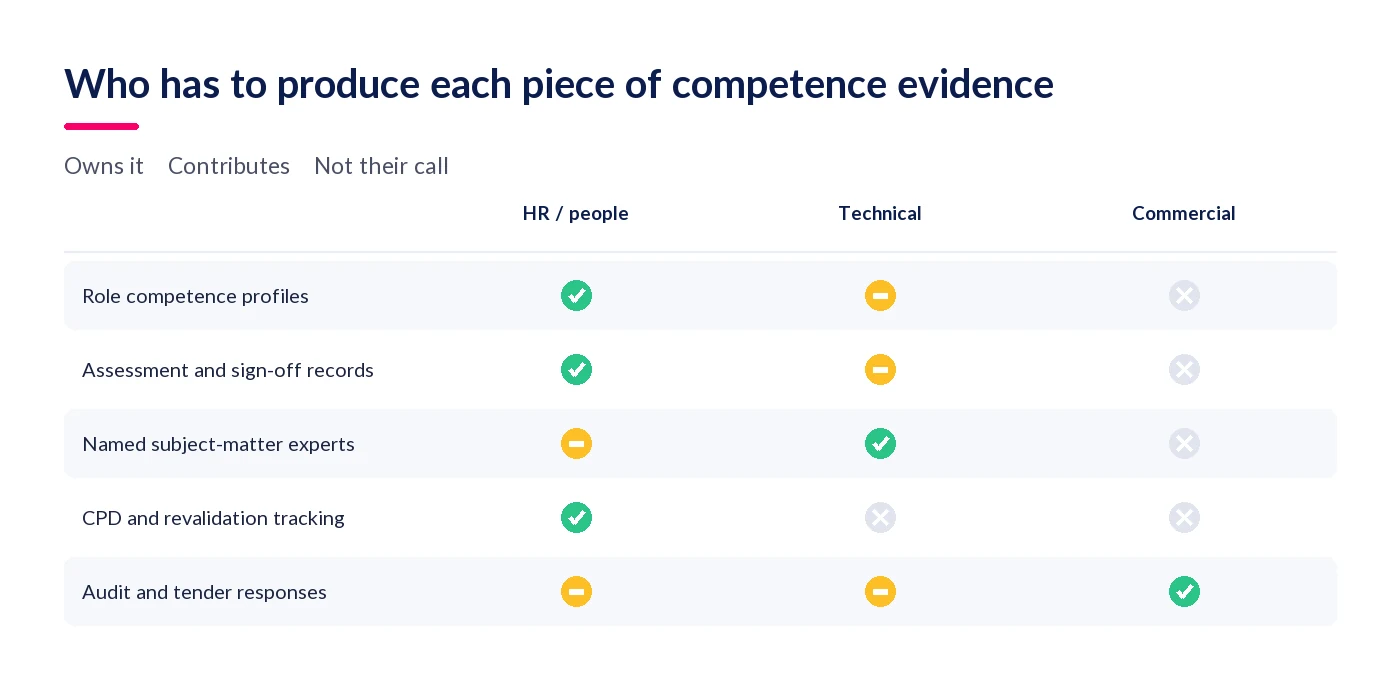
Who owns BS 8670-2 readiness internally?
In practice it splits. The technical function owns product knowledge and named expert roles; the people function owns role profiles, assessment records, sign-off and revalidation; the commercial team owns the audit and tender responses. The failure mode is assuming the other two have it covered, which is how firms arrive at an audit with nothing dated.
How long does it take to get ready for BS 8670-2?
Firms that already run a competency framework with proficiency levels usually need weeks, because they are mapping an existing structure onto A to E. Firms starting from a training spreadsheet should plan for months, most of it spent agreeing which roles are high-risk and who is competent to sign off.
Related articles
See StaffCircle in action
Book a personalised demo and see how StaffCircle drives performance, engagement and development.