SKEB explained: skills, knowledge, experience, behaviours
The four letters of SKEB are skills, knowledge, experience and behaviours — the four elements the Building Regulations in England use to define competence. A SKEB profile records all four for a role, at a stated level and a stated scope, so competence becomes something you can assess and evidence rather than something you assert.
Key facts
- SKEB stands for skills, knowledge, experience and behaviours.
- Regulation 11F of the Building Regulations 2010 uses those four words verbatim.
- Behaviours include refusing non-compliant work and declining work beyond your capability.
- CDM 2015 used skills, knowledge and experience. Behaviours came later.
- A profile without a stated scope cannot say what a person must not do.
What does SKEB stand for?
SKEB stands for skills, knowledge, experience and behaviours. It is not industry shorthand invented by consultants: it is the wording of the law. Regulation 11F of the Building Regulations 2010 requires that a person carrying out design or building work in England has “the skills, knowledge, experience and behaviours necessary” to do it, or organisational capability where the duty-holder is an organisation.
The four elements are separable on purpose, because each fails differently. Skills can be demonstrated and lost. Knowledge can be tested and go out of date. Experience accumulates and can be irrelevant to the system in front of you. Behaviours are the element nobody can be trained into in an afternoon, and they are the element most competence records ignore entirely.
Why does the law say competence rather than skills?
Because a skilled person who does the wrong thing anyway is not competent, and the Grenfell Tower Inquiry and Dame Judith Hackitt’s independent review of building regulations and fire safety both landed on that distinction. Competence is the whole package: capable, informed, experienced in the right things, and disposed to behave correctly under commercial pressure.
The regulations say what those behaviours are. Regulation 11Q(4) lists complying with the requirements, refusing to carry out work that would not comply, cooperating with others on the project, and declining work beyond your own capability. That last one is worth sitting with. A competence framework that never gives anyone a reason to say no is not describing competence, it is describing throughput. Earlier law framed it more narrowly: regulation 8 of CDM 2015 requires skills, knowledge and experience, without the fourth element. Anyone still writing profiles to that shape is a regime behind.
What evidence satisfies each part of SKEB?
Take a real high-risk role: a passive fire protection installation supervisor, working on penetration seals and cavity barriers, responsible for signing off that installations match the tested detail. Below is what each SKEB element means for that one role, and what actually satisfies it. Most competence records hold the first column and stop.
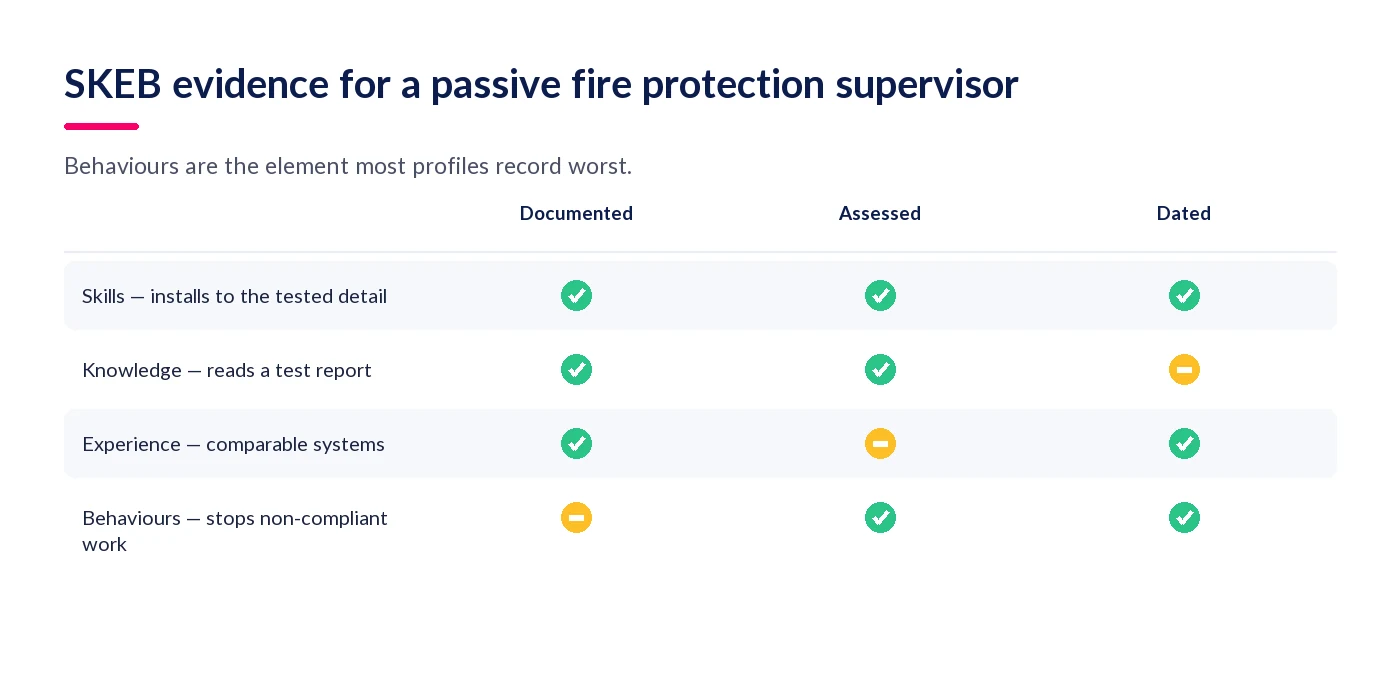
| SKEB element | What it means for this role | Evidence that satisfies it | What does not satisfy it |
|---|---|---|---|
| Skills | Can install and inspect penetration seals to the tested detail for the specific system | Practical assessment against the manufacturer’s tested detail, observed and signed off by a named assessor, dated | A course completion certificate with no assessment of the installed work |
| Knowledge | Can read a fire test report and identify where the installed condition departs from it | Assessed questioning on real test evidence, plus current continuing professional development for the systems in use | Attendance at a product briefing three years ago |
| Experience | Has supervised comparable systems, at comparable complexity, in comparable buildings | Project history naming systems and building types, corroborated by a supervisor rather than self-declared | “Twelve years in the trade”, with no detail of what kind of work |
| Behaviours | Stops non-compliant work, escalates rather than improvising a substitution, declines work outside scope | Recorded instances of escalation or stop-work, plus assessor commentary against the regulation 11Q(4) behaviours | A values statement in an induction pack that nobody is assessed against |
The fourth row is the whole argument for SKEB over skills. You cannot evidence “stops non-compliant work” from a training record; it has to be observed, recorded and signed. If your existing framework has no home for that column, our guide to building a competency framework covers where it goes, and the BS 8670-2 readiness checklist will tell you quickly which of the four elements you can currently produce.
How do SKEB and the A to E levels fit together?
SKEB is the four things you assess. The level is how far a person’s authority extends once they have been assessed. The draft BS 8670-2 standard consulted on during 2026 uses a five-level scale, A to E, and the same four SKEB elements are written out at every level — not replaced by different elements as you go up.
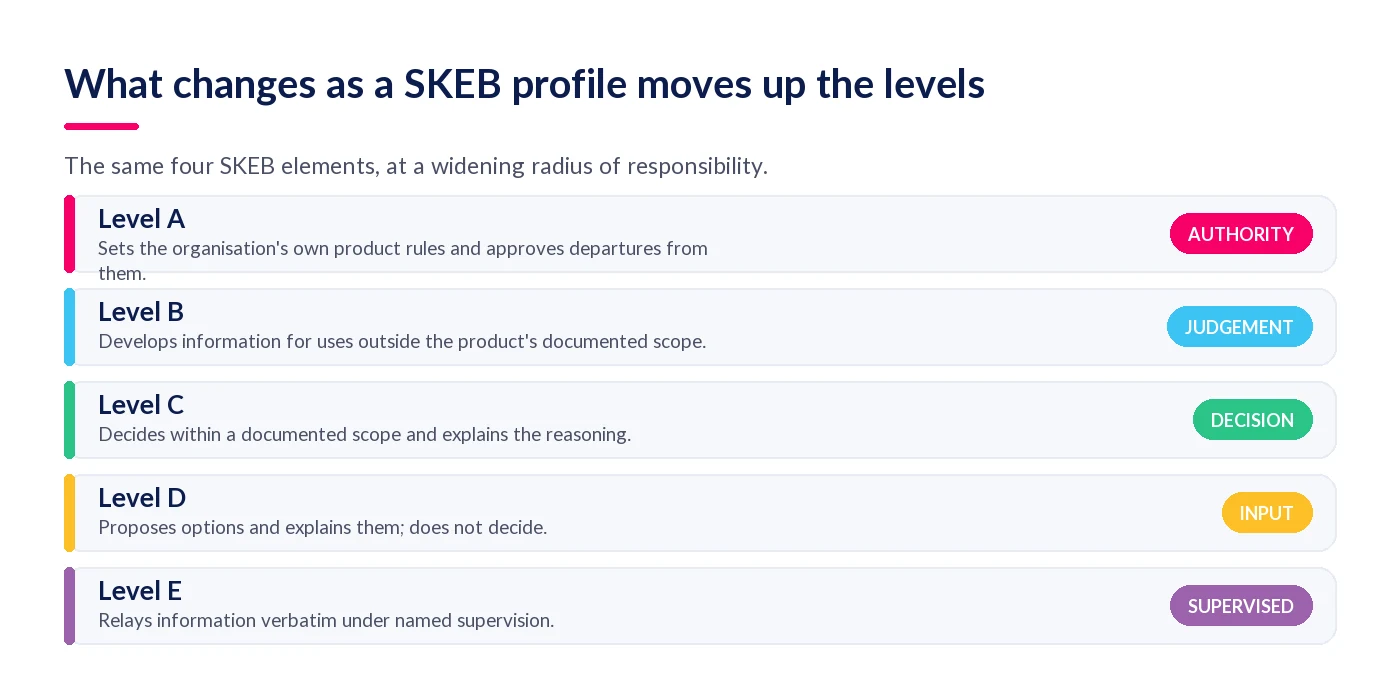
Two rules keep this honest. First, the level attaches to a function, not a person’s job title, so the same supervisor can be at one level for installation and a lower one for specification. Second, seniority is not competence: a director who has never assessed a tested detail does not acquire the authority to approve a departure from one by being a director. Because Part 2 is not yet published, treat the level definitions as the draft’s shape rather than final wording — our note on what BS 8670-2 means for HR and the fuller plain-English explainer on BS 8670-2 both set out where that detail still moves.
How many competencies should a SKEB profile hold?
Fewer than instinct suggests. A workable profile for a single high-risk role holds around six to ten competencies, each written out across the four SKEB elements. Beyond that the assessment stops being something a supervisor can actually complete, and the profile becomes a document that exists rather than a standard that gets used.
The economy comes from writing the SKEB elements once per competency and reusing the level ladder across roles, rather than drafting a fresh scale for every trade. That is what turns framework building from a quarter-long project into around 40 minutes of structured work, and it is the same discipline as any skills compliance exercise. Keeping the profiles current afterwards is a separate problem, covered in our guide to competence validation and revalidation.
This article is general guidance, not legal or regulatory advice. What competence a specific role requires depends on the building, the duty-holder role and the work involved. Verify the requirements for your own project before relying on them.
If you want SKEB profiles, levels and revalidation running in one place rather than four, StaffCircle’s training compliance module builds and maintains them per role.
Frequently asked questions
Is SKEB the same as a competency framework?
SKEB is the structure a competence profile uses; a competency framework is the collection of those profiles across every role. In building safety the two are used almost interchangeably, but the distinction matters when writing one: SKEB tells you what four things each competency must describe.
How do you assess behaviours?
By recording what someone actually did, not what they say they value. Real evidence looks like a logged escalation, a documented refusal to proceed with non-compliant work, or an assessor’s observation against the specific behaviours named in regulation 11Q(4). Anything self-declared and unwitnessed will not survive an audit.
Does SKEB apply to organisations or individuals?
Individuals. Where the duty-holder is an organisation, the Building Regulations require organisational capability instead. In practice that capability still has to rest on identifiable people with assessed SKEB profiles, so most organisations end up evidencing individuals whichever way the duty is framed.
What is the difference between SKEB and SKE?
Behaviours. Regulation 8 of CDM 2015 requires skills, knowledge and experience of designers and contractors. The Building Regulations competence provisions that came in for England in October 2023 added behaviours as a fourth element, with a defined list attached. Profiles written to the older three-element shape are incomplete.
Who should write SKEB profiles?
The technical function owns what the role has to know and do; the people function owns the structure, the levels, the assessment process and the record. Written by technical alone, profiles become unassessable. Written by HR alone, they miss the detail that makes the work safe.
Related articles
See StaffCircle in action
Book a personalised demo and see how StaffCircle drives performance, engagement and development.