What is the golden thread, and who owns it?
The golden thread is the digital record of the information needed to understand a higher-risk building in England and keep the people in it safe, kept current from design through to occupation. It is a legal duty rather than a filing convention. The people half of it — who was competent, and when — is where ownership usually breaks down.
Key facts
- The golden thread is a statutory duty for higher-risk buildings in England.
- It must be digital, secure, available, usable, and the building’s single source of truth.
- Client, principal designer and principal contractor hold it during design and construction.
- Accountable persons hold it once the building is occupied.
- Competence records are the part of it most often left unowned.
What is the golden thread?
The golden thread is the information about a higher-risk building, held digitally, so that anyone who needs to understand the building and keep it safe can retrieve what they need. The Government’s guidance on keeping information about a higher-risk building sets out the qualities it must have: kept digitally, secure from unauthorised access, available when someone needs the information, presented in a way someone can use, and functioning as “a building’s single source of truth”.
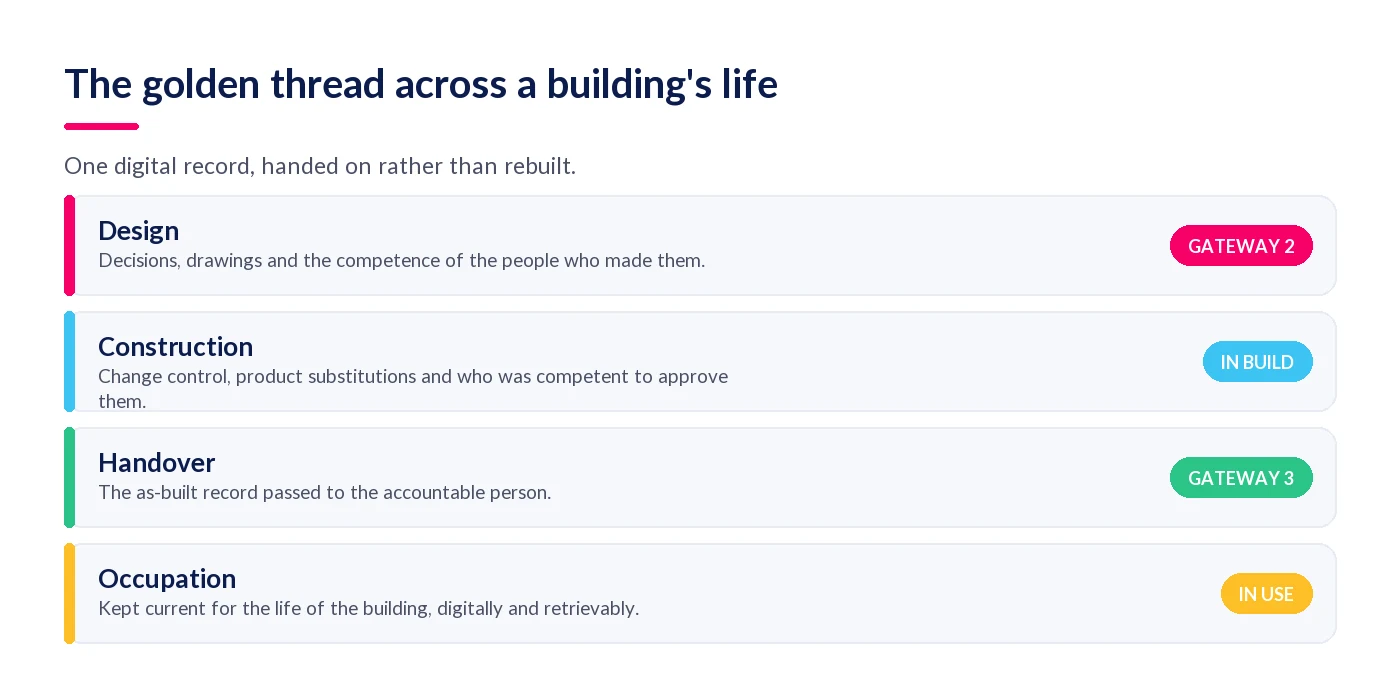
The duty sits in two sets of regulations. During design and construction it comes through the Building (Higher-Risk Buildings Procedures) (England) Regulations 2023; in occupation, through the Higher-Risk Buildings (Keeping and Provision of Information etc.) (England) Regulations 2024. The word “thread” is doing real work in the name. The point is continuity: the record is handed on rather than rebuilt, so nothing is lost at handover.
Who owns the golden thread?
Ownership changes with the stage of the building’s life. During design and construction the duty sits with the client, the principal designer and the principal contractor. Once the building is occupied it sits with the accountable person and the principal accountable person. That is the legal answer, and it is the easy half.
The harder question is who owns each part of it inside your organisation, because the golden thread is not one document. Design records, product decisions and competence records are produced by different functions, and the competence half is routinely orphaned: technical assumes HR has it, HR assumes the project team has it, and nobody has written down which.
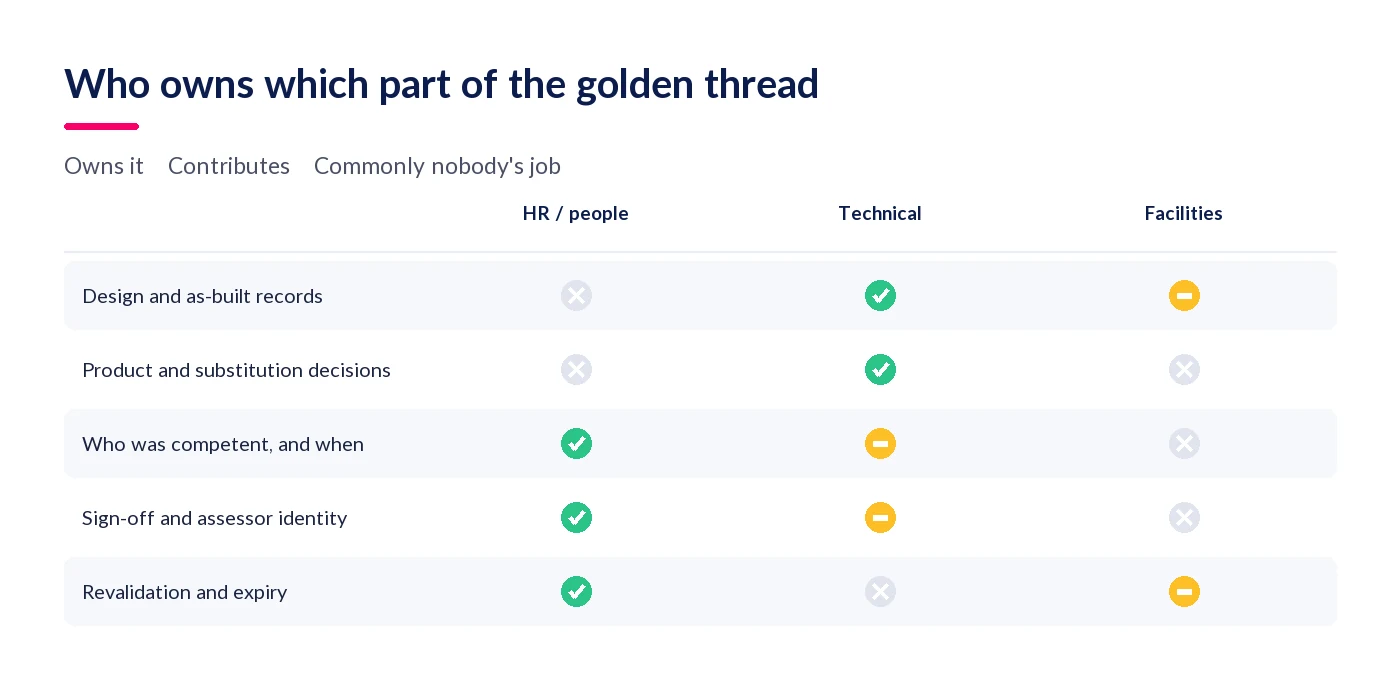
| Part of the record | Who realistically owns it | The gap where nobody does |
|---|---|---|
| Design intent and as-built information | Technical or design function, handed to the accountable person | Rarely a gap — this is the part everyone already thinks of as the golden thread |
| Product selections and substitutions | Technical function, with commercial sign-off | Who was competent to approve the substitution, as opposed to who approved it |
| Who was competent, at what level, on which date | The people function, in practice | Very common. Training records exist; dated competence positions do not |
| Who signed a competence assessment off | The people function | Very common. Sign-off is verbal, or recorded as a team rather than a person |
| Revalidation dates and expiries | The people function | Common. Tracked in a spreadsheet that nobody owns after the author leaves |
| Named subject-matter experts for high-risk roles | Technical function, maintained by the people function | Common. The named expert left eighteen months ago |
If you read one row twice, make it the third. That is the row an auditor turns into a point-in-time question, and it is the subject of our guide to competence validation and revalidation. The BS 8670-2 readiness checklist is a quick way to find out which of these rows you can currently answer.
Is competence data part of the golden thread?
Partly, and this deserves a careful answer rather than a confident one. The Government guidance is explicit that a client must keep the competence declaration submitted with a building control approval application within their record-keeping system. It does not go on to say that competence data in general forms part of the golden thread, and we are not going to claim it does.
What is clear is the practical position. The golden thread exists so that questions about the building can be answered from the record. Many of those questions are about people: who specified this, who was competent to approve that substitution, who supervised this installation. If your competence records cannot answer them as at the relevant date, the thread has a hole in it regardless of how the duty is formally drafted. Treat competence records as part of the same discipline even where the regulations stop short of saying so, and see our guide to evidencing competence for a Gateway submission for how that plays out at the submission points.
What happens when nobody owns the people half?
You find out at the worst moment, because the trigger is always external. A tier-one contractor’s audit, a client’s pre-order assurance request, an insurer, or in the worst case an investigation. The question arrives phrased in the past tense, and the honest answer takes a fortnight of asking around.
The failure has a recognisable shape. Training completions are recorded, because a system captured them. Competence levels are not, because deciding someone is at a level requires a judgement and a name against it. Scope is not recorded either, so nothing distinguishes the person who may approve a departure from the tested use from the person who may only relay information. Our explainer on SKEB — skills, knowledge, experience and behaviours covers how to write the standard that makes those judgements possible in the first place.
Which buildings need a golden thread?
The statutory golden thread duty applies to higher-risk buildings in England. Under section 65 of the Building Safety Act 2022, that means a building at least 18 metres in height or with at least seven storeys, containing at least two residential units; the design and construction descriptions also cover care homes and hospitals at that height. Below the threshold, the duty does not bite.
Suppliers into the sector should be careful about reading that as an exemption. If you make, specify or install products that go into higher-risk buildings, your customer carries the duty and will pass the evidence requirement down the contract to you — which is why the vocabulary now turns up in tenders for work on buildings that are nowhere near 18 metres. Scotland, Wales and Northern Ireland run their own regimes, and the England golden thread duty does not extend to them. Our plain-English guide to BS 8670-2 covers how that supply-chain pressure is arriving ahead of the standard.
This article is general guidance, not legal or regulatory advice. What your golden thread must contain depends on the building, your duty-holder role and the stage of the project. Verify the requirements for your own building before relying on them.
If the people half of your golden thread currently has no owner, StaffCircle’s competence management software for construction gives it one system and one dated record.
Frequently asked questions
Does the golden thread have to be digital?
Yes. The Government guidance is explicit that the information must be kept digitally, secure from unauthorised access, available when someone needs it and presented in a way someone can use. A paper archive or a shared drive of scanned documents does not meet the availability and usability expectations in practice.
Who hands the golden thread over at completion?
Responsibility passes from the design and construction duty-holders to the accountable person for the occupied building. In practice the principal contractor and client assemble the as-built record and hand it across, and gaps left in it at that point become the accountable person’s problem rather than disappearing.
Is a training matrix part of the golden thread?
A training matrix is usually the wrong shape for it. It records that training happened, overwrites its own history, and rarely names who assessed competence or what scope a person works within. The record needs to show a dated position that can be retrieved later, not a current summary.
How long does the golden thread have to be kept?
It is designed to run for the life of the building rather than for a fixed retention period, passing between duty-holders as ownership and occupation change. That is the practical difference between the golden thread and a project archive: the archive closes, and the thread does not.
Does the golden thread apply in Scotland?
No. The golden thread duty comes from the England higher-risk building regime. Scotland operates a separate building standards system under the Building (Scotland) Act 2003, with its own compliance plan approach and its own definition of a high-risk building. Wales and Northern Ireland have separate arrangements again.
Related articles

See StaffCircle in action
Book a personalised demo and see how StaffCircle drives performance, engagement and development.