How to evidence competence for a Gateway submission
A Gateway submission is a hard stop in the building control regime for higher-risk buildings in England, at which the Building Safety Regulator must approve before work proceeds. Competence evidence is part of it: the application has to be accompanied by a competence declaration, and the roles named in it need dated, signed-off assessments behind them.
Key facts
- Gateway 2 precedes construction. Gateway 3 precedes occupation. Both are England-only.
- A competence declaration must accompany the building control approval application.
- Higher-risk means at least 18 metres or seven storeys, with two residential units.
- The regulations do not prescribe what a competence declaration must contain.
- The Building Safety Regulator became a standalone public body in January 2026.
What is a Gateway submission?
A Gateway submission is an application to the Building Safety Regulator at one of the fixed decision points in the higher-risk building regime in England. Gateway 2 is the building control approval application made before construction starts. Gateway 3 is the completion application made before the building can be registered and occupied. Neither is a formality: work cannot lawfully proceed past either without approval.
The Regulator’s own guidance on building control approval for higher-risk buildings sets out what an application involves, including a check that the client has appointed people who are, in its words, “competent to do their job”. Gateway 1 sits earlier, in the planning system, and works differently; this article deals only with Gateways 2 and 3. Since 27 January 2026 the Regulator has been a standalone non-departmental public body sponsored by the Ministry of Housing, Communities and Local Government rather than a unit inside the Health and Safety Executive, as its strategic plan for 2026 to 2027 records. A lot of older guidance still says otherwise.
What competence evidence does a Gateway submission need?
The regulations require a named document. Under regulation 4(2) of the Building (Higher-Risk Buildings Procedures) (England) Regulations 2023, a building control approval application for higher-risk building work must be accompanied by a competence declaration. For work on an existing higher-risk building, regulation 12 requires one for category A work and allows the Regulator to ask for one for category B work.
Behind that single document sits the substance. Part 2A of the Building Regulations 2010 requires that anyone doing design or building work has “the skills, knowledge, experience and behaviours necessary” for it — regulation 11F — and regulation 11E puts a duty on whoever makes the appointment to take all reasonable steps to satisfy themselves the appointee meets it. A declaration you cannot substantiate is worse than no declaration, because you have now put your name to it.
Which duty-holder roles have to evidence competence?
Every duty-holder role in the England regime carries a competence requirement, but they do not all carry the same evidence burden. The principal designer and principal contractor face the heaviest, because the regulations single them out with their own competence provisions. The client’s duty is different in kind: it is a duty to check, not a duty to be technically competent.
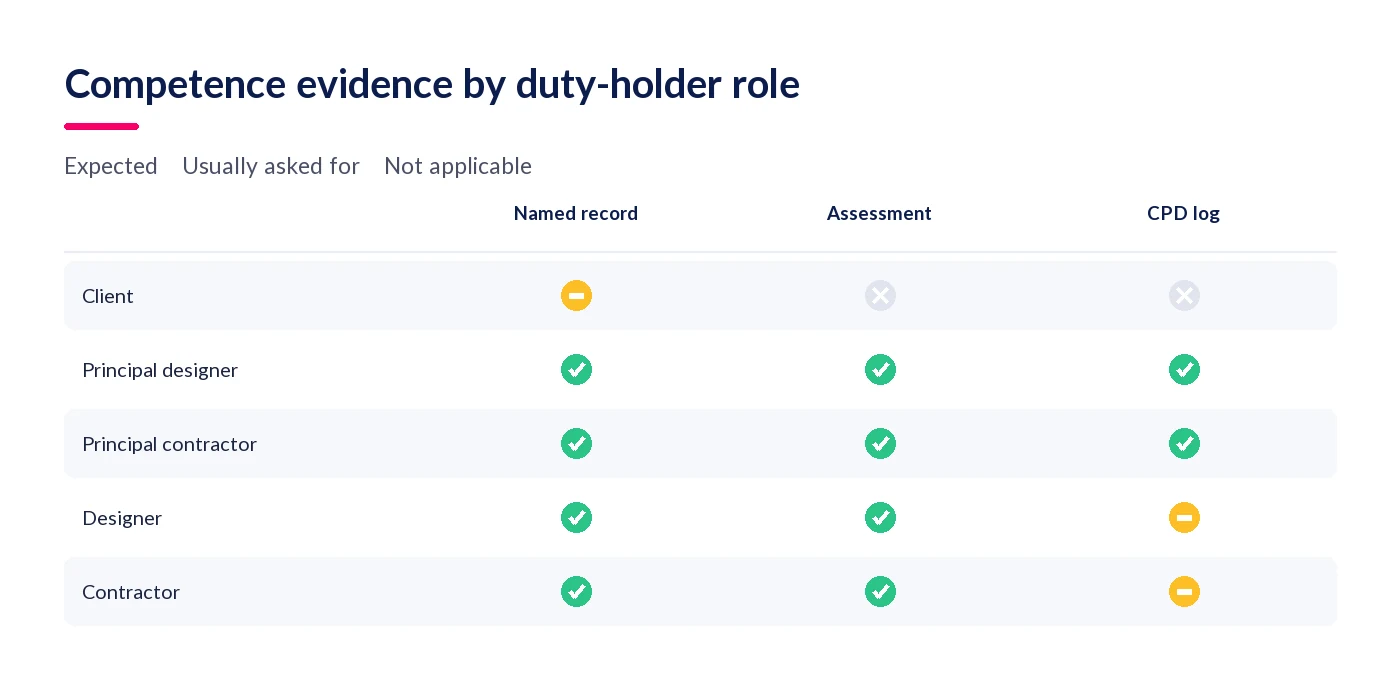
| Duty-holder role | What the evidence has to show | Where firms come unstuck |
|---|---|---|
| Client | That reasonable steps were taken to satisfy themselves each appointee is competent, before appointment | No written record of the check, only the appointment itself |
| Principal designer | Named individual or organisational capability against the specific design work, with assessment and sign-off | A CV, offered in place of an assessment against a defined standard |
| Principal contractor | Named capability to plan, manage and monitor the construction phase on this project | Company accreditations offered instead of individual competence |
| Designer | Competence for the discipline and the specific scope, including product selection decisions | Nothing showing who may approve a substitution |
| Contractor | Competence for the trade and the systems installed, with supervision recorded where applicable | Training completed, but no assessment of whether it worked |
| Every role above | The behaviours in regulation 11Q(4): refusing non-compliant work, declining work beyond capability | Behaviours never assessed, because nobody knows how |
That last row is the one that catches people. Regulation 11Q(4) makes behaviours part of the competence requirement, not a soft extra, which is why the sector talks about SKEB rather than skills. If you want the readiness questions on one page, the BS 8670-2 readiness checklist is a faster route than reading the regulations twice.
How do you prepare competence evidence for a Gateway submission?
Work backwards from the question the Regulator or the client will ask, which is always about a specific person on a specific date. Six steps get you there, and the order matters: the sequence below fails if you assess people before you have written down what competent means for their role.
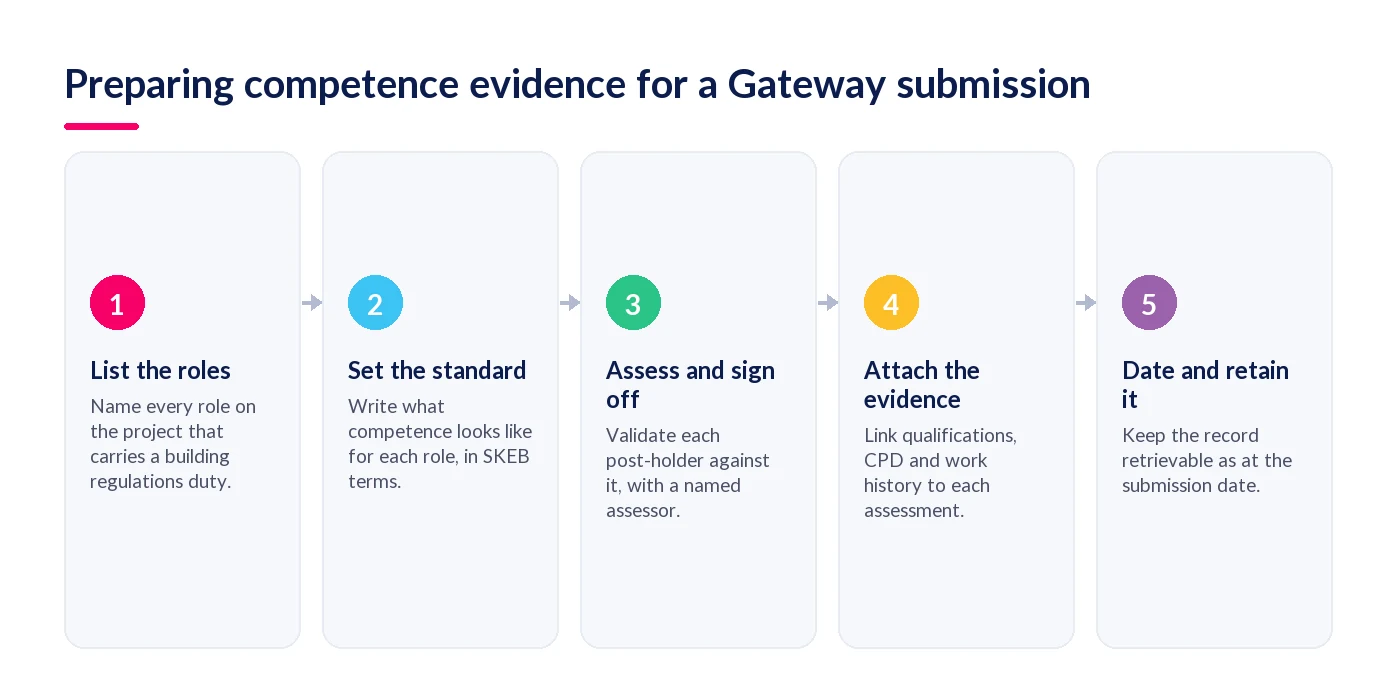
- List every role on the project that carries a duty. Start from the duty-holder roles in the regulations, then add every function that makes or influences a product decision. Name the actual post-holders, not the departments.
- Write the competence standard for each role. Express it as skills, knowledge, experience and behaviours, at a stated level and with a stated scope. A standard that does not say what the person may not do is not finished.
- Validate each post-holder against the standard. Run an assessment, record the outcome, and name the assessor. An unnamed sign-off is treated as no sign-off in an audit.
- Attach the supporting evidence to the assessment. Qualifications, training records, continuing professional development and comparable project history, linked to the assessment rather than filed on a shared drive.
- Record the client’s own competence check. Regulation 11E requires reasonable steps before appointment. Write down what was checked, by whom, and when, so the check exists as evidence rather than as a memory.
- Freeze and date the position. Keep the record so the level, scope, sign-off and evidence as at the submission date can be retrieved later without reconstruction.
Steps three and six are where most programmes quietly fail, and both are covered in more depth in our guide to running competence validation and revalidation.
What does a competence declaration have to contain?
The regulations do not say. Regulation 4(2) requires that a competence declaration accompany the application, and regulation 12 does the same for category A work on existing buildings, but neither prescribes its contents. This is a genuine gap in the published detail rather than something we have chosen not to repeat, and any guidance that hands you a definitive field list is going beyond the regulations.
What follows from that is a practical rule: build the declaration so it can be substantiated line by line. If it asserts that a principal designer is competent, you should be able to produce the role standard, the assessment against it, the assessor’s name and the date, in minutes. Confirm the format the Regulator expects for your specific application rather than assuming, because it varies with the building and the work.
Which buildings does the Gateway regime cover?
The Gateway regime covers higher-risk buildings in England. Section 65 of the Building Safety Act 2022 defines a higher-risk building for the occupation regime as one that is at least 18 metres in height or has at least seven storeys, and contains at least two residential units. For the design and construction regime the descriptions also bring in care homes and hospitals at that height.
Outside those thresholds, and outside England, the Gateways do not apply — but the competence duty does not go away. Part 2A of the Building Regulations applies to building work in England generally, and regulation 8 of CDM 2015 applies UK-wide. Scotland runs its own compliance plan approach instead of Gateways. That is why suppliers who work across nations end up building one competence record and using it everywhere, which is the point of our note on BS 8670-2 in plain English and on skills compliance more broadly.
This article is general guidance, not legal or regulatory advice. Which duties apply, and what a Gateway submission must contain, depend on the building, your duty-holder role and the Gateway in question. Verify the requirements for your own project before relying on them.
If you want the level, scope, assessor and date to be retrievable in minutes rather than assembled by hand, StaffCircle’s competence management software for construction holds all four against every person.
Frequently asked questions
Who signs the competence declaration?
The declaration accompanies the building control approval application, so it sits with the applicant — in practice the client or their agent. The client cannot delegate the underlying duty to check. Regulation 11E requires the appointer to take all reasonable steps to satisfy themselves that each appointee is competent.
Does a Gateway submission need individual or organisational competence?
Both, depending on the appointment. The Building Regulations set the requirement as skills, knowledge, experience and behaviours for an individual, or organisational capability where the duty-holder is an organisation. An organisational claim still has to rest on identifiable competent people, so most submissions end up evidencing individuals anyway.
Can a training matrix serve as Gateway competence evidence?
Rarely on its own. A matrix usually records that training happened, not that competence was assessed, and almost never records who signed it off or what the person may not do. It also overwrites history, so it cannot answer what level someone held on the submission date.
How far back does competence evidence need to go?
Far enough to answer a question about any date on which a decision was made. The practical test is the golden thread: the record must show the position as it stood then, not only as it stands now. Reconstructing it after the fact is what turns an audit into a scramble.
Does the Gateway regime apply in Scotland or Wales?
No. Gateways 2 and 3 are part of the England higher-risk building regime. Scotland operates a separate system under the Building (Scotland) Act 2003, with a compliance plan manager role instead. Wales and Northern Ireland have their own building regulations regimes and different arrangements again.
Related articles

See StaffCircle in action
Book a personalised demo and see how StaffCircle drives performance, engagement and development.