How to run competence validation and revalidation
The difference between validation and revalidation is timing. Validation is the first assessment that establishes a person is competent at a stated level and scope; revalidation is the scheduled re-check that keeps that position current. At scale, both have to produce a dated, signed record that can be retrieved for any past date.
Key facts
- Validation establishes competence. Revalidation keeps the recorded position current.
- Every validation needs a named assessor, a stated level and a stated scope.
- Point-in-time reporting answers what level a person held on a chosen date.
- A snapshot report overwrites the position it replaces.
- Set the revalidation trigger and expiry date at sign-off, not later.
What is the difference between validation and revalidation?
Validation is the assessment that first establishes a person is competent for a defined function, at a defined level, within a defined scope, signed off by a named assessor on a stated date. Revalidation is the scheduled or triggered re-check that confirms the position still holds. They are the same activity performed for different reasons, and organisations that treat them as one thing usually end up doing neither well.
The reason to keep them distinct is what each one proves. A validation proves somebody made a judgement and put their name to it. A revalidation proves the judgement has not been left to rot. In England, regulation 11F of the Building Regulations 2010 requires the “skills, knowledge, experience and behaviours necessary” at the time the work is done, which is a present-tense duty. A validation from four years ago does not discharge it.
How often should competence be revalidated?
There is no statutory revalidation frequency, and any guidance that gives you one as though it were law is overstating the position. The regulations set a competence duty, not a calendar. What follows is practice: a cycle table you can adopt and defend, built around triggers rather than a single annual sweep, because most competence goes stale for a reason rather than on a birthday.
| Trigger | Typical frequency | Evidence required | Owner |
|---|---|---|---|
| Fixed cycle, high-risk role | Annually | Full reassessment against the current standard, plus the period’s continuing professional development | People function, with a named assessor |
| Fixed cycle, lower-risk role | Every two to three years | Reassessment against the current standard; scope confirmed unchanged | People function |
| Product or system change | On change | Evidence of training on the new system, and the scope reassessed for it | Technical, recorded by the people function |
| Standard or regulation change | On publication | Gap check across every affected profile, with the changes listed | People function, with technical review |
| Role change or promotion | On appointment | A fresh validation for the new function — never a transfer of the old level | Hiring manager, with a named assessor |
| Incident, near miss or non-conformance | Immediately | Reassessment, including an explicit review against the required behaviours | Technical, with the people function |
| Return after extended absence | On return | Scope confirmation and, where needed, a recorded period of supervision | Line manager, with a named assessor |
The row that most often gets skipped is role change. Carrying a level across from an old function is the single most common way an organisation ends up with someone formally competent for work they have never done. If you want to test your own position against these triggers quickly, the BS 8670-2 readiness checklist walks through them in a page.
Why is point-in-time reporting different from a snapshot?
A snapshot tells you who is competent today. Point-in-time reporting tells you who was competent on a date somebody else chooses. Those are different questions, and almost every question an auditor, a client or an investigator asks is the second one, because it is asked about work that has already happened.
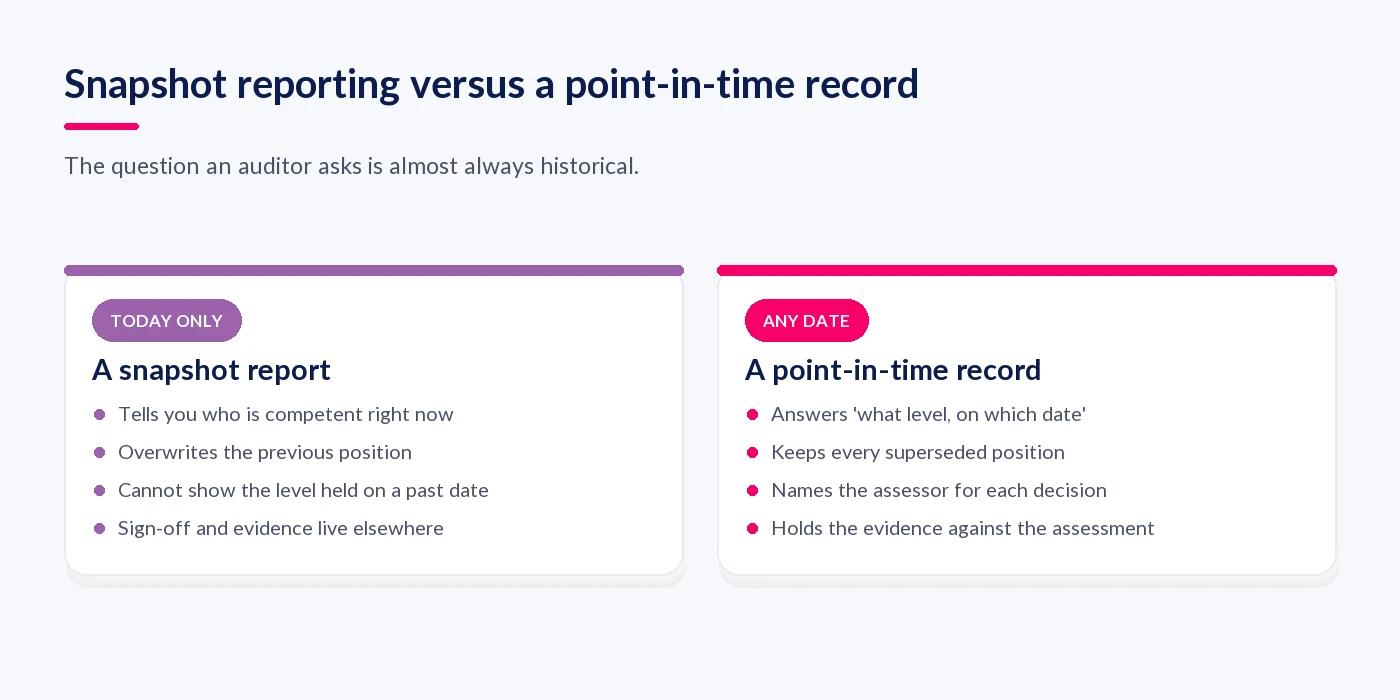
This is why a training matrix cannot be patched into compliance. A spreadsheet holds the current state; when a level changes, the previous one is typed over and gone. To answer a point-in-time question the record has to keep every superseded position, together with the assessor’s name, the scope in force and the evidence attached at the time. That is the same property the golden thread requires of building information, applied to people, and it is what makes evidencing competence for a Gateway submission possible months after the submission was made.
How do you run validation and revalidation at scale?
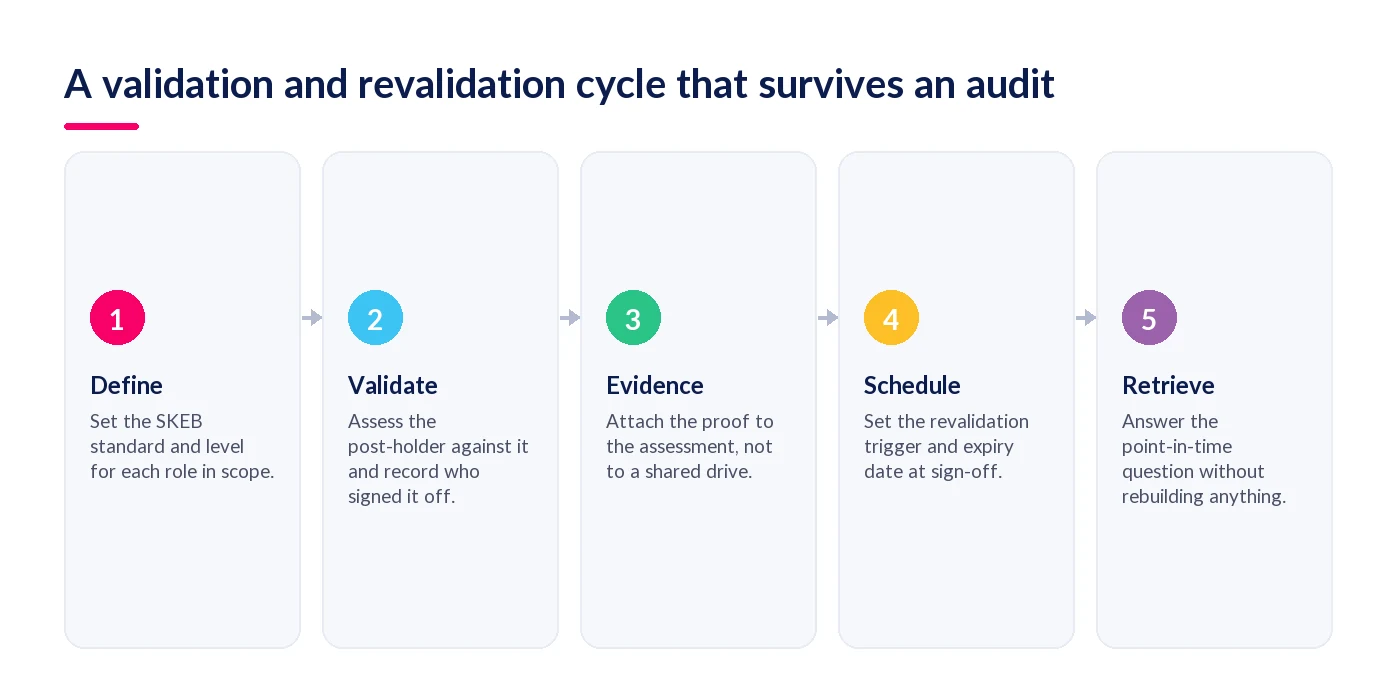
Scale is the point at which good intentions stop working, because a process that needs somebody to remember something will fail across three hundred people. Five steps, in this order. Getting steps one and two the wrong way round is the most expensive mistake available, because assessments made against an unwritten standard have to be redone.
- Write the standard before you assess anyone. One profile per function, expressed as skills, knowledge, experience and behaviours, at a stated level and with an explicit scope. Reuse the level ladder across roles rather than inventing a new scale per trade.
- Validate against it, with a named assessor. Record the level awarded, the scope, the assessor’s name and the date. An assessment signed by a department rather than a person is not evidence.
- Attach the evidence to the assessment. Qualifications, observed practice, project history and continuing professional development, linked to the assessment record itself so retrieval does not depend on knowing where somebody filed it.
- Set the revalidation trigger and expiry at sign-off. Decide the cycle and the event triggers in the same moment as the award, so the next re-check is scheduled before anyone has a chance to forget it exists.
- Prove you can retrieve a past position. Pick a person and a date at random and try to produce the level, scope, assessor and evidence as they stood. If that takes longer than an audit will wait, the process is not yet at scale.
Step five is a drill, not paperwork, and it is the only one that tells you the truth about the other four. Firms that automate the cycle report up to 90% less performance and compliance admin, and our customer outcomes page sets out what that figure measures and how it is calculated.
Who should sign off a validation review?
Somebody competent to judge the work, named individually, and senior enough in the relevant discipline that their judgement would stand up if challenged. In practice that means a technical assessor or subject-matter expert for the discipline, not the line manager by default and never the person being assessed.
There is a structural reason to be strict about this. Regulation 11E of the Building Regulations 2010 requires whoever makes an appointment to take all reasonable steps to satisfy themselves the appointee is competent, and regulation 8 of CDM 2015 imposes a comparable duty UK-wide. A sign-off from someone who could not themselves do the assessed work is not a reasonable step. Where nobody internally can judge a specialism, name the external assessor and record that too — the requirement is a name, not an employee. Our explainer on SKEB — skills, knowledge, experience and behaviours covers what that assessor is actually assessing against.
This article is general guidance, not legal or regulatory advice. Revalidation frequencies here are practice rather than statutory requirements, and what your duty-holder role demands depends on the building and the work. Verify the requirements for your own project before relying on them.
If you would rather the revalidation cycle ran itself, StaffCircle’s training compliance module schedules the re-checks, holds the evidence and keeps the dated record retrievable.
Frequently asked questions
How often is competence revalidation legally required?
No statutory frequency exists. The Building Regulations set a competence duty that applies at the time work is carried out, which effectively requires the position to be current rather than re-checked on a fixed date. Sector schemes and customer contracts often impose their own cycles, and those are usually the binding ones in practice.
Can a manager validate their own team's competence?
Only where the manager is genuinely competent to judge the work being assessed. A line manager signing off a technical specialism they have never practised is not a reasonable step towards satisfying themselves of competence. For specialist work, name a technical assessor or an external one and record who it was.
What triggers an out-of-cycle revalidation?
A change in the person, the work or the rules. In practice that means a role change or promotion, a new product or system entering scope, a revised standard or regulation, an incident or non-conformance, or a return after extended absence. Each should reopen the assessment rather than wait for the annual cycle.
What does a validation record need to contain?
The function assessed, the level awarded, the scope and its limits, the named assessor, the date, and the evidence relied on. Anything missing from that list weakens the record. Scope is the field most often omitted, and it is the one that says what the person must not do.
Does a spreadsheet ever work for competence records?
For a handful of people in one discipline, briefly. It breaks at the point somebody asks a historical question, because a spreadsheet overwrites the position it replaces and rarely records the assessor or the scope. Rebuilding a past position from email and memory is what turns a routine audit into a fortnight of work.
Related articles
See StaffCircle in action
Book a personalised demo and see how StaffCircle drives performance, engagement and development.