Becoming a Skills-Based Organisation: What Changes and What Does Not
Dana runs people for a 600-person facilities services business: cleaning, maintenance, security and a small team of gas engineers spread across forty client sites. The new three-year plan arrives with one line underlined in the board pack: "We will become a skills-based organisation." Nobody has said what that means on Monday morning. The operations director thinks it means dropping qualifications from adverts. Finance thinks it means a new system. The security contracts manager wants to know whether it means putting unlicensed officers on a door.
Dana's real question is narrower and more useful. Which of the things HR does today actually have to change, in what order, and which must stay exactly as they are?
A skills-based organisation uses verified skills, rather than job titles, degrees or years of service, as the main basis for hiring, moving people between roles and planning their development. Becoming one changes three people processes first: hiring criteria, internal mobility and development planning. It needs a shared skills framework and evidence that people actually hold the skills they claim. It does not remove legal licences or mandatory qualifications for regulated roles. Those stay as a floor beneath the skills.
This guide follows Dana through that question. Most writing on the subject is consultancy-led and stays at the level of operating models. Here the focus is on the processes, the data and the limits.
What "skills-based" means in practice
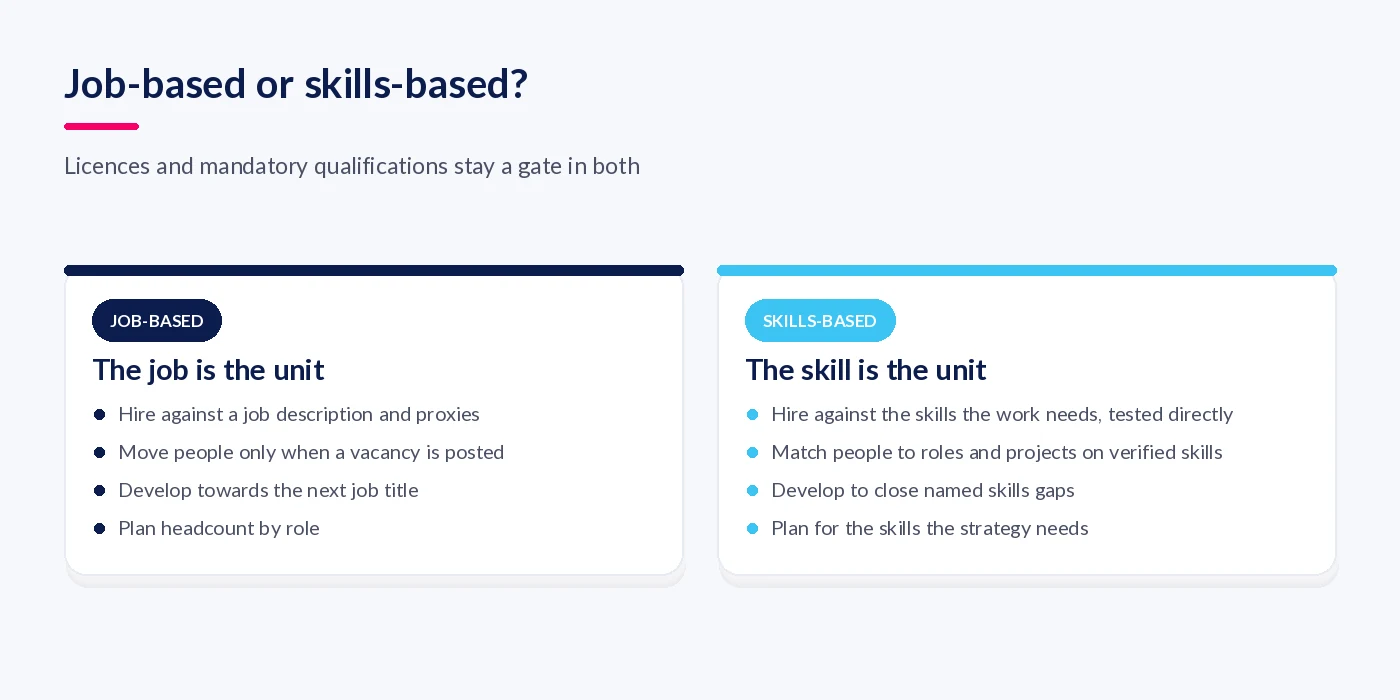
In a job-based organisation, the job is the unit of everything. People are hired against a job description, paid against a grade, developed towards the next job title and moved only when a vacancy is posted. In a skills-based organisation the unit is the skill. A role becomes a bundle of skills at stated levels, and a person becomes a profile of skills they can evidence.
That sounds abstract until you write down what your people systems would need to answer. A skills-based organisation can answer questions like these from its own data:
- Which skills, at what level, does each role actually need, as distinct from what the job title implies?
- Who already holds those skills, and how do we know: self-report, manager rating, observed assessment or certificate?
- Who could move into a role with a small, specific gap, rather than a full retraining?
- Which skills do we rely on a single person for?
- Where is the business heading, and which skills will that need that we do not have yet?
- Which roles carry a legal licence or qualification that no amount of skill can replace?
If your current answer to most of those is "we would have to ask the managers", you are job-based. That is not a criticism. It is simply where nearly every organisation starts. If the vocabulary is new, our guide to the difference between a skills framework and a competency framework is a useful primer, and a skills taxonomy explains how skills get named and grouped.
The announcement is the easy part
Here is the part the consultancy material tends to skip. Saying you are skills-based and hiring differently are not the same thing, and the gap between them is measurable.
In February 2024 the Burning Glass Institute and Harvard Business School's Project on Managing the Future of Work published Skills-Based Hiring: The Long Road from Pronouncements to Practice. It looked at large US employers that had publicly removed degree requirements from roles. The headline finding was that the promised increase in opportunity had borne out in "not even 1 in 700 hires" the previous year. Approximately 45% of firms appeared to make the change "in name only", and around one-fifth were "backsliders". Nearly all of the real change in hiring came from 37% of the firms studied. The authors' conclusion is the one Dana should pin above the desk: successful adoption "involves more than simply stripping language from job postings".
The firms that did follow through saw a benefit. In those firms, non-degreed workers had a retention rate 10 percentage points higher than their degree-holding colleagues.
Deloitte's 2022 report The skills-based organization, based on a survey of 1,021 workers and 225 business and HR executives, found that "fewer than one in five" organisations were adopting skills-based approaches to a significant extent. These are US and global figures, not UK ones, but the pattern is familiar to anyone who has watched a policy change on paper and not on the shop floor.
The reason is not hard to find. If you remove a degree requirement but keep the same interview questions, the same CV sift and the same hiring manager instincts, the degree comes back through the side door. Changing the advert changes nothing unless the evidence used to make the decision changes too. That is why the order below starts with data, not with adverts.
The order to make the changes in
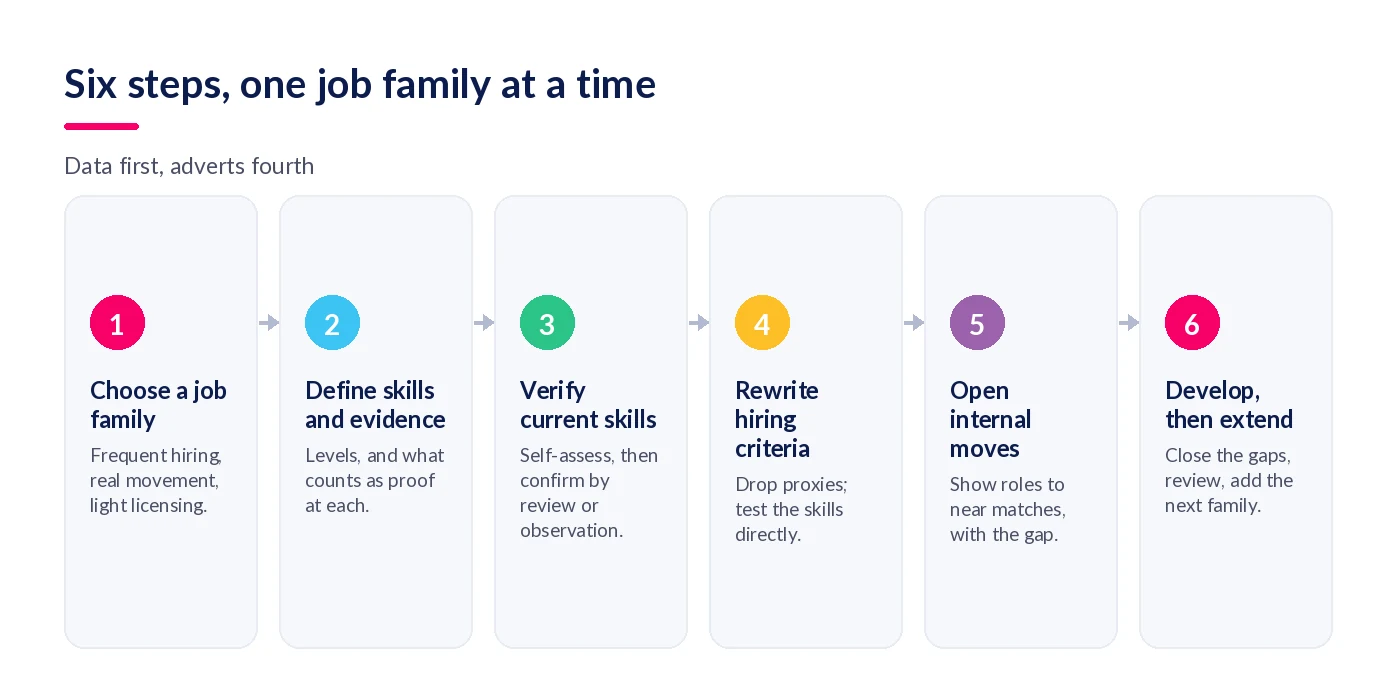
Dana's instinct is to launch everywhere at once. Resist it. A skills-based approach works when the skills data for one area is good enough to make decisions with, and that takes a few months to build. Start narrow and extend.
- Choose one job family to start with. Pick an area with frequent hiring, real internal movement and no heavy licensing burden. For Dana, that is building maintenance technicians rather than the security team.
- Define the skills and the evidence for each. Build a skills framework for that family with four to six proficiency levels, and decide for every skill what counts as proof at each level.
- Verify what people can do now. Start with self-assessment, then confirm through manager review, observed assessment or certificates, so the inventory reflects ability rather than confidence.
- Rewrite the hiring criteria. Replace proxies such as degrees and years of experience with the skills and levels the role needs, and change the interview and practical test to match.
- Open internal moves on skills. Show vacancies and projects to existing staff whose verified profile is close, and record the gap each would need to close.
- Point development at the gaps, then extend. Build development plans from the gaps the data shows, review what worked after a quarter and add the next job family.
Hiring criteria: what actually changes
The change is not "stop asking for qualifications". It is "ask only for what the job needs, and test for it directly". A maintenance technician advert that asked for a degree in building services and five years' experience becomes one that lists the skills (fault-finding on commercial heating controls, planned preventive maintenance, safe isolation) and describes how candidates will show them, usually with a short practical.
There is a legal reason to take this seriously in the UK, not just a fashionable one. Under section 19 of the Equality Act 2010, applying a "provision, criterion or practice" that puts people who share a protected characteristic "at a particular disadvantage" is indirect discrimination unless you can show it is "a proportionate means of achieving a legitimate aim". A blanket degree or length-of-service requirement is exactly that kind of criterion. A requirement tied to a skill the job demonstrably needs is far easier to justify. The same test applies to your new skills assessments, so keep them tied to the job.
Internal mobility: the quickest win
For most organisations the fastest return comes from inside. When skills are recorded and verified, a cleaner supervisor with strong scheduling and client-handling skills shows up as a near match for a helpdesk coordinator role she would never have seen advertised. Our guide to internal mobility covers the mechanics. The skills-based version simply means the match is made on evidence rather than on who happens to know whom.

Development: from courses to gaps
In a job-based model, development is often a catalogue of courses attached to the next grade. In a skills-based model it starts with a skills gap analysis: the distance between the verified profile and the role, or the next role, a person wants. Training is then chosen to close a named gap and checked afterwards to see whether it did.
What stays fixed: the regulated floor
This is where Dana's security contracts manager was right to worry, and where much skills-based writing goes quiet. For some roles, the law sets a gate that no skills profile can open.
Take Dana's gas engineers. Regulation 3 of the Gas Safety (Installation and Use) Regulations 1998 says that no person shall work on a gas fitting "unless he is competent to do so", and an employer may not let employees do that work unless the employer "is a member of a class of persons approved for the time being by the Health and Safety Executive". In practice that is Gas Safe registration. A brilliant heating technician without the right registration and qualifications still cannot do the work.
The security team is the same. Section 3 of the Private Security Industry Act 2001 makes it an offence "to engage in any licensable conduct except under and in accordance with a licence", and section 5 makes it an offence to supply security services through someone who is not the holder of a licence. A skills-based internal move into a door supervisor role starts with the licence, not the skills match.
Financial services has its own version in the Senior Managers and Certification Regime, covered in our guide to FCA fitness and propriety. Health and social care, education and legal services all have registers of their own.
And for everyone, regulation 13(1) of the Management of Health and Safety at Work Regulations 1999 requires employers, when entrusting tasks to employees, to "take into account their capabilities as regards health and safety". A skills-based approach that redeploys people more freely has to keep that check in the loop.
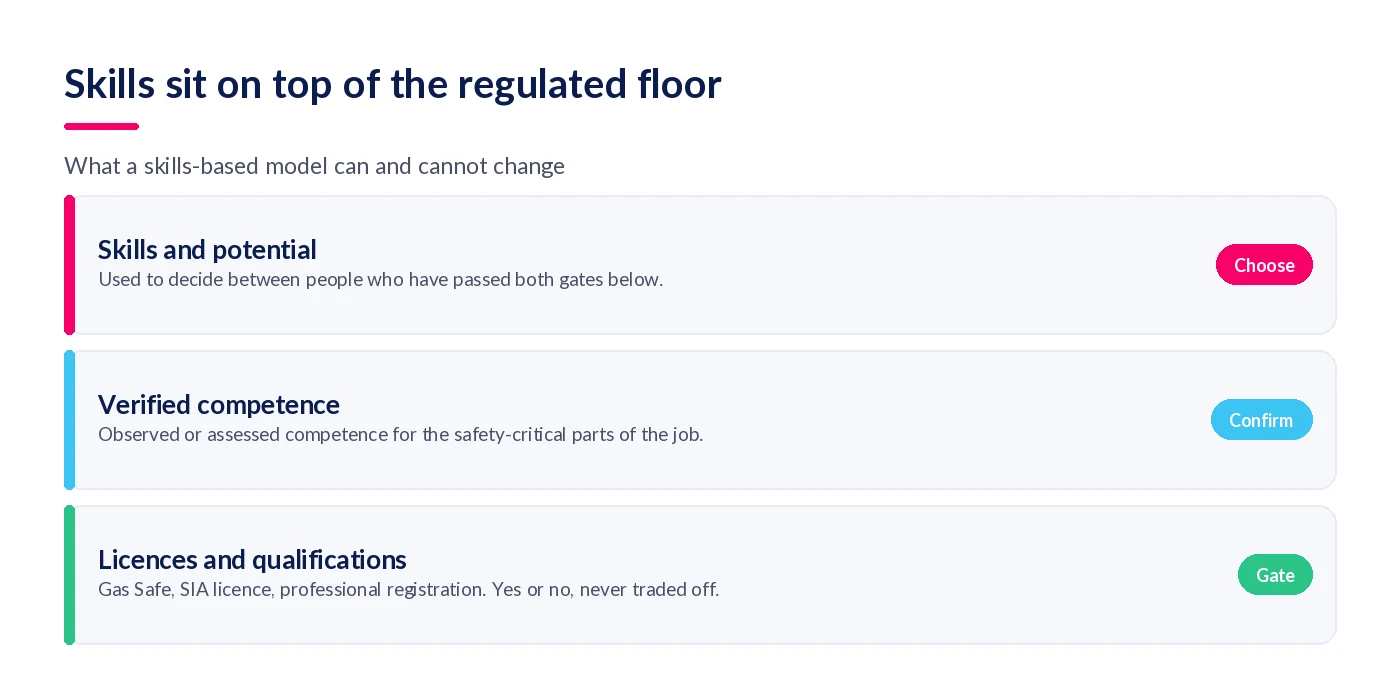
The practical model is three layers. The legal floor is a yes-or-no gate. Above it sits verified competence for the safety-critical parts of the job. Skills and potential are used to make choices only among people who have passed both.
Where skills-based programmes stall
The skills inventory is self-reported and never checked
Ask staff to tag their own skills and you get a list of what people feel confident about, not what they can do. It is a reasonable starting point and a poor basis for a hiring or redeployment decision. Our guide to competency assessment methods covers the range, from manager ratings to observed assessment. Use the stronger methods where a decision carries risk.

The taxonomy is too big to maintain
Some programmes import a library of thousands of skills and then cannot keep it current. Start with the skills that change a decision for the job family you chose, often 15 to 30, and grow from there.
The advert changed and the interview did not
This is the Burning Glass finding in miniature. If the hiring manager still sifts CVs for the old proxies, nothing has moved. Change the scoring guide and the practical test at the same time as the advert.
Pay and grading were promised too early
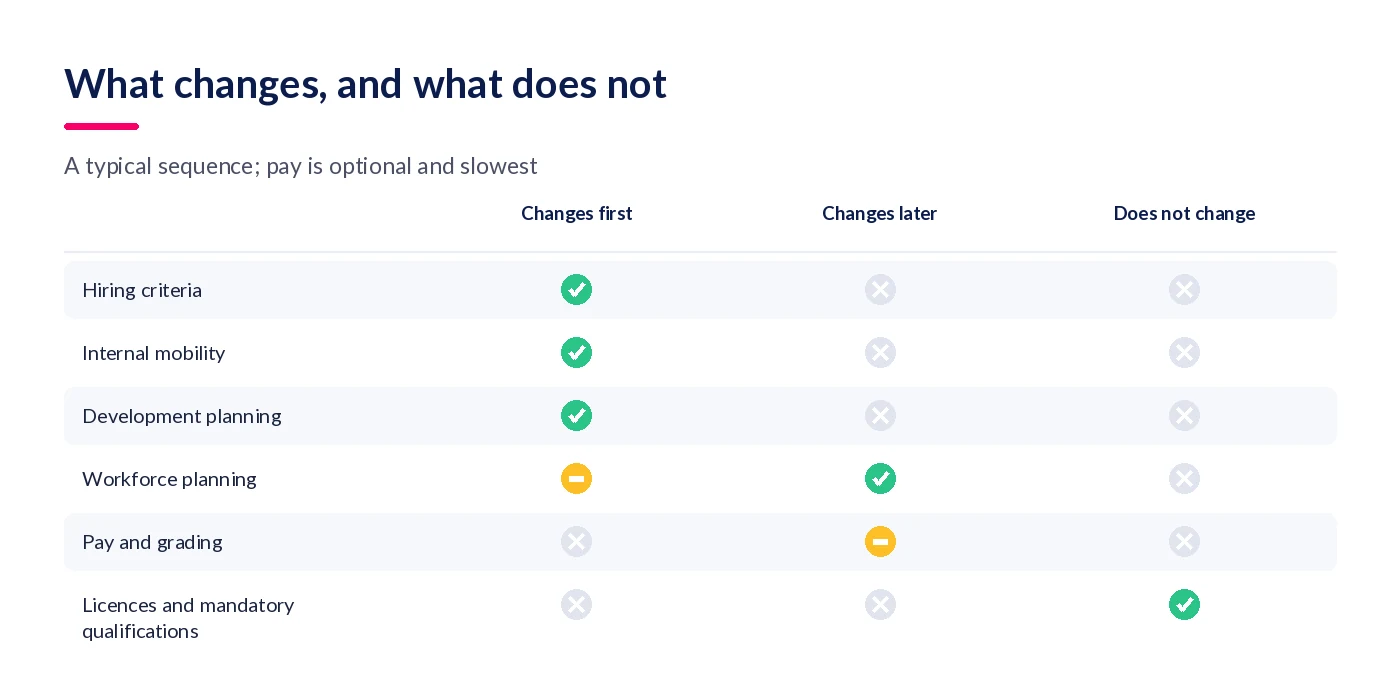
Skills-based pay is the hardest change and the one with most risk of unequal outcomes. Most organisations leave grading on jobs for some time and use skills for hiring, mobility and development first. That is a perfectly sound place to stop for a while.
Dana's first 90 days
Here is how the plan looks for the maintenance technician family, about 80 people across the sites.
| Weeks | Work | Output | Owner |
|---|---|---|---|
| 1–3 | Agree the 20 or so skills that matter for the family, with levels and the evidence for each | Skills framework v1 | HR with two senior technicians |
| 4–6 | Self-assessment for all 80, then manager review; observed checks for safe isolation and controls work | Verified skills inventory | Site managers |
| 7–8 | Rewrite the advert, scoring guide and practical test; remove proxies the job does not need | New hiring pack | HR and hiring managers |
| 9–10 | Show open roles and projects to near-match staff across all sites | Internal shortlist with gap per person | HR |
| 11–13 | Development plans aimed at the top three gaps; review and choose the next family | Plans in place; go or no-go for extension | Line managers and HR |
Gas and security roles join later, with the licence or registration recorded as a mandatory gate before any skills match is run. The matrix below is the summary Dana takes back to the board.
Where StaffCircle fits
The hard part of becoming skills-based is the data: a shared framework, verified evidence and a view of the gaps that people trust. That is the part StaffCircle is built for.
A framework for each job family, quickly
StaffCircle's AI competency frameworks generate role profiles enriched with skills and progression paths, which you then edit to fit your business. That shortens steps one and two without handing the judgement to the software.
Skills you can see, and gaps you can act on
A real-time skills-gap view shows coverage by team and highlights priority gaps, so internal moves and development choices are made on the same data. See employee development software for how it works.
Training records tied to skills
The Unified Training Database keeps every course, internal or external, linked to skills and development plans, so certificates and refresher dates for regulated roles sit next to the skills they underpin.
Succession on the same evidence
Readiness for key roles is tracked against the same skills profile, so succession decisions and day-to-day mobility use one source of truth.
The short version
Becoming a skills-based organisation is less a transformation than a change of evidence. Hiring, internal moves and development start using verified skills instead of titles and proxies. Licences, registrations and safety competence stay exactly where the law puts them. Start with one job family, get the data right and let the results make the case for the next one. If you want to see how that looks in practice, book a demo.
FAQ
What is a skills-based organisation?
A skills-based organisation uses verified skills, rather than job titles, degrees or years of service, as the main basis for hiring, moving people between roles and planning development. Roles are described as bundles of skills at stated levels, and people as profiles of skills they can evidence.
What is the difference between a job-based and a skills-based organisation?
In a job-based organisation the job is the unit: people are hired, paid, developed and moved against job titles and grades. In a skills-based organisation the skill is the unit, so decisions are made by matching the skills a piece of work needs with the verified skills people hold.
Is becoming skills-based just removing degree requirements?
No. Removing degree requirements from adverts on its own changes very little. Research by the Burning Glass Institute and Harvard Business School found the promised opportunity had borne out in not even 1 in 700 hires, because interviews and sifting often stayed the same. The evidence used to make decisions has to change too.
Which people processes change first?
Hiring criteria, internal mobility and development planning usually change first, because each can use verified skills data straight away. Workforce planning follows. Pay and grading are normally left on jobs for longer, because they are the hardest and riskiest to change.
What data do you need to become a skills-based organisation?
You need a shared skills framework that names the skills and levels each role needs, and evidence that people actually hold them. Self-assessment is a starting point; manager review, observed assessment and certificates turn claimed skills into verified ones.
Can a skills-based organisation ignore qualifications?
Not for regulated roles. Gas work requires an employer in a class approved by the HSE under the Gas Safety (Installation and Use) Regulations 1998, and licensable security work requires an SIA licence under the Private Security Industry Act 2001. Those stay as a mandatory gate; skills are used to choose between people who meet it.
Does skills-based hiring help with equality?
It can. Under section 19 of the Equality Act 2010, a criterion that puts a group sharing a protected characteristic at a particular disadvantage is indirect discrimination unless it is a proportionate means of achieving a legitimate aim. Criteria tied to skills the job needs are easier to justify than blanket degree or service requirements. New skills tests must meet the same standard.
How long does it take to become a skills-based organisation?
There is no fixed timescale. A single job family can usually be framed, assessed and moved onto skills-based hiring and mobility in around a quarter. Extending that across a whole organisation is a multi-year programme, done one area at a time.
How many skills should a skills framework include?
Start small. For a single job family, 15 to 30 skills that genuinely change a decision is usually enough. Large imported skills libraries are hard to keep current and tend to go stale.
Should pay be based on skills?
Skills-based pay is possible but is the hardest change to make well and carries the most risk of unequal outcomes. Most organisations keep grading on jobs while they move hiring, mobility and development onto skills, and only revisit pay once the skills data is trusted.
What software do you need for a skills-based organisation?
You need somewhere to hold the skills framework, record verified skills, see gaps by team and link training to skills. Employee development software such as StaffCircle combines competency frameworks, skills-gap analysis, development plans and training records in one place.
Related articles


See StaffCircle in action
Book a personalised demo and see how StaffCircle drives performance, engagement and development.