How Much Do Employee Engagement Surveys Cost?
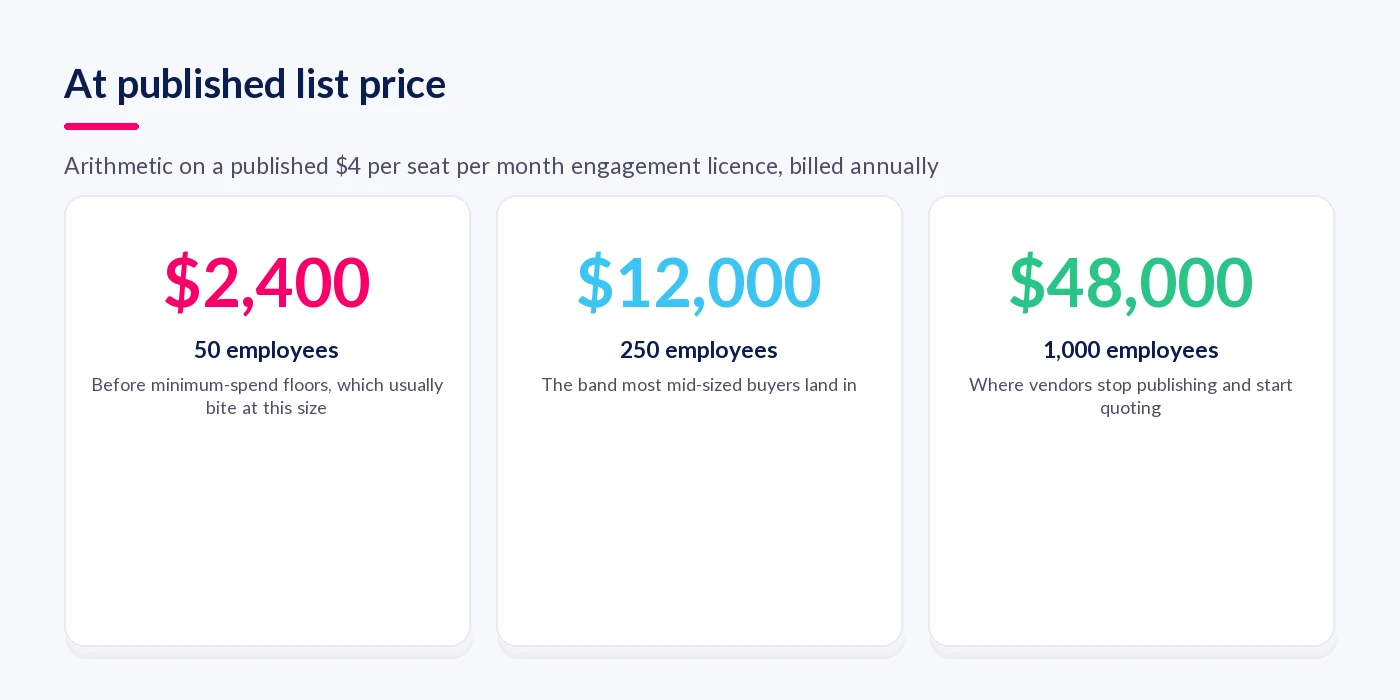
The published list price for a dedicated employee engagement survey module is around $4 per employee per month billed annually, which works out at roughly $2,400 a year for 50 employees, $12,000 for 250 and $48,000 for 1,000. Minimum-spend floors raise the small-company figure, and most enterprise vendors publish nothing.
Key facts
- Lattice and 15Five both publish engagement modules at $4 per seat monthly.
- Lattice publishes a $4,000 minimum annual agreement, which binds below roughly 83 seats.
- Workleap charges a flat platform fee: $4,999 or $11,999 per year.
- Culture Amp publishes no price and directs buyers to request a quote.
- Your own team's time usually costs more than the licence does.
What do engagement survey platforms actually charge?
Three vendors publish a real list price, and the table below turns those published prices into annual totals for 50, 250 and 1,000 employees. Two pricing models are in play: per seat per month, and a flat platform fee. Which one is cheaper flips depending on your headcount, which is why the same vendor can look expensive at 50 people and cheap at 1,000.
| Vendor and tier | Published list price | 50 employees | 250 employees | 1,000 employees |
|---|---|---|---|---|
| Lattice, Engagement module | $4 per seat per month, billed annually, with a $4,000 minimum annual agreement | $4,000 — the minimum, not the seat maths | $12,000 | $48,000 |
| 15Five, Engage plan | $4 per user per month, billed annually | $2,400 | $12,000 | $48,000 |
| Workleap, Standard and Pro | Flat platform fee: $4,999 or $11,999 per year | $4,999 | $11,999 | Enterprise tier, price not published |
| Culture Amp | No list price published. The pricing page states cost depends on employee numbers, product and service tier, and directs buyers to request a quote | Quote only | Quote only | Quote only |
Where these bands come from. Every figure above is either a price the vendor publishes on its own pricing page, or simple arithmetic on that published price — headcount multiplied by the per-seat rate multiplied by twelve. Nothing here is a survey of what buyers actually paid, an analyst estimate or a discounted deal price. All four vendors publish in US dollars, so a UK buyer should expect a sterling quote whose figure depends on the day's rate and the vendor's UK price list. We have not converted the bands, because a converted number would look more precise than it is.
Two things the table shows that vendor pages do not. First, minimum spend matters far more than headline rate at small sizes: at 50 employees, Lattice's $4,000 floor works out at an effective $6.67 per seat per month rather than $4, because $4,000 divided by 600 seat-months is $6.67. Second, a flat platform fee is a bad deal at 50 employees and a good one at 250 — Workleap's Pro tier costs $11,999 whether you have 100 people or 250.
What drives the cost of an employee engagement survey?
Five lines drive the total, and only the first is reliably on a price page. The licence model sets the floor, survey frequency usually costs nothing extra in a software model but plenty in a consultancy one, and analysis, benchmarking and implementation are almost always quoted rather than published. Your own team's time is the largest line and appears nowhere.
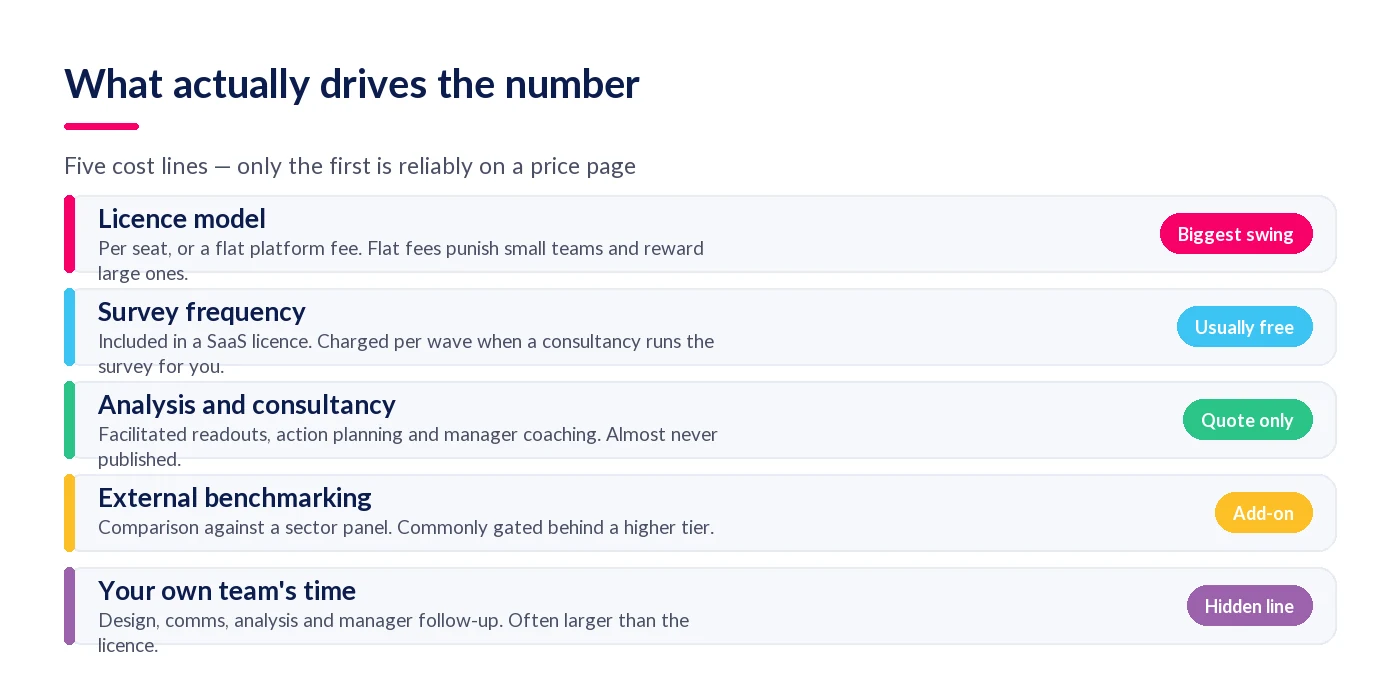
| Cost line | How it is usually charged | What moves it | Is a price published? |
|---|---|---|---|
| Platform licence | Per seat per month, or a flat annual platform fee | Headcount, which modules you take, contract length | Sometimes — Lattice, 15Five and Workleap do |
| Minimum annual spend | A floor under the annual contract value | Nothing you control; it simply binds below a certain headcount | Occasionally — Lattice publishes a $4,000 floor |
| Survey frequency | Included in a software licence; charged per wave when a consultancy runs it | Number of waves a year, and whether a partner fields them for you | No for consultancy-run surveys |
| Analysis and consultancy | Day rate or a fixed-scope engagement | Facilitated readouts, action planning workshops, manager coaching | No — quote only, and rarely even a range |
| External benchmarking | Add-on, or bundled into a higher tier | Access to a sector or country comparison panel | Rarely |
| Implementation and onboarding | One-off fee, sometimes waived on multi-year terms | HRIS integration, data load, single sign-on, org-structure mapping | No — quote only |
| Your own team's time | Internal cost, invisible on any invoice | Headcount, survey frequency, size of the manager population | Not applicable — you have to calculate it |
The honest gap in this list is analysis and consultancy. Nobody in the UK market publishes a day rate for engagement survey consultancy, action-planning facilitation or manager coaching, and we are not going to invent a band for it. If a partner-run survey is on your shortlist, ask for the day rate and the number of days in writing before you compare it with a software licence — the two are not the same purchase.
What is the total cost of ownership, including your own team's time?
For a 250-person organisation running a quarterly pulse, the licence is the smallest number in the calculation. Below is the whole cost, worked through: a published licence price, plus the employee, HR and manager time the cycle consumes. The time figures are arithmetic on stated assumptions, clearly marked, rather than market data.
- Licence, at published list price: 250 employees × $4 × 12 months = $12,000 a year.
- Employee time answering: 4 waves × 250 people × 10 minutes = 10,000 minutes = 166.7 hours, which at a 7.5-hour day is 22.2 working days.
- HR and project time (assumption): 3 days designing and communicating, plus 9 days analysing and reporting across four waves = 12 working days.
- Manager follow-up (assumption): 25 managers × 1 hour per wave × 4 waves = 100 hours = 13.3 working days.
- Total internal time: 22.2 + 12 + 13.3 = 47.5 working days a year.
Multiply those 47.5 days by your own blended day rate to finish the sum. We are deliberately not publishing a rate: there is no credible market figure for a blended UK HR-and-manager day rate that would apply to your organisation, and putting one here would make the total look authoritative when it is a guess. Use your own payroll data — the number you get will almost certainly exceed the $12,000 licence.
That is the real decision. The licence is not the expensive part; the follow-through is. If you want to put a value on the other side of the ledger — manager time saved, productivity, retention — our ROI calculator works through it on your own headcount and salary figures rather than ours.
Why do most engagement survey vendors not publish a price?
Because engagement platforms are usually sold as modules of a wider HR suite, and the price depends on which modules you take, how many people you have and what level of service you buy. Culture Amp's pricing page says exactly that, and directs buyers to request a quote. It also, less charitably, keeps price out of the comparison until a salesperson is in the room.
The practical effect on your buying process is worth planning around:
- You cannot shortlist on price. Expect to run a discovery call with every quote-only vendor before you can compare anything, which adds weeks.
- List price is a ceiling, not a price. Where a list price exists, multi-year and multi-module commitments are commonly negotiated below it. Ask.
- Ask what happens at renewal. A discount on year one with an uncapped increase at year two is a common shape. Get the cap in the contract.
- Ask what is excluded. Benchmarking, extra languages, HRIS integration and facilitated readouts are all common exclusions from a headline seat price.
How should you budget for an engagement survey?
Budget the licence at published list price, add the same amount again for internal time in your first year, and hold something back for the action rather than the measurement. A useful planning rule: if the whole budget goes on asking the question, you have bought a report, not an improvement — and an unactioned survey lowers engagement rather than raising it.
Before you buy anything, decide three things: the decision the survey has to inform, how often you can genuinely act between cycles, and who owns the follow-up. Those answers change the specification more than any feature comparison will. How to design an employee engagement survey covers the first, and how to measure employee engagement covers what you should be able to calculate from whatever you buy.
One line item worth checking on any quote in 2026 is AI. Several vendors charge per user for AI features on top of the seat price, which turns a predictable licence into a variable one. StaffCircle has no per-user AI licensing, so AI analysis of survey comments and sentiment does not add a per-head charge as usage grows.
If you want engagement measurement, recognition and communication in one licence rather than three, take a look at StaffCircle's employee engagement software — and if you are still defining the term for a business case, start with what employee engagement is.
Frequently asked questions
How much does an employee engagement survey cost per employee?
Where vendors publish a price, a dedicated engagement module costs around $4 per employee per month billed annually — about $48 per employee a year. Minimum annual spends push the effective per-employee cost higher for organisations under roughly 100 people, and flat platform fees make per-employee cost fall as headcount rises.
Are free employee engagement survey tools worth using?
A general-purpose free survey tool will collect answers, but it usually cannot guarantee team-level anonymity thresholds, hold a trend history, benchmark you against anything, or push results to the managers who need them. For a one-off diagnostic it is fine. For a quarterly cycle you will outgrow it fast.
Is an annual census or a quarterly pulse more expensive?
In a software licence, neither: frequency is normally included, so a quarterly pulse costs the same as one annual census. In a consultancy-run model the survey is usually priced per wave, which makes frequency the single biggest cost driver. Your internal time rises with frequency either way.
What should a 250-employee organisation budget for engagement surveys?
Around $12,000 a year at published list prices for a per-seat engagement licence, or $11,999 for a flat-fee platform at that size. Then budget roughly the same again for internal time in year one, plus whatever the resulting actions cost. Consultancy support sits outside all of that and is quote-only.
Why is engagement software pricing so hard to find?
Because most engagement tools are modules of a broader HR suite, priced by headcount, module mix and service level, and sold through a discovery call. Culture Amp states this on its pricing page. Lattice, 15Five and Workleap are the notable exceptions that publish real list prices you can compare.
Related articles
See StaffCircle in action
Book a personalised demo and see how StaffCircle drives performance, engagement and development.