How to Build a 90-Day Employee Retention Program from Scratch
“Up to 20 percent of turnover takes place in the first 45 days,” said Michelle Smith, VP of Marketing at O.C. Tanner.
When a new hire signs an employment contract, the human resources team breathes a sigh of relief. The budget has been approved, the recruiters have delivered, and the vacant seat is finally filled.
But across the business landscape, an uncomfortable reality sets in immediately after day one. When an individual leaves an organisation during this initial three-month window, it represents a significant financial hit. According to SHRM.org, replacing a standard entry-to-mid-level employee typically costs between six and nine months of that employee’s salary. However, as responsibilities scale, those numbers quickly climb.
A generic welcome pack and a quick office tour are no longer enough to protect your investment. To keep your best talent, you must stop treating onboarding as an administrative task and turn it into an automated, data-driven, 90-day retention program.
A 90-day employee retention programme is a structured onboarding strategy that helps organisations retain new hires during their first three months of employment. It focuses on providing clear expectations, regular feedback, manager support, measurable goals, and career development while using employee data to identify and address retention risks before they lead to turnover.
Key Stats About Employee Retention and Onboarding In 2026
- Only 12% of employees strongly agree their organisation does a great job onboarding new employees, highlighting an 88% onboarding failure rate. (Gallup)
- Employees are 3.4 times more likely to say their onboarding was exceptional when managers take an active role. (Gallup)
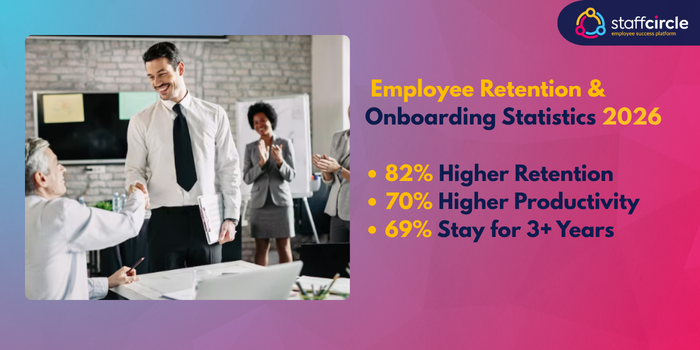
- A strong onboarding programme improves new hire retention by 82% and productivity by more than 70%. (Harvard Business Review)
- 69% of employees are more likely to stay with an organisation for three years after a positive onboarding experience. (SHRM.org)
- New hires are around 50% more productive when organisations use a standardised onboarding process. (SHRM.org)
- Using a dedicated HR management and employee engagement platform can help you reduce the employee turnover rate by 57% and increase employee engagement by 74%. (StaffCircle)
Why 90 Days Is the Critical Window for New Hires
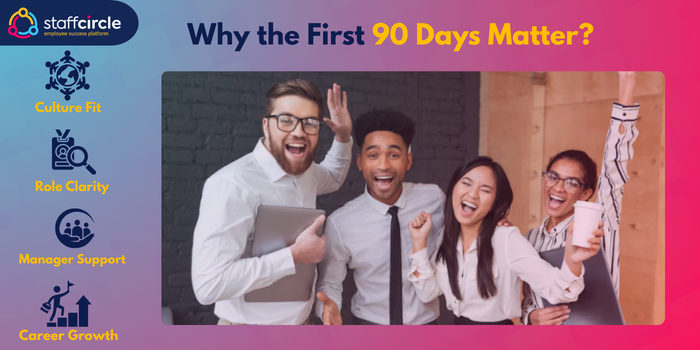
The first 90 days of an employee’s tenure represent a vulnerable psychological phase. During this period, new hires are actively validating their decision to join your business. They are constantly looking for alignment between what they were promised during the interview process and the day-to-day reality of the workplace.
Three primary triggers typically drive early departures:
- Culture Shock: If an employee came from a work culture with different policies than yours. They’ll start comparing and can feel isolated, especially in a hybrid setup, or discover a toxic team dynamic.
- Lack of Role Clarity: Most of the time, the role description doesn’t match reality. Also, hired employees can’t simply understand what success looks like or how their performance will be measured.
- Tool and System Friction: Employees have to spend weeks struggling to get basic software logins, hardware, or access to the resources needed to do the job.
By systemising your approach over these critical 90 days, you can address these roadblocks before they turn into a resignation letter. And StaffCircle will help you with that. It is an HR management platform designed to reduce admin and engagement headaches for HR leaders and managers because we believe that great engagement leads to great retention.
Key Takeaway: Employees are most likely to leave because of unclear expectations, poor onboarding, and limited manager support. Addressing these issues during the first 90 days significantly improves retention.
Week-by-Week: Your 90-Day Retention Roadmap
52% of organisations say their onboarding programme lasts between one and three months. However, for ideal tracking, we suggest structuring this time around a 30-60-90-day plan with manageable, structured operational phases.
1. Weeks 1 to 2: Acclimatisation & Connection
When employees join the company, they are already dealing with transition fatigue, uncertainty, and anxiety. They have left behind familiar routines, colleagues, and processes, so they need to feel genuinely welcomed from day 1. For that, you need a structured onboarding system first.
- Ensure all hardware, software, email accounts, communication tools, and system permissions are fully configured before or on the first day so employees can begin working without unnecessary delays.
- Assign a dedicated workplace buddy who can answer everyday questions, explain team norms, and help the new hire navigate company processes. According to Microsoft, 56% of employees say meeting with an onboarding buddy helped them become productive faster.
- Schedule informal introductions with teammates, cross-functional colleagues, and key stakeholders to build relationships early and reduce feelings of isolation, particularly for remote and hybrid employees.
- Provide a clear onboarding roadmap outlining what the employee should expect during their first 30, 60, and 90 days. Clarify role expectations, success metrics, communication channels, and reporting structures.
- Introduce the company’s mission, values, products, customers, and long-term goals so new hires understand not only what they do, but why their work matters.
- Also, encourage participation in team meetings and social activities.
Companies using the StaffCircle platform usually announce and celebrate the joining via a public post, encouraging other employees to welcome the new hire.
2. Weeks 3 to 4: Role Clarity & Target Setting
As employees become more comfortable within the organisation, they need clear direction on their roles, objectives, performance tracking, and expected results.
Introduce the employee’s initial Objectives and Key Results (OKRs). Instead of assigning a long list of tasks, define a few measurable objectives that can realistically be achieved during the first month.
Map out what success looks like for the first month and show how their day-to-day tasks feed directly into the company’s broader goals.
In StaffCircle, employees and employers can assess performance through Success Circles™. This will allow them to take an overview of their current skills, which are updated in real time, tracking employee performance. And if there’s a skill gap, they can take the learning courses from platforms like Udemy or LinkedIn Learning to improve over time.
Managers should review Success Circles™ of new hires after 30 days and conduct regular one-on-one check-ins during this period to answer questions, identify challenges, and offer encouragement before small issues become bigger concerns. Research shows 72% of new hires say one-to-one interaction with their direct manager is the most important part of onboarding.
3. Weeks 5 to 8: The Feedback Loop
By weeks five to eight, employees should have settled into their daily responsibilities. The focus now shifts to calibration by reinforcing good habits, identifying improvement areas, and ensuring they continue progressing in the right direction.
Establish a consistent schedule of weekly or bi-weekly one-on-one meetings between the employee and their manager. Use these meetings to discuss progress against initial goals and OKRs, remove operational blockers, answer questions, and provide practical coaching. Such meetings can be reduced if you are using StaffCircle. In other words, it crafts automated employee onboarding feedback templates for HR.
Encourage two-way feedback during every check-in. Managers should provide timely, specific, and constructive feedback, while employees should be invited to share their onboarding experience, workload concerns, training gaps, and suggestions for improvement.
Managers should also monitor employee well-being during this period. Signs of disengagement, confusion, or burnout are often easier to identify through regular conversations than through productivity metrics alone. Ensuring workloads remain manageable and providing ongoing support can significantly improve long-term retention.
4. Weeks 9 to 12: Autonomy & Progression
Transition the employee from highly managed onboarding tasks to independent projects.
Conduct a formal 90-day review to evaluate progress against the goals established during the first month. Discuss achievements, strengths, areas for improvement, and any support the employee still needs.
Begin discussing long-term career development by introducing competency frameworks, learning pathways, leadership opportunities, and potential career progression within the organisation.
Work together to create an individual development plan (IDP) that outlines future skills to develop, recommended training programmes, certifications, mentoring opportunities, and stretch assignments aligned with the employee’s career aspirations and business needs.
By the end of the first 90 days, employees should feel confident working independently.
Key Notes: According to Click Boarding, new employees for senior roles may take up to 6 to 12 months to reach full productivity. However, the productivity of entry-level and mid-level roles can be tracked within 3 to 6 months.
How to Measure Retention Rate & Risk in the First 90 Days
You cannot manage what you do not measure. Instead of waiting for a 90-day probation review to ask how a new hire is doing, use proactive data collection to spot flight risks early.
Modern people platforms allow HR teams to monitor these key metrics:
1. Automated Pulse & Sentiment Analytics
Instead of waiting three months to ask a new hire how they are settling in, deploy automated micro-surveys at key intervals, such as day 30 and day 60.
Combine these answers with standard Employee Net Promoter Scores (eNPS) on a centralised dashboard. If an individual’s sentiment scores drop below your team baseline, the platform triggers an alert for an early check-in.
2. OKR Progression & Goal Velocity
Monitor how quickly a new starter makes updates or logs initial progress against their month-one and month-two Objectives and Key Results (OKRs).
If an employee’s goal progression remains at zero as day 45 approaches, it rarely indicates a lack of motivation. Instead, it serves as a leading indicator pointing to a breakdown in training, unclear expectations, or a lack of proper equipment.
3. 1-on-1 Consistency and Continuity Rates
Monitor the software logs to see if managers are actively holding or repeatedly postponing scheduled check-ins with new team members. When a manager cancels or pushes back more than two consecutive 1-on-1 sessions during an employee’s first 90 days, the risk of early voluntary departure increases substantially due to perceived isolation.
4. Asynchronous Recognition Interaction:
Track whether a new starter has received or sent their first digital peer reward or values badge on the company newsfeed by day 30. A total lack of recognition activity often signals that an individual is struggling to integrate socially into a hybrid or multi-site team culture.
Retention Programme Templates and Checklists
To make this framework highly actionable, we have created a custom-made and effective guide to improve employee retention. Download it here.
Here’s the basic checklist you can follow:
1. The Manager’s Day One Essentials
- Hardware configured, updated, and delivered on-site or to the home office.
- Active logins for communication tools, HR software, and project management apps.
- Welcome email sent detailing the week-one schedule and introducing the team buddy.
- First 1-on-1 meeting blocked out in the manager’s calendar.
2. The Month One Alignment Tracker
- 30-day SMART goals or initial OKRs formally documented in your performance platform.
- Completed week-two and week-four feedback check-ins.
- First informal peer-to-peer recognition or values badge logged on the social feed.
3. The Month Three Milestone Review
- Competency framework and long-term career path shared with the employee.
- Formal 90-day probation evaluation completed with multi-source 360 feedback.
- Next quarter’s OKRs aligned and assigned.
How StaffCircle Automates 90-Day Retention Workflows
Manual administration kills even the best-laid retention programs. When human resources teams are forced to spend their weeks chasing managers for paperwork, tracking milestone dates on scattered spreadsheets, or manually compiling survey results, critical signs of new-hire disengagement slip through the cracks.
StaffCircle is the best software for tracking new hire milestone objectives. It converts your 90-day retention roadmap from a manual checklist into an automated, predictable, and measurable workflow engine. By unifying performance metrics, continuous feedback, and culture analytics under a single login, the platform systematically reduces the administrative burden on HR by up to 90% while actively protecting your talent investment.
1. Automated Milestone Triggers
You no longer have to manually monitor your calendar to see who is reaching their 30, 60, or 90-day milestones.
StaffCircle uses automated workflows tied directly to an employee’s start date. The moment a new hire crosses a calendar threshold, the platform instantly triggers and delivers the corresponding review form, self-assessment prompt, or feedback loop.
Reminders are pushed contextually through the communications channels your team lives in daily (such as Microsoft Teams, Google Workspace, or Slack), helping companies achieve review completion rates of up to 96% on time.
2. Real-Time Flight Risk Alerts
Waiting for a standard end-of-probation meeting means finding out an employee is unhappy only after they have decided to hand in their notice. StaffCircle functions as an early-warning radar:
The platform automatically layers regular pulse survey metrics, eNPS data, and OKR progress velocities together on custom dashboards.
If an employee’s survey scores dip or their goal progress stalls during the initial three months, the system automatically flags that worker’s profile, alerting HR and leadership to deploy a supportive intervention before the employee checks out.
3. Microsoft Teams & Google Workspace Integrations
Switching between multiple software programs breeds tool fatigue. StaffCircle builds its retention touchpoints directly into your existing infrastructure.
Employees can update their key goals, respond to pulse check-ins, or acknowledge peer rewards directly within Microsoft Teams or Google Workspace without opening a separate browser tab.
To ensure critical performance and well-being conversations are never lost, StaffCircle’s native AI Notetaker securely records and transcribes video or audio check-ins. It automatically summarises the discussion, highlights action points, and attaches agreed developmental milestones right onto the user’s dashboard profile.
4. Mobile Parity for Frontline and Remote Workers
Traditional desktop systems routinely fail non-desk, frontline, or field staff, leading to high initial turnover rates in those operational roles. StaffCircle solves this disconnect through its progressive web app layout.
Frontline, retail, or field workers enjoy complete feature parity from any standard mobile web browser. They can access company announcements, log their personal objectives, complete onboarding check-ins, and send values-based badges without needing a corporate email address or a static office workspace.
5. Unified Data for C-Suite Strategy
When it comes to proving the return on investment of your retention program to the executive board, scattered spreadsheets are ineffective. StaffCircle centralises all onboarding sentiment, performance metrics, and cultural data points into a single source of truth.
Through its Microsoft-certified Power BI Connector, StaffCircle allows HR teams to build automated executive reports. This lets your C-suite view exact workforce trends, evaluate manager consistency, and plan future growth based on reliable talent analytics, contributing to a 57% lower employee turnover rate compared to industry averages.
The Bottom Line
Retaining employees begins long before the annual performance review. The first 90 days determine whether a new hire develops confidence, builds meaningful relationships, and sees a future within your organisation or starts looking for opportunities elsewhere.
A successful retention programme is built on consistency rather than guesswork. By providing structured onboarding, setting clear goals, collecting continuous feedback, recognising achievements, and supporting career development, organisations can identify potential issues before they become resignations. Small interventions made during the first few weeks often have a greater impact than major initiatives introduced months later.
Managing these activities manually, however, quickly becomes difficult as your workforce grows. StaffCircle brings every stage of the 90-day employee journey into one integrated platform.
If your organisation wants to reduce early turnover, improve employee engagement, and build a more resilient workforce, investing in a structured 90-day retention programme supported by the right technology is one of the highest-impact decisions you can make.
Frequently Asked Questions (FAQs)
What is a good employee retention rate?
Across mid-market businesses, an overall annual employee retention rate between 85% and 90% is considered healthy. If your first-90-day retention rate drops below 90%, it points to critical gaps in your onboarding, recruitment, or early management processes.
How do you calculate new hire retention rate?
Use this simple calculation to track your early onboarding success:
New Hire Retention Rate = {Number of New Hires who reached Day 90 \ Total Number of New Hires onboarded during that period} x 100
How do you reduce early turnover in hybrid teams?
Focus on intentional cultural connection and communication. Standardise your digital check-ins, ensure tool access is seamless on day one, use peer-to-peer recognition platforms to counter isolation, and use outcome-based OKRs rather than monitoring physical desk presence to measure early success.
What is a 90-day employee retention program?
A 90-day employee retention program is a structured, data-driven onboarding framework designed to systematically integrate, engage, and retain new hires during their first three months of employment, the period of highest voluntary turnover risk. Rather than focusing solely on administrative paperwork, the program uses automated pulse surveys, clear 30-60-90-day Objectives and Key Results (OKRs), and consistent 1-on-1 manager check-ins to eliminate operational friction and align the employee with company culture from day one.
Why do employees quit in the first 90 days?
Early voluntary turnover is primarily driven by a disconnect between the promises made during recruitment and the workplace reality. New hires typically exit within the first three months due to operational friction (such as delayed hardware setup or missing software logins), a lack of clear performance metrics or direction from management, and feeling isolated due to skipped or irregular 1-on-1 meetings with their direct manager.
How to measure new hire retention ROI?
To calculate new hire retention Return on Investment ($ROI$), businesses subtract the implementation costs of an automated onboarding program from the total financial savings generated by reducing early staff departures. Organisations track this by measuring the year-over-year drop in their 90-day turnover rate, evaluating how much faster new hires hit their performance goals (Goal Velocity), and multiplying those saved heads by the historical cost of replacing a worker.
What is the cost of losing an employee in the first 3 months?
Losing a worker within their first 90 days costs an organisation an estimated 0.5 to 2 times that employee’s annual salary, depending entirely on seniority and role complexity.
While a mid-level staff member earning $60,000 costs roughly six to nine months of their salary ($30,000 to $45,000) to replace, senior or highly specialised roles can easily cost 1.5 to 2 times their annual earnings ($90,000 to $120,000+). These steep expenses are driven by a combination of sunk recruiter fees, heavy management onboarding hours, specialised training investments, and the domino effect of diminished team productivity.
How to build a 90-day onboarding plan for remote employees?
A remote 90-day onboarding plan replaces physical office proximity with structured, automated digital workflows to eliminate isolation. The plan coordinates zero-day hardware delivery and buddy pairings in the first month, establishes clear role milestones using shared digital OKRs by day 60, and leverages asynchronous communication tools (like company newsfeeds and digital peer recognition badges) by day 90 to ensure the worker feels culturally connected and supported.
How to stop managers from skipping 1-on-1 meetings
To stop managers from skipping 1-on-1 meetings, organisations must transition from manual calendar updates to an automated, trackable meeting cadence linked to company dashboards. By embedding check-ins directly into existing tools like Microsoft Teams or Google Workspace, the system can automatically send calendar notifications, enforce mandatory agendas, and record attendance analytics. When a manager repeatedly reschedules or skips these meetings, the platform flags the dropped continuity on an HR dashboard, transforming hidden communication gaps into visible, actionable retention risks.
How to handle employee job shock in the first month
Employee job shock is the sudden realisation that a new role or company culture differs drastically from interview expectations. Handling it requires immediate, structured communication to rebuild psychological safety. HR and leadership must deploy automated 30-day pulse surveys to explicitly uncover early misalignments and friction points. Once a gap is flagged, direct managers must use their next scheduled 1-on-1 check-in to clear up role ambiguities, adjust initial Objectives and Key Results (OKRs), and provide the employee with targeted training or tool access to address performance anxiety.
Do I need to replace my HRIS for a performance management system?
No, you do not need to replace your core Human Resources Information System (HRIS) to get advanced performance management capabilities; you simply need to connect it to an integrated performance platform. Core HRIS systems excel at static data storage like payroll and employee records, but they lack the dynamic workflows required for modern talent management. Integrating a specialised performance platform via a live API or a Microsoft Power BI Connector allows you to manage continuous feedback, track real-time OKRs, and monitor 1-on-1 completions without disrupting your foundational payroll and compliance databases.
How to build a continuous feedback loop for new hires
Building a continuous feedback loop for new hires requires replacing annual performance reviews with a structured cycle of automated pulse checks, transparent goal management, and real-time cultural recognition. The loop begins by pushing short sentiment surveys at specific 30, 60, and 90-day milestones, feeding that data directly into the employee’s success profile. This sentiment data is then layered with visible OKR progress tracking during weekly 1-on-1 manager check-ins, while peer-to-peer digital badges ensure the new hire receives ongoing, asynchronous encouragement from the wider team.
Related articles
See StaffCircle in action
Book a personalised demo and see how StaffCircle drives performance, engagement and development.