How to Design an Employee Engagement Survey
A good employee engagement survey is designed backwards, from the decision it has to inform to the wording of each item. Fix the decision and the three metrics first, draft short items against the known drivers, reject leading and double-barrelled wording, pilot on twenty people, then publish results and one action per team.
Key facts
- Design fails at the first step far more often than at the wording stage.
- Fix your metrics before your questions, or the questionnaire grows without limit.
- Four wording faults void data: leading, double-barrelled, ambiguous, speculative.
- Five to fifteen items suits a pulse; 30 is the ceiling for an annual census.
- Publish results within three weeks or the next survey goes unanswered.
How do you design an employee engagement survey, step by step?
In seven steps, running from the decision the survey informs through to publishing what changed. The order matters more than the content of any single step: most engagement surveys fail because nobody named the decision at the start, not because the questions were badly written. Work through them in sequence and the questionnaire more or less writes itself.
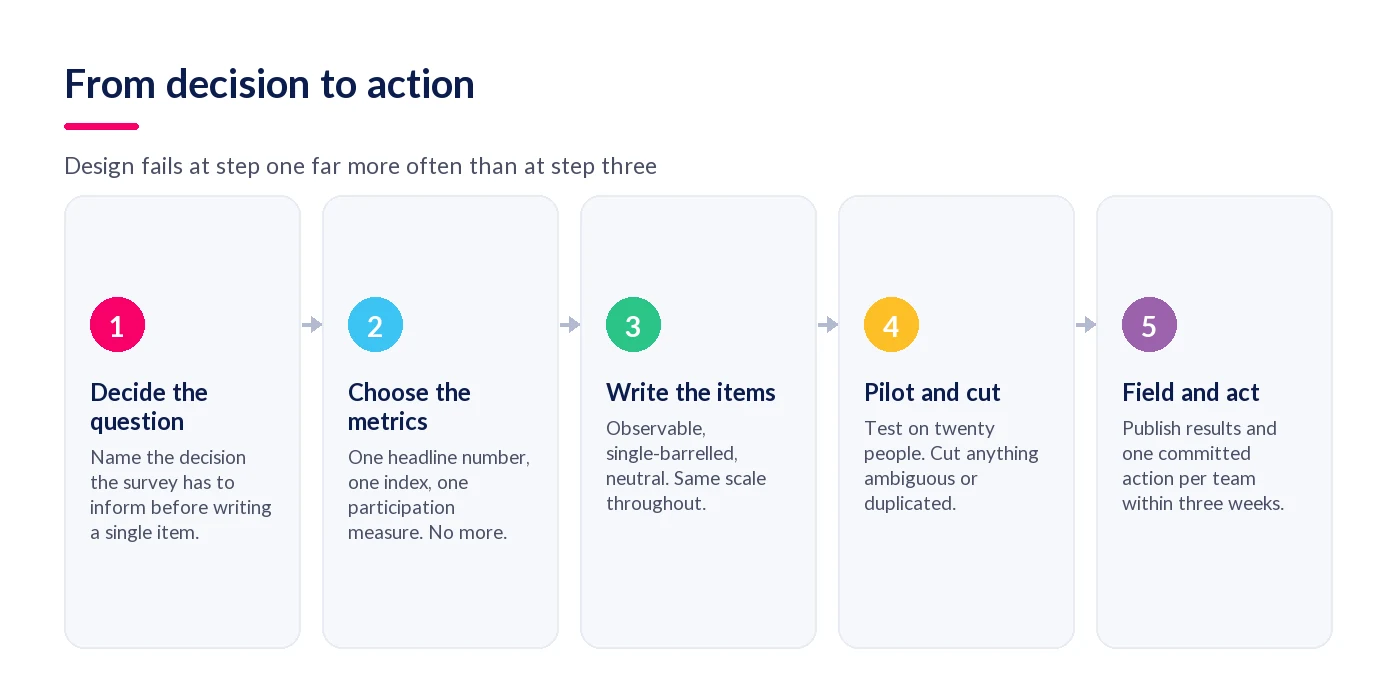
- Name the decision the survey has to inform. Write down, in one sentence, the decision that will be made differently depending on the answers. "We will decide which two teams get manager coaching next quarter" is a decision. "We want to understand how people feel" is not, and it produces a survey nobody can act on.
- Choose your metrics before you choose your questions. Decide the three numbers you will report: a headline score such as eNPS, an engagement index built from a fixed item set, and a participation rate. Fixing the metrics first stops the questionnaire growing every time a stakeholder asks for one more thing.
- Draft a short item bank against the known drivers. Write two or three candidate items for each driver you intend to measure — manager quality, clarity of expectations, recognition and voice, growth, workload. Drafting more than you need means you can cut the weak wording later instead of defending it.
- Test every item against the four failure modes. Reject any item that is leading, double-barrelled, ambiguous about whose behaviour it refers to, or that asks the respondent to guess about other people. Each of these produces a number you cannot act on, and each is invisible once the data is in a dashboard.
- Decide who is asked, how often, and how anonymity works. Set the eligible population, the cadence, and the minimum group size below which results are never broken out — five responses is a common floor. Publish the anonymity rule with the survey, because what people believe about anonymity determines what they tell you.
- Pilot with twenty people, then cut. Run the draft past twenty employees from different parts of the workforce, including one shift-based or frontline group. Ask them what each item means in their own words. Cut anything two people interpret differently, and cut anything that duplicates another item.
- Publish the results and one committed action per team. Within three weeks of closing, give every manager their own team's results, ask each for one commitment, and publish what the organisation as a whole will change. This step is the survey's entire value; skipping it is what makes the next round unanswerable.
The two steps most often dropped are the pilot and the publication. Both feel optional under deadline pressure and both are the difference between a dataset and a decision. A pilot costs an afternoon; rerunning a survey because half the workforce read an item differently costs a quarter.
What makes a good engagement survey question?
A good item describes one specific, observable thing the respondent can answer about their own experience, on the same scale as every other item. It names who or what it refers to, avoids adjectives that invite interpretation, and does not signal the answer you want. The table below shows the same intent written badly and then well.
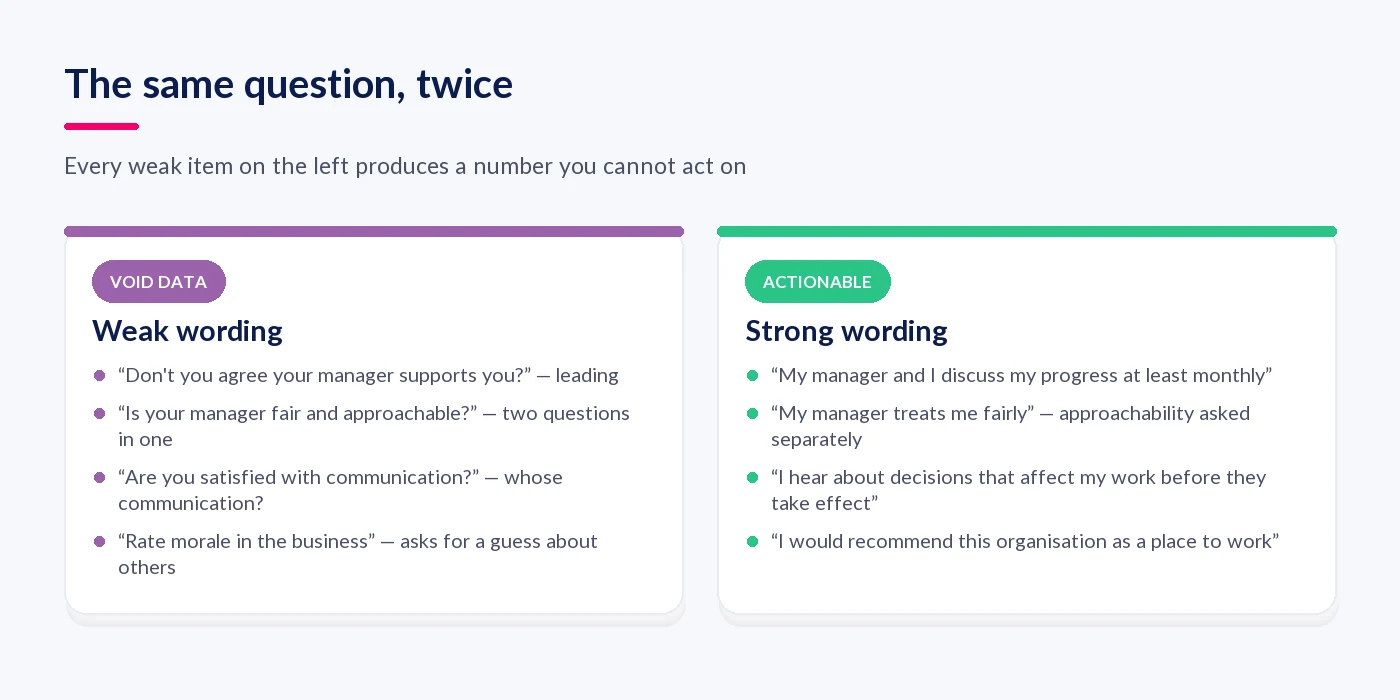
| What you want to know | Weak wording | Why it fails | Strong wording |
|---|---|---|---|
| Manager support | "Don't you agree that your manager supports you?" | Leading — it tells the respondent which answer is expected | "My manager and I discuss how my work is going at least once a month" |
| Fairness and approachability | "Is your manager fair and approachable?" | Double-barrelled — a disagree could mean either half, and you cannot tell which | "My manager treats me fairly" — with approachability asked as a separate item |
| Communication | "Are you satisfied with communication?" | Ambiguous — whose communication, about what, through which channel? | "I hear about decisions that affect my work before they take effect" |
| Morale | "How would you rate morale in the business?" | Speculative — it asks the respondent to guess what colleagues feel | "I would recommend this organisation as a place to work" (0–10) |
| Clarity of expectations | "Do you have good objectives?" | Adjective-led — "good" means something different to everyone | "I know what a successful quarter looks like in my role" |
| Recognition | "Do you feel valued and rewarded?" | Double-barrelled, and conflates recognition with pay | "In the last month, someone has recognised me for good work" |
| Employee voice | "Does the company listen to feedback?" | Abstract — nobody can point at evidence either way | "When I have raised a problem, something has changed as a result" |
| Workload | "Are you happy with your work-life balance?" | Measures contentment rather than a condition you can change | "My workload is manageable in a normal week" |
Every strong item above shares three properties: it is about the respondent's own experience, it names a timeframe or an observable event, and it can be answered on the same agreement scale as its neighbours. That last point is not cosmetic — mixing scales inside one survey makes an engagement index impossible to calculate, as set out in how to measure employee engagement.
If you would rather not write your own, validated item sets exist. Gallup's Q12 items have decades of published research behind them, but they are proprietary: you cannot reproduce or administer them without Gallup's written consent, so the choice is to licence them or write items of your own with the discipline above.
How many questions should an employee engagement survey have?
Five to fifteen items for a regular pulse, and no more than 30 for an annual census. The binding constraint is not attention span but action capacity: every item you add creates a finding somebody expects you to respond to, and a survey that generates 30 findings you cannot act on damages trust more than a short one that generates three you can.
Three practical tests for whether an item earns its place:
- Name the action. If the answer came back badly, what specifically would you do? No answer means no item.
- Check for a duplicate. Two items measuring the same driver double its weight in your index without adding information.
- Time it on a phone. If a shift worker cannot finish it in three minutes on a mobile between tasks, you will only hear from desk-based staff. Our ebook Deskless Not Voiceless: How to Engage Frontline Employees covers designing for that audience properly.
Keep one or two open-text questions, and read them by theme rather than counting words. Ten comments naming the same rota problem is the most useful output most surveys produce, and it is the part a dashboard is worst at surfacing.
How to raise employee engagement
You raise engagement by acting visibly on what the survey told you, not by running a better survey next time. The single strongest predictor of whether your next round produces honest answers is whether people can point to something that changed after the last one. Publish results within three weeks, take one commitment per team, and report back on those commitments at the next cycle.
Concretely, that sequence looks like this:
- Week one: managers receive their own team's results, not the company average.
- Week two: each manager discusses the results with their team and agrees one action they will own.
- Week three: the organisation publishes the headline findings and the two or three things it will change centrally.
- Next cycle: every published commitment is reported against, including the ones that were not delivered.
That last item is the one that builds credibility, because admitting a commitment slipped is more believable than a page of successes. The prioritised list of what to commit to — every intervention scored on effort against expected impact — is in how to improve employee engagement, and if you are still building the business case, what employee engagement is and how much engagement surveys cost cover the definition and the budget.
StaffCircle carries this whole cycle in one place: pulse surveys and real-time eNPS with sentiment analysis on the open text, results pushed to the manager who owns the team, and recognition and a central newsfeed to close the loop with desk-based, remote and frontline staff on the same day. Customers see 74% higher employee engagement, measured as documented on our customer outcomes page.
To see a survey designed, fielded and acted on in one system, take a look at StaffCircle's employee engagement software.
Frequently asked questions
Should employee engagement surveys be anonymous?
Yes for most organisations, with a published minimum group size — commonly five responses — below which results are never broken out. Anonymity raises honesty but removes your ability to follow up individually, so state the rule clearly before the survey opens rather than leaving people to guess.
What rating scale should an engagement survey use?
Use a five-point agreement scale for index items and a separate 0 to 10 scale for the single recommendation question that produces eNPS. Keep the same scale throughout the index, because mixing scales makes the index impossible to calculate and comparisons between items meaningless.
How do you avoid bias in engagement survey questions?
Reject four wording faults: leading items that signal the expected answer, double-barrelled items asking two things at once, ambiguous items that do not say whose behaviour is meant, and speculative items asking people to guess what colleagues think. Piloting on twenty employees catches most of what survives review.
Should you use a validated survey or write your own questions?
Validated item sets such as Gallup's Q12 carry published research and comparability, but they are proprietary and must be licensed. Writing your own is legitimate and often better fitted to your context, provided you apply the same discipline: one idea per item, observable wording, a consistent scale, and a pilot before launch.
How soon should you share engagement survey results?
Within three weeks of the survey closing. Managers should get their own team's results first, then agree one action with the team, then the organisation publishes headline findings and central commitments. Longer than a month and people conclude nothing is happening, which suppresses the next round's response rate.
Related articles
See StaffCircle in action
Book a personalised demo and see how StaffCircle drives performance, engagement and development.