Probation Reviews: A Process That Decides Early and Fairly
Ruth runs the night shift at a regional distribution centre. On Monday 4 January 2027 a new shift lead, Arjun, starts on a six-month probation. On the same Monday, Ruth also inherits a problem from the person who had her job before: a team leader hired last summer whose probation file holds a signed offer letter and nothing else. No objectives, no review notes, no dates. Ruth has no evidence for passing him, and none for failing him either.
This post follows Arjun's probation from his first morning to his final review. Ruth and Arjun are a composite, and the details are illustrative.
A probation review process is a planned set of meetings that tests a new employee against objectives agreed on day one. It has regular formal reviews with notes shared with the employee, check-ins in between, and a final review held early enough to confirm, extend or end the employment fairly. From 1 January 2027, a six-month probation also ends around the time unfair dismissal protection begins, so the timing matters more than it used to.
Key facts
- There is no legal requirement to have a probation period, and it can be any length (Acas).
- Any probationary period, its conditions and its duration must be in the written statement of employment particulars.
- From 1 January 2027 the unfair dismissal qualifying period falls from two years to six months.
- An extension must be confirmed before the original probation ends, or it could be a breach of contract (Acas).

What is a probation review actually deciding?
Most probation templates are a form with three tick boxes at the bottom. The form is the end of the process. What a review actually decides is whether you have enough fair evidence, collected over time, to answer a short list of questions:
- Can this person do the core parts of the job to the standard we set out at the start?
- Do they work in the way the role needs: with the team, with customers, safely?
- Where they have fallen short, did we tell them early and give them a real chance and the support to improve?
- Is there anything, such as absence, a missing piece of training or a change of role, that means we have not yet seen enough to judge?
- Would the outcome come as a surprise to them? (Acas says it should not.)
If you cannot answer those questions from your notes, you do not have a probation process. You have a probation date.
Probation is optional. Acas says there is "no legal requirement to have a probation period" and that one can be any length (Acas, probation periods). If you do use one, section 1 of the Employment Rights Act 1996 requires the written statement of employment particulars to include "any probationary period, including any conditions and its duration", and the statement must be given no later than the beginning of the employment (ERA 1996, s.1). The review process tests against those written expectations.
Why 1 January 2027 changes the timing
Most probation guides were written when an employee needed two years' service to claim unfair dismissal. That is changing. Section 25 of the Employment Rights Act 2025 substitutes "six months" for "two years" in section 108 of the 1996 Act (ERA 2025, s.25), and the commencement regulations bring section 25 into force on 1 January 2027 (SI 2026/559, reg. 3). Acas summarises it plainly: "From 1 January 2027, protection from unfair dismissal will become a right after 6 months of being in a job." Acas also says the limit on unfair dismissal compensation will be removed (Acas, Employment Rights Act 2025).
Acas is equally clear that "the Act does not affect probation periods". You can still use one, of any length. But two practical things follow for Ruth.
First, Arjun's six-month probation now ends at roughly the point he gains unfair dismissal protection. A final review held on his last day leaves no room to extend properly, and a decision that slips past the six-month mark is made with different legal stakes. Acas notes that some employers may want probation to end before protection starts, then adds: "However, this does not avoid legal risks." Discrimination and whistleblowing protections apply from day one regardless.
Second, the inherited team leader. Acas says someone "will be protected if they already have at least 6 months' service on 1 January 2027". A long probation that began last summer may already cover someone who, from that date, can claim unfair dismissal. An empty file is a bigger problem than it was.
The fix is not a shorter probation. It is a final review held early, on evidence gathered throughout. That is the process below.
Arjun's probation, review by review
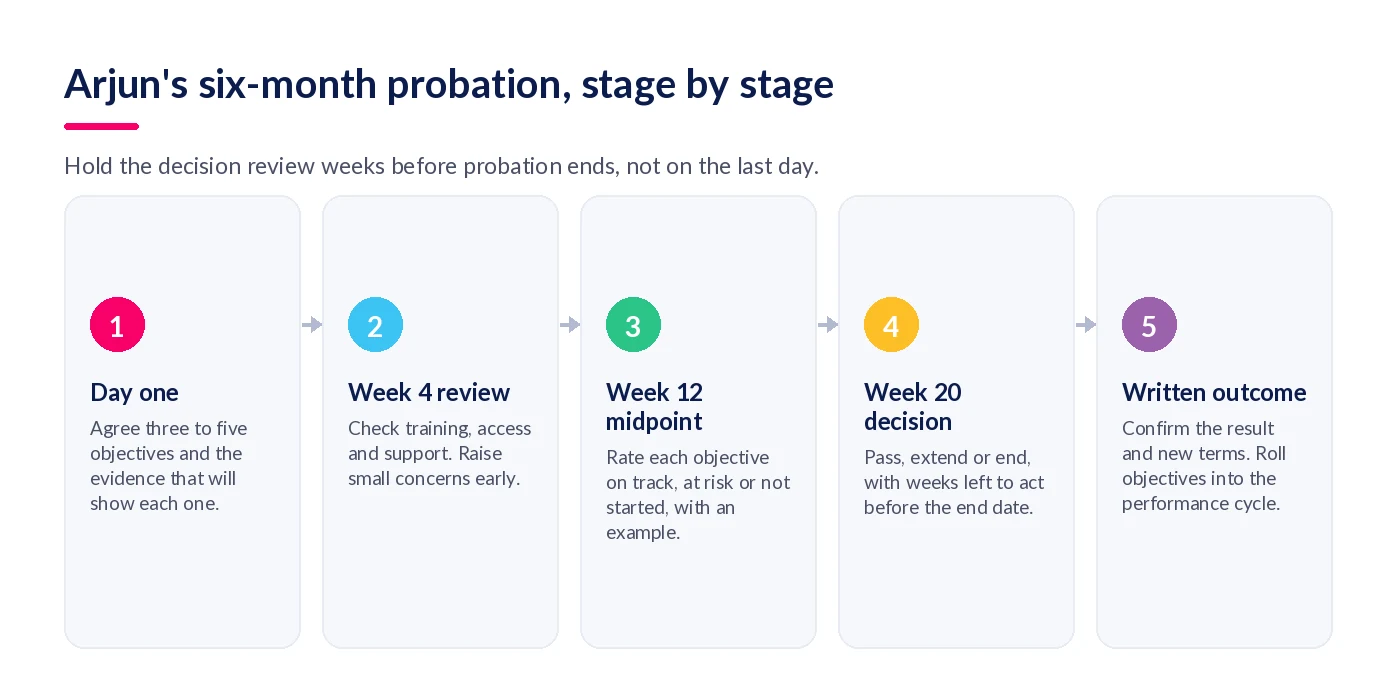
Ruth uses five stages for a six-month probation: objectives on day one, three formal reviews, and a written outcome. Here is each stage as it played out.
- Day one: agree three to five objectives and how they will be judged. Ruth and Arjun turn the job description into specific objectives, such as running a shift handover without supervision by week eight, and agree what evidence will show each one. Both keep a copy.
- Week 4: first review, mostly about fit and support. It is early to judge output. Ruth checks that Arjun has the training, systems access and contacts he needs, and raises small concerns while they are still small.
- Week 12: midpoint review against each objective. This is the honest one. Each objective is rated on track, at risk or not yet started, with an example for each. Anything at risk gets a named action and a date.
- Week 20: decision review. Held four weeks before the end date, so there is time to confirm the outcome in writing and, if needed, agree an extension before the original probation runs out.
- Outcome in writing. A letter or email confirming a pass and any new terms, the terms of an extension, or the reasons for ending the employment. Then the objectives roll into Arjun's normal performance cycle.
Between the formal reviews, Ruth and Arjun have short weekly check-ins. Acas recommends "regular informal check-ins" alongside formal reviews (Acas, probation reviews), and they are where most of the evidence comes from. If you need a structure for those conversations, our guide to effective one-to-ones covers it, and our post on setting SMART objectives helps with stage 1.
A three-month probation compresses the same stages into the familiar 30, 60 and 90 day pattern. The risk there is the opposite one: by day 60 you need to be honest about concerns, because the decision review is only a few weeks away.
| Stage | Three-month probation | Six-month probation | Main question |
|---|---|---|---|
| Objectives agreed | Day 1 | Day 1 | What does good look like, and how will we know? |
| First review | Day 30 | Week 4 | Does the person have what they need? |
| Midpoint review | Day 60 | Week 12 | Which objectives are on track or at risk? |
| Decision review | Around day 75 to 80 | Week 20 | Pass, extend or end, with time to act before the end date |
| Written outcome | Before day 90 | Before week 26 | Confirm the result and any new terms |
What evidence should a manager bring to each review?
Acas says managers should review the probation expectations and the employee's work so far, check for feedback, and share that information with the employee before the meeting. They should also keep records of each review and share them afterwards (Acas, probation reviews). In practice, Ruth brings the same five things to every review, weighted differently as probation goes on.
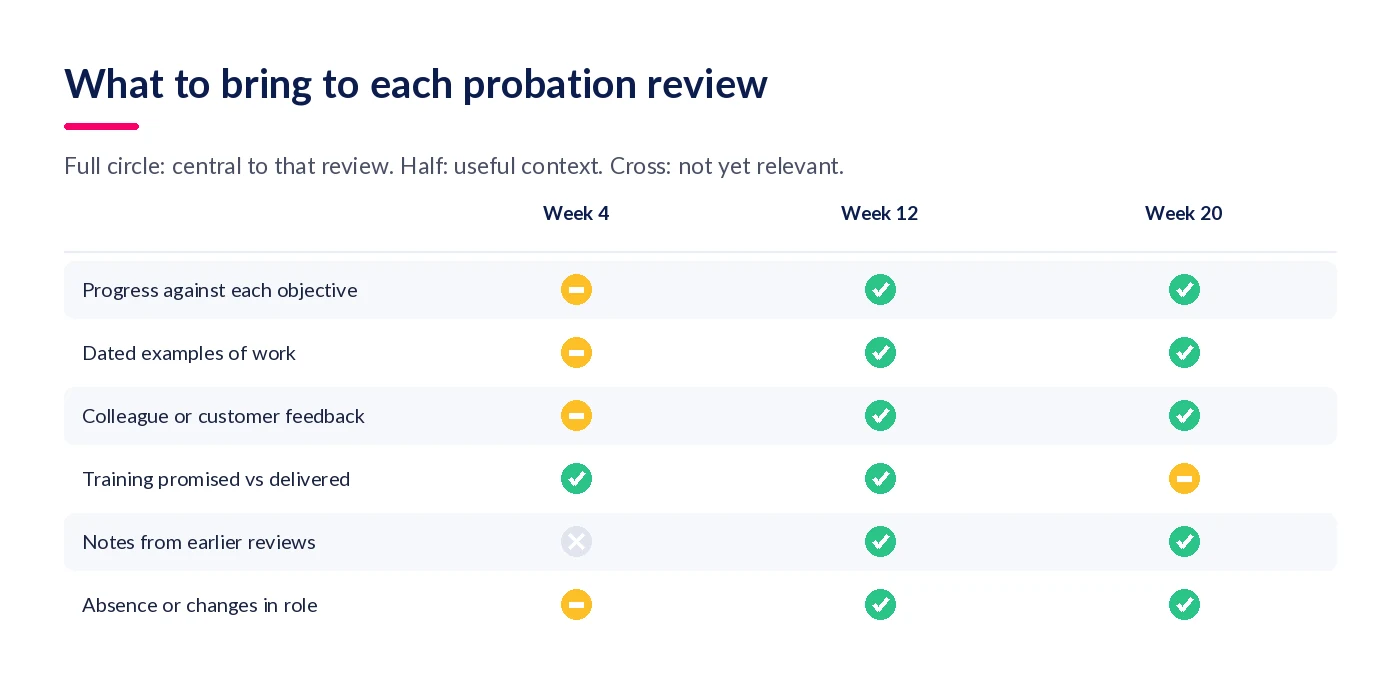
- Progress against each objective, with a rating and a dated example. "Good attitude" is not evidence. "Ran the Tuesday night handover alone, with no missed loads" is.
- Feedback from others: colleagues, other shift leads, customers. Ask the same two or three questions each time so it is comparable.
- Training and support: what was promised, what was delivered, and what is still outstanding. You cannot fairly fail someone on a skill you never trained.
- Notes from earlier reviews and check-ins, so concerns can be traced to the date they were first raised.
- Absence or changes that affected what you could see. Acas says an employee who has been off "can still successfully complete their probation without extension", using reasonable evidence of performance (Acas, extension).
Arjun's week 12 review had one objective at risk: he was still asking a senior colleague to sign off load plans. Ruth wrote down the example, booked two shadow shifts, and set a check for week 16. That one note is the difference between a fair decision later and a surprise.
Pass, extend or end: making the final call
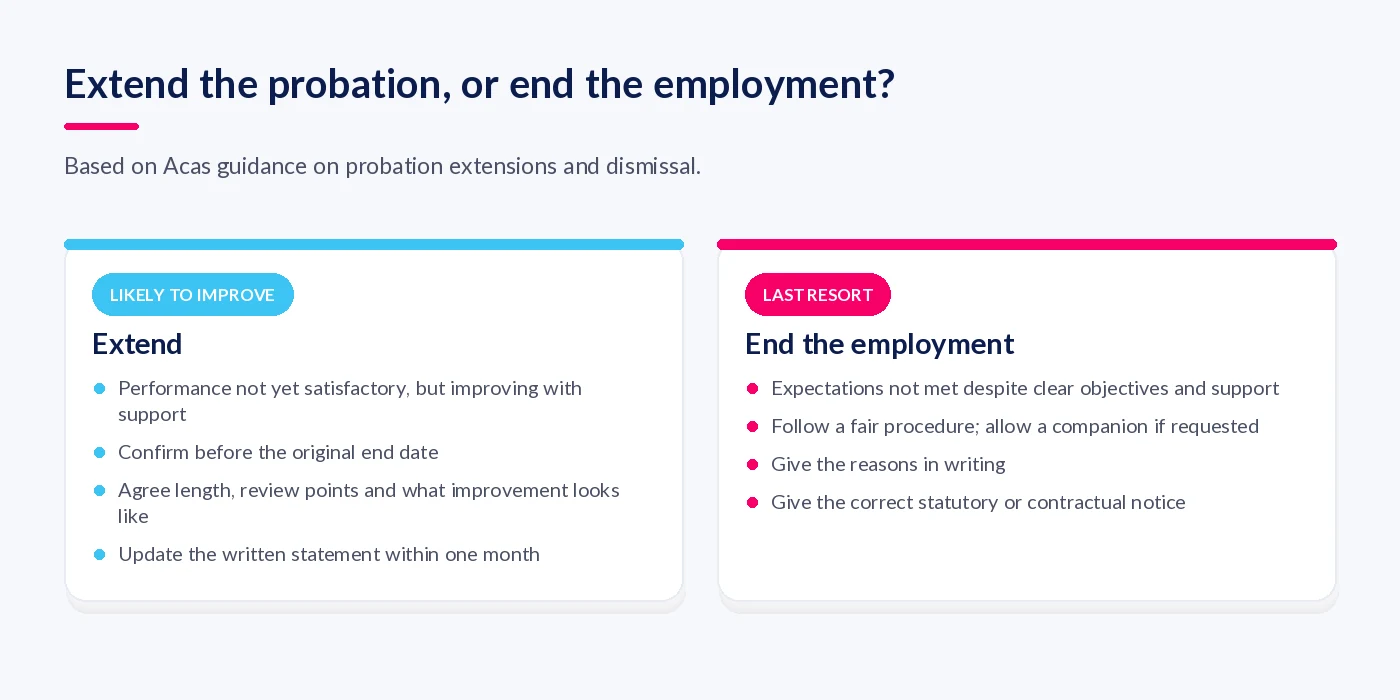
Acas lists three outcomes from the final review: the employee passes, the employee fails because they have not met the expectations, which "likely means the employee will be dismissed", or the probation is extended (Acas, probation reviews).
When an extension is the right call
Acas says an extension fits when performance is not yet satisfactory but the employee is "likely to improve with more support or training". The extension must be confirmed before the original probation ends, and failing to do so "could be a breach of contract". The written statement should be updated within one month. Agree the length, the review points, what improvement looks like, any training, and when the final review will be (Acas, extension). An extension without those things is a delay, not a plan.
When ending the employment is the right call
Acas calls dismissal during probation "a last resort" and says employers should follow a fair procedure, give the reasons in writing and give the correct notice (Acas, dismissal). Once someone has a month's continuous service, the statutory minimum is one week's notice while their service is under two years (ERA 1996, s.86); the contract may say more. Employees have a right to request to be accompanied to meetings that could result in dismissal. If the concerns are about performance rather than fit, our guide to dealing with underperformance covers the conversation itself.
When it is a pass
Say so in writing. Acas says the employer should confirm a successful probation, for example by letter or email, and must give the employee any new terms of employment (Acas, following a fair process).
Five ways probation reviews go wrong
Objectives are set in week six
If the expectations were never written down at the start, every later judgement is open to challenge. The written statement already has to cover the probation's conditions; turn those into objectives on day one.
The first honest conversation is the final one
"The outcome of probation should not come as a surprise to the employee," says Acas. If concerns first appear at the decision review, the process has failed, whatever the outcome.
The decision review is on the last day
No time to extend properly, no time to write to the employee, and, from 2027, a decision that can drift past the six-month qualifying point. Hold it weeks before the end date.
Different managers run different processes
Acas says probation should be consistent across the organisation and that a consistent process helps explain how decisions are made, which reduces the risk of discrimination (Acas, following a fair process). One shift lead doing weekly check-ins while another does none is not consistent.
Probation ends and so does the attention
The signed confirmation letter goes in a file and the regular one-to-ones stop. The person who had the most structured support of their working life suddenly has none. That is the last failure, and the next section deals with it.

After the letter: probation into the performance cycle
Acas says probation, induction and performance management will overlap, and employers should make clear how they work together. The simplest way is to keep using the same tools. Arjun's probation objectives become his first set of performance objectives, with the dates moved on. The weekly check-ins become fortnightly one-to-ones. The development actions from his week 12 review, such as load planning and handover, become the first lines of his development plan.
Keep probation notes alongside ongoing performance records, too, and the next manager who inherits a team will not find an empty file. Our new starter checklist covers the practical first-week setup that sits alongside this.
Where StaffCircle fits
StaffCircle is performance management and development software, so probation sits naturally inside the same cycle as everyone else's objectives and one-to-ones.
Objectives from day one
Managers can set a new starter's probation objectives in StaffCircle on their first day, linked to team goals, so both sides see the same expectations and progress against them. See how KPI and objective tracking works.
Check-ins that become the evidence
Regular one-to-one check-ins are recorded as they happen, so by week 12 the manager has dated notes, feedback and actions to bring to the review rather than relying on memory.
A clear view of capability
Success Circles show where a new starter's skills and performance sit against what the role needs, which makes the midpoint review a conversation about specific gaps.
Decide early, decide fairly
A good probation review process is mostly done before the final meeting: objectives on day one, honest notes at weeks 4 and 12, and a decision review with time to spare. From January 2027 the time to spare matters more. If you would like to see how StaffCircle keeps probation objectives, check-ins and reviews in one place, book a demo.
FAQ
What is a probation review process?
A probation review process is the planned series of meetings in which a manager checks a new employee's progress against expectations agreed at the start, records what was discussed, and reaches a final decision to confirm the employee, extend the probation or end the employment. It runs alongside induction and should feed into normal performance management once probation ends.
How often should probation reviews happen?
There is no legal rule. Acas recommends regular formal reviews during probation, informal check-ins in between, and a final review to discuss the outcome. For a six-month probation, formal reviews at around weeks 4, 12 and 20 work well; for three months, use the 30, 60 and 90 day pattern.
Is a probation period a legal requirement in the UK?
No. Acas states there is no legal requirement to have a probation period and that it can be any length. If you use one, the written statement of employment particulars must include any probationary period, its conditions and its duration.
How long should a probation period be?
The law sets no length. Three and six months are common choices, and Acas notes that technical or specialist roles might need longer for training and assessment. State the length in the written statement.
Can you extend a probation period?
Yes, if your contract or policy allows it and the employee is likely to improve with more support or training. Acas says an extension must be confirmed before the original probation ends, or it could be a breach of contract, and the written statement should be updated within one month.
What evidence should a manager bring to a probation review?
Bring progress against each objective set on day one, dated examples of work, relevant feedback from colleagues or customers, notes from earlier reviews and check-ins, training completed, and any absence that affected the period. Share it with the employee before the meeting, as Acas recommends.
What happens if an employee fails their probation?
If the employee has not met the expectations, Acas says this likely means dismissal. The employer should follow a fair procedure, give the reasons in writing and give the correct notice, which is at least one week once someone has a month's continuous service, or the contractual period if longer.
Does the Employment Rights Act 2025 change probation periods?
Not directly. Acas says the Act does not affect probation periods. It does change the context: from 1 January 2027 the qualifying period for unfair dismissal falls from two years to six months, so a six-month probation now ends around the time a new employee gains that protection.
Do employees on probation have employment rights?
Yes. Acas says day-one rights apply during probation, including the minimum wage, paid holiday and protection against discrimination and whistleblowing detriment. Sick pay and notice rules also apply.
Can an employee bring someone to a probation review?
Employees have a right to request to be accompanied to meetings that could result in dismissal. Acas notes the right might not apply to some or all routine probation reviews, but employers can offer it anyway and must make reasonable adjustments for disabled employees.
What should you put in writing after a probation review?
Record what was discussed, progress against each objective, any concerns, the support agreed and the date of the next review, then share the record with the employee. After the final review, confirm the outcome in writing: a pass, the terms of any extension, or the reasons for dismissal.
What happens after an employee passes probation?
Confirm it in writing and give the employee any new terms that now apply, such as a longer notice period or benefits. Then carry the probation objectives and development actions straight into the normal performance cycle so the regular one-to-ones continue without a gap.
Related articles


See StaffCircle in action
Book a personalised demo and see how StaffCircle drives performance, engagement and development.