Performance Management Software Pricing: What You Pay For
Here is an unpopular view from someone who sells this software: the per-employee price on a quote is the least useful number on it. It is the figure every buyer compares first, and the one least likely to decide what you actually spend over three years. Renewal terms, add-ons, setup, integrations and your own team's time usually decide that.
Performance management software pricing is usually a per-employee, per-month licence, billed annually in advance, with lower rates as headcount grows and a minimum annual charge. The real cost also includes modules and add-ons, one-off setup and training, integrations, support tier, renewal increases, exit terms and internal admin time. Compare three-year totals, not headline rates.
Key facts
- Most vendors price per employee per month and bill the year in advance.
- Lattice publishes a $4,000 minimum annual agreement on its pricing page.
- G-Cloud 14 pricing documents cannot use "prices from" or price ranges.
- Under IFRS, SaaS configuration costs are usually expensed, not capitalised.
- UK standard-rate VAT is 20% and sits on top of most quoted prices.
This guide explains how the pricing models work, the costs that rarely make it onto a pricing page, and how to build a three-year comparison your finance director will accept. If you are earlier in the process, our buyer's guide to performance management software covers what to look for in the product itself.
How is performance management software priced?
Most performance management software is priced per employee per month and billed annually in advance. The rate usually falls as headcount rises, a minimum annual charge sets a floor for small organisations, and the platform is often split into modules you buy separately. Few vendors still sell perpetual licences.
Within that, you will meet five variations:
- Per employee per month (PEPM). Every person on the payroll who is in the system counts, whether or not they log in that month.
- Per active user or per seat. You pay only for named users. Cheaper on paper, but check who counts: a manager who only signs off reviews is still a user.
- Volume bands. The rate steps down at set headcounts. Ask where the band edges are, because adding ten people can move you into a cheaper band or leave you paying for capacity you do not use.
- Modular pricing. Reviews, objectives, engagement surveys, skills and analytics are separate products. You pay for what you switch on.
- Minimum annual charge. A floor on the contract value. Below a certain headcount, you pay the minimum whatever the per-employee maths says.
Some vendors publish their rates; many do not. On 2 November 2026, Lattice's pricing page listed Performance at $10 per seat per month, Goals & OKRs at $8 and Engagement at $4, stated that "Lattice bills all contracts annually" and that "The minimum annual agreement is $4,000". 15Five's pricing page listed its Perform plan at $11 per user per month, billed annually, with add-ons such as compensation priced separately and a note that "Some optional add-ons may include minimum requirements". Culture Amp publishes no prices: its pricing FAQ says pricing "depends on the number of employees, product chosen, and service tier". Prices change, so treat these as an illustration of the models, not a current rate card.
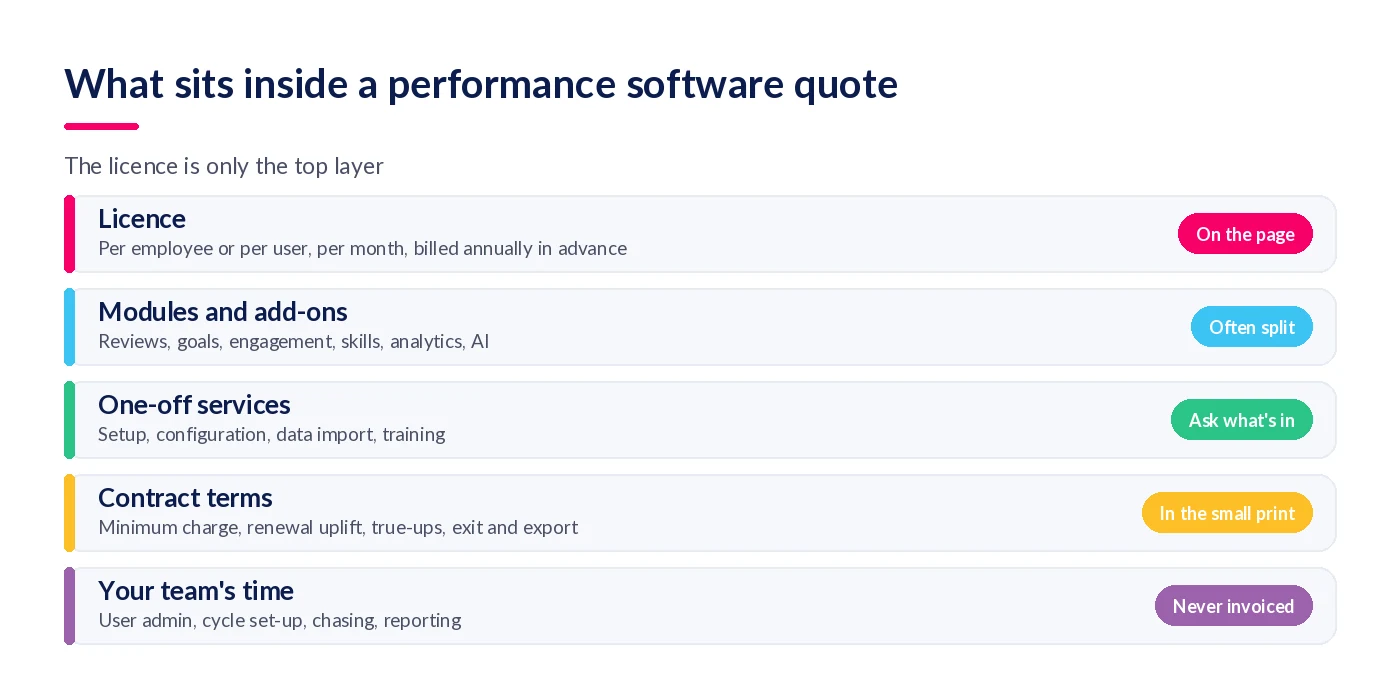
The costs that never make the pricing page
The costs most often missed are one-off setup and training, integrations, premium support, renewal increases, mid-term headcount true-ups, exit and data export, VAT and your own team's time. None of them is hidden in a sinister sense. They are simply not on the page you compared.
Setup, configuration and training
Some vendors charge a one-off fee to configure review templates, import people data and train administrators. Others include it. Lattice's pricing page, for example, says that for its performance management software "there are no additional costs for change management or implementation". Either can be fine. What matters is knowing what the fee covers: how many review templates, how many training sessions, and whether data migration from your current tool is in scope.
Integrations
Ask whether the connector to your HRIS is included or sold as an add-on, and whether single sign-on is on every plan. Without a sync, someone in HR uploads joiners, leavers and manager changes by hand. That cost does not appear on any invoice, but it appears in your team's week. Our guide to performance management software integration covers what a good sync looks like.
Support tier
Standard support may mean email only. Phone support, a named customer success manager or faster response times can sit in a higher tier. Ask what the service level agreement says, not what the sales deck says.
Renewal increases and true-ups
This is where the largest surprises usually live. Ask how much the price can rise at each renewal and whether that rise is capped. An uncapped uplift clause compounds: a few percentage points a year looks small in year one and does not in year three. Ask too how headcount growth is billed mid-term. Some contracts true up quarterly, others at renewal, and the difference matters in a year when you are hiring.
Exit costs
Ask what it costs to get your data out, in what format, and for how long you keep access after the contract ends. Some vendors export review history one cycle at a time, which takes days of someone's time. Our guide to switching performance management software explains why the exit terms set your real deadline.
Your own team's time
Every option needs someone to run it. Count the HR hours each one needs per month for user admin, building review cycles, chasing completion and pulling reports. A cheaper tool that needs an extra day a month of admin is not cheaper.

How do you build a three-year cost comparison?
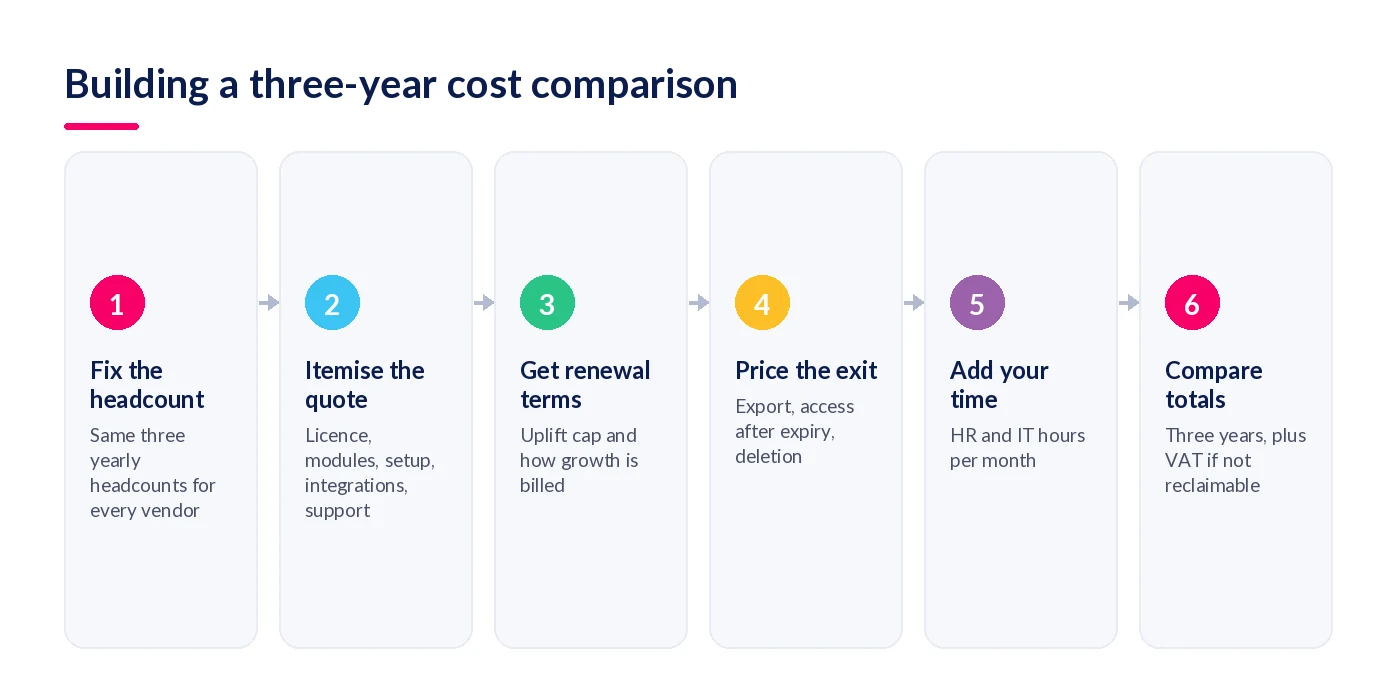
Ask every vendor to quote against the same headcounts for three years, itemise every line, price the renewal and exit terms, add your own team's time and compare totals. Three years is long enough for uplifts and growth to show, and short enough to plan honestly.
- Fix the headcount you will price against. Write down today's headcount and a realistic figure for years two and three, and ask every vendor to quote against the same three numbers.
- Ask for a fully itemised quote. Request licence, every module and add-on, setup, training, integrations and support tier as separate lines, with any minimum annual charge shown.
- Get the renewal terms in writing. Ask how much the price can rise at each renewal, whether the rise is capped, and how mid-term headcount growth is billed.
- Price the exit. Find out what data export costs, how long you keep access after the contract ends and whether the vendor deletes or returns your data.
- Add your own team's time. Estimate the HR and IT hours each option needs every month, especially manual user updates where there is no HRIS sync.
- Compare three-year totals, not year-one prices. Put every option in one table over three years, add VAT if you cannot reclaim it, and choose on the total.
Step one is the one most buyers skip. If one vendor quotes for 250 employees and another for 300, you are comparing two different purchases. Step five feels awkward because it means putting a cost on your own team, but it is often the line that separates two otherwise similar quotes.
A worked example: two quotes for 250 employees
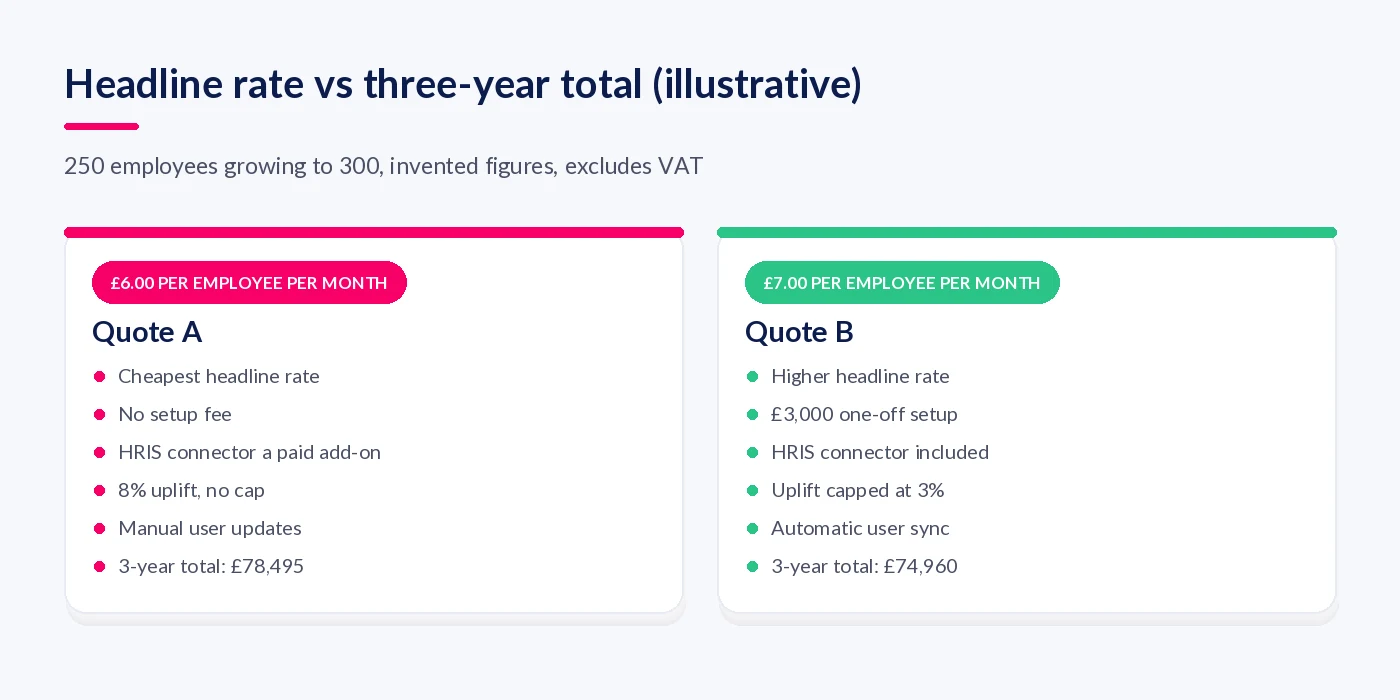
The cheaper quote in year one can be the more expensive one over three years. The example below uses invented figures, chosen to show the mechanics. They do not describe any real vendor.
A 250-person business expects to reach 280 employees in year two and 300 in year three. It has two quotes:
- Quote A: £6.00 per employee per month, no setup fee, HRIS connector as a £1.00 per employee per month add-on, renewal uplift of 8% a year with no cap. No automatic user sync, so HR estimates three hours a month of manual updates at a loaded cost of £25 an hour.
- Quote B: £7.00 per employee per month, a £3,000 one-off setup fee, HRIS connector included, renewal uplift capped at 3% a year.
| Year | Headcount | Quote A (licence + connector + admin time) | Quote B (licence + setup) |
|---|---|---|---|
| 1 | 250 | £21,900 | £24,000 |
| 2 | 280 | £26,302 | £24,226 |
| 3 | 300 | £30,293 | £26,735 |
| Total | £78,495 | £74,960 |
On the headline licence rate, Quote A looks £3,000 a year cheaper. Over three years it costs £3,535 more. The difference comes from the uncapped uplift, the paid connector and the admin hours, not from the rate anyone compared first. Figures exclude VAT. Change any one assumption and the answer can flip, which is the point: do the sum with your own numbers.
If you also want to estimate the return side of the business case, our ROI calculator models productivity, manager time and turnover for your headcount.
What will your finance team ask?
Finance will want to know whether prices include VAT, whether the setup fee can be capitalised, and how the contract renews. Have answers ready before the business case goes in.
VAT
Most UK software quotes exclude VAT, and the standard rate is 20%. For a business that reclaims all its VAT this washes out. If your organisation cannot reclaim all of its input VAT, as can be the case for some charities and financial services firms, the 20% is a real cost and belongs in the comparison.
Can the setup fee be capitalised?
Usually not, for organisations reporting under IFRS. In its 2021 agenda decision on configuration or customisation costs in a cloud computing arrangement, the IFRS Interpretations Committee observed that a customer "often would not recognise an intangible asset" for configuring a supplier's software, because it does not control that software. The costs are generally recognised as an expense when the services are received, or over the contract term where they are not distinct from the access itself. Your auditors make the final call, and organisations on other frameworks should check their own rules, but expect setup to hit the budget in year one.
Public sector buyers
If you buy through G-Cloud, pricing is more transparent by design. The G-Cloud 14 suppliers' guide requires a pricing document that includes the service price and prices for extra services, and it cannot use "Price on Application (POA), price ranges or prices from".
Where pricing comparisons go wrong
Most bad software purchases are not caused by a high price. They are caused by comparing the wrong things.
Comparing per-user and per-employee rates directly
A £5 per-user rate and a £6 per-employee rate are not comparable until you know how many of your people count as users. If every employee completes a self-review, every employee is a user.
Buying modules you will not switch on for a year
Bundles are often good value, but only for modules you will use. If engagement surveys are a year-two project, ask whether you can add them at year two at the same rate.
Signing a multi-year deal without a renewal cap
A discount for a three-year commitment is worth having. A three-year commitment followed by an uncapped renewal is not the same deal.
Leaving HR's time out of the sum
The people who run the system are rarely in the room when the price is agreed. Ask them how many hours the current process takes before you decide which tool saves money.

How StaffCircle prices it
We publish our pricing model on our pricing page, because a buyer should not need a sales call to know the shape of the bill.
A per-employee rate that falls as you grow
StaffCircle starts from £3.85 per employee per month, billed annually, and the per-employee price falls as you add employees. The pricing page calculator shows an estimate for your headcount and modules before you speak to anyone.
Modules you choose
Performance Management and Employee Development are core modules at the same price, and Employee Engagement, Notetaker and Custom Insights are add-ons. You pay for what you use, and AI features come with no per-user AI licensing. See what the core module covers on our performance management and development page.
Setup and the contract, stated up front
A one-off setup fee covers configuration and training, and the calculator shows it next to the annual estimate. Contracts are billed annually in advance with a minimum annual charge. Our professional services team handles implementation, and StaffCircle integrates with 30+ HRIS platforms so user admin is not a monthly chore.
The short version
Performance management software pricing looks simple because the headline rate is simple. The bill is not. Ask for itemised quotes against the same headcounts, get renewal and exit terms in writing, count your own team's hours and compare three-year totals. The vendor with the lowest rate may still be the right choice, but you will know why.
If you would like an itemised StaffCircle quote to put into your comparison, book a demo and we will price it against your headcount.
FAQ
How much does performance management software cost?
Most vendors charge per employee per month, billed annually, with a minimum annual charge for smaller organisations. Published rates vary widely by vendor and module, so the useful figure is a three-year total that includes setup, add-ons, integrations, renewal increases and your own team's admin time.
Is performance management software priced per user or per employee?
Both models exist. Per-employee pricing counts everyone in the system, while per-user or per-seat pricing counts named users. If every employee completes a self-review or sets objectives, the two usually come to the same number, so compare them only once you know who counts.
Do you pay monthly or annually for performance management software?
Annual billing in advance is the norm. Lattice, 15Five and Culture Amp all state on their pricing pages that contracts are billed annually. Monthly terms are less common and, where offered, usually cost more per employee.
What is a minimum annual charge?
It is a floor on the contract value. If your headcount multiplied by the per-employee rate comes to less than the minimum, you pay the minimum. Lattice, for example, publishes a minimum annual agreement of $4,000. Small organisations should check this first.
Are implementation fees normal for performance management software?
They are common but not universal. Some vendors charge a one-off fee for configuration, data import and training; others include it. Ask exactly what the fee covers, including how many review templates, training sessions and whether migration from your current tool is in scope.
What hidden costs should I look for?
Look for paid add-on modules, HRIS connectors sold separately, premium support tiers, uncapped renewal increases, mid-term headcount true-ups, data export or exit costs, VAT if you cannot reclaim it, and the HR hours needed to run the system each month.
How much can the price rise at renewal?
That depends entirely on the contract. Some agreements cap annual increases at a fixed percentage or an inflation index, others leave them uncapped. Ask for the renewal terms in writing before you sign, because an uncapped uplift compounds over a multi-year relationship.
How do I compare quotes from different vendors?
Ask every vendor to quote against the same headcount for three years and itemise every line. Add renewal increases, integration costs, exit terms and your team's admin time, then compare three-year totals rather than headline per-employee rates.
Can you capitalise performance management software setup costs?
Usually not under IFRS. A 2021 IFRS Interpretations Committee agenda decision observed that a SaaS customer often would not recognise an intangible asset for configuring software it does not control, so the costs are generally expensed. Check with your auditors and your own reporting framework.
Do performance management software prices include VAT?
Most UK business software quotes exclude VAT, which is charged at the standard rate of 20%. Businesses that reclaim all their VAT can usually ignore it in comparisons, but organisations that cannot fully reclaim it should add it to every option.
Is cheaper performance management software worth it for a small business?
It can be, if it does what you need and managers will use it. But check the minimum annual charge, which can outweigh the per-employee rate at low headcounts, and count the admin time a cheaper tool without HRIS sync can add.
How much does StaffCircle cost?
StaffCircle starts from £3.85 per employee per month, billed annually, with the per-employee price falling as headcount grows. You choose modules, a one-off setup fee covers configuration and training, and a minimum annual charge applies. The calculator on the pricing page gives an estimate.
Related articles

See StaffCircle in action
Book a personalised demo and see how StaffCircle drives performance, engagement and development.