Performance Management Software for SMEs: What You Actually Need
Performance management software for small business is a lightweight tool for setting goals, running feedback and completing reviews that a manager can configure and run without a dedicated HR systems team. The right product for a 15-person company and the right product for a 200-person company are rarely the same one, and most of the advice online skips that distinction entirely. Buy less than the enterprise shortlist tells you to, match the stack to your actual headcount band, and check who is going to configure it before you check the feature list.
What Is Performance Management Software for a Small Business?
Performance management software for a small business supports the same core cycle as any performance tool — setting goals, giving feedback, running reviews — but sized, priced and configured for a company without a dedicated HR systems administrator to run it. Before shortlisting anything, a working answer needs to cover:
- What actually counts as "small" for buying purposes, and does the answer change what you should shortlist?
- What is the real difference between this and the HR software you might already run?
- What is the smallest set of features that earns its cost at your current headcount?
- Who configures and runs it day to day if there is no dedicated HR system administrator?
How "Small" Is Actually Defined, and Why It Matters
The UK Government's own definition, set out in the Procurement Act 2023 supplementary guidance, sets the SME ceiling at fewer than 250 staff, measured as full-time equivalent rather than headcount, and either £44m or less in annual turnover or £38m or less on the balance sheet. That threshold "remains substantively the same as that in the previous legislation derived from EU guidance," so it is not a new bar, just a sterling-denominated restatement of a long-standing one. The same guidance notes that SMEs accounted for 99.9% of the UK business population at the start of 2024, with 99.2% of that population being small businesses with fewer than 50 employees.
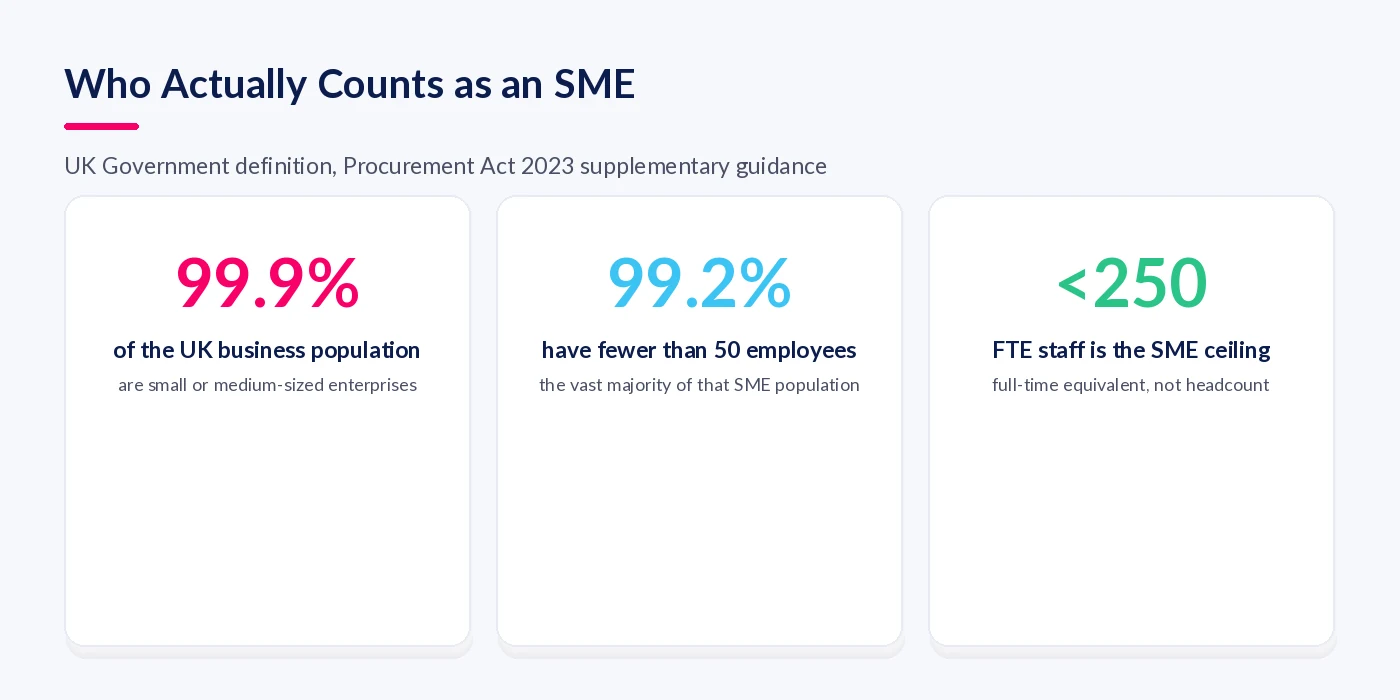
That single legal definition covers everything from a 12-person agency to a 240-person manufacturer, which is exactly why a single "best performance management software for small business" list rarely helps. A tool built for the 12-person end of that range and a tool built for the 240-person end have almost nothing in common except the SME label. The headcount-band breakdown further down this page exists because the legal definition of "small" is far too wide to double as a buying guide.
Performance Management Software vs a Plain HRIS
An HRIS holds the system-of-record data — contracts, absence, pay, personal details. Performance management software runs the ongoing cycle of goals, feedback and reviews on top of who works there. Some all-in-one platforms bundle both; many SMEs already run an HRIS for the record-keeping and are really deciding whether to bolt on a dedicated performance layer or find one already built into what they have. If your current HRIS treats a review as a single free-text box completed once a year, that is usually the sign you need the dedicated layer rather than a workaround inside the system you already pay for.
The Enterprise-Bloat Problem
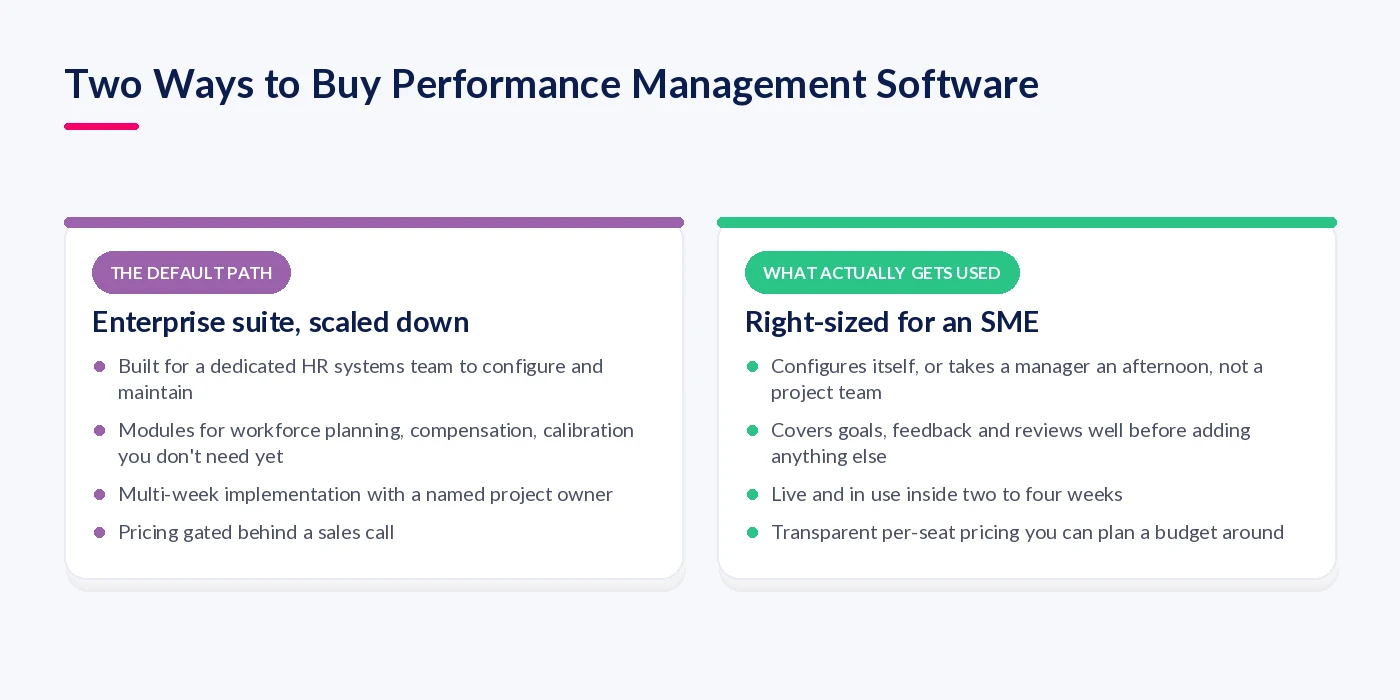
Search for this category and the same names come up regardless of company size: enterprise-grade suites built for organisations with a systems team, scaled down in marketing copy rather than in actual complexity. That is why SMEs end up searching for a Workday alternative for SMEs. The features are impressive in a demo. The problem shows up three months later, when half the modules are still unconfigured and nobody remembers who was supposed to finish the setup.
Why "Enterprise-Grade, Just Smaller" Fails Small Teams
Acas's own guide for small firms makes a point worth sitting with: "Many small firms might find the thought of introducing a performance management system from scratch very daunting. But setting up an appraisal system is often just a way of clarifying and formalising what is already happening informally between line managers and employees." Acas's guide is itself built entirely around a paper appraisal form and a worked example of SMART objectives — it never mentions software at all. That is a useful sanity check on scope: the underlying job software should do is lighten and formalise a conversation that is already happening, not bolt an enterprise change-management project onto a team that was managing perfectly well with a notebook and a monthly one-to-one.
The One Question That Predicts Whether It Gets Used
Before signing anything, ask whether a manager could configure their own team's first cycle in an afternoon, unassisted. If the honest answer involves a consultant, an implementation partner or an IT ticket before the first goal gets set, you have picked a product built for a company several times your size, regardless of how the feature list reads. Adoption in a small company almost never fails because a feature was missing. It fails because the person who was supposed to set it up moved on to something else, and nobody else could pick it back up without help.
How to Roll Out Performance Management Software Without It Becoming a Project
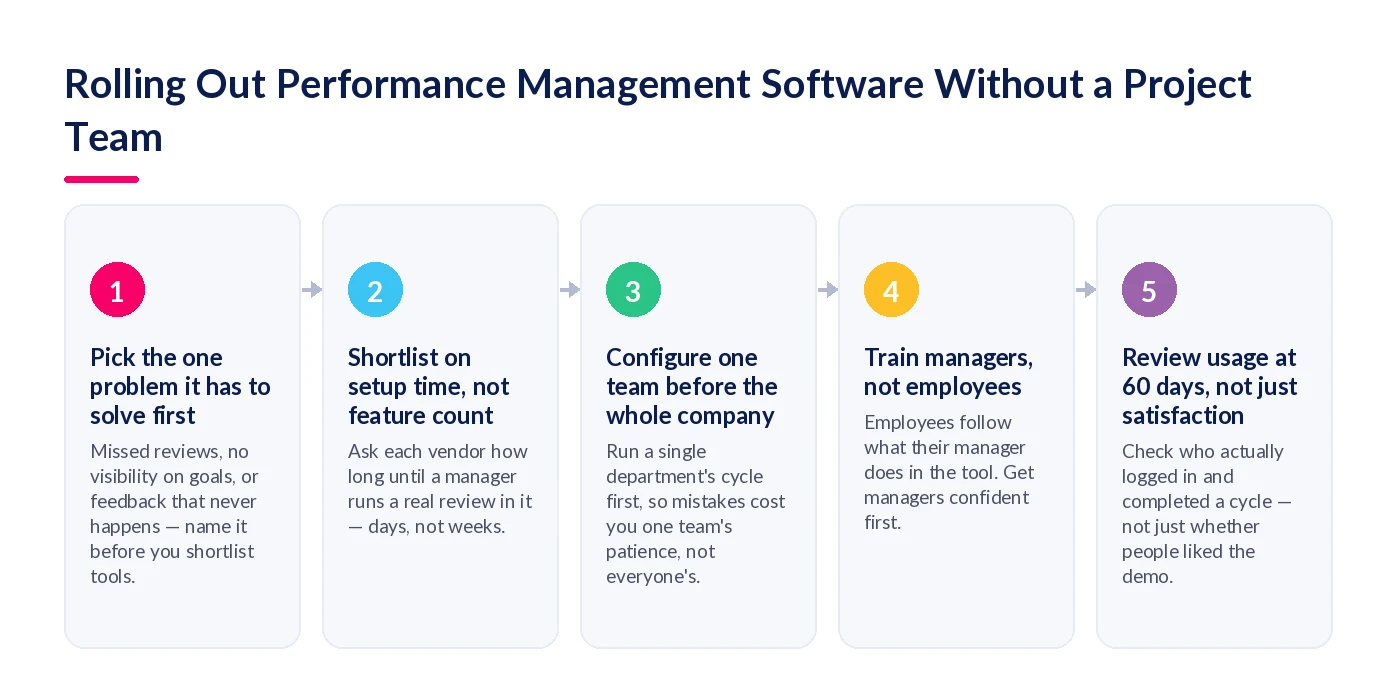
Step 1: Pick the One Problem It Has to Solve First
Missed reviews, no visibility on who is working towards what, or feedback that only happens once a year — name the specific problem before you look at a single vendor. A shortlist built around "what does the demo show" rather than "what is actually broken here" is how companies end up buying capacity they never use.
Step 2: Shortlist on Setup Time, Not Feature Count
Ask each vendor directly how long until a manager can run a real review inside the tool — not a demo account, an actual review with real goals attached. An honest answer measured in days is a good sign. An answer that starts with "it depends on your requirements-gathering session" is not.
Step 3: Configure One Team Before the Whole Company
Run one department's cycle first. Mistakes in scale, wording or cadence then cost you one team's patience rather than the whole company's first impression, and you fix the setup before it is locked in everywhere at once.
Step 4: Train Managers, Not Employees
Employees follow whatever their manager actually does inside the tool, not what a company-wide email says the process should be. Put the training effort into making managers confident running a cycle, and the employee side mostly takes care of itself.
Step 5: Review Usage at 60 Days, Not Just Satisfaction
A satisfaction survey after the demo tells you whether people liked the pitch. A usage check at 60 days — who actually logged in, who completed a full cycle, which manager never opened it — tells you whether the rollout actually worked.
The Minimum-Viable Stack by Headcount Band
None of the widely-read buying guides for this category break their advice down by headcount in any structured way — most default to a single generic feature list regardless of whether the reader runs a 15-person team or a 200-person one. Here is a working split, using the same full-time-equivalent basis the Government uses to define an SME in the first place.
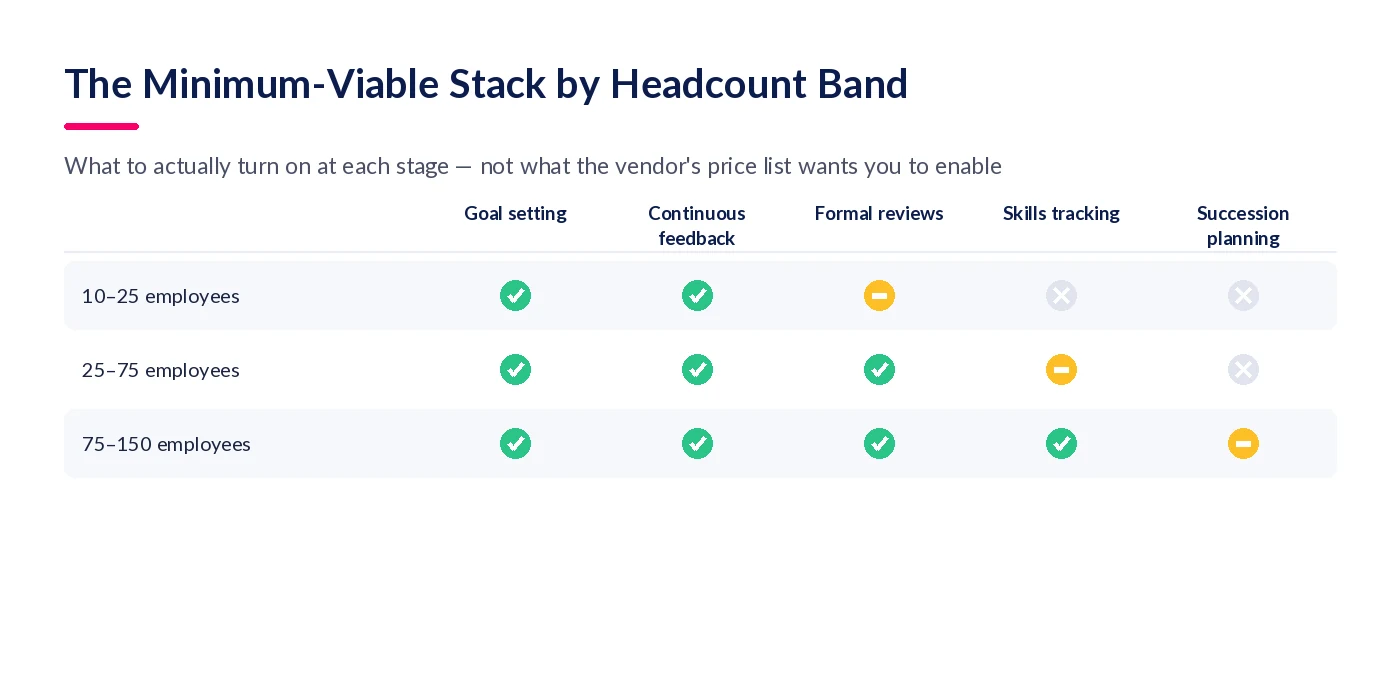
10–25 employees: Goal setting and lightweight continuous feedback earn their cost immediately; a formal review cycle is worth turning on but can stay simple. Skills tracking and succession planning are very rarely worth the setup time yet — there usually aren't enough people in any one role for a structured skills matrix to tell you something a conversation wouldn't.
25–75 employees: This is where a proper formal review cycle starts paying for itself, because informal memory of who agreed to what starts breaking down across more than a couple of teams. Basic skills tracking becomes worth piloting in one function, particularly where you have obvious skill-dependent roles, but succession planning can usually still wait.
75–150 employees: Skills tracking earns a full rollout, not just a pilot, because you now have enough people in comparable roles to make comparison meaningful. Succession planning starts to matter for key roles, though rarely needs the full depth an enterprise succession module offers — a short list of ready-now and ready-later candidates per critical role is usually enough at this size.
Treat a vendor's refusal to give even an indicative price range without a discovery call as a signal in itself: software genuinely built for this end of the market tends to publish something close to a real number, because the sales cycle it is designed for does not assume a multi-week procurement process.
Where This Breaks Down
No One Configures It, So No One Uses It
This is the single most common failure mode, and it is almost entirely a capacity problem rather than a product problem. A tool that needs ongoing administration — permissions, review cycles, form changes — assumes someone is available to do that administration. In a company without a dedicated HR systems role, that job quietly falls to whoever set the tool up in the first place, and it stops the moment that person gets busy with something else.
Buying for the Company You'll Be in Three Years, Not the One You Have Now
It is tempting to buy headroom, especially when a vendor frames the bigger package as "future-proofing." The cost is not just money: every module you switch on before you need it is one more thing a manager has to understand, ignore, or misuse. Buy for your current headcount band, and treat the ability to add a module later as the actual future-proofing, rather than switching everything on up front.
Frontline and Deskless Staff Get Left Out
Most of the guidance in this category is written as if every employee sits at a desk with a laptop, which is a poor assumption for an SME in retail, hospitality, care or trades. If a meaningful share of your team works shifts, works remotely from a site, or shares a device, that has to be a shortlist question from the start — not a limitation you discover after rollout when half the workforce can't reasonably reach the tool.
It Becomes a Compliance-Only Ritual
Acas's own guidance notes that "the number of performance meetings held will vary from one employer to another. Some managers find that monthly reviews work well, while others only meet quarterly," while "most managers hold an annual review." A tool that only gets opened for that one annual event stops being a performance management tool and becomes a compliance record nobody looks at between cycles — which defeats the purpose of buying software over a paper form in the first place.
Live in 30 Days
- Week 1: Name the one problem the software has to solve, agree who owns the rollout, and shortlist two or three vendors on setup time rather than feature count.
- Week 2: Configure one pilot team's cycle, including real goals and a real review date — not placeholder data.
- Week 3: Run the pilot team's first cycle and collect specific friction points, not just a general reaction.
- Week 4: Fix what broke in the pilot, then roll out to the rest of the company with managers who already know what to expect.
How StaffCircle Fits a Growing SME
One System a Manager Can Actually Run
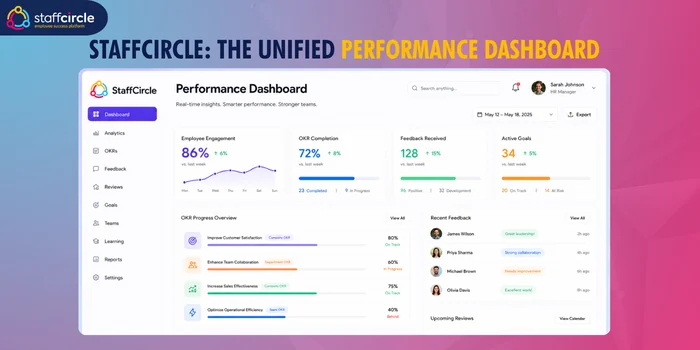
StaffCircle brings goals, feedback and reviews into a single unified dashboard rather than a set of disconnected tools a manager has to check separately, so a team's first cycle can be configured without a systems project behind it.
Room to Add Skills and Succession When You Actually Need Them
As a growing SME crosses into the headcount band where a competency framework or succession planning starts to earn its keep, those modules sit inside the same platform rather than requiring a second system and a second login to manage.
AI Assist Covers the Admin a Small Team Doesn't Have Spare
StaffCircle's AI Assist can draft review summaries and surface who has gone quiet on their goals, which matters most precisely where there is no dedicated HR admin with time to chase that manually.
Built to Reach Deskless and Frontline Teams
For SMEs where not everyone sits behind a laptop, StaffCircle is designed to be reachable by frontline and deskless employees rather than assuming universal desk access, so the rollout doesn't quietly exclude a chunk of the workforce.
Final Thoughts
The best performance management software for a small business is rarely the one with the longest feature list. It is the one a manager can configure without help, that matches what your current headcount band actually needs, and that stays open between review cycles rather than only appearing once a year. Get those three things right and the rest of the shortlist mostly sorts itself out.
If you want to see how goals, feedback and reviews work together in one system sized for where your company actually is, book a demo and we'll walk through it against your own headcount and structure.
FAQ
What is performance management software for small business?
It is a tool that supports the core cycle of setting goals, giving feedback and running reviews, sized and priced for a company without a dedicated HR systems administrator to configure and maintain it.
How much does performance management software cost for a small business?
Pricing across this category is typically per seat per month, but many vendors do not publish a number and instead require a sales conversation before disclosing one. Treat that reluctance as useful information: software genuinely built for smaller companies tends to publish something close to a real price, because its sales process does not assume a lengthy procurement cycle.
Do small businesses actually need performance management software, or can they manage without it?
Acas's own guidance for small firms treats performance management primarily as a management conversation, not a software requirement — its guide for small firms is built around a paper appraisal form and never mentions software. Software becomes worth adding once informal tracking starts breaking down: missed reviews, no visibility on who is working towards what, or feedback that only happens once a year.
What is the difference between performance management software and an HRIS?
An HRIS holds system-of-record employee data such as contracts, absence and pay. Performance management software runs the ongoing cycle of goals, feedback and reviews on top of that data. Some platforms bundle both; many SMEs run a separate HRIS and add a dedicated performance layer once the informal process stops scaling.
Is performance management software the same as an appraisal system?
Not quite. An appraisal system is the underlying process — setting objectives, agreeing competencies, planning development, and reviewing progress. Performance management software is a way of running that process digitally rather than on paper, but the process itself, per Acas's own guidance, is often just formalising what a line manager and employee are already doing informally.
How is a "small business" or SME actually defined in the UK?
Under the Procurement Act 2023 supplementary guidance, an SME has fewer than 250 full-time-equivalent staff and either £44m or less in annual turnover or £38m or less on the balance sheet. SMEs made up 99.9% of the UK business population at the start of 2024, with 99.2% of that population employing fewer than 50 people.
How long does it take to implement performance management software in a small company?
For a genuinely SME-sized product, a manager should be able to configure a real review cycle for their own team within days rather than weeks. If a vendor's answer involves a consultant-led requirements-gathering phase before anyone can use it, that is usually a sign the product is built for a much larger organisation.
Can we replace our performance review spreadsheet with software, and is it worth it?
A spreadsheet can hold review dates and ratings, but it has no reminders, no history a manager can search across cycles, and nothing that prompts a conversation between reviews. It is usually worth replacing once you notice reviews slipping, feedback happening only once a year, or nobody being able to find what was agreed last cycle.
What features does a 10–25 person company actually need, compared with a 100-person company?
A 10–25 person company typically gets full value from goal setting and continuous feedback, with a simple formal review cycle, but rarely needs skills tracking or succession planning yet. A company nearer 100 people usually has enough people in comparable roles to make a proper skills matrix worthwhile, and key-role succession starts to matter.
Who should configure and run performance management software if we don't have an HR team?
Usually a general manager, operations lead or the founder, at least for the first cycle. Before buying, check that a non-specialist could realistically configure a team's first review cycle in an afternoon — if the honest answer requires outside help, the product is probably scaled for a larger organisation than yours.
Does performance management software work for deskless or frontline small business teams?
Not all of it does, and this is one of the most overlooked shortlist questions. If a meaningful share of your team works shifts, works on-site without a laptop, or shares a device, confirm mobile access and offline-friendly design before buying, rather than discovering the gap after rollout.
What is the biggest reason performance management software fails to get adopted in a small company?
Administrative capacity, not features. The tool typically needs someone to keep configuring it — cycles, permissions, form changes — and in a company without a dedicated HR systems role, that job falls to whoever set it up first and stops the moment they get busy with something else.
Related articles
See StaffCircle in action
Book a personalised demo and see how StaffCircle drives performance, engagement and development.