The Mid-Year Performance Review: What to Cover and How to Make It Count
It is the last week of October. Hannah runs operations at a distribution business whose performance year starts in April, and she has eleven mid-year reviews to finish by Friday. The form HR sent round is the year-end appraisal form with the word “interim” added to the title. It asks for a rating out of five on every objective.
Two of those objectives were written for a customer contract that ended in August. One of her team leaders has been on a phased return from sick leave since July. Another moved to four days a week in September. If Hannah fills in the form as designed, she will score people against a plan that stopped existing months ago, and nobody will learn anything from it.
Almost every mid-year review problem I have seen starts here: treating the halfway point as a smaller version of the annual review, when it is the one moment in the year built for changing course.
A mid-year performance review is a structured check-in at the halfway point of the performance year. It looks at progress against objectives, checks development, surfaces risks while there is still time to act, and resets the plan for the second half. Done well, it re-baselines objectives with recorded reasons and produces a short written record, rather than a rating.
Key facts
- There is no UK legal requirement to hold appraisals; Acas advises reviewing employees at least once a year.
- Acas says a written record of the review should be shared with the employee afterwards.
- Employees can request their appraisal notes through a subject access request, normally answered within one month.
- Part-time workers are protected from less favourable treatment, with the pro rata principle applied unless inappropriate.

A checkpoint, not a smaller annual review
The mid-year review exists to answer one question: given everything we now know, what should the next six months look like? The annual review judges a year that has finished. The mid-year review can still change the outcome of the year it sits in, which is why it deserves its own design rather than a cut-down version of the year-end form.
Acas describes performance reviews as a chance to discuss what someone is doing well, any areas for improvement, whether they need more support or training, and their career and development objectives (Acas, Reviews and appraisals). At the halfway point, each of those becomes a forward-looking question. A useful mid-year review should leave you able to answer:
- Which objectives are still the right objectives, and which have been overtaken?
- For each objective that stays, is it on track, at risk or off track, and what is the evidence?
- What has got in the way, and how much of it was in the employee’s control?
- What has the person learned, and what development would help most in the second half?
- Is there a performance concern that needs naming now, while there is time to support improvement?
- What will the manager do differently?
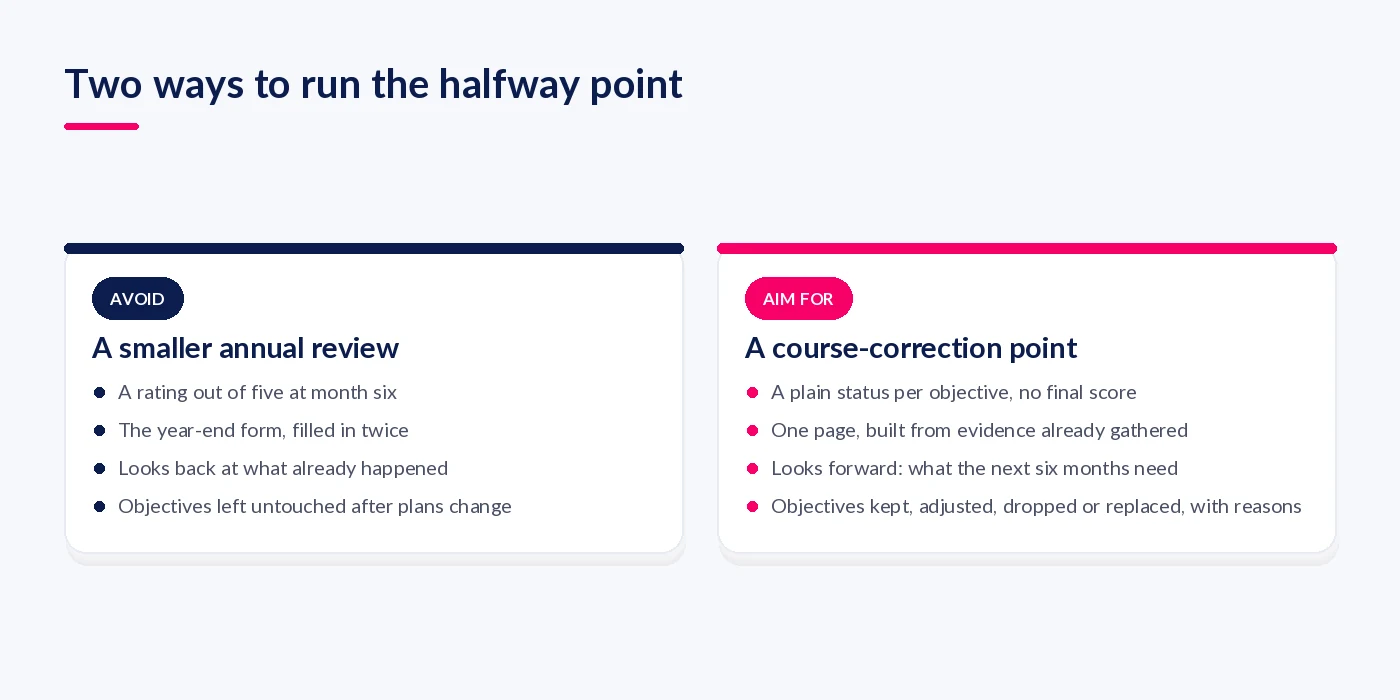
Notice what is missing from that list: a score. A rating at six months tends to anchor the year-end result, and it pulls the conversation towards defending a number. A plain status per objective (on track, at risk, off track) does the same job without the argument.
The half-year re-baseline nobody writes down
Most mid-year guidance says “revisit goals” and moves on. The step that actually protects fairness at year-end is more specific: decide what happens to each objective, and write down why.
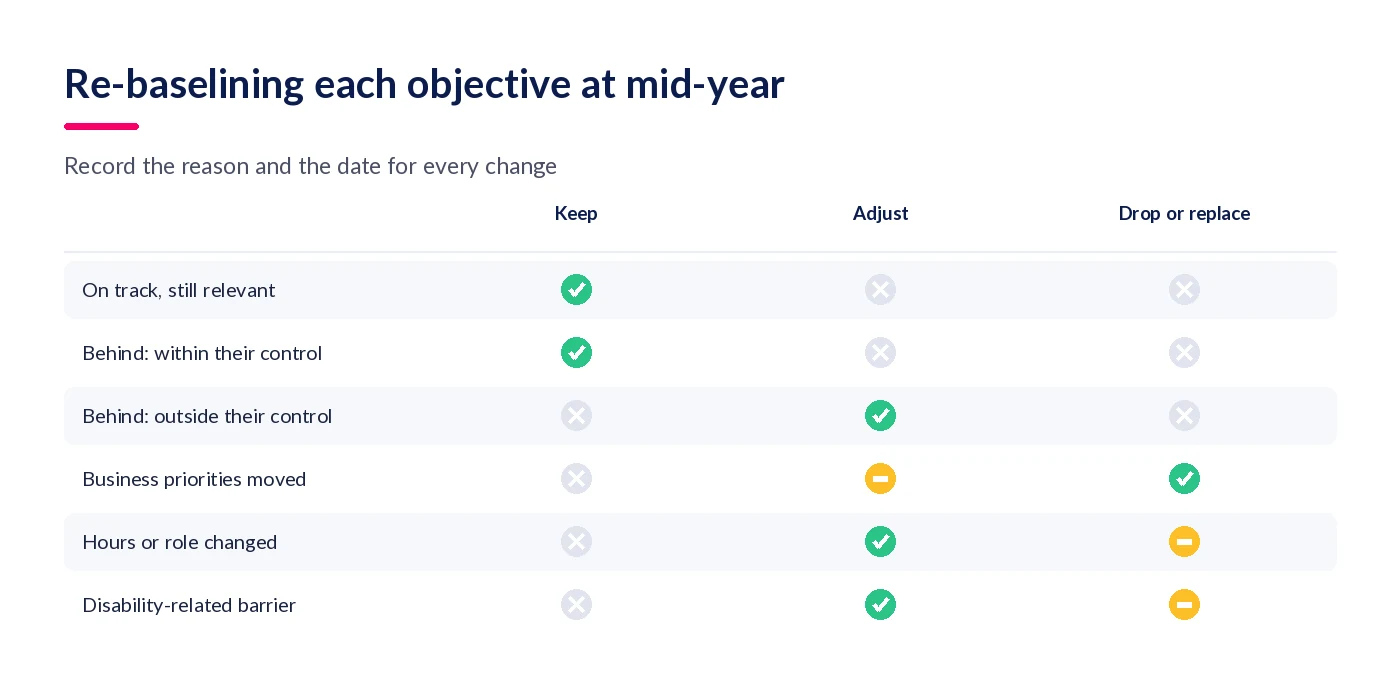
Every objective gets one of four outcomes. Keep it if it is still relevant, whether or not it is on track. Adjust the target or deadline if circumstances outside the person’s control have moved it. Drop it if the business no longer needs it. Replace it with whatever the work has actually become. Then record the reason and the date. Without that record, the year-end review quietly judges people against the January or April plan, and the person whose project was cancelled in month four looks like an underperformer.
When hours or availability have changed
Hannah’s team leader who moved to four days a week still has objectives set for five. The Part-time Workers Regulations give part-time workers the right not to be treated less favourably than a comparable full-time worker, and say the pro rata principle applies unless it is inappropriate (regulation 5). The mid-year review is the obvious place to pro-rate volume targets and record that you did.
When someone is on, or returning from, maternity leave
Do not run a review that judges the leave. The Equality Act makes it discrimination to treat a woman unfavourably because she is exercising, or has exercised, her right to maternity leave (section 18). Reasonable contact, for example to discuss the return to work, does not end maternity leave, and an employee may work up to ten keeping-in-touch days, though neither side can require them (regulation 12A). If someone returns mid-year, re-baseline their objectives for the time they will actually be at work.
When a disability or health condition is affecting performance
The duty to make reasonable adjustments applies where a provision, criterion or practice puts a disabled person at a substantial disadvantage (Equality Act, section 20). A target is a criterion. Acas notes that capability issues can sometimes be resolved through adjustments such as more time for written tasks or changed shift patterns (Acas, Problems with an employee’s performance). The phased return Hannah’s team leader is on should be reflected in what she is measured against.
Write it as if they will read it, because they can
The ICO lists “Can I have a copy of the notes from my last appraisal?” as an example of a valid subject access request, and employers must normally respond within one month (ICO, Subject access request Q and As for employers). Its worked example also shows an employer redacting comparisons with colleagues before releasing pay review notes. Practical consequence: keep mid-year notes factual, specific and about the person in front of you.
Running it in six steps
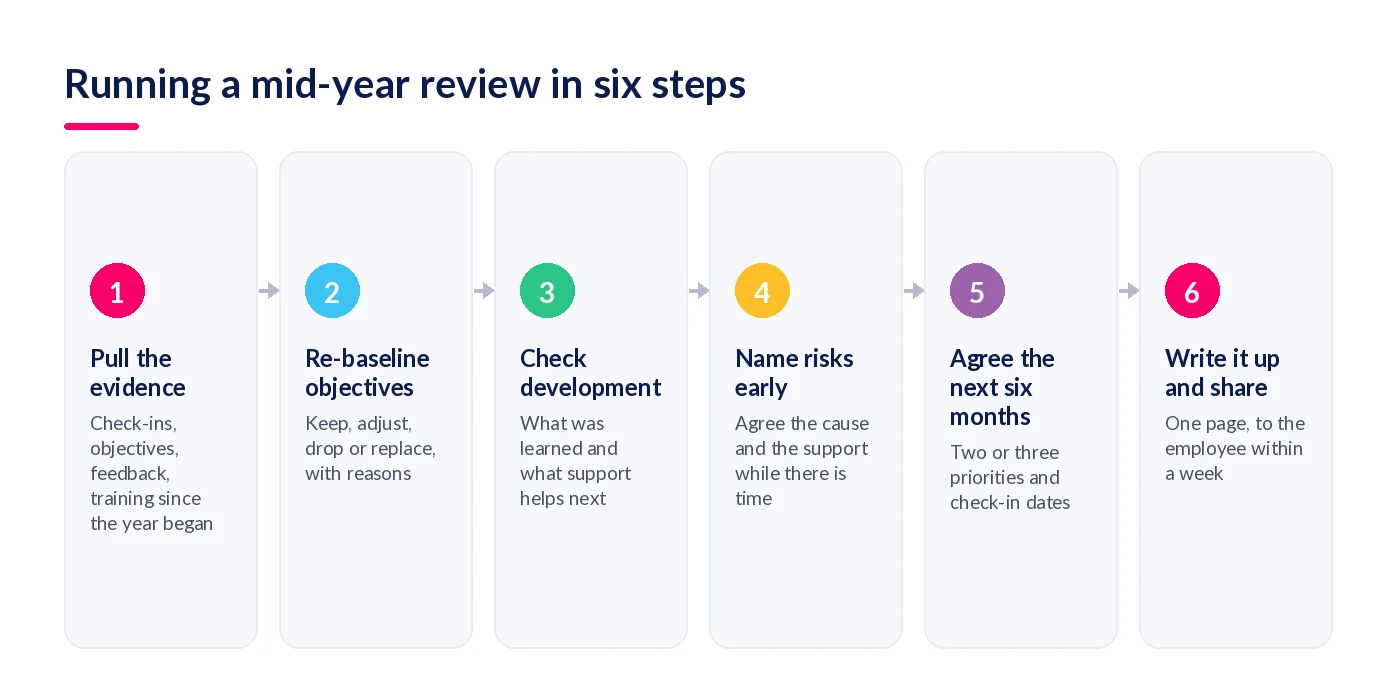
The meeting itself should take 45 to 60 minutes for most roles. The work that makes it short happens before and after.
- Pull the evidence before the meeting. Collect check-in notes, objective progress, feedback received and any training completed since the year began. Ask the employee to do the same, and to bring a view on which objectives should change. If evidence is thin, that is itself a finding about how often you have been meeting.
- Re-baseline every objective. Go through each objective and agree keep, adjust, drop or replace, using the matrix above. Record the reason and the date. Acas says objectives should be fair and reflect the employee’s usual tasks and workload; the halfway point is where you check they still do.
- Check development, not just delivery. Look at the development plan as seriously as the delivery objectives. What has the person learned? What do they want to be doing in a year? Which single piece of support, training or stretch work would help most before year-end?
- Name risks while there is time to act. If an objective is at risk or there is a performance concern, say so plainly. Agree the cause first: Acas separates capability, which support and training can address, from conduct. Agree the support you will offer. Year-end should never be the first time someone hears it.
- Agree the next six months. Leave with two or three priorities, not a long list, plus the support each needs and the dates of the check-ins where you will look at progress. Ask what you should do differently as their manager, and write that down too.
- Write it up and share it within a week. Acas advises keeping a written record of what is discussed and sharing it with the employee afterwards (Acas). One page is enough: objective status, changes with reasons, development focus, risks and support, next check-in dates.
If you want a deeper treatment of the year-end conversation that this one feeds, our guide to how to conduct performance reviews covers it, and The Ultimate Guide to Performance Reviews includes templates you can adapt.
Five ways mid-year reviews go wrong
It becomes a second form-filling exercise
If the mid-year form is the annual form with fewer boxes, managers will treat it as admin, and employees will notice. Cut it to the six questions above. Anything else should already live in your check-in notes.
Objectives are reviewed but never changed
Talking about a cancelled project, then leaving its objective untouched, guarantees an unfair year-end. Change the record, not just the conversation.
The bad news is saved for December or March
Acas’s guidance is that employers should try to help someone improve before any formal procedure. That needs time. A concern first raised at year-end leaves none. If the mid-year review shows a real gap, it may be the moment to agree a structured plan; our guide to performance improvement plans explains how to do that fairly.
Ratings drift without calibration
Even status labels drift. One manager’s “at risk” is another’s “on track”. A short cross-team look at mid-year statuses catches it while it is cheap to fix, using the same discipline as performance review calibration at year-end.
Frontline and shift teams are left out
Reviews built around a desk and a meeting room quietly skip people on rotas. A 30-minute conversation at the start of a shift, captured on a phone or tablet, beats a review that never happens.

The questions and the one-page record
Good mid-year questions look forward from evidence. Mix ones the manager asks with ones the employee should ask back. For more on phrasing, see asking the right performance check-in questions, and encourage employees to use a self-evaluation as preparation.
| Purpose | Manager asks | Employee asks | What to record |
|---|---|---|---|
| Progress | Which objective are you proudest of so far, and what is the evidence? | Which of my results matter most to you this year? | Status per objective with one example |
| Relevance | Which objectives no longer make sense? | Have the team’s priorities changed since we set these? | Keep, adjust, drop or replace, with reason and date |
| Obstacles | What has got in your way, and what was in your control? | What could you remove from my plate? | Blockers and owner for each |
| Development | What have you learned, and what do you want to learn next? | What would I need to show to be ready for the next step? | One or two development actions |
| Support | What should I do differently as your manager? | What support can I count on in the next six months? | Manager commitments |
The written record that follows should fit on a page:
- Objective-by-objective status: on track, at risk or off track, with evidence.
- Changes to objectives, each with its reason and the date agreed.
- Development focus for the second half.
- Any concern raised, its agreed cause and the support offered.
- Manager commitments.
- Dates of the next check-ins.
Back to Hannah. Using that structure, her eleven reviews took most of Thursday rather than all week. Two objectives were dropped and replaced, with the end of the customer contract recorded as the reason. Her team leader on a phased return had targets adjusted to her actual hours. One person heard, for the first time, that their quality figures were a concern, with five months still left to fix it.
Where StaffCircle fits
Software does not make a mid-year review good. It removes the reasons managers skip the preparation and the write-up.
Evidence that is already there
StaffCircle records one-to-one check-ins, feedback and objective updates as they happen through the year, so step one is a matter of opening the employee’s record rather than reconstructing six months from memory.
Objectives you can change with a history
Objectives and key results sit in one place and link to team and company goals. When a priority moves at mid-year, the objective can be updated and the change stays visible, which is exactly the audit trail the year-end review needs.
Development alongside delivery
Success Circles show where someone’s skills and performance sit against what their role needs, so the development half of the conversation starts from the same evidence as the delivery half.
Review templates that fit the halfway point
Configurable review templates let HR run a short mid-year form, separate from the year-end appraisal, with a shared record that both people can see afterwards. See how it works across the performance management and development platform, or read our overview of what a performance management system does.
Make the second half count
A mid-year review earns its place when something changes because of it: an objective dropped, a target made fair, a concern raised while there is time, a development step agreed. If nothing changes, it was a form. Keep it short, keep the evidence ready, write down every change and why, and share the record within a week.
If you would like to see how StaffCircle supports mid-year reviews, check-ins and objectives in one place, book a demo.
FAQ
What is a mid-year performance review?
A mid-year performance review is a structured conversation at the halfway point of the performance year. Manager and employee look at progress against objectives, check development, raise risks early and agree any changes for the second half. It is a course-correction point rather than a final judgement, so it usually carries no formal rating.
When should a mid-year review take place?
Hold it at the halfway point of your own performance year, not the calendar. For a January to December cycle that means June or July. For an April to March cycle it falls in October or November. Schedule it a few weeks before any mid-year budget or headcount decisions so the evidence can inform them.
Should you give a rating at a mid-year review?
Usually not. A rating at the halfway mark invites people to argue about the score instead of the plan, and it can anchor the year-end result too early. Record a plain status for each objective instead, such as on track, at risk or off track, with the evidence behind it.
How long should a mid-year review take?
For most roles 45 to 60 minutes is enough when the evidence has been gathered beforehand from check-ins, objectives and feedback. If the meeting regularly runs much longer, the preparation is probably happening in the room. Book longer only where objectives need substantial re-planning or there is a performance concern to discuss.
What questions should a manager ask in a mid-year review?
Ask questions that look forward from evidence. Which objectives still matter, and which no longer do? What has got in the way, and what is in your control? What have you learned since January or April? What support or training would make the biggest difference? What should I do differently as your manager?
How should an employee prepare for a mid-year review?
Spend twenty minutes before the meeting listing progress against each objective with an example or figure, anything that has blocked you, and one or two development goals for the second half. Note any objective you think should change and why. Bringing a proposal makes the conversation about planning rather than defending.
Can objectives be changed at the mid-year review?
Yes, and they often should be. Keep, adjust, drop or replace each objective based on what has changed since it was set. Write down the reason for every change and the date it was agreed, so the year-end review judges the person against the objectives they were actually working to.
Is a mid-year review a legal requirement in the UK?
No. There is no statutory requirement for appraisals of any kind. Acas advises that employers conduct regular performance reviews for employees and suggests doing them at least once a year. A mid-year review is a management choice, but the records it produces can matter later in a capability process or a dispute.
What if someone is on maternity leave at mid-year?
Do not hold a performance review that judges the leave period. Reasonable contact, such as discussing the return to work, is allowed and does not end maternity leave. Keeping-in-touch days are optional for both sides. On return, re-baseline objectives so the person is not measured against targets set for a full year at work.
Can an employee ask to see their mid-year review notes?
Yes. Review notes are personal data, and the ICO gives a request for the notes from an appraisal as an example of a subject access request. Employers must normally respond within one month. Write every note as if the employee will read it, because they are entitled to.
What should happen if the mid-year review uncovers underperformance?
Name it clearly, agree why it is happening, and decide on support. Acas says employers should try to understand the cause, separate capability from conduct, consider reasonable adjustments, and help someone improve before any formal procedure. A mid-year review is often the right moment to start that, not the year-end.
What is the difference between a mid-year review and a one-to-one?
A one-to-one is a short, frequent conversation about the work in front of you this week or month. A mid-year review steps back to look at the whole half-year, resets objectives and development plans, and produces a written record shared with the employee. Good one-to-ones make the mid-year review quicker to prepare.
Related articles


See StaffCircle in action
Book a personalised demo and see how StaffCircle drives performance, engagement and development.