How to write a self-evaluation
A self-evaluation is your own written assessment of your performance over the review period, organized under the same objectives and competencies your manager will rate. Group your evidence, attach a number or a named beneficiary to every claim, name one real gap, and close with one specific request.
Key facts
- Managers frequently draft their assessment after reading yours, so submit it early.
- Under-claiming costs more ratings than over-claiming. Numbers fix both.
- One honest gap, with a fix attached, makes every other claim more credible.
- Structure it under the same objectives and competencies you are rated against.
- Half a page per objective is plenty. Length is not evidence.
How to write a performance review for yourself?
Write it in four moves: gather everything from the period, group it under the objectives and competencies you are rated on, quantify each claim, then close with one gap and one ask. Most people start writing at move three and produce a page of adjectives, because the evidence was never collected and the structure was never decided.
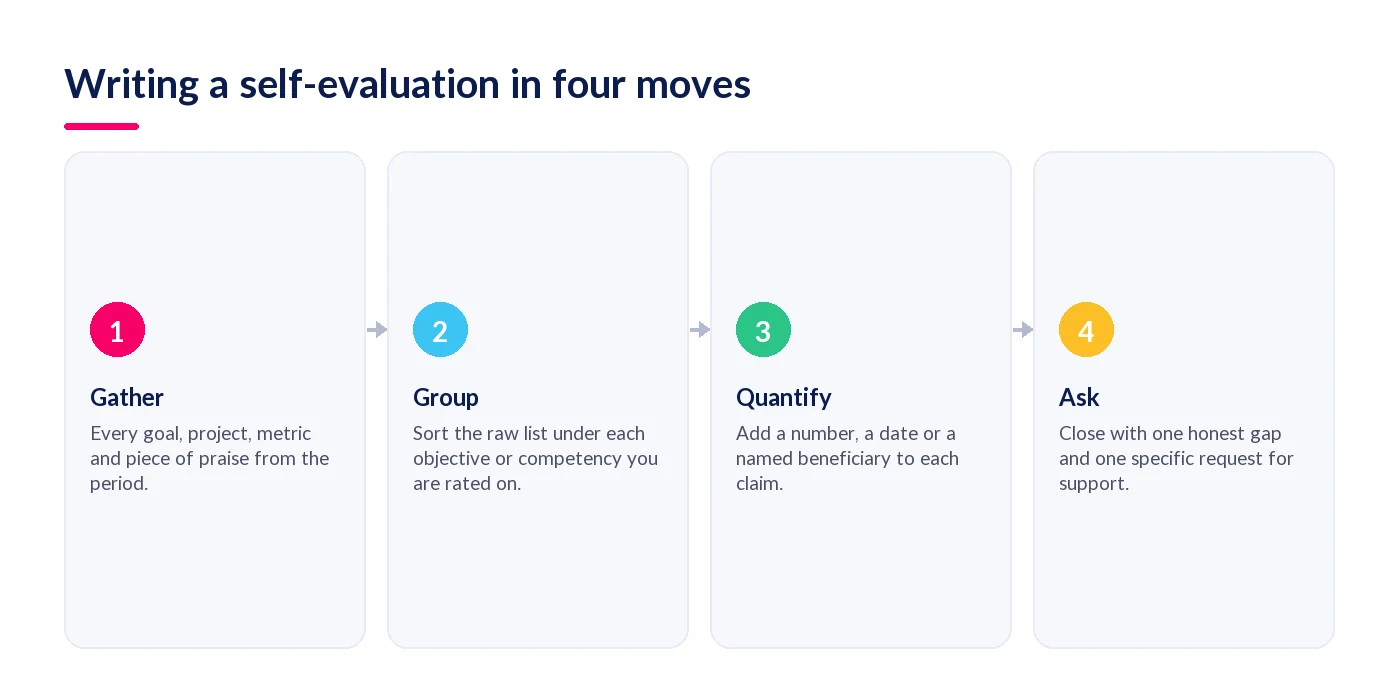
- Gather. Work back month by month through your calendar, sent items, project boards, metrics and any thanks you received. Write a raw list — results, dates, numbers, names. Do not judge or edit anything yet. Ten minutes per month recovers work you would otherwise lose entirely, and it is the single highest-value part of the exercise.
- Group. Sort that raw list under the objectives you were set and the competencies your form asks about. Anything that does not fit either goes in a short “other contributions” section at the end. Grouping this way means your evaluation reads in the same order as your manager’s form, which makes it far more likely to be used.
- Quantify. Give every claim a number, a date or a named beneficiary. “Improved the reporting process” becomes “rebuilt the weekly sales report in April, cutting the run from three hours to twenty minutes.” Where nothing can be counted, name who saw it: “the two new starters I onboarded were handling calls unsupervised by week three.”
- Ask. Finish with one gap you own and one specific request. The gap should have the corrective action already attached, and the request should be small enough to say yes to — a course, a piece of scope, a decision, a quarter of shadowing. Vague asks get vague answers.
What does a good self-evaluation look like?
It reads as evidence rather than advocacy, and it takes roughly half a page per objective. Below is a worked example for an operations analyst with four objectives — wording you can lift and refill with your own facts. Note what it does with the objective that went badly: it names it early, explains the cause without blaming anyone, and states what changed as a result.
Objective 1 — automate the weekly sales report. Complete. I rebuilt the report in April; preparation went from about three hours a week to under twenty minutes, which returns roughly a day a month to the team. Two managers now pull it themselves rather than requesting it, and the version history removed the recurring question about which numbers were current.
Objective 2 — support the warehouse migration. Complete. I owned the data validation workstream, including the pre-cutover sign-off checks. We went live on 31 October with no rollback and two minor data corrections, both fixed inside a day.
Objective 3 — reduce month-end corrections. Partly met. Corrections fell from four a quarter to one, short of the zero we agreed. The remaining case came from the discount column, which is still a manual entry. I have drafted a second-pair check and would like to put it in place from January.
Objective 4 — the CRM data cleanse. Not met. I underestimated how much of the data needed manual checking, and I did not raise the risk until the deadline was already at stake. Since June I have flagged slippage risks at the fortnightly check-in instead, and the migration workstream stayed on schedule as a result. I would like to restart the cleanse in Q1 with a scoped sample first.
Beyond the objectives. I onboarded two new analysts; both were working unsupervised by week three against a normal ramp of six weeks. I also took on the reporting workload when a colleague left in June, and the weekly pack stayed on schedule throughout.
My gap. I raise problems later than I should. The change above has helped, but I want a clearer rule for it, which is why I am asking for the next item.
My request. I would like to shadow the pricing meetings for one quarter. I keep reaching the edge of what I can decide alone, and that is currently the limit on how much of the reporting work I can own end to end.
Four things make that example work: it is organized to match the review form, every claim carries a number or a witness, the failed objective is named before anyone has to ask about it, and it ends with one request rather than five. For more sample structures and phrasing, our self-appraisal examples cover several formats, and what an appraisal is explains where the self-evaluation sits within the wider process.
What mistakes do people make in a self-evaluation?
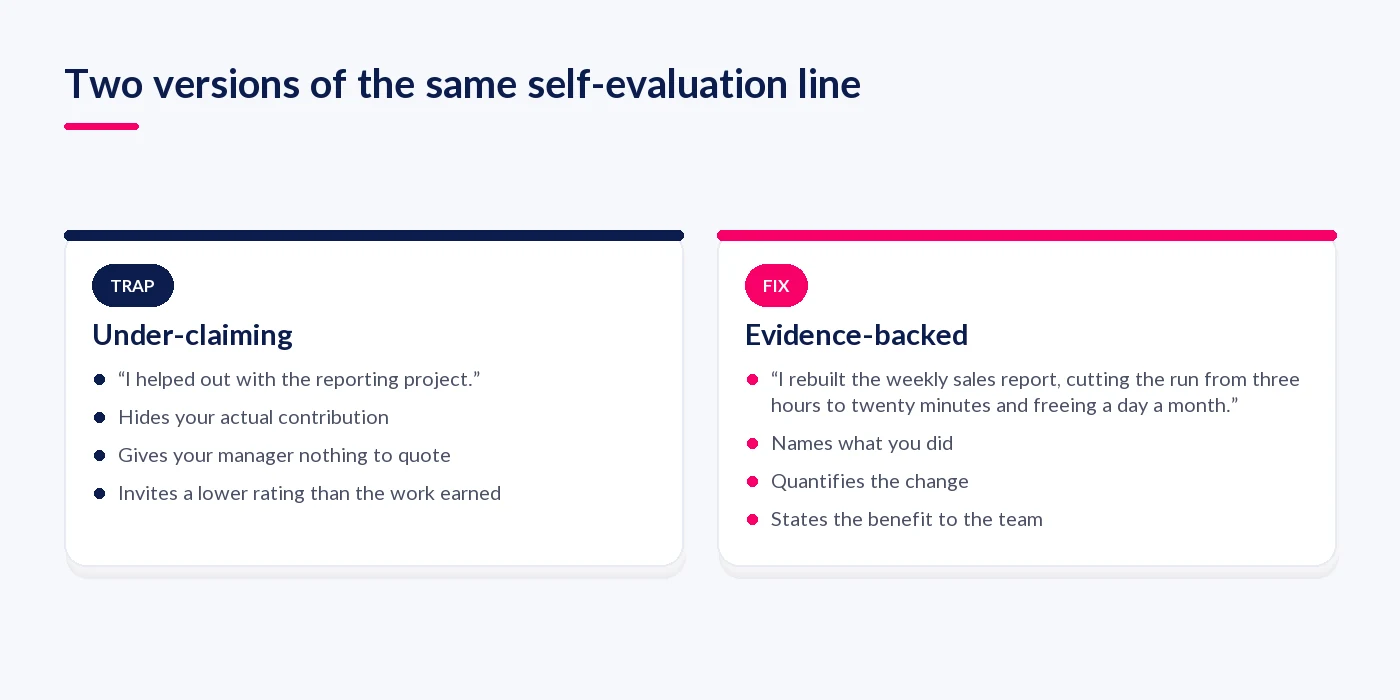
Eight traps account for nearly all weak self-evaluations, and only two of them involve exaggerating. The more expensive mistakes are the quiet ones: hedging your best work, listing tasks instead of outcomes, and writing only about the last two months. Each row below has the fix as a form of words you can use directly.
| Trap | What it looks like | Why it costs you | The fix |
|---|---|---|---|
| Over-claiming | “Led the migration project.” — when you were one of four people on it | Your manager checks with the others, and it costs you credibility on the wins that were genuinely yours | Name your actual part: “Owned the data validation workstream on the migration, including the pre-cutover sign-off checks.” |
| Under-claiming | “Helped out with the reporting project.” | Gives your manager nothing to quote, and invites a lower rating than the work earned | “Rebuilt the weekly sales report; run time went from three hours to twenty minutes, freeing about a day a month.” |
| Vagueness | “Worked hard and delivered consistently all year.” | Unverifiable, so it gets skipped — it is the sentence every self-evaluation contains | Attach a number, a date or a named beneficiary to every claim you make. |
| Listing tasks | “Answered tickets, attended planning meetings, kept the tracker updated.” | Describes the job description rather than your performance in it | Convert each task to an outcome: what was different because you did it? |
| Recency bias | Only the last six or eight weeks appear | You lose most of your own evidence, and the early wins go unrated | Work back month by month through your calendar, sent items and project boards before writing. |
| Blaming | “The project slipped because Finance was slow to approve.” | Reads as deflection even when it is accurate | State the constraint, then what you did about it and what you would do differently next time. |
| No gap named | Everything is presented as having gone well | Your manager then supplies the gap, in their words rather than yours | Name one real gap, with the corrective action you have already started. |
| No ask | The evaluation ends with a summary and nothing else | You waste the one scheduled moment when scope, training and budget get allocated | Close with one specific request: a course, a piece of scope, or a decision you need. |
The under-claiming row is the one worth rereading. People worry about sounding arrogant and hedge their strongest evidence into invisibility — and because a manager writing twelve reviews will quote the specific sentences and skip the vague ones, the hedged version quietly lowers the rating. Stating what you did, with a number attached, is not boasting; it is the format the document is asking for.
How long should a self-evaluation be?
Roughly half a page per objective, plus a short section for anything outside them — usually one to two pages in total. If a section runs longer than that, it is normally because evidence is thin and description is filling the space. A tight, quantified page is more persuasive than three pages of context, and far more likely to be read closely.
Give yourself two weeks rather than one evening, and submit it before your manager drafts their assessment — a late self-evaluation has no influence at all on the rating. Our guide to preparing for a performance review covers the rest of that preparation, including what to say in the meeting itself and how to disagree with a rating if you need to.
It also helps to see the other side of the desk: what your manager has been asked to gather, how they are supposed to word a comment, and why a rating should never be a surprise. Our guides to conducting performance reviews and writing a performance review set that out, and the Ultimate Guide to Performance Reviews is the longer version if your organization is redesigning its cycle.
Frequently asked questions
What should you not put in a self-evaluation?
Leave out complaints about named colleagues, claims you cannot evidence, and personal circumstances you would not want on a permanent record. Do not use it to negotiate pay, and do not list your job description back. Keep it to what you did, what changed, and what you need next.
How do you write about weaknesses in a self-evaluation?
Name one real gap, not a disguised strength, and attach the action you have already taken. For example: I raised delivery risks too late, so since June I have flagged them at the fortnightly check-in. That format shows judgment rather than exposing you, and it usually improves how the rest is read.
Should you rate yourself highly in a self-evaluation?
Rate yourself where the evidence puts you, and show the evidence next to the rating. A high rating with numbers attached is easy to defend; a high rating with adjectives is not. Systematically rating yourself low does not read as modest, it reads as agreement with a lower rating.
What is the STAR method in a self-evaluation?
STAR stands for situation, task, action, result. You describe the context, what you were responsible for, what you personally did, and what changed as a consequence. It is a useful shape for your two or three strongest examples, though it becomes repetitive if every paragraph follows it.
How do you write a self-evaluation after a difficult year?
State the outcome plainly, explain the cause without blaming individuals, and show what you changed once you understood it. Then give equal space to what did work, because a difficult year almost never means nothing went well. Finish with the support that would make next period different.
Related articles
See StaffCircle in action
Book a personalised demo and see how StaffCircle drives performance, engagement and development.