Job Architecture and Competency Frameworks: Building Levels That Mean Something
Most job architectures are pay structures wearing a career framework’s clothes. They start life in reward, as a way of putting jobs into grades so salaries can be benchmarked, and they are good at that. Ask a manager what separates a level 4 analyst from a level 5 analyst, though, and you usually get a salary range and a shrug.
That gap matters. When a level only reliably tells you the pay band, promotion becomes a negotiation, two teams use one title for very different jobs, and nobody can tell an employee what they need to do differently to move up.
The fix is not a bigger grading exercise. It is connecting the architecture to a competency framework, so each level is defined by observable scope and behaviour rather than by money.
Job architecture is the structure that sorts every role into job families and levels, with a consistent definition of what each level means. It becomes useful for careers, not just pay, when each level is defined by scope, autonomy and behaviour, and points to the competencies and proficiency expected there. That turns levels into explicit promotion criteria that managers can apply consistently.
Key facts
- Under the Equality Act 2010, work is “rated as equivalent” when a job evaluation study gives two jobs equal value in terms of the demands made on a worker (s.65).
- Where a job evaluation study has given two jobs different values, an employment tribunal must find they are not of equal value unless the study is discriminatory or otherwise unreliable (s.131).
- Acas advises up-to-date job descriptions, consistent job titles for the same work and one pay structure for the organisation.
- The EU Pay Transparency Directive requires pay structures based on skills, effort, responsibility and working conditions, with a transposition deadline of 7 June 2026.

Families, levels and the language in between
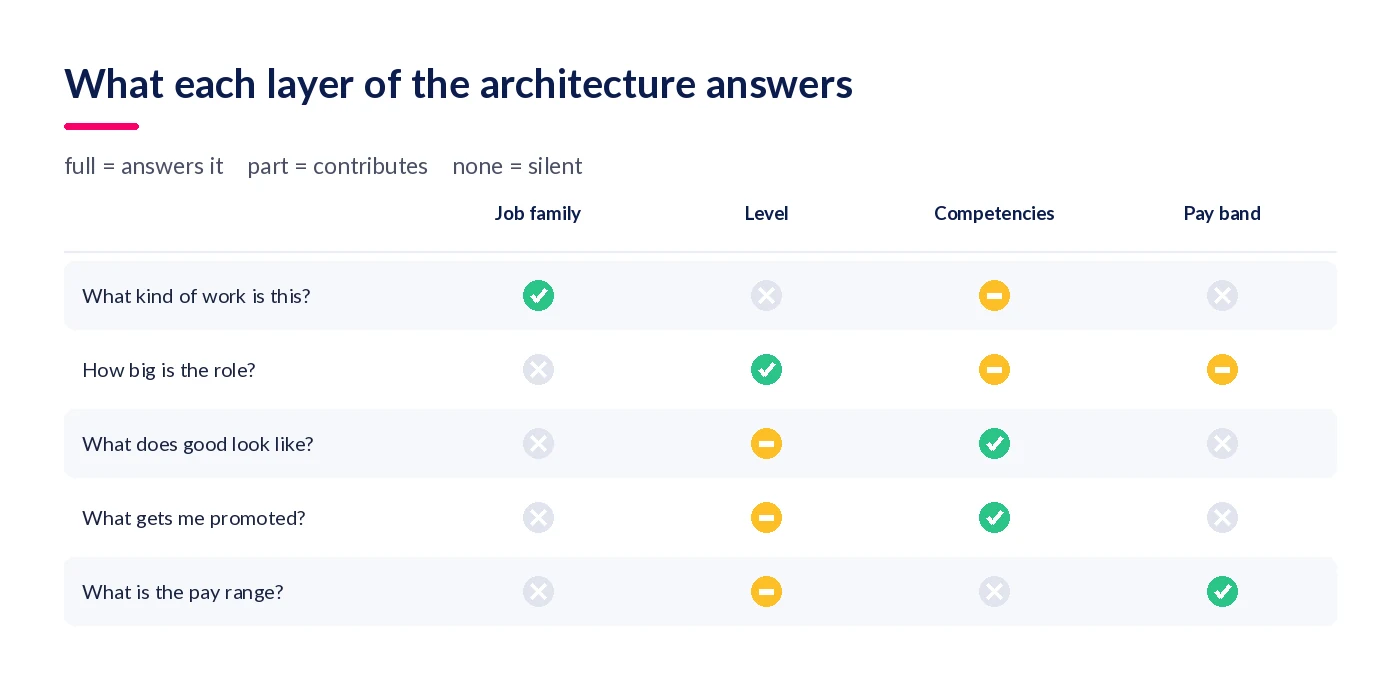
Strip away the jargon and a job architecture has three layers.
- Job families group roles that do related work and draw on similar skills: finance, engineering, customer service, people. Large organisations split these into sub-families, such as payroll within finance.
- Levels describe how big a role is: how much scope it carries, how much autonomy it has, how complex its problems are and how far its influence reaches. Ideally one scale runs across every family.
- Role profiles sit where a family and a level meet. A “level 3 payroll specialist” profile says what that role does and what it needs.
Pay bands, titles and career paths attach to that frame, and that is where most guides stop. The architecture answers “where does this job sit?” very well. It answers “what does good look like at this level?” badly, because nobody wrote that part down.
Before you build anything, write down the questions the structure must be able to answer:
- What kind of work is this role, and which family owns it?
- How large is the role compared with roles in other families?
- What skills and behaviours does someone need to be fully effective at this level?
- What would someone need to show to move to the next level?
- What is the pay range, and is it defensible if two roles are compared?
Why a grade is not a level
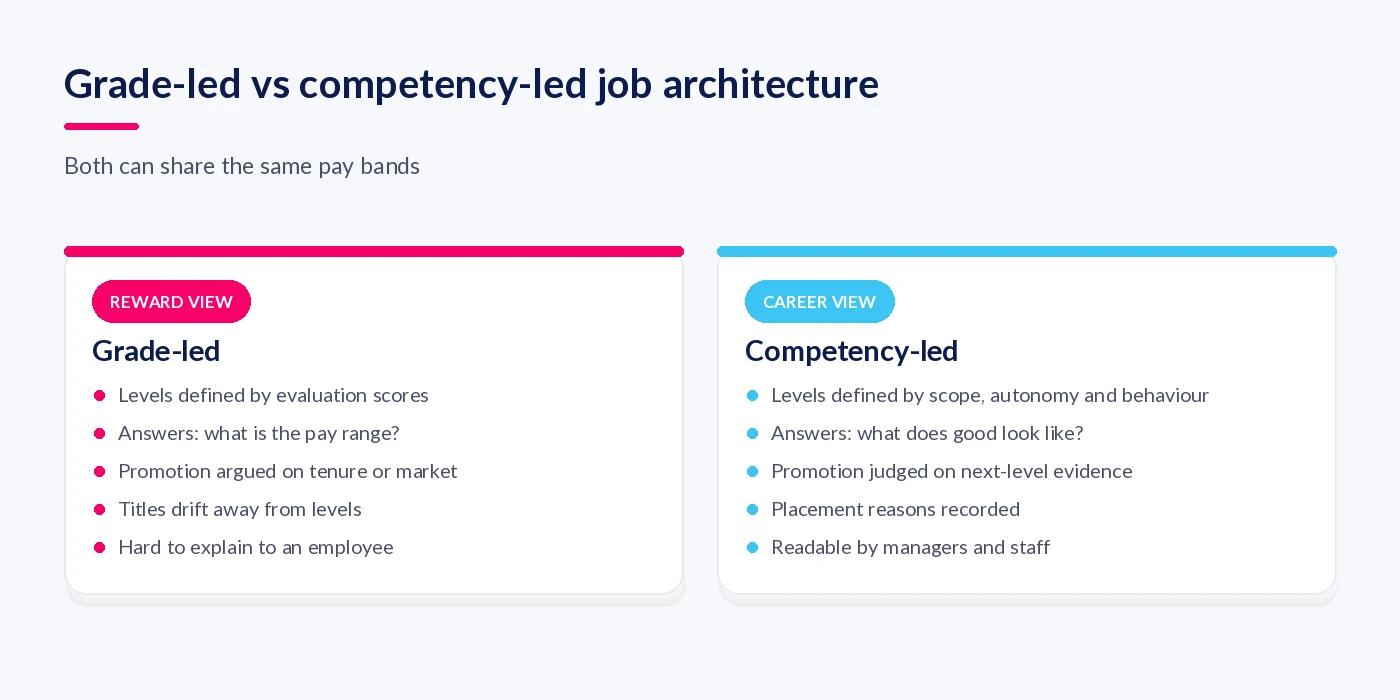
A grade is a pay container. A level is a description of work. The two often share a number, which is where the confusion starts.
Grade-led architectures evaluate jobs, score them and band the scores. That is legitimate, and legally valuable, as we will see. But the output is a number, and a number cannot coach anyone. Telling an engineer they are “grade 6” does not tell them whether they are expected to own a system, lead a small team or set technical direction.
A competency-led architecture starts at the other end. Each level is written as a short set of generic attributes that apply across families, typically covering:
- Scope: a task, a workstream, a team, a function, the organisation.
- Autonomy: close supervision, general direction, broad direction, setting direction.
- Complexity: routine problems with known methods through to novel problems with no precedent.
- Influence: own work, immediate team, across teams, outside the organisation.
This is not an invention. The SFIA framework uses seven levels of responsibility, from “Follow” to “Set strategy, inspire, mobilise”, each defined by generic attributes, and says those levels can serve as the basis for core competencies and mapping structures. If you work in digital or technical roles, our guide to the SFIA skills framework shows how that looks in practice.
Family-specific competencies then sit on top of the generic levels. The generic definition says a level 4 “guides others and works under general direction”. The finance competencies say what that means for month-end close; the engineering competencies say what it means for code review. Same level, comparable size, different technical content.
The part reward guides skip: your levels are evidence
Most job architecture content misses this. In the UK, how you define and compare jobs can decide an equal pay claim.
Under section 65 of the Equality Act 2010, one person’s work is equal to another’s if it is like their work, rated as equivalent, or of equal value. Work is “rated as equivalent” where a job evaluation study gives the two jobs an equal value “in terms of the demands made on a worker”. Section 80(5) defines a job evaluation study as one that evaluates jobs by reference to factors such as effort, skill and decision-making.
The sharper point is in section 131. Where a job evaluation study has given two jobs different values, the tribunal must find the work is not of equal value unless it has reasonable grounds to suspect the study discriminates because of sex or is otherwise unreliable. A sound, documented evaluation carries real weight. A levelling exercise done by negotiation and remembered by nobody carries none.
Acas guidance on equal pay points the same way. It recommends up-to-date job descriptions that accurately describe the work, making sure men and women doing the same work do not have different job titles, and having one pay structure for the organisation. It also recommends job evaluations, where needed, as part of an equal pay audit for employers with 50 or more staff.
If you employ people in the EU, the bar is higher. Article 4 of the EU Pay Transparency Directive requires pay structures that let employers assess the value of work on objective, gender-neutral criteria, which “shall include skills, effort, responsibility and working conditions”. It adds that relevant soft skills “shall not be undervalued”. Article 6 requires employers to make the criteria for pay, pay levels and pay progression easily accessible to workers, although member states may exempt employers with fewer than 50 workers from the progression part. The transposition deadline was 7 June 2026.
Two practical consequences follow for anyone building levels:
- Write level definitions in terms of demands, not people. “Resolves non-routine customer escalations without supervision” describes a demand. “Confident and assertive” describes a personality, and personality language is where bias gets in.
- Do not undervalue the soft skills. Roles heavy in care, coordination or emotional labour are the ones most often under-levelled. If your influence and complexity definitions only recognise technical problems, they will tilt the structure.
A competency-led architecture is not automatically a job evaluation study in the legal sense, so take specialist advice if equal pay risk is live. But demand-based definitions are far easier to defend than titles and salary history.
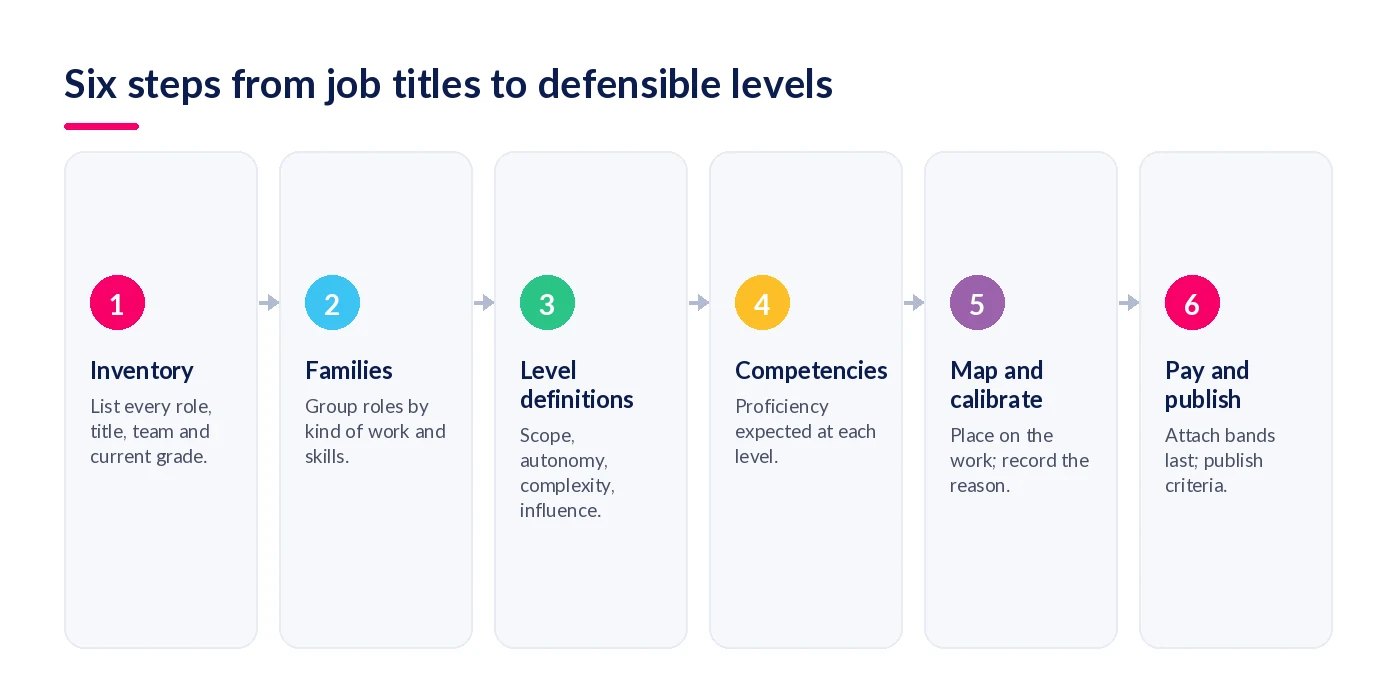
Building it: six steps from job titles to defensible levels
Resist the urge to perfect every role profile first. The order matters more than the polish.
1. Inventory what exists
List every role with its title, team, reporting line, headcount and current grade. Expect the same job under three titles and three jobs under one. Do not fix anything yet.
2. Define the families
Group roles by the kind of work and skills, not by department. Analysts in marketing and finance may share a family. Keep families few enough that each has an owner.
3. Write the generic level definitions
Draft one definition per level across scope, autonomy, complexity and influence, two or three sentences each. Read adjacent levels side by side. If you cannot state the difference in a sentence, you have one level, not two.
4. Attach competencies and proficiency to each level
For each family, list the competencies that matter and the proficiency expected at each level. This is where the architecture meets your proficiency levels. Write observable behavioural indicators rather than adjectives, so two managers would reach the same view.
5. Map roles, then calibrate across families
Place each role against the definitions based on what the job requires, not what the current holder is paid. Then run a cross-family panel on the borderline cases, the same way you would run performance review calibration. Record the reason for every placement.
6. Attach pay and publish the criteria
Only now link levels to pay bands, then publish the level definitions and competency expectations. Better to find a gap between someone’s role and pay now than in a grievance.
Promotion criteria people can actually read
The payoff is that promotion stops being a mystery. Once each level points to a set of competencies and expected proficiency, the promotion question becomes simple: is this person already working at the next level’s definition, consistently, with evidence?
That changes three conversations.
- Development planning. Employees see the gap to the next level, and managers plan stretch work against named competencies. Our guide to career progression covers how to turn that into a plan.
- The promotion case. Managers bring evidence against the next level’s indicators rather than an argument about tenure or market rate.
- The “no”. A decline names which competencies are not yet evidenced and what would show them, which beats “not this year”.
It also makes promotion data worth analysing: if promotion rates differ between groups, a written standard shows whether the gap is in the evidence or the judgement. See our article on equality action plans for promotion and succession.

How levels drift, and the governance that stops it
In my experience an architecture rarely fails at launch. It fails eighteen months later, one exception at a time.
Promotions as retention
A strong performer gets an outside offer and the quickest counter-offer is a level. The role has not changed, so the level now means less.
New roles levelled by negotiation
A hiring manager needs a level 6 to make a candidate’s salary work. Untested, the architecture absorbs whatever the market demanded that month.
Title inflation without level change
“Senior” and “lead” creep into titles as rewards. Titles that no longer match levels break the Acas principle that people doing the same work should not carry different titles.
Managers reading definitions differently
One department treats “leads others” as line management; another counts mentoring a graduate. Without calibration, the same level means different things.
The controls are not complicated:
- An owner. One person or small panel owns the level definitions and signs off every new role and every level change.
- A placement record. Each role has a recorded reason for its level, so changes are compared with the original logic.
- Annual calibration. Once a year, sample roles across families and check placements still hold, alongside promotion calibration.
- Change rules. A level changes when the role changes, with evidence, not when the person needs a pay rise. Pay can move within a band for other reasons.
- Slow definitions. Rewrite generic definitions rarely; our guide on reviewing a competency framework covers updating the competencies underneath.
A worked example: one family, four levels
Here is how a customer service family might look once the generic levels and competencies are joined. The table is illustrative; your definitions should come from your own work.
| Level | Scope and autonomy | Example competency expectation | Promotion evidence for next level |
|---|---|---|---|
| 1 Adviser | Handles routine enquiries using set scripts, under close supervision | Resolves standard queries accurately and records them correctly | Handles non-routine queries with light guidance; quality scores consistently on standard |
| 2 Senior adviser | Handles non-routine cases under general direction; manages own queue | De-escalates complaints and judges when to refer | Coaches new advisers; resolves escalations without referral |
| 3 Team lead | Responsible for a team’s service levels; works to broad direction | Plans rotas, coaches against quality standards, spots process failures | Owns a process improvement across teams; manages service risk |
| 4 Service manager | Accountable for a channel or site; sets local priorities | Designs service standards and balances cost, quality and staff wellbeing | Shapes service strategy beyond own channel |
Notice what the table does not contain: salary. Pay bands attach afterwards. The emotional labour at levels 1 and 2 is written as a demand, so it counts.
Where StaffCircle fits
The architecture is a design decision. Keeping it alive is a systems problem: the links between levels, competencies, reviews and promotions need to be visible every day, not in a spreadsheet updated yearly.
Competencies attached to roles and levels
The StaffCircle competency framework lets you define competencies and proficiency expectations and attach them to roles, so each role profile carries the standard for its level.
Gaps visible to employee and manager
Assessments against those expectations show where someone sits and what the next level requires, which gives development plans a clear target. More on that in skills and development.
Evidence gathered through the year
Check-ins, feedback and objectives sit in the same place as competency assessments, so a promotion case can draw on a year of evidence rather than a manager’s memory. See performance management and development.
Levels worth having
A job architecture that only sets pay is half finished. The other half is writing down what each level demands, in language a manager can use in a one-to-one and an employee can plan against, then protecting those definitions from the exceptions that wear them away.
Do that and one structure serves reward, careers and fairness: a defensible basis for pay, a readable path for people and a record that decisions were made on the work. If you would like to see how competencies, reviews and promotion evidence connect in one system, book a demo.
FAQ
What is job architecture?
Job architecture organises every role into job families and levels, with a consistent definition of what each level means. It gives managers a shared language for scope and seniority, and it is the frame that pay bands, career paths and promotion criteria hang from.
What is the difference between job architecture and a competency framework?
Job architecture says where a role sits: its family and level. A competency framework says what good looks like. Linked together, each level points to the competencies and proficiency expected there, which turns a grade into a usable promotion standard.
What is a job family?
A job family is a group of roles that do related work and draw on similar skills, such as finance or customer service. Roles in a family share a progression path, so the family is where you define how the work deepens from level to level.
How many levels should a job architecture have?
There is no correct number. Use as many levels as you can genuinely tell apart by scope, autonomy and impact. If two adjacent levels cannot be distinguished in writing, merge them. Too many levels invite title inflation.
What is the difference between job levelling and job evaluation?
Job levelling places roles on a common seniority scale using level definitions. Job evaluation measures the relative size of jobs against factors such as skill, effort and responsibility, often with points. Many organisations level first and evaluate borderline roles formally.
Should levels be the same across every job family?
The level scale should be shared, so level 4 in finance and level 4 in operations carry comparable scope. The technical content changes by family. Shared generic definitions plus family-specific competencies give comparability without forcing every role into one mould.
How do you map existing roles to levels?
Start from what the role does, not its title or salary. Compare it with the level definitions for scope, autonomy, complexity and influence, place it, then calibrate borderline cases across families. Record the reason for each placement.
How does job architecture make promotion criteria explicit?
Promotion becomes evidence that someone already works at the next level's definition, judged against that level's competencies. Because the criteria are written in advance, employees can see the gap and managers test every decision against the same standard.
Is job architecture a legal requirement in the UK?
No. But the Equality Act 2010 gives weight to job evaluation studies in equal pay claims, and Acas advises consistent pay structures and accurate job descriptions. A documented architecture makes it easier to show why two roles are or are not equal work.
Does the EU Pay Transparency Directive affect UK employers?
It applies to employers in EU member states, so UK businesses with EU-based staff may be covered there. Article 4 requires pay structures based on objective, gender-neutral criteria including skills, effort, responsibility and working conditions. The transposition deadline was 7 June 2026.
What causes level drift?
Roles promoted, created or re-titled without being tested against the level definitions. Typical causes are counter-offers dressed as promotions, new roles levelled by negotiation and managers reading definitions differently. An owner and regular calibration keep it in check.
How often should a job architecture be reviewed?
Review a placement when a role changes materially, and check a sample across the structure once a year alongside promotion calibration. Rewrite the level definitions only when the business changes shape, because frequent rewrites destroy comparability.
Related articles


See StaffCircle in action
Book a personalised demo and see how StaffCircle drives performance, engagement and development.