Food Hygiene Training Records: What Inspectors Expect
It is 11.20 on a Tuesday and Priya, who runs the kitchen at the second site of a three-site café group, has an environmental health officer at the pass. Nobody rang ahead. GOV.UK says you will usually not be told an inspection is coming, and this one is no exception.
The officer asks for food hygiene training records. Priya hands over a neat folder of Level 2 certificates. Then the officer turns to Josh, who started nine days ago and is portioning cooked chicken, and asks how he knows it has been cooled safely. Josh's certificate is from his last job. Nobody at this site has shown him the cooling procedure, and nothing in the folder says they have.
Priya is a composite, but most kitchen managers I talk to recognise the moment. The folder proved people had sat a course, not what the law asks for.
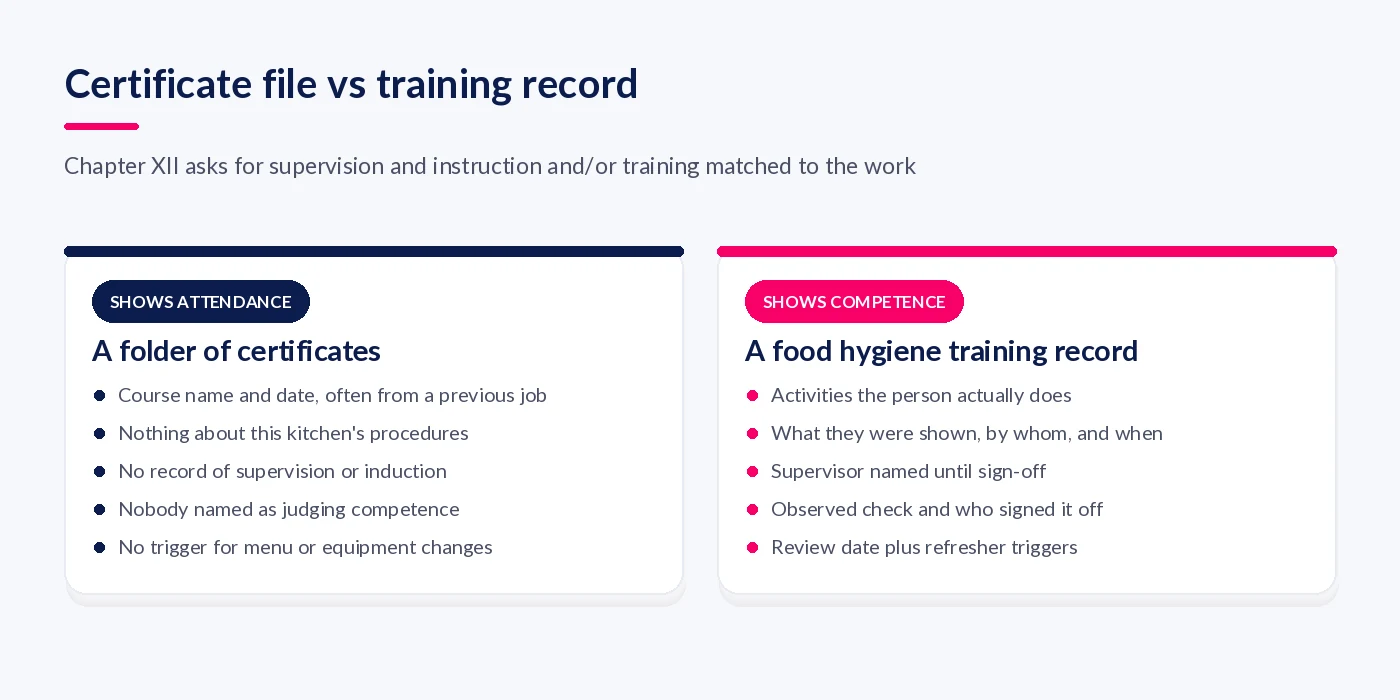
Food hygiene training records are your evidence that every food handler is supervised and instructed and/or trained in food hygiene to a level that matches their work, as Regulation (EC) 852/2004 Annex II Chapter XII requires. Certificates are optional. A good record shows what each person does, what they were taught, who checked they can do it, and when it is next reviewed.
Key facts
- The legal duty is supervision, instruction and/or training commensurate with each person's work.
- Food handlers do not have to hold a food hygiene certificate.
- People who develop or maintain HACCP-based procedures need adequate HACCP training.
- A food hygiene rating of 5 needs every individual inspection score, including confidence in management, at 5 or below.
- No law sets an expiry date for food hygiene training.
What does the law actually require?
The training duty sits in Chapter XII of Annex II to Regulation (EC) No 852/2004, as it applies in UK law. It is three short paragraphs, and food business operators are to ensure:
- “that food handlers are supervised and instructed and/or trained in food hygiene matters commensurate with their work activity”;
- “that those responsible for the development and maintenance of the procedure referred to in Article 5(1) of this Regulation or for the operation of relevant guides have received adequate training in the application of the HACCP principles”; and
- compliance with any UK law requirements on training programmes for people working in certain food sectors.
Note what paragraph 1 says: supervised and instructed and/or trained, matched to the work. It does not mention certificates, course levels or refresher periods.
GOV.UK's guidance for food businesses, published with the Food Standards Agency, turns that into plain instructions. The staff training page says you “must be able to show that your staff have the right skills and up-to-date training for their role”, and to “keep a record of any training staff have completed so you can show this during an inspection.” It lists four routes to those skills: courses provided or recommended by your local authority, training on the job, self-study and relevant previous experience. And it is explicit: “Food handlers do not have to hold a food hygiene certificate.”
Two neighbouring provisions belong in the same record:
- Article 5 requires a permanent procedure based on HACCP principles, with “documents and records commensurate with the nature and size of the food business”, and Article 5(4)(c) requires you to retain those records “for an appropriate period”.
- Chapter VIII of Annex II requires anyone affected by an illness likely to be transmitted through food to “report immediately the illness or symptoms” to the food business operator. People cannot report what they were never told to report, so the illness briefing is training too.
So your food hygiene training records need to answer five questions for every food handler:
- What does this person actually do with food?
- What were they taught for those activities, by whom and when?
- Who supervised them until they were competent?
- Who judged them competent, and on what evidence?
- What has changed since, and has their training kept up?
Why your hygiene rating can hinge on this
Most guides stop at “inspectors may ask for records”. Few explain how those records feed the rating.
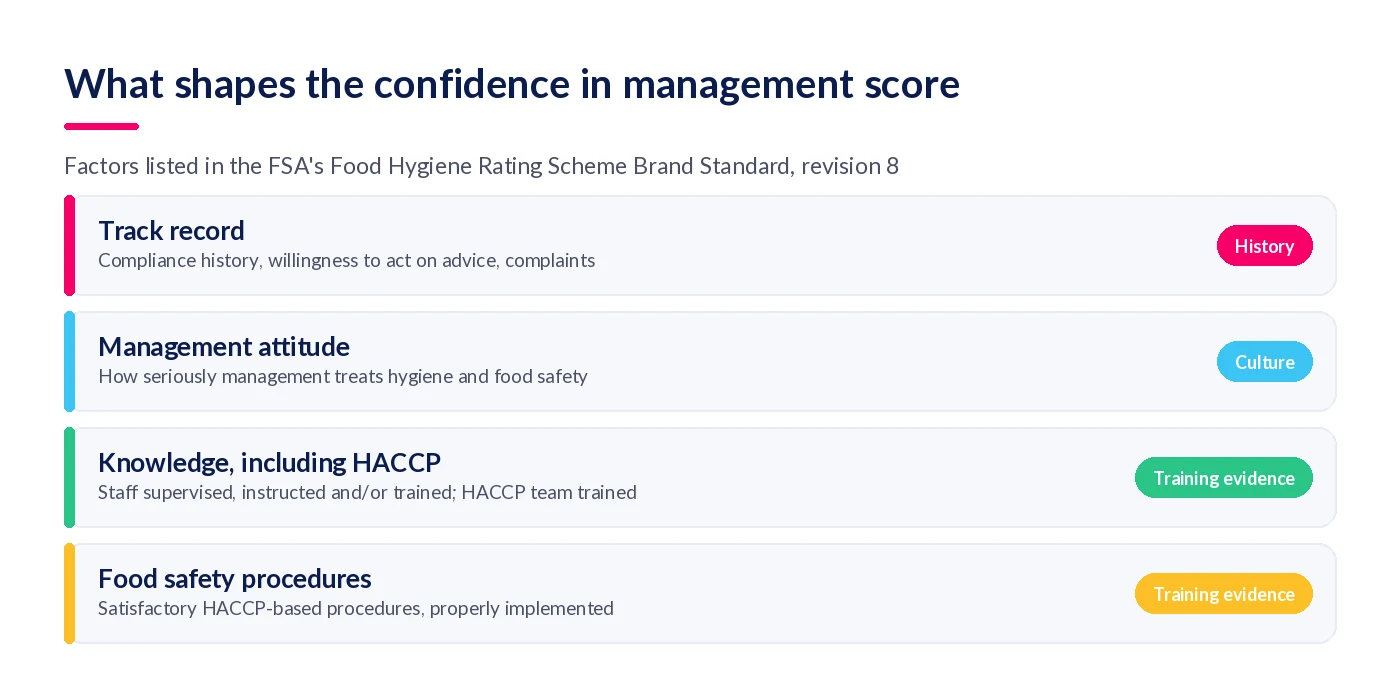
The FSA's Food Hygiene Rating Scheme Brand Standard (revision 8, June 2023) explains that a rating is built from three inspection scores: compliance with food hygiene and safety procedures, structural compliance, and confidence in management/control procedures. Confidence in management is described as “a judgement on the likelihood of satisfactory compliance being maintained in the future.”
Training is written into the descriptors for that score. At a score of 5, what the officer expects to see includes “Staff suitably supervised, instructed and/or trained in food hygiene with good general staff knowledge and new staff receiving induction training” and “Appropriate staff adequately trained in application of HACCP principles.” At 10, the description becomes “Staff generally suitably supervised, instructed and/or trained in food hygiene but there may be some minor issues e.g. not all staff fully aware.”
Now the part that matters. Table 3 of the same document maps scores to ratings, and to get a 5 the total must be 0 to 15 and “No individual score greater than 5”. A confidence in management score of 10 caps you at a 4, however spotless the kitchen. Gaps in induction, supervision or HACCP training are exactly the kind of thing that moves that score.
One more detail for groups. The Brand Standard says that “For a multi-site business, the company-wide management system and procedures are key”, but that the officer “must also consider the local store level management.” A group-wide training policy will not rescue a site where it is not followed. If you want a broader view of how inspectors test evidence across sites, our guide to preparing for a skills compliance audit covers the same logic outside food.
Who needs what training, and what evidence works?
“Commensurate with their work activity” means the training need follows the activity. A kitchen porter who only washes pots does not need the same depth as a chef cooling rice, but both need personal hygiene, handwashing and illness reporting. A starting point, not a legal list:
| Role | What the law points to | Evidence that holds up |
|---|---|---|
| New starter, first days | Supervision and instruction before training is complete | Signed induction checklist, named supervisor and the date supervision ends |
| Food handler preparing open food | Instruction and/or training commensurate with the work | Activity-specific training notes plus an observed competence check |
| Front of house serving food | Hygiene matched to their tasks, plus allergen handling | Allergen briefing record, refreshed when the menu changes |
| Supervisor or shift lead | Must supervise effectively, so must know the standard | Training record plus evidence they can check others' work |
| Owner, manager or HACCP team | Adequate training in applying HACCP principles | HACCP training record linked to the plan they maintain |
| Agency, seasonal or relief staff | Same duty: they are food handlers | Prior training evidence, plus your own induction and sign-off |
Allergens deserve their own line. GOV.UK's allergen guidance says “You should make sure all staff are given appropriate training to manage allergens in their role”, and that your procedures should “make sure all staff know about recipe changes.” A recipe change is therefore a training event, and it should leave a trace on the record.

How to build food hygiene training records that stand up
This method is built from the wording of Chapter XII and the confidence in management descriptors, not from a course syllabus.
- List the food-handling activities in each role. Write down what each role actually does with food: receiving deliveries, storing, preparing open high-risk food, cooking and cooling, serving, answering allergen questions, cleaning. The activity, not the job title, sets the training need.
- Set the standard for each activity. For every activity, say what a competent person knows and does. Take it from your HACCP-based procedures or Safer Food, Better Business pack, so the training and the food safety system say the same thing.
- Induct and supervise before anyone works unsupervised. Brief every new starter on personal hygiene, illness reporting, handwashing and the activities they will do on day one. Record who supervised them and until when.
- Train to close the gap. Use whatever route fits: a course, on-the-job instruction, self-study or relevant experience elsewhere. Record what was covered, by whom and when, not just a course title.
- Check competence and sign it off. Watch the person do the task, ask the questions an officer would ask, and record who judged them competent and on what date. This is the line most records are missing.
- Set refresher triggers, not just a date. Pick a review interval, then add the events that force an earlier refresh: a menu or recipe change, new equipment, an incident, a near miss, an observed lapse or a long absence.
- Review the records site by site. Have each site manager check the record against the rota every month, and have someone at group level sample it. Gaps found by you are cheaper than gaps found by an inspector.
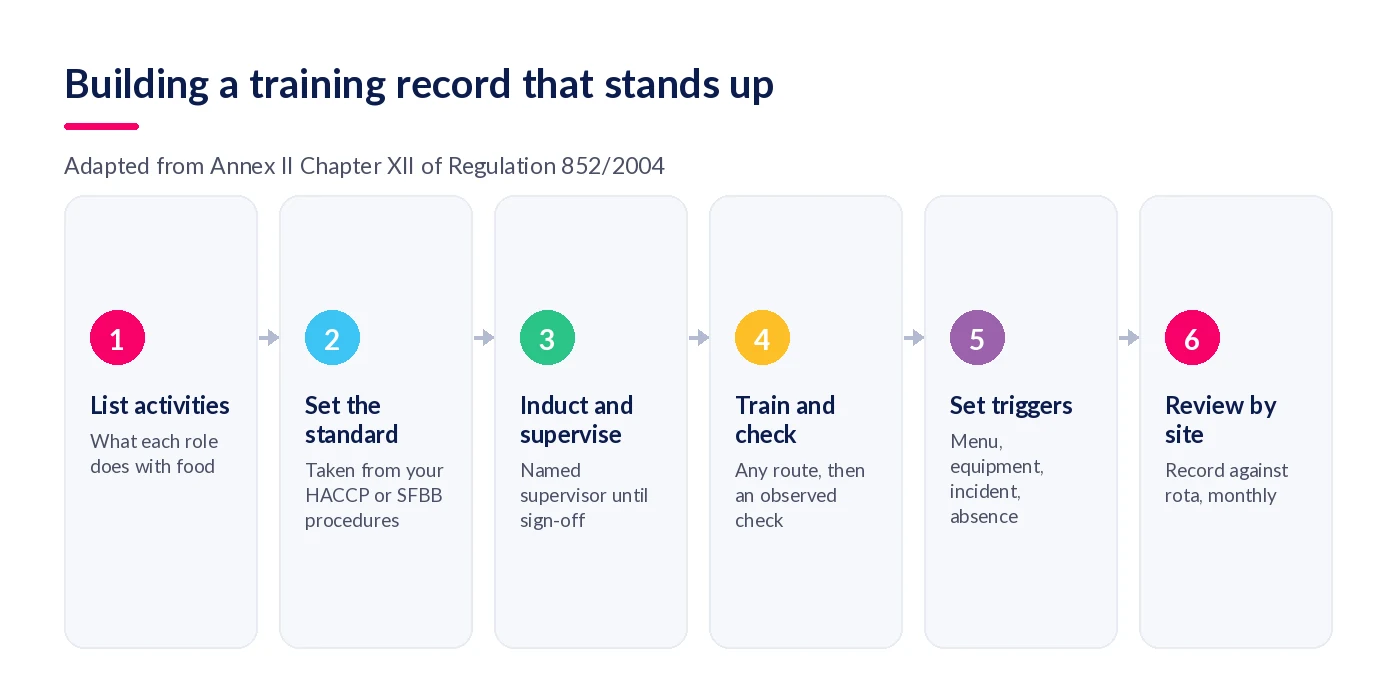
Step 5 matters most. “Josh completed Level 2, March 2025” says nothing about Josh in your kitchen. A record that says “Josh shown cooling procedure for cooked chicken by Priya, 4 November; observed cooling and logging a batch unsupervised, 6 November; signed off by Priya” answers the question the officer actually asked. If you want to tighten how that judgement is made, our piece on competency assessment methods compares observation, questioning and work samples.
Does food hygiene training expire?
No law sets an expiry date for food hygiene training or for certificates. Chapter XII asks for training that matches the work, and GOV.UK asks for “up-to-date training for their role”. Neither puts a number on it.
The three-year refresher on most training providers' sites is a convention. A fixed date misses the moments training actually goes stale: a new dish, a new combi oven, a changed cooling method, an allergen incident, a long absence. Use an interval as the backstop and make those events the real triggers.
Our guide to PUWER training requirements makes the same case for work equipment.
Where food hygiene training records fall apart
The certificate pile
Certificates show training somewhere, at some point. They do not show supervision, instruction on your procedures, or a competence check.
Induction that happened but left no trace
Most kitchens induct new starters; few write it down. The score-5 descriptor names “new staff receiving induction training”, so an unrecorded induction is wasted evidence.
Menu changes nobody was briefed on
A supplier swaps an ingredient, the allergen matrix changes, and front of house finds out from a customer. Every recipe change should trigger a short, signed briefing.
A HACCP plan maintained by someone untrained
The second paragraph of Chapter XII is the one most often missed. Whoever writes and reviews the food safety plan needs adequate HACCP training, and the record should link that person to the plan they own.
Group policy, site reality
Head office writes a good standard; each site keeps its own spreadsheet; nobody compares it with the rota.
Agency and seasonal staff
Relief chefs and summer staff start on a busy shift and leave before anyone updates the record. They are food handlers; the duty is the same.
Worked example: one café's six-person record
After the visit, Priya rebuilt her six-person team's record around activities rather than certificates.
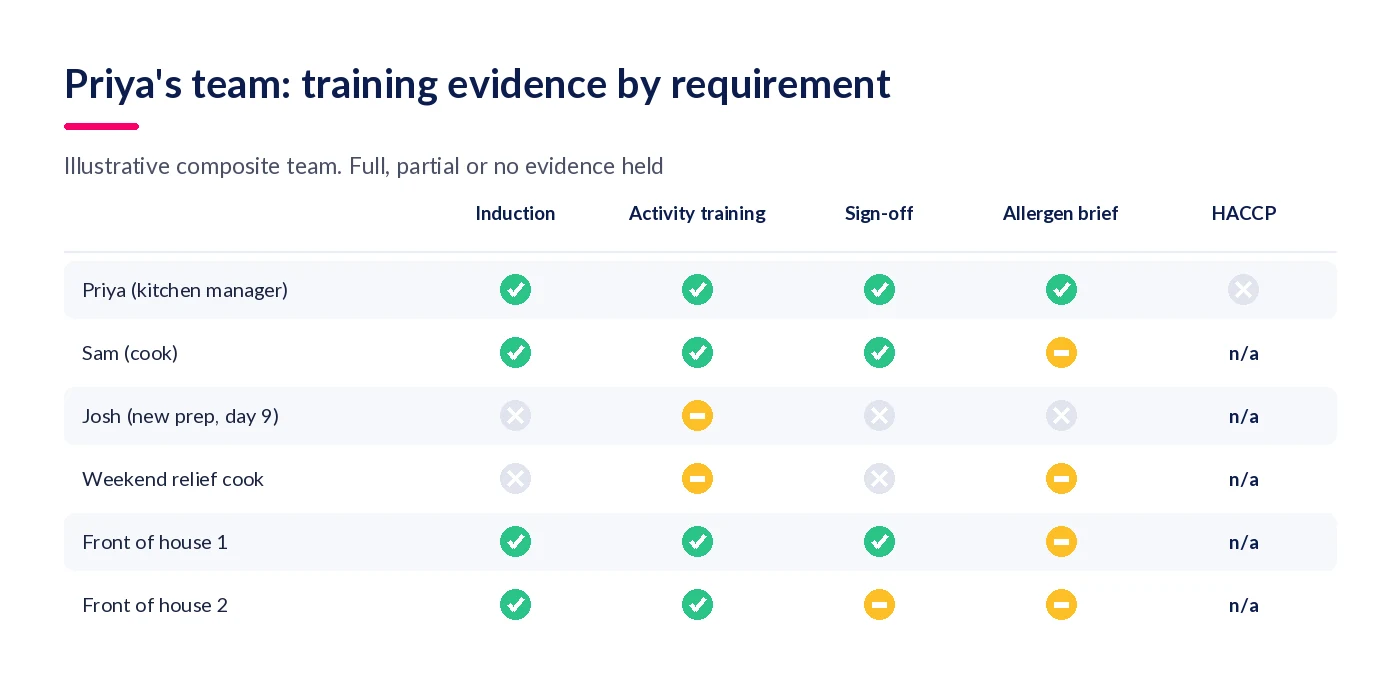
Josh and the weekend relief cook had certificates but no induction or sign-off at this site. Front of house had missed two autumn menu changes. And Priya, who maintains the site's Safer Food, Better Business pack, had no record of HACCP training. The fix was an hour of observed checks, two briefings and one course booking.
The pattern is familiar from mandatory training matrices in frontline businesses: the course column is green, the competence column is blank.

Keeping training evidence current with StaffCircle
A spreadsheet can hold all of this. Keeping it true across shifts, sites and turnover is the hard part.
Role standards that match the work
With StaffCircle's competency framework tools, you can set out what competent looks like for each role, so a prep chef, a barista and a shift lead each have the activities and standards that apply to them rather than one generic course requirement.
Training, sign-off and refresher dates in one record
Training compliance tracking keeps each person's training, certificates and sign-offs together with dates, so the refresher interval you choose, and the events that trigger an earlier one, are visible rather than buried in a folder.
Gaps visible by site
A skills matrix view of people against requirements shows where evidence is missing at each site, so a group operations manager can see the Josh problem before an officer does. Staff can reach it from their phone, which matters when most of your team never sits at a desk.
The short version
Food hygiene law asks one thing of your training: that every food handler is supervised and instructed and/or trained to match the work they actually do, and that the people running your HACCP system are trained to run it. Certificates are optional. Evidence is not, because the confidence in management score that can cap your rating at 4 is built partly on it.
Record activities, not just courses. Record who checked competence, not just who attended. Make menu changes and incidents trigger a refresh. If you would like to see how that looks across several sites, book a StaffCircle demo.
FAQ
Are food hygiene training records a legal requirement?
The law requires supervision, instruction and/or training matched to each food handler's work, not a particular record. But GOV.UK tells food businesses to keep a record of any training staff have completed so they can show it during an inspection.
Do food handlers need a food hygiene certificate?
No. GOV.UK states that food handlers do not have to hold a food hygiene certificate. Skills can come from courses, on-the-job training, self-study or relevant previous experience. A certificate is useful evidence of training, but it is not the legal duty and it does not prove competence on its own.
What should a food hygiene training record include?
At minimum: the person, their role and food-handling activities, what training or instruction they received, when, who delivered it, how competence was checked, who signed it off, any supervision arrangements, and when the next review or refresher is due. Keep induction and allergen briefings on the same record.
How long should food hygiene training records be kept?
No fixed period is set for training records. Article 5(4)(c) of Regulation 852/2004 requires food business operators to retain HACCP-related documents and records for an appropriate period. A sensible approach is to keep records for the whole of employment and for a period afterwards that covers any complaint or investigation.
How often should food hygiene training be refreshed?
The law sets no expiry date for food hygiene training or certificates. Many businesses refresh every three years by convention. Better practice is a set review interval plus triggers: menu or recipe changes, new equipment, an incident or near miss, an observed lapse, or a long absence.
Who needs HACCP training?
Annex II Chapter XII of Regulation 852/2004 requires that people responsible for developing and maintaining your HACCP-based procedures, or for operating relevant guides, have adequate training in the application of the HACCP principles. That is usually the owner, manager or the team that writes and reviews the food safety plan.
Is in-house food hygiene training acceptable?
Yes. GOV.UK lists training on the job and self-study alongside courses as ways staff can learn the skills they need. In-house training is only as good as its record, so note what was covered, who delivered it, and how you checked the person can do the task.
What do inspectors look for in training records?
Officers check the processes, training and systems you use to maintain good hygiene. Under the Food Hygiene Rating Scheme guidance, the confidence in management score considers whether staff are suitably supervised, instructed and/or trained, whether new staff receive induction training, and whether appropriate staff are trained in HACCP principles.
Can poor training records lower a food hygiene rating?
They can. Confidence in management is one of three scores behind the rating, and a top rating of 5 requires that no individual score is greater than 5. Staff training and supervision are named in the descriptors for that score, so weak evidence there can cap the rating.
Do agency and temporary staff need food hygiene training?
Yes. The duty covers food handlers, not just your payroll. Treat the agency's evidence of previous training as a starting point, then induct, supervise and check them on your own procedures and record it, as you would for a direct recruit.
Is allergen training part of food hygiene training?
Treat it as part of the same record. GOV.UK says you should make sure all staff are given appropriate training to manage allergens in their role, and that staff must know about recipe changes. The FSA offers free online food allergy training you can log as one element.
How do multi-site food businesses manage training records?
Keep one standard for each role across the group and one record per person, with site managers responsible for local implementation. The rating scheme guidance says that for a multi-site business the company-wide management system is key, but officers also consider local management at each site.
Related articles


See StaffCircle in action
Book a personalised demo and see how StaffCircle drives performance, engagement and development.