PUWER Training Requirements: What Employers Must Prove
Here is an unpopular view: most PUWER training records I have seen would not survive the first question an inspector asks after an accident. Not because the training never happened. Because the record proves the wrong thing.
A folder of course certificates proves that people attended something. The question after an incident is narrower and harder: was this person competent to use this machine, in this way, on that day, and who decided they were?
PUWER training requirements come from regulation 9 of the Provision and Use of Work Equipment Regulations 1998. Employers must ensure everyone who uses work equipment, and every employee who supervises or manages its use, has received adequate health and safety training in the methods of use, the risks and the precautions. Adequate means enough to make that person competent on that equipment, not a certificate.
What does PUWER actually say about training?
The training duty is short. Regulation 9(1) says every employer shall ensure that all persons who use work equipment “have received adequate training for purposes of health and safety, including training in the methods which may be adopted when using the work equipment, any risks which such use may entail and precautions to be taken.” Regulation 9(2) applies the same duty to any employee “who supervises or manages the use of work equipment”.
Three neighbouring provisions shape what that means in practice:
- Regulation 8 requires adequate health and safety information and, where appropriate, written instructions, including “foreseeable abnormal situations and the action to be taken”. These must be “readily comprehensible to those concerned”.
- Regulation 7 restricts equipment with a specific risk to “those persons given the task of using it”, and its repair, maintenance or servicing to people “specifically designated” and adequately trained for that work.
- Regulation 2 defines use as “any activity involving work equipment”, including “starting, stopping, programming, setting, transporting, repairing, modifying, maintaining, servicing and cleaning”.
Underneath all of it sits section 2(2)(c) of the Health and Safety at Work etc. Act 1974: the provision of “such information, instruction, training and supervision as is necessary”. And regulation 13 of the Management of Health and Safety at Work Regulations 1999 adds when training must happen: on recruitment, on exposure to new or increased risks, repeated periodically where appropriate, and during working hours.
Put together, your PUWER training records need to answer five questions for every person and every item of equipment they use:
- Which equipment, and which uses of it (operating, setting, cleaning, maintaining), is this person allowed to do?
- What do they need to know about methods, risks and precautions for it?
- How do we know they can do it safely, and who judged that?
- Who supervises them, and has that supervisor been trained?
- What has changed since, and has their training kept up?
A certificate is evidence of training, not of competence
This is the gap almost every page about PUWER training skips. HSE's Approved Code of Practice and guidance, L22 Safe use of work equipment (fourth edition, 2014), is blunt about it at paragraph 130: “Training in itself will not ensure competence but it is part of what is required.”
The guidance on what “adequate training” means points the same way. Paragraph 121 does not tell you to send people on a course. It tells you to evaluate the existing competence of employees and agency workers on the full range of equipment they will use, evaluate the competence needed, and train “to make up any shortfall”. Training is defined by the gap, and the gap can only be measured by an assessment.
The lift-truck code, L117 Rider-operated lift trucks (third edition, 2013), makes the point most clearly because it is the most detailed. It notes there is no legal requirement to issue certificates of basic training (paragraph 69), that “there is no such thing as a lift-truck ‘licence’”, and that “training will not in itself ensure the competence of individuals” (paragraph 73). After the three stages of training it expects the employer to give written authorisation naming the operator, the date, the trucks covered and any limits (paragraph 67).
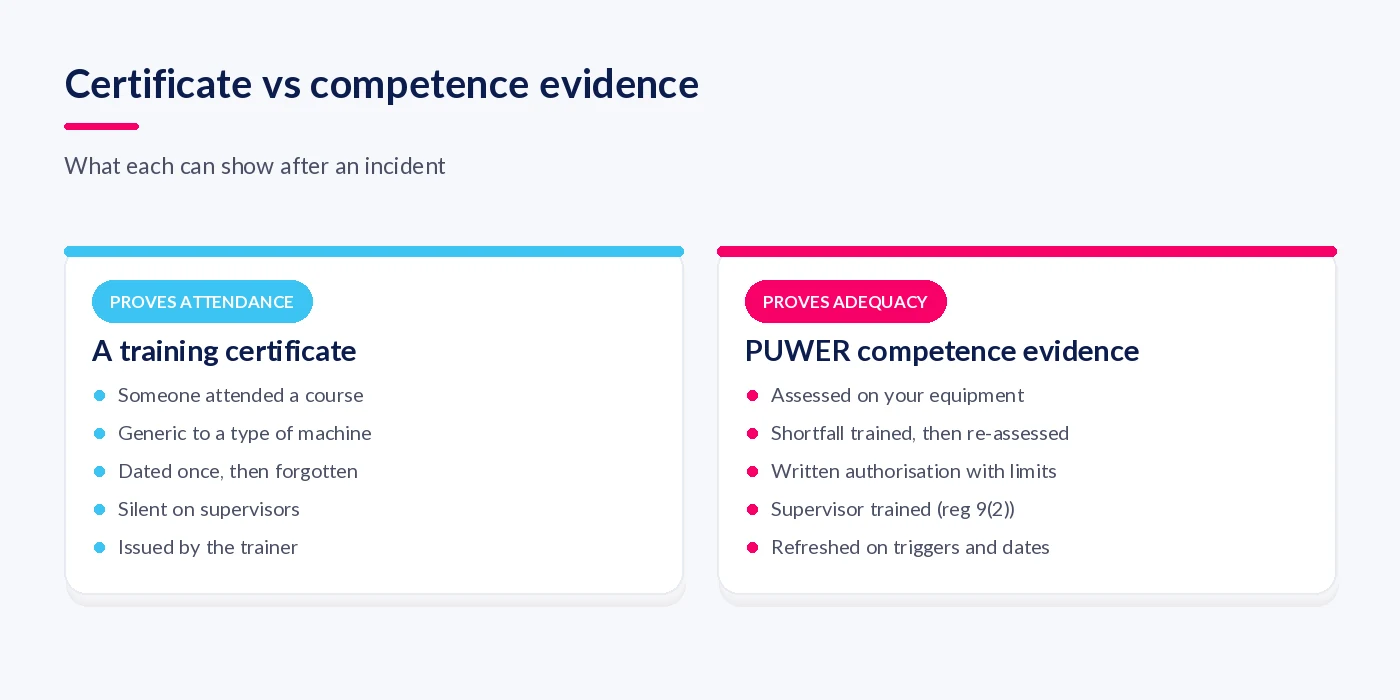
L117 is specific to lift trucks, so do not treat its paragraphs as rules for every machine. But the model it describes (train, test, authorise, monitor) is the clearest statement HSE has published of what good evidence looks like, and it maps neatly onto everything else. If you want a wider view of how to evidence competence, our guide to competency assessment methods compares observation, questioning and work-product review.
Who needs PUWER training?
Everyone who uses work equipment, plus everyone who supervises or manages that use. Because the definition of use is so wide, that is more people than most training matrices list.
Operators
The obvious group. They need the methods, risks and precautions for each item they use, and HSE's ACOP adds specific expectations for some equipment: self-propelled equipment should only be driven by workers trained in driving it safely (L22 paragraph 132), and chainsaw work on or in trees calls for a certificate of competence or national qualification (paragraph 133).
Supervisors and managers
Regulation 9(2) is the half of the duty people forget. L117 explains the standard in plain terms: supervisors need enough training and knowledge “to recognise safe and unsafe practices”, which does not mean full operator training. A supervisor who has never been trained on the equipment cannot sign anyone off on it.
People who clean, set and maintain
Cleaning, setting and maintaining are use under regulation 2. Where equipment carries a specific risk, regulation 7 restricts repair and maintenance to designated people who have received adequate training for those operations. Night cleaners and contract maintenance staff are a common blind spot.
Agency and temporary workers
Regulation 9(1) says “all persons who use work equipment”, not all employees. L22 paragraph 121 explicitly names temporary workers supplied by an employment agency. If your records only cover the payroll, they do not cover your duty.
Young people and occasional deputies
PUWER has no general age limits, but HSE describes induction training for young people as particularly important. And L22 paragraph 124 flags people who deputise infrequently: they “may need more frequent refresher training than those who do the job regularly”. Our mandatory training matrix guide shows how to keep these groups visible.

When does PUWER training have to happen?
At the start, whenever the risk changes, and again when skills may have faded. There is no fixed calendar in the regulations, which is precisely why a calendar on its own is not enough.
| Trigger | Where it comes from | What to record |
|---|---|---|
| Recruitment or first use | MHSWR reg 13(2)(a); L22 para 123 | Competence assessed on arrival, shortfall trained, sign-off |
| Change of tasks or responsibilities | MHSWR reg 13(2)(b)(i); L22 para 123(a) | New equipment or uses added to the person's authorisation |
| New or changed equipment | MHSWR reg 13(2)(b)(ii); L22 para 123(b) | Which people were retrained and assessed on the change |
| New or changed system of work | MHSWR reg 13(2)(b)(iv); L22 para 123(c) | Briefing or retraining against the new method |
| Long absence or infrequent use | L22 para 124; L117 para 78 | Check of competence before return to the equipment |
| Unsafe practice, accident or near miss | L117 para 78 | Retest or refresher, with the reason linked |
| Periodic refresher | MHSWR reg 13(3)(a); L117 para 79 | Interval you chose, and why |
On refresher intervals, L117 paragraph 79 is the most useful line HSE has written: there is no specific time period, but you may decide that automatic refresher training or a retest after a set period, “for example 3-5 years”, is the best approach, and you will still need to monitor performance in between. The interval is your decision. Record it and the reasoning behind it.
How to build PUWER training evidence that stands up
Seven steps, in this order. Each one produces a record you can point to. Step 5 matters most: an authorisation turns “trained at some point” into a dated permission a supervisor can check on the shop floor in seconds.
- List the equipment and flag the specific risks. List every item of work equipment people use, including the ones that are cleaned, set or maintained rather than operated. Flag the items where use involves a specific risk, because regulation 7 then restricts use and maintenance to named people.
- Define what competent looks like for each item. For each item, write down the methods of use, the risks and the precautions a competent user must know, mirroring the three things regulation 9 names. Add the abnormal situations and the action to take from regulation 8.
- Assess existing competence before you train. Evaluate what each person, including agency and temporary workers, can already do safely on the equipment they will use. Insist on evidence where someone claims experience, and assess them where you are in doubt.
- Train the shortfall, not the whole syllabus. Close the gap between the competence a person has and the competence the work needs. Use whatever method fits: instruction and supervised practice, formal in-house training or an external course with an assessment.
- Assess, then authorise in writing. Have a competent person observe the worker using the equipment and record the result. Then issue a written authorisation naming the person, the equipment, the date and any limits on use.
- Monitor, and refresh on triggers. Watch how people actually use the equipment and log the triggers for retraining: a long absence, occasional use, a change of equipment or system of work, unsafe practice, an accident or near miss.
- Train the supervisors as well. Regulation 9(2) applies to employees who supervise or manage the use of work equipment. Make sure they can recognise safe and unsafe use of the equipment they oversee, and record that training too.
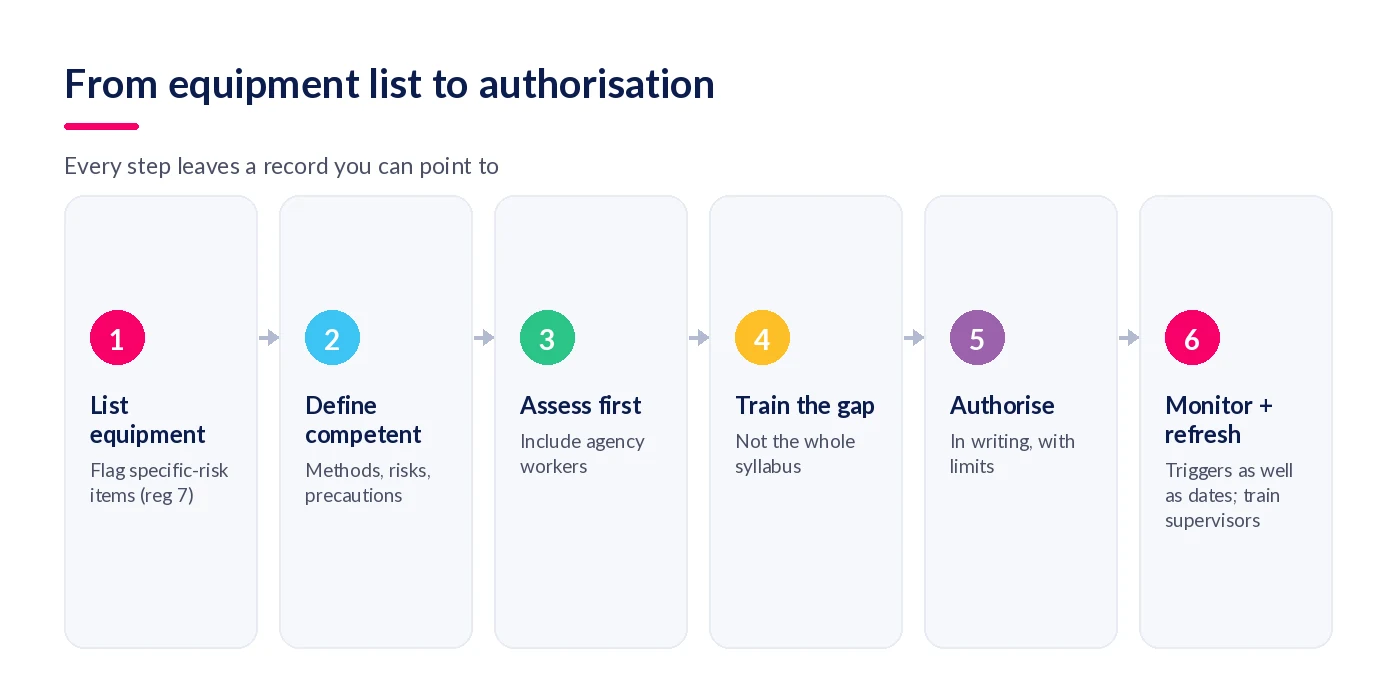
Step 3 is where most of the time is saved. HSE's training and competence guidance lists methods from self-study of the manufacturer's instructions, through supervised in-house instruction, to external training with a competence assessment. An experienced recruit may need only a short assessment and site familiarisation, not a full course.

Where PUWER training records fall apart
The record names a course, not a machine
“Machinery safety, half day, 2023” tells nobody which equipment the person may use. Regulation 9 is about the methods, risks and precautions of the work equipment itself, so the record has to name it.
Authorisation lives in a supervisor's head
If the only proof that someone may run the press brake is that the supervisor knows them, the evidence leaves when the supervisor does. Write it down, with a date and any limits.
Supervisors were never trained
Regulation 9(2) is routinely missing from training matrices. A sign-off by an untrained supervisor is weak evidence of anything.
Refreshers run on a calendar only
A three-year cycle with no monitoring misses the triggers HSE actually lists: absence, occasional use, unsafe practice, near misses and change. Calendar plus triggers is the defensible pattern.
Agency workers and contractors are invisible
If temporary workers are inducted on paper at reception and never appear in the training system, nobody can show they were assessed. The same problem appears up the supply chain; our post on supply chain competence for tier one contractors covers it.
Instructions nobody can read
Regulation 8(4) requires information to be readily comprehensible. L22 paragraph 120 asks you to pay particular attention to people whose first language is not English. An English-only safe system of work handed to a mixed-language night shift is a gap.
A worked example: one workshop's PUWER evidence matrix
Take an illustrative fabrication workshop with four items of equipment: a band saw, a pillar drill, a press brake (flagged as a specific risk under regulation 7) and a counterbalance lift truck. Five people use them: two operators, a setter who also does routine maintenance, an agency worker on a six-week contract and a shift supervisor.
Built from certificates, the matrix looks complete: everyone has “machinery safety” and the operators have a forklift course. Built from the seven steps, it looks different:
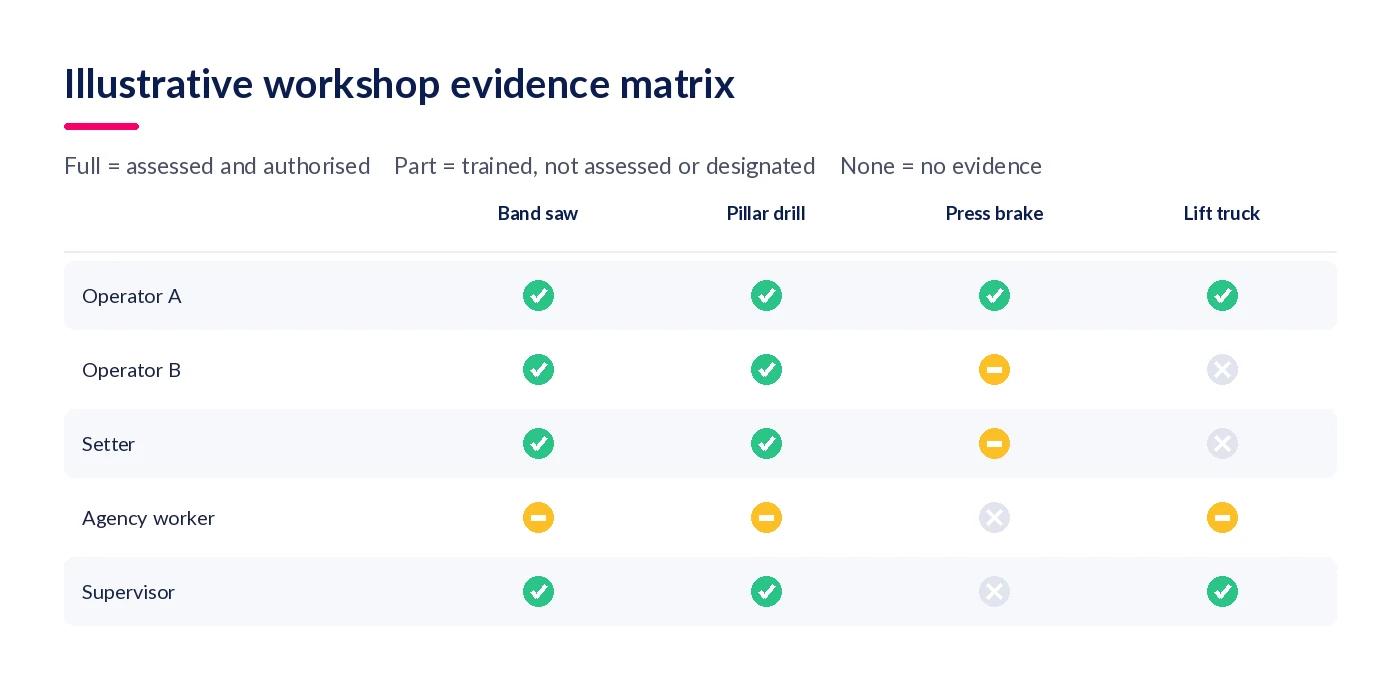
- The agency worker holds a valid course certificate but has not been assessed on your lift truck or site layout. Under L117 they should not operate it until that happens.
- The setter is authorised to operate the press brake but has no designation for maintaining it, which regulation 7 requires.
- The supervisor signs everyone off but has never been trained on the press brake, so regulation 9(2) is not met for that machine.
None of these gaps shows up in a certificate folder.
How StaffCircle supports PUWER training evidence
StaffCircle is not a substitute for a competent assessor on the shop floor. What it does is keep the evidence the seven steps produce in one place, against the person and the role.
Competence defined per role and per equipment
With the competency framework tools you can set out what competent means for each role, including the equipment-specific methods, risks and precautions, so an assessment is made against a written standard rather than a supervisor's memory.
Training records with expiry and refresher dates
Training compliance tracking holds each person's training and certificates with their dates, so refresher intervals you have chosen can be tracked rather than remembered.
Gaps you can see before an inspector does
A skills matrix view of people against requirements shows where evidence is missing, which is exactly the view the worked example needed. See our skills matrix template for the structure, and Skills & Development for how development plans close the gaps.
Final thoughts
PUWER does not ask you to collect certificates. It asks you to make sure people are adequately trained to use specific equipment safely, and to train the people who supervise them. Assess before you train, assess again before you authorise, write the authorisation down, and refresh on triggers as well as dates. If you would like to see how StaffCircle keeps that evidence in one place, book a demo.
FAQ
What are the PUWER training requirements?
Regulation 9 of PUWER 1998 requires employers to ensure everyone who uses work equipment, and every employee who supervises or manages its use, has received adequate health and safety training. That training must cover the methods of use, the risks the use may entail and the precautions to take.
Is PUWER training a legal requirement?
Yes. Regulation 9 of the Provision and Use of Work Equipment Regulations 1998 places a legal duty on employers to provide adequate training. It builds on the general duty in section 2(2)(c) of the Health and Safety at Work etc. Act 1974 to provide information, instruction, training and supervision.
Who needs PUWER training?
Anyone who uses work equipment, and PUWER defines use widely: starting, stopping, programming, setting, transporting, repairing, modifying, maintaining, servicing and cleaning all count. Supervisors and managers of that use need training too, and so do agency and temporary workers.
How often should PUWER training be refreshed?
PUWER sets no fixed interval. HSE guidance says refresher training is needed when necessary because skills decline without use, for example after a long absence or for people who deputise infrequently. The lift-truck code gives 3 to 5 years as an example of a set retest period.
Does a PUWER training certificate prove competence?
No. A certificate shows that training happened. HSE guidance on PUWER says training in itself will not ensure competence but is part of what is required. You also need evidence that the person can use that particular equipment safely in your workplace, usually from an observed assessment.
Do I need to keep PUWER training records?
Regulation 9 does not spell out a record-keeping duty, but without records you cannot show training was adequate. The lift-truck ACOP does expect a record for each employee who completes basic training, identifying the person and the nature and content of the training and testing.
What does adequate training mean under PUWER?
HSE says adequate training varies with the job, the equipment, the worker's existing competence and the circumstances, such as how closely they are supervised. Its guidance is to evaluate existing competence, evaluate the competence needed, and train to close the shortfall.
Do supervisors need PUWER training?
Yes. Regulation 9(2) requires employers to ensure employees who supervise or manage the use of work equipment have received adequate training, covering the same methods, risks and precautions as users. They do not always need full operator training, but must recognise safe and unsafe use.
Who can deliver PUWER training?
HSE says there is no bar to competent in-house staff delivering training, provided it is given competently and to the standard needed for health and safety. Trainers should be sufficiently skilled and competent, and able to assess the skills people have attained.
Does PUWER apply to agency workers?
Yes. Regulation 9 covers all persons who use work equipment, not only employees. HSE's guidance on adequate training specifically mentions evaluating the competence of temporary workers supplied by an employment agency, on the full range of equipment they will use.
Is there an age limit for using work equipment under PUWER?
PUWER contains no general age restrictions. HSE guidance stresses that training and supervision of young people are particularly important because of their inexperience, and the Management Regulations require employers to assess and protect young workers from risks they may not recognise.
Should PUWER training happen during working hours?
Yes. The Management of Health and Safety at Work Regulations 1999 require health and safety training to take place during working hours, and HSE's training guidance says it should be at no cost to the employee.
Related articles


See StaffCircle in action
Book a personalised demo and see how StaffCircle drives performance, engagement and development.