The Continuous Performance Management Cycle: 2026 Guide
Continuous Performance Management (CPM) is an ongoing approach that replaces annual performance reviews with regular feedback, continuous coaching, goal tracking, and employee development throughout the year. It replaces these retrospective appraisals with an ongoing, five-stage cycle: Plan (agile quarterly OKRs), Monitor (real-time progress tracking), Review (frequent 1-on-1s), Develop (targeted upskilling), and Recognise (peer appreciation).
The cloud platform StaffCircle operationalises this cycle, cutting HR admin workloads by 90% and boosting employee engagement by 74%. It achieves this through native Microsoft Teams/Google integrations, a secure GDPR-compliant AI Notetaker, mobile Progressive Web Apps (PWA) for frontline workers, and live Power BI analytics that proactively flag turnover risks.
According to Deloitte, 61% of managers and 72% of workers say they do not trust their organisation’s performance management process.
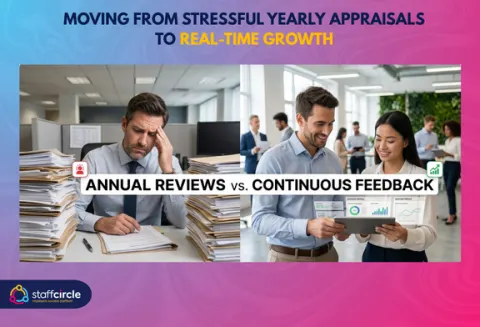
Annual appraisals are dead in 2026. When I say this, I mean the once-a-year meeting where an employee’s performance is judged largely on recent events rather than the whole year. It frustrates both managers and employees. For example, an employee who exceeded targets for 10 months but struggled during the last few weeks may receive a lower rating because of recency bias.
Around 95% of managers are dissatisfied with traditional annual performance reviews, according to research by Gallup. And only 14% of employees strongly agree that the performance reviews they receive inspire them to improve.
What’s the Best Alternative to Traditional Annual Appraisals and Reviews?
If you ask me, I’d say Continuous Performance Management. It’s because recency bias is one of the most common rating errors in old methods like the 9-box grid. Our software, StaffCircle, is crafted to track continuous performance and 360° feedback for an agile, automated, and continuous performance management cycle for remote teams. It has delivered 57% lower employee turnover, 74% higher employee engagement, and 90% less admin work.
Moreover, research from Adobe also found that after replacing annual reviews with regular check-ins, the company saw a 30% reduction in voluntary employee turnover.
When organisations wait twelve months to address a skills gap, resolve a bottleneck, or realign goals, employees lose valuable productivity. According to a 2025 study, 63% of employees agree that poor communication is a contributing factor to their resignations.
What is Continuous Performance Management?
Continuous Performance Management (CPM) is an ongoing, real-time approach for career & skill tracking and development throughout the calendar year with agile methods. It includes continuous skill-gap analysis, live feedback loops, professional coaching, agile goal structures, knowledge development, and increasing productivity.
Here, we ditch all the processes that consume unnecessary time and contain risks of bias and unethical practices. We typically use intuitive cloud software, tools, and platforms like StaffCircle to embed short, meaningful touchpoints directly into an employee’s weekly workflow.
The 5-Stage Continuous PM Cycle Explained
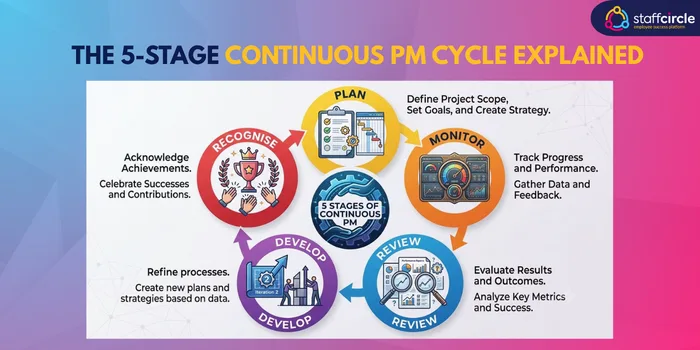
To be truly effective, continuous performance management must run as a repeating, five-stage cycle. Each stage feeds directly into the next, ensuring that no employee’s development hits a plateau or drops out of alignment with the wider business strategy.
Stage 1: Plan (Collaborative Goal Setting)
The cycle begins by establishing transparent, flexible objectives. Instead of managers handing down static checklists, the planning stage is a collaborative effort where employees and leaders map out specific goals for the upcoming quarter. These objectives are built using the OKR (Objectives and Key Results) or SMART framework, ensuring every individual clearly understands exactly what success looks like and how their daily output drives broader corporate growth.
Stage 2: Monitor (Real-Time Progress Tracking)
Performance is not left to be evaluated months down the line. In the monitoring stage, managers and HR track ongoing progress against established OKRs using live dashboards. This step focuses on tracking objective data patterns as they happen, allowing teams to spot declining goal velocities or operational hurdles early, rather than discovering them after a project baseline fails.
Stage 3: Review (Regular Check-ins & Pulse Feedback)
The review stage shifts performance conversations from formal annual meetings to short, high-frequency touchpoints. This involves structured weekly or bi-weekly 1-on-1 meetings, monthly goal alignment reviews, and automated sentiment pulse surveys. The focus is entirely forward-looking: discussing current priorities, resolving active roadblocks, and maintaining a clear line of communication.
Stage 4: Develop (Skills Alignment & Growth Pathways)
Continuous review data naturally highlights individual capabilities and skill gaps. During the development stage, managers use these real-time insights to build personalised employee development plans. By steering away from generic, one-size-fits-all training, leaders can assign highly targeted learning paths, mentorship programs, or stretch assignments designed to close specific skill gaps and prepare top talent for internal succession.
Stage 5: Recognise (Real-Time Praise & Appreciation)
High performance cannot be sustained without consistent motivation. The final stage of the cycle embeds meaningful, values-driven appreciation into daily work. Rather than waiting for a yearly bonus announcement, employees receive timely, visible validation through peer-to-peer digital badges and public corporate announcements, which reinforces positive contributions across the entire business.
How to Implement Each Stage of the PM Cycle
Now, the implementation of a continuous performance management cycle is something many companies fail at. According to Business Insider, 65% of organisations now use some form of continuous performance design, but many still struggle with execution quality.
But it is way too easy with StaffCircle – if you are wondering how, this is your step-by-step guide. The planning stage sets the trajectory for employee success. StaffCircle replaces static, hidden goal documents with a transparent, digitised objective-setting architecture.
1. Automate OKR Planning and Goal Weighting
StaffCircle is an intuitive cloud platform that everyone (employees and leaders) can access to track the performance of their tasks. So, when you get to StaffCircle’s admin dashboard, you can assign the company’s objectives to the employees’ accounts.
- Managers and employees then co-author individual or department-level Key Results that lock directly into those company goals, giving everyone clear sight of how their daily output impacts the wider business.
- Within the platform, you can weight objectives based on priority and assign distinct metric types (such as percentages, currency targets, or task counts), ensuring every goal is completely quantifiable.
- The platform automatically alerts HR if an employee profile lacks active objectives for the current quarter, preventing anyone from slipping through the cracks.
2. Managing the Monitoring Stage
Monitoring performance must be a low-friction, daily habit. StaffCircle turns metric tracking into a self-service, asynchronous process.
- Staff members can access their goal profiles via their desktop browser or the mobile Progressive Web App (PWA) to log real-time progress, attach project evidence, or drop context notes directly onto specific Key Results.
- The system tracks the “velocity” of your goals. If a Key Result’s progress drops below its expected target timeline, StaffCircle flags it in amber or red on the manager’s dashboard, signaling a need for a supportive intervention before the end of the quarter.
- Project leads can instantly request real-time feedback from cross-functional colleagues regarding an employee’s contribution to a specific milestone, ensuring a multi-layered view of performance as it occurs.
3. Making Reviews Easy (Regular Check-ins & Pulse Feedback)
The review stage keeps communication consistent. StaffCircle embeds structured check-ins straight into your daily operating environment to protect meeting frequency.
- StaffCircle embeds directly into your existing communication systems. Managers receive automated reminders to schedule 1-on-1s, and both parties are prompted to submit agenda items inside their daily workspace before the meeting starts.
- During virtual 1-on-1s, StaffCircle’s native, GDPR-compliant AI Notetaker securely transcribes the conversation, automatically extracts agreed action points, and appends the summary directly to the employee’s permanent performance timeline.
- The platform automatically distributes brief, recurring pulse surveys. This real-time sentiment data flows straight into an HR analytics panel, flagging spikes in workload stress or communication friction instantly.
4. Driving the Development Stage
Continuous tracking naturally surfaces hidden capabilities and skill gaps. StaffCircle translates this data into clear, long-term development plans.
- HR can define standard competency matrix profiles for every position in the business. Managers evaluate employees against these clear metrics during review periods to pinpoint exact upskilling needs.
- Development goals can be natively integrated with corporate Learning Management Systems (LMSs) and e-learning providers such as Udemy and LinkedIn Learning via open APIs. Progress on upskilling is tracked with the same visibility as standard operational OKRs. According to LinkedIn Learning, 94% of employees would stay longer if employers invested in learning and development.
- HR leaders can also map top talent onto digital talent matrices (such as a 9-box grid) powered by live performance data, making it simple to build reliable, unbiased internal succession pipelines.
5. Standardising the Recognition Stage
Recognition is the fuel that keeps the continuous cycle spinning. StaffCircle makes appreciation an open, cultural element of your digital workspace.
- StaffCircle features a central corporate newsfeed where both office staff and frontline mobile workers can publicly view and celebrate team achievements.
- Employees can send peer-to-peer appreciation badges directly through the platform. Every digital badge must be tied to a specific core corporate value, ensuring recognition reinforces your target culture.
- All recognition data is securely aggregated. Through a live Microsoft Power BI Connector, HR and executives can monitor cultural participation metrics to ensure that remote, distributed, or frontline teams remain fully included and recognised. According to Harvard Business Review, recognition can increase employee engagement by up to 40%.
Continuous PM vs. Traditional Annual Reviews: Comparison
To understand why modern HR teams are moving away from legacy systems, we can look at how the traditional annual review framework stacks up against a continuous performance model across key business metrics:
| Business Metric | Traditional Annual Reviews | Continuous Performance Management (CPM) |
|---|---|---|
| Frequency of Contact | Once or twice per year (episodic) | Weekly, bi-weekly, and monthly (high-frequency) |
| Primary Focus | Retrospective evaluation and past errors | Forward-looking growth and real-time coaching |
| Data Accuracy | Highly subjective, prone to recency bias | Objective, backed by real-time progress data |
| Administrative Workload | Massive, time-consuming documentation spikes | Distributed, automated low-friction check-ins |
| Goal Adaptability | Rigid, static goals set twelve months ago | Agile, quarterly OKRs that evolve with the market |
| Employee Sentiment | High anxiety, defensiveness, and friction | Psychological safety, trust, and clear alignment |
| Turnover Prevention | Reactive (discussions happen after resignation) | Proactive (early-warning risk signals flag HR) |
How StaffCircle Supports the Full Continuous PM Cycle
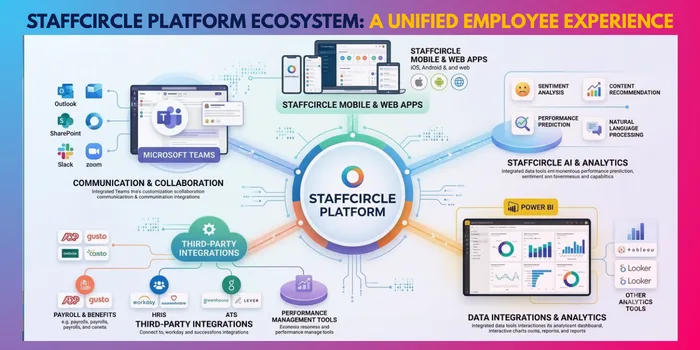
Traditional human resource systems often fail because they create an artificial barrier between daily operations and performance tracking. They force employees to leave their primary workspaces to log into disconnected, complex databases just to complete an administrative task.
StaffCircle solves this fundamental adoption problem by functioning as an all-in-one platform that unifies real-time performance tracking, employee engagement, and internal corporate communications into a single, automated hub.
Here is exactly how StaffCircle’s architecture supports every stage of the continuous performance management loop while eliminating manual administrative friction.
1. Streamlining Admin Workloads with Smart Automation
According to research by CEB, managers spend an average of about 210 hours per year (nearly five full weeks) on performance management activities. Mid-market organisations often waste time and budget juggling multiple point solutions, using one tool for engagement surveys, another for OKRs, a third for 1-on-1 tracking, and spreadsheets for annual appraisals.
StaffCircle consolidates these disconnected channels into a single system. By automating recurring meeting cadences, distribution schedules for surveys, and deadline reminders, the platform reduces performance management administrative workloads by up to 90%. HR teams shift away from manual form-chasing and focus instead on strategic talent development.
2. Eliminating Meeting Friction with Secure AI
StaffCircle ensures high employee adoption rates by embedding itself directly into the tools your teams already use every day.
Through native integrations with Microsoft Teams and Google Workspace, employees can update their key results, view company-wide communications, and submit 1-on-1 meeting agendas directly from their central chat application. This eliminates log-in friction, turning performance tracking from an isolated HR chore into a natural part of the daily workflow.
3. Secure, GDPR-Compliant AI Meeting Intelligence
Capturing accurate development data from informal check-ins can easily turn into an administrative burden for managers. StaffCircle tackles this challenge with its native AI Notetaker.
Operating within secure, regional Microsoft Azure data centers that maintain strict ISO 27001 and SOC 2 certifications, the tool securely transcribes 1-on-1 conversations. The AI automatically creates structured summaries, extracts agreed action items, and logs them directly onto the employee’s timeline. This keeps commitments transparent and fully visible to both parties without requiring manual data entry.
4. Full Feature Parity for Deskless and Frontline Workers via PWA
Traditional HR software often leaves out deskless, field, and frontline shift workers because it requires a corporate desktop computer or a dedicated company email address to log in.
StaffCircle bridges this digital divide through its responsive Progressive Web App. Frontline employees can access the platform from any mobile web browser on shift to check central newsfeeds, update project metrics, complete pulse surveys, and send peer-to-peer recognition badges, ensuring the entire workforce stays culturally and operationally aligned.
5. Live Predictive Analytics and Executive Insights
When talent data lives on scattered spreadsheets, building an accurate, forward-looking workforce strategy is incredibly difficult. StaffCircle pulls these continuous interactions together into an absolute source of truth.
Through a live Microsoft Power BI Connector, all sentiment logs, eNPS scores, competency gaps, and goal velocities are aggregated into real-time executive dashboards. The platform’s analytics engine automatically flags high-risk profiles (such as individuals with combined dropping pulse scores and missed OKRs), alerting HR to step in with proactive support before issues lead to voluntary turnover.
Frequently Asked Questions (FAQs)
What is an OKR?
An OKR (Objective and Key Result) is a goal-setting framework aligning individual output with corporate strategy. The Objective defines an ambitious, action-oriented goal, while Key Results provide quantifiable, verifiable metrics to measure success.
How does check-in frequency affect employee performance?
High-frequency check-ins accelerate performance by replacing historical reviews with real-time course correction. Companies reviewing goals monthly or bi-weekly are three times more likely to rank in the top business performance percentiles, driving a 39% increase in goal execution.
What are the biggest challenges when implementing continuous performance management?
Primary challenges include manager resistance, inconsistent feedback habits, lack of leadership buy-in, and poor software adoption. Organisations overcome these hurdles by deploying standardised templates, training managers in continuous coaching techniques, and automating workflow reminders.
How is continuous performance management different from traditional annual performance reviews?
Traditional reviews evaluate historical performance retrospectively once or twice a year. Continuous performance management focuses on real-time coaching, forward-looking feedback, agile goal tracking, and ongoing skill development throughout the calendar year.
Can continuous performance management work for remote and hybrid teams?
Yes. Continuous performance management relies on frequent digital touchpoints, collaborative software, and objective progress metrics. This provides managers with clear visibility into output and sentiment without requiring physical co-location.
How long does it take to implement a continuous performance management system?
Most mid-market organisations achieve full implementation within four to twelve weeks. A typical phased rollout introduces collaborative goal-setting and bi-weekly 1-on-1s first, before expanding to development tracking and advanced predictive analytics.
What KPIs should HR monitor in a continuous performance management program?
HR should track employee engagement/eNPS scores, OKR completion velocities, check-in frequency compliance, feedback participation rates, internal promotion rates, and voluntary employee retention metrics.
Is continuous performance management suitable for small businesses?
Yes. Small businesses benefit heavily by replacing lengthy, over-engineered review processes with lightweight, monthly check-ins and agile quarterly goals that drive engagement while drastically reducing administrative overhead.
How often should managers conduct performance check-ins?
We recommend weekly or bi-weekly 1-on-1 operational alignment conversations, supported by formal monthly goal reviews and iterative quarterly objective updates to match shifting market conditions.
How does continuous performance management improve employee retention?
Regular touchpoints build stronger manager-employee relationships and catch flight risks early. Shifting to continuous check-ins addresses operational bottlenecks and career growth in real time, reducing voluntary turnover by up to 30%.
What role does AI play in continuous performance management?
AI automates manual documentation. Tools like StaffCircle’s AI Notetaker securely transcribe 1-on-1 meetings, extract action items, and log summaries onto the employee timeline, shifting managerial focus from admin to active coaching.
What industries benefit most from continuous performance management?
Any sector relying on rapid goal alignment and employee development benefits, particularly healthcare, manufacturing, tech, retail, financial services, education, hospitality, and professional services.
What are common mistakes when adopting continuous performance management?
Common pitfalls include treating frequent check-ins like mini annual reviews, over-complicating workflows, setting too many goals, failing to train managers, and neglecting to track program adoption metrics.
Does continuous performance management replace performance ratings?
Not necessarily. Many organizations retain objective rating systems for compensation and promotion cycles, but decouple them from daily development, utilizing continuous coaching to drive year-round improvement.
How does continuous performance management save HR admin time compared to annual reviews?
Traditional reviews create massive administrative logjams of form-chasing and manual spreadsheets. Continuous platforms automate meeting schedules, pulse surveys, and documentation tracking, reducing total performance management admin workloads by 90%.
Is StaffCircle's platform compliant with strict data regulations like GDPR?
Yes. StaffCircle is ISO/IEC 27001:2022 certified and maintains strict SOC 2 standards. Data is hosted in secure, regional Microsoft Azure data centers. The native AI Notetaker employs zero-data-retention protocols, ensuring conversations never train public models.
Can we use StaffCircle if our workforce is mostly frontline or deskless?
Yes. StaffCircle bridges the office-frontline divide via a mobile Progressive Web App (PWA). Deskless workers can access newsfeeds, update metrics, complete pulse surveys, and send peer recognition badges from any mobile browser on shift.
Do we need to replace our existing payroll or HRIS platform to implement StaffCircle?
No. Your foundational HRIS remains the system of record for payroll and compliance contracts. StaffCircle connects via open APIs and native connectors to power dynamic, daily performance tracking, OKRs, and engagement feedback loops.
How do we roll out a continuous feedback model without overwhelming our managers?
Deploy a structured 60-day phased implementation plan. Begin by automating a baseline monthly pulse survey, then introduce simple, bi-weekly 1-on-1 templates natively embedded into daily collaboration tools like Microsoft Teams or Google Workspace.
How monthly goal setting affects team productivity compared to annual reviews?
Monthly goal setting increases team productivity by creating agile, shorter feedback loops that help teams adjust as priorities change. Unlike annual reviews, which rely on retrospective evaluations and are often affected by recency bias, monthly goals encourage continuous progress through regular check-ins, real-time adjustments, and clear milestones. This keeps employees aligned with current business priorities and improves accountability throughout the year.
What is Zero UI in HR technology?
Zero UI, or Zero User Interface, in HR technology refers to platforms like StaffCircle where employees interact with HR systems using natural language through AI assistants, voice commands, or messaging apps such as Slack and Microsoft Teams instead of navigating traditional menus and forms. The software works in the background to complete tasks like requesting leave, checking payslips, updating goals, or providing HR information through simple conversations.
How high-performing companies use agentic AI for manager coaching?
High-performing companies use agentic AI to provide managers with proactive, real-time coaching instead of relying only on scheduled training sessions. These autonomous AI agents analyse operational data such as workload, communication patterns, missed deadlines, and employee engagement signals to identify potential issues. They then deliver timely recommendations that help managers address challenges, improve team performance, and support employees when it matters most.
Why performance management is shifting from output metrics to skill-based metrics?
Performance management is moving towards skill-based metrics because output targets can quickly become outdated as business needs change. Measuring technical skills, behavioural competencies, and transferable capabilities gives organisations a clearer understanding of workforce readiness, supports internal mobility, and helps build adaptable teams that can respond to changing priorities over the long term.
What are the examples of micro-rewards and instant employee recognition?
Micro-rewards and instant recognition help reinforce positive behaviours as they happen. Common examples include peer-to-peer digital badges linked to company values, spot bonuses or points that employees can redeem for gift cards, and public recognition shared through Slack or Microsoft Teams immediately after an important achievement. These small but timely rewards strengthen engagement and encourage consistent performance.
Does continuous performance management increase manager burnout?
Continuous performance management can increase manager burnout if it adds extra administrative work or requires managers to use multiple disconnected systems. However, when supported by modern HR platforms that automate meeting scheduling, structure one-on-one discussions, capture notes, and track goals, it often reduces burnout by spreading performance conversations throughout the year and removing the heavy workload associated with annual reviews.
Is using AI to summarise employee communication for performance reviews ethical?
Using AI to summarise employee communication can be ethical when organisations are transparent about how employee data is used, obtain appropriate consent, protect privacy, and apply strong data security measures. AI-generated summaries should only support the review process rather than replace human judgement. Managers should always review, verify, and add context to AI insights before making performance decisions.
How do organisations manage salary increases without annual performance ratings?
Many organisations separate compensation decisions from traditional performance ratings by using broader evidence of employee contribution. Salary increases are often based on current market benchmarks, demonstrated skill development, business impact, peer feedback, and contributions to cross-functional projects. This approach focuses on overall value rather than relying on a single annual score.
Will continuous feedback systems create tool fatigue?
Continuous feedback systems can create tool fatigue if employees are expected to log into separate platforms for routine updates. Organisations can reduce this risk by embedding feedback into the tools employees already use every day, such as project management platforms, Slack, or Microsoft Teams. Keeping feedback within existing workflows makes participation easier and reduces unnecessary context switching.
How to prevent proximity bias in remote and hybrid performance reviews?
Organisations can reduce proximity bias by using standard evaluation criteria based on measurable outcomes, demonstrated skills, and documented contributions rather than physical office attendance. Adding 360-degree feedback from colleagues across different teams and regularly reviewing promotion and performance data for remote and in-office employees also helps ensure fair and consistent evaluations.
What are the best practices for human-in-the-loop AI in performance management?
Human-in-the-loop AI works best when AI handles repetitive tasks such as collecting goal updates, summarising feedback, identifying skill gaps, and highlighting trends, while managers retain full responsibility for performance ratings, promotions, and development decisions. Organisations should also maintain transparency by allowing employees to understand how AI-generated insights were produced and how they are used.
How to separate continuous feedback from promotions and compensation?
Continuous feedback should focus on coaching, learning, and career development rather than salary discussions. Organisations can achieve this by scheduling regular development conversations separately from compensation reviews. This encourages more open and honest discussions because employees are not concerned that every conversation will immediately affect their pay or promotion opportunities.
Can continuous feedback tools integrate with Slack or Microsoft Teams?
Yes, most modern continuous performance management platforms like StaffCircle offer native integrations with Slack and Microsoft Teams. These integrations allow employees and managers to share feedback, update goals, record one-on-one action items, and recognise achievements without leaving their everyday communication platform, making performance management more consistent and accessible.
How remote employee performance should be measured instead of online activity?
Remote employee performance should be measured by outcomes rather than digital activity such as keystrokes or online status. Organisations should evaluate project completion, quality of work, business impact, collaboration, communication effectiveness, and achievement of agreed goals. This approach provides a more accurate picture of employee performance while supporting trust and flexibility in remote work.
Related articles
See StaffCircle in action
Book a personalised demo and see how StaffCircle drives performance, engagement and development.