Performance Management for Hybrid and Deskless Teams
So, how do you manage the performance of your remote, hybrid, or frontline employees as an HR leader or manager? Are you still using the typical 9-box method for succession, spreadsheets for feedback, and paper notes?
Well, here’s the catch: across manufacturing, logistics, healthcare, retail, and field services, the overwhelming majority of the global workforce does not sit at a desk. These frontline, blue-collar, and distributed shift workers operate on the move, managing machinery, fulfilling delivery metrics, or executing client-facing tasks. When you overlay this deskless reality with corporate hybrid office schedules, HR leaders find themselves facing a massive technology gap.
When an organisation tries to manage a mixed workforce using legacy, desk-first software, they immediately isolate their frontline and widen the digital divide in a non-desk workforce. Traditional platforms introduce extreme log-in friction, require complex enterprise licenses, and rely heavily on manual management tracking. The inevitable result is an unengaged workforce, severe data gaps for human resources, and high voluntary turnover.
As a comprehensive performance, engagement, and development platform, StaffCircle was built from the ground up to solve this exact structural challenge. Let us tell you how.
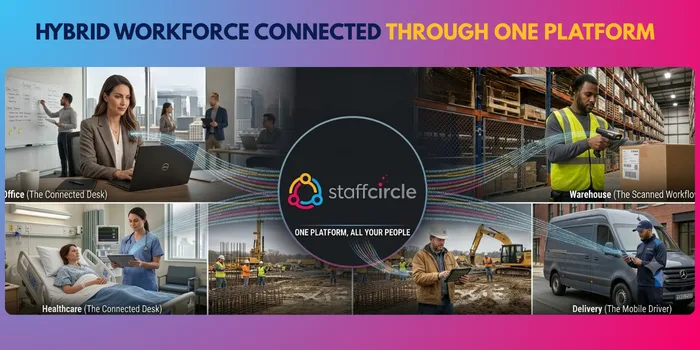
The Unique Challenges of Managing Deskless Employees
According to 2018 research data by Emergence Capital, around 80% of the global workforce is deskless, and you can expect the number to have increased today after the COVID-19 pandemic. But still, most enterprise HR systems were originally designed for office-based employees. This leaves millions of frontline workers disconnected from performance management, communication, and development opportunities.
There is a clear difference between a desk-based employee and a deskless one. So, let’s take a look at it first.
| Area | Hybrid / Desk-Based Employees | Deskless / Frontline Employees |
|---|---|---|
| Primary Device | Corporate laptop or desktop computer | Personal smartphone or shared kiosk/tablet |
| Digital Identity | Company email and corporate login credentials | Limited or no corporate email identity |
| Access to HR Systems | Continuous access to HR, payroll, and performance platforms | Often disconnected from HR systems and company portals |
| Manager Communication | Regular virtual meetings, chat, and scheduled 1-on-1s | Limited communication, often only during shifts |
| Performance Feedback | Frequent structured feedback and coaching conversations | Little or no consistent feedback process |
| Career Development | Easy access to learning, development, and internal opportunities | Fewer opportunities for training, mentoring, and career progression |
| Recognition & Visibility | High visibility with managers, increasing the risk of proximity bias | Lower visibility despite critical operational contributions |
| Employee Experience | More connected to company culture and leadership | Greater risk of isolation, disengagement, and higher turnover |
Managing performance for deskless employees requires addressing deep structural barriers. You cannot simply apply traditional corporate appraisal templates to a factory floor or a distribution center and expect meaningful engagement. To build a successful performance culture, organisations must first overcome four primary challenges.
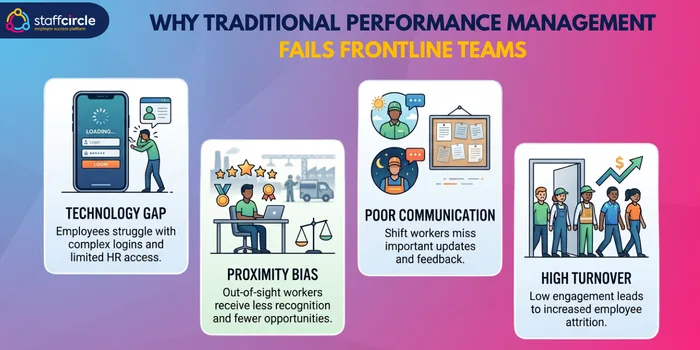
1. The Technology Access Gap & Identity Friction
The first and most immediate barrier is basic system access. Standard enterprise software requires a dedicated corporate email account or single sign-on (SSO) linked to a desktop license (such as Microsoft Office 365 or Google Workspace). Frontline employees rarely have these digital identities. Forcing a delivery driver or a manufacturing technician to manage complex corporate log-in details simply to view a company update or log an objective ensures they will never adopt the system.
2. Pervasive Proximity Bias
Proximity bias is a major operational challenge in hybrid environments. Managers naturally form higher opinions of, and give better ratings to, the employees they see face-to-face in the office, regardless of actual output. Deskless workers, who operate entirely out of sight in fields or regional warehouses, regularly find their milestones overlooked. Without objective data tracking, performance reviews become highly subjective, which damages trust and increases employee turnover.
According to Gallup, only 23% of frontline employees strongly agree they receive the information they need to do their jobs effectively, highlighting the communication gap many organisations face.
3. Asynchronous Schedules and Communication Churn
Poor internal communication and low employee engagement are structural problems that cost the global economy an estimated $8.9 trillion annually, according to Gallup’s State of the Global Workplace 2026.
Desk-based employees share synchronous communication environments like Slack or Microsoft Teams. Frontline staff, however, work across staggered shifts, varying time zones, and remote locations. They cannot stop their daily tasks to attend a corporate town hall or read long internal email updates. When corporate communications rely strictly on static email channels, frontline staff are left isolated, missing out on core values, updates, and strategic changes.
4. High Volatility and Rapid Turnover Rates
Frontline sectors experience some of the highest voluntary turnover rates in the business landscape. Because these roles are highly operational, employees often feel like easily replaced cogs rather than valued team members. When feedback is restricted to a surprise review session once a year, HR has no way to track shifting employee sentiment, catch declining engagement, or intervene before an individual decides to hand in their notice.
What Deskless PM Software Must Do Differently
To successfully engage a mixed workforce, performance software must throw out the legacy desktop playbook. Frontline teams need a solution tailored specifically to their day-to-day operating environment.
True Mobile-First Architecture Over App Clutter
Deskless software cannot just be a scaled-down, hard-to-read desktop website opened on a phone screen. It must be built as a native mobile experience optimised for quick, on-the-go interactions. Frontline workers do not have the time to navigate complex drop-down menus; they need clean interfaces, single-tap pulse surveys, and straightforward input options they can easily complete in the middle of a busy shift.
Complete Independence from Corporate Licenses
An effective platform must allow employees to authenticate securely using alternative identities, such as personal mobile numbers, unique employee IDs, or QR-coded access tokens. By removing the requirement for expensive desktop software licenses, organisations can easily scale access to thousands of frontline workers at a fraction of the cost.
Blending Internal Communications with Performance
For desk-based workers, communication and performance are managed in separate spaces. For the frontline, these elements must live together. A deskless platform needs to combine operational goal tracking with a real-time corporate newsfeed and peer appreciation channels. This keeps field workers informed about the broader business while tracking their specific daily contributions.
StaffCircle Features Built for Deskless and Hybrid Teams
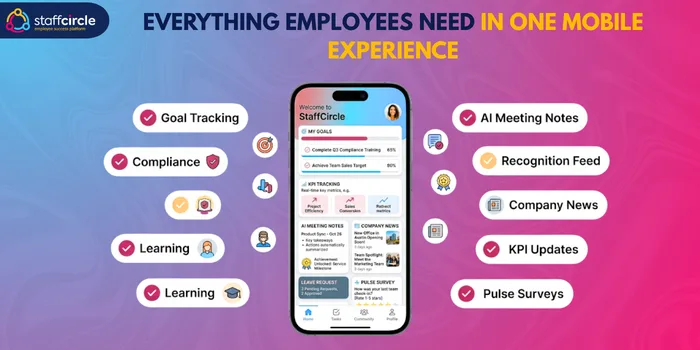
StaffCircle is built differently. When we started developing this software, we had to do something to solve all possible problems that HR leaders and administration face regarding employee management. So, let’s talk about how this platform can reduce 90% of your admin time and increase the employee engagement rate by 74%.
Cross-Device Access and the Progressive Web App (PWA)
According to a survey from Samsung, 41% of frontline workers have to use multiple devices because they don’t have a single device with all the features they need.
StaffCircle delivers an optimised mobile experience through its advanced Progressive Web App. Employees do not need to download bloated files from consumer app stores or rely on corporate hardware. The PWA loads instantly on any modern smartphone or mobile web browser, ensuring shift workers can check schedules, book annual leave, and complete performance checks right from the palm of their hand.
Automated, Multi-Channel Communications
To keep field teams updated, StaffCircle features a built-in social intranet and centralised corporate newsfeed. Communications teams can target critical updates to specific groups based on role, location, or department. Urgent safety or operational updates can be pushed as direct mobile alerts, ensuring vital messages are read and acknowledged instantly.
Real-Time, Employee-Led Goal and KPI Logs
StaffCircle removes the administrative strain of tracking performance across regional sites by introducing self-service goal tracking. Whether your teams use structured OKRs or straightforward operational KPIs, field employees can independently update their milestones, log production numbers, and add notes or photos as project evidence. This provides management with live performance metrics while highlighting frontline achievements across the business.
Secure AI Notetaking to Neutralise Proximity Bias
To protect hybrid 1-on-1 check-ins, StaffCircle includes a native, GDPR-compliant AI Notetaker. When a supervisor holds a virtual or telephone check-in with a remote worker, the AI securely transcribes the conversation, summarises the core development targets, and adds the notes directly to the employee’s timeline. This automated audit trail ensures that out-of-sight staff receive fair documentation, keeping their development visible and reducing proximity bias.
Values-Driven Peer Recognition Feeds
Gallup research shows that employees who receive meaningful recognition are 45% less likely to leave their employer within two years. StaffCircle builds an active culture of appreciation through a public peer recognition feed. Employees can send digital badges and public shout-outs to colleagues across different departments or job sites. Because every badge is tied directly to a core company value, this public recognition reinforces positive contributions and keeps remote team members feeling valued.
Connecting Performance with Compliance
In industries like healthcare, manufacturing, and field services, good performance is about more than meeting targets. Employees also need to follow safety procedures and maintain the certifications required for their role. Someone who delivers strong results but ignores safety rules can create serious risks for the business. StaffCircle brings compliance and performance together in one platform, making it easier for managers to keep employees qualified and workplaces safe.
- Proactive certification alerts: Store mandatory safety certifications, medical licenses, and operational permits directly within the employee’s profile. StaffCircle automatically tracks expiration dates and triggers mobile alerts to both the employee and their supervisor weeks before a credential lapses, preventing costly compliance gaps and scheduling disruptions.
- Audit-ready compliance dashboards: Give HR and safety officers a real-time, high-level view of compliance rates across different shifts, facilities, or regional sites. Instead of digging through filing cabinets or disparate spreadsheets during a surprise inspection, leadership has instant access to verifiable qualification data.
- Gamified safety cultures: Reinforce a “zero-incident” workplace by tying compliance to StaffCircle’s peer recognition feed. Managers can automatically dispatch digital badges and company-wide shout-outs to teams that hit safety milestones (e.g. 100 days accident-free), transforming safety from a rigid rulebook into a celebrated team achievement.
Just-in-Time Development: Bridging Performance Gaps with Micro-Learning
Traditional learning systems often expect employees to spend long periods completing online courses. That may work for office-based staff, but it is not practical for delivery drivers, retail associates, healthcare workers, or manufacturing teams who spend most of their day away from a desk.
Deloitte found that organisations with strong learning cultures are 92% more likely to innovate and 37% more productive, reinforcing the importance of continuous learning rather than one-off training events.
StaffCircle makes learning part of everyday work by connecting employee development LMS platforms.
- Learning based on real performance: When a manager identifies a skill gap during a check-in, or when an employee’s performance falls below a target, StaffCircle can recommend short training that focuses on the specific skill needing improvement.
- Mobile-friendly learning: Employees receive short learning resources, such as a two-minute video, a quick guide, or a simple checklist, directly through the Progressive Web App (PWA). They can access the information on their phone whenever they need it.
- Ready before the shift starts: Because the learning content is short and easy to access, employees can review it before starting work, during a team briefing, or whenever there are a few minutes available. This helps them apply what they learn straight away instead of waiting for scheduled training sessions.
By replacing long training courses with short, targeted learning, StaffCircle helps organisations close skill gaps faster, reduce mistakes, improve performance, and give frontline employees more opportunities to develop while they work.
Enabling the Accidental Frontline Manager
Landmark research from the Chartered Management Institute (CMI) indicates that a staggering 82% of UK managers enter their roles without formal leadership training.
In industries like manufacturing, logistics, and retail, many shift supervisors and floor managers become managers because they were great at their jobs, not because they were trained to lead people. They know how to meet targets, run operations, and solve day-to-day problems, but they are often expected to manage employee performance with little or no leadership training. On top of that, they have very limited time during busy shifts.
StaffCircle doesn’t just reduce administrative burdens for HR; it actively coaches the coach. The platform bridges the leadership capability gap by embedding performance enablement directly into the manager’s daily workflow:
- Quick feedback templates: Instead of writing feedback from scratch, managers can use simple, mobile-friendly templates to record clear and useful feedback in less than two minutes.
- Automatic discussion prompts: Before a 1-on-1 meeting, StaffCircle creates a list of talking points based on the employee’s recent goals, KPI progress, development plans, and any issues that need attention. Managers know exactly what to discuss without spending time preparing.
- Fast, guided check-ins: Managers can complete meaningful performance conversations from their phone in around 10 minutes, even if they have never received formal HR or leadership training. Every conversation is automatically recorded, creating a secure audit trail without extra paperwork.
By transforming performance management from a complex HR exercise into a fast, guided routine, StaffCircle empowers frontline supervisors to become effective people leaders without sacrificing their operational output.
The Business Case for Finance Leaders
HR teams focus on employee engagement and development. Finance teams focus on controlling costs and improving returns. StaffCircle helps both by removing unnecessary technology costs while improving workforce performance.
Many organisations give frontline employees corporate email or desktop accounts simply so they can access HR systems. For workers who spend their day on the shop floor, on the road, or in the field, these licences often provide little value but still add to software costs.
StaffCircle removes this extra expense by allowing frontline employees to access the platform without needing a corporate email account or desktop licence.
| Financial Area | Traditional Platforms | StaffCircle |
|---|---|---|
| Access | Employees often need a corporate email account or desktop licence to log in. | Employees can access the platform using their employee ID, QR code, or mobile number. |
| Software Costs | Organisations may pay for software licences that many frontline workers rarely use. | Employees only need access to the tools they actually use for performance and engagement. |
| IT Administration | IT teams spend time creating accounts, resetting passwords, and managing access. | Simple self-service onboarding reduces the time spent managing user accounts. |
Understanding the Cost
For organisations with a large frontline workforce, these unnecessary software licences can become a significant ongoing expense. For example, if a business has 1,000 frontline employees and each requires an £8 per month licence only to access an HR system, the cost is:
- 1,000 employees × £8 per month = £8,000 per month
- £8,000 × 12 months = £96,000 per year
That is money spent on software many frontline employees may never fully use.
The Value Goes Beyond Software Savings
Reducing unnecessary licence costs is only part of the return on investment.
When organisations improve employee engagement, provide regular feedback, and support career development, they are more likely to retain experienced employees. Lower turnover means lower recruitment, onboarding, training, and temporary staffing costs, while also reducing productivity losses caused by vacant roles.
For organisations that have seen improvements in frontline retention, even preventing a small number of employee departures each year can offset a significant portion of the investment in a performance management platform.
Case Study: 200-Person Logistics Company Improves Retention 22%
The Challenge
A fast-growing UK logistics and distribution firm with 200 employees faced severe retention issues. While the 40 office-based staff used standard email and chat tools, the 160 delivery drivers and warehouse workers were entirely disconnected from corporate systems. Performance management was non-existent, communication relied on physical paper notices posted in staff areas, and annual turnover among the frontline workers hit an unsustainable 48%.
The Strategy
The company deployed StaffCircle to unify its workforce under one platform. They launched the mobile Progressive Web App, giving drivers and warehouse staff secure access via their personal smartphones using unique employee IDs. The management team rolled out three core initiatives:
- Simplified operational KPIs: Drivers logged their weekly delivery compliance rates directly into the app.
- Automated monthly 1-on-1 check-ins: Managers used structured mobile templates to run quick, consistent reviews.
- Values-based peer recognition: Warehouse staff could instantly send digital badges to recognise peers for outstanding safety compliance.
The Results
Within twelve months of launching the platform, the company transformed its operational metrics:
| Operational Metric | Before StaffCircle | After StaffCircle | Net Impact |
|---|---|---|---|
| Voluntary Employee Turnover | 48% annually | 26% annually | 22% improvement in staff retention |
| Frontline Software Engagement | Less than 5% | 91% active weekly use | Significant adoption across shift workers |
| Performance Admin Hours | 120 hours per quarter | 12 hours per quarter | 90% reduction in HR tracking workloads |
| Unplanned Absenteeism | 8.2% average | 6.5% average | 20% reduction in total lost days |
By replacing fragmented paper tracking with an accessible, mobile performance loop, the business protected its workforce stability, improved operational execution, and saved thousands in recruitment costs.
Getting Started: Deskless PM in 30 Days
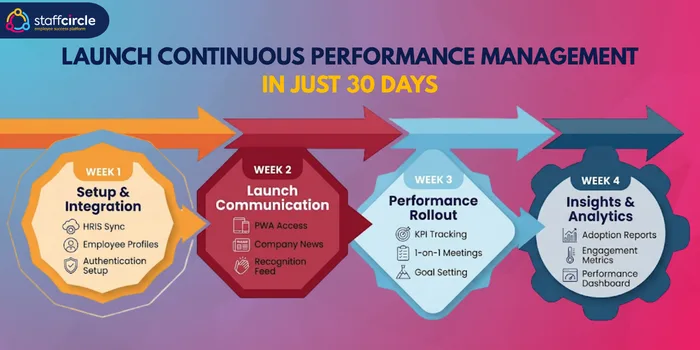
Transitioning a distributed workforce to a continuous performance management model doesn’t have to be a multi-month project. By following a clear, structured 30-day implementation plan, you can roll out the platform smoothly without overwhelming your operations.
Days 1 to 10: Technical Mapping and Foundation Setup
The initial phase focuses on aligning system structures with your active corporate directories.
- Data integration: Sync your primary HRIS or payroll directory with StaffCircle to automatically build user profiles, establish manager hierarchies, and define regional departments.
- Access provisioning: Set up alternative authentication paths for your deskless staff, allowing them to log in securely using employee IDs or personal phone numbers without needing corporate emails.
- Communications prep: Design your central intranet channels and create custom value-driven recognition badges tailored to your corporate goals.
Days 11 to 20: Launching Communications and Engagement Tracks
The second phase introduces the platform to your workforce through low-friction engagement channels.
- The PWA launch: Send mobile invitations to your frontline staff, guiding them to add the StaffCircle Progressive Web App to their smartphone home screens.
- Central communication blast: Publish your first corporate update via the central newsfeed, using direct push notifications to ensure broad visibility across shift teams.
- Open the recognition feed: Encourage team leaders to send the first public value badges, showing employees how simple it is to celebrate peer contributions.
Days 21 to 30: Embedding the Performance Loop
The final phase launches your structured, automated performance tracking mechanisms.
- Deploy KPI frameworks: Load simple, quantifiable operational metrics or quarterly OKRs onto employee profiles based on department roles.
- Trigger automated 1-on-1s: Launch automated recurring 1-on-1 check-in schedules, prompting managers and employees to submit their talking points before meetings start.
- Review live pulse analytics: Open your HR reporting panels to track initial sentiment data, monitor adoption rates across sites, and review real-time workforce metrics.
Bottom Line
Building a high-retention workplace is ultimately an execution problem, not a strategy problem. Most organisations already understand what their people need: clear communication, consistent management support, fair development paths, and a culture of appreciation. The breakdown occurs when human resource teams are forced to manage these needs through scattered spreadsheets, fragmented point solutions, and manual check-in reminders.
By unifying performance metrics, automated feedback loops, and internal communications into a single digital environment, StaffCircle transforms employee retention from an administrative guessing game into a predictable, automated process. Whether your people operate from a corporate office, a home desk, or a regional warehouse floor, the platform removes operational friction and gives managers the data-driven tools they need to protect talent investments.
The future of talent management belongs to agile, high-frequency communication. Transitioning away from outdated annual reviews to a continuous performance loop helps organisations minimise voluntary turnover, maximise frontline engagement, and build a resilient workforce designed to grow alongside the business.
Frequently Asked Questions (FAQs)
Does StaffCircle work offline? Is a mobile app available?
Yes, StaffCircle is delivered as an advanced Progressive Web App (PWA) available for both iOS and Android platforms. The PWA format provides full cross-device feature parity without forcing users to manage constant updates through consumer app stores. While a live internet connection is needed to update dashboards or send real-time alerts, the platform includes offline task and worksheet support. Employees working in low-connectivity areas can log project information and fill out worksheets independently; the app securely caches their entries and syncs the data back to the central server the moment they reconnect.
How do frontline workers log in if they do not have a company email?
StaffCircle removes corporate identity barriers entirely. Workers without an office email can log in securely using alternative identifiers, including personal mobile phone numbers, unique corporate employee numbers, or automated single sign-on (SSO) tokens. This allows organisations to onboard thousands of frontline shift or seasonal workers easily, without paying for unneeded enterprise desktop licenses.
Will our field managers find the performance tools too complicated to use?
No, the platform is built for ease of use. StaffCircle uses clean mobile interfaces and structured, step-by-step review templates designed to make performance tracking accessible for users of all technical skill levels. Field managers can log 1-on-1 discussions, update operational metrics, and review employee histories with just a few taps on their smartphones, keeping administrative friction to an absolute minimum.
How does mobile recognition help improve retention among deskless teams?
Frontline workers often feel isolated from the wider company culture, which directly drives high turnover rates. StaffCircle’s public recognition feed gives long-distance teams a shared space to connect. Allowing peers and supervisors to instantly send values-based digital badges for great work makes quiet contributors feel valued across the entire business, which lowers voluntary turnover and boosts frontline engagement by up to 74%.
Can we connect StaffCircle to our existing field management or scheduling tools?
Yes. StaffCircle features an open API alongside an enterprise Zapier connector that allows your IT team to link performance profiles with external operational systems. You can connect the platform to third-party scheduling, warehouse management, or CRM tools to automatically pull fulfillment data, update performance metrics, and trigger review tasks based on real-world milestones.
How does StaffCircle ensure employee privacy on personal phones (BYOD)?
StaffCircle protects employee privacy on personal phones by running as a browser-based Progressive Web App (PWA), so employees do not need to install software on their devices. It does not access personal photos, messages, browsing history, or real-time GPS location. The platform only records work-related activity performed within StaffCircle, such as completing goals, submitting updates, or viewing company communications. All data is encrypted using AES-256 and TLS 1.2, stored in UK-based Microsoft Azure data centers, protected by role-based access controls, and handled in compliance with UK and EU GDPR requirements. This allows employees to use their own devices for work without exposing personal information or enabling corporate surveillance.
What are the key features of an all-in-one employee experience (EX) platform for distributed teams?
An all-in-one employee experience (EX) platform for distributed teams brings communication, performance, and employee development together in a single mobile-accessible hub. Key features include a centralised corporate newsfeed with targeted alerts, mobile-first OKR and KPI tracking, automated one-on-one check-in workflows with secure AI meeting summaries, peer-to-peer recognition linked to company values, and competency mapping profiles. These capabilities should be available across devices through technologies such as Progressive Web Apps (PWAs), allowing employees to access the platform without relying on desktop computers.
What ROI can organisations expect from reducing frontline administrative work and employee turnover?
Organisations using an automated performance platform like StaffCircle can experience significant operational improvements, including an average 57% reduction in employee turnover and a 20% decrease in absenteeism. By replacing paper-based and spreadsheet processes with digital check-ins and automated workflows, companies can reduce performance administration time by up to 90%. This lowers recruitment, onboarding, and temporary staffing costs while improving workforce productivity.
Can frontline employee experience platforms replace workforce management (WFM) and shift scheduling software?
No. An employee experience platform is not intended to replace workforce management (WFM) or shift scheduling software. Instead, it complements these systems by focusing on employee engagement, performance management, learning, recognition, and internal communication. While WFM software manages operational activities such as shift scheduling, attendance, and time tracking, an employee experience platform supports continuous feedback, goal tracking, development planning, and company-wide communication.
Do companies need to pay full enterprise HR software licence fees for deskless employees?
No. Traditional enterprise software often requires organisations to purchase expensive licences designed for office-based employees, even when frontline workers only need basic communication and performance tools. StaffCircle uses modular, role-specific licensing that allows organisations to provide full functionality for desk-based employees while giving frontline teams access to streamlined mobile features at a lower cost. This approach reduces unnecessary software spending without limiting employee engagement.
How do Progressive Web Apps (PWAs) and SMS verification improve mobile access for frontline employees?
Progressive Web Apps (PWAs) and SMS verification remove many of the access barriers faced by frontline workers. A PWA runs directly in a mobile browser without requiring employees to download an app from an app store or use a company-owned device. Combined with SMS verification or unique employee ID login, it allows employees without corporate email addresses or single sign-on (SSO) accounts to securely access company resources from their personal smartphones.
How do employee experience platforms integrate with workforce management (WFM) and shift scheduling systems using REST APIs?
Employee experience platforms integrate with workforce management systems through secure REST APIs that automatically exchange information between connected applications. Events such as employee onboarding or offboarding, shift updates, completed performance reviews, or goal progress can be synchronised in real time. This keeps HR records, performance data, scheduling information, and payroll systems aligned while reducing manual data entry and administrative effort.
How can role-specific milestone check-ins and digital talent mapping reduce proximity bias?
Role-specific milestone check-ins and digital talent mapping help reduce proximity bias by ensuring employees are evaluated based on measurable achievements rather than physical visibility. Managers can track progress against goals, competencies, and key performance indicators within a shared performance platform, allowing remote and frontline employees to receive equal recognition. Documented achievements create an objective record that supports fair performance reviews, promotions, and development decisions.
How can modular HR software licensing reduce total cost of ownership (TCO) for organisations with frontline workers?
Modular HR software licensing reduces total cost of ownership by matching software access to each employee's role. Rather than purchasing a full enterprise licence for every worker, organisations can provide comprehensive HR tools for office-based employees while offering lightweight communication and performance features to frontline staff. This approach eliminates unnecessary licence costs and ensures software investment aligns with actual business needs.
How can organisations secure employee data on personal devices while managing identity access and instant offboarding?
Organisations can secure employee data on personal devices by using Progressive Web Apps that store only temporary encrypted data within the browser instead of downloading sensitive company information onto the device. Access can be controlled through SMS verification, unique employee IDs, or secure authentication tokens. When an employee leaves the organisation, administrators can immediately revoke access, removing the employee's connection to company systems without requiring access to the personal device itself.
Related articles
See StaffCircle in action
Book a personalised demo and see how StaffCircle drives performance, engagement and development.