What is a performance improvement plan?
A performance improvement plan (PIP) is a written, time-bound agreement between a manager and an employee that sets out where performance falls short of the standard the role requires, what good looks like, what support the employer will provide, how progress is measured and when it is reviewed.
Key facts
- A PIP is a support mechanism, not a pre-written route to dismissal.
- Every plan needs a measured baseline, a target, a support offer and review dates.
- UK plans commonly run four to twelve weeks, matched to the evidence needed.
- The ACAS Code of Practice should shape any formal performance process in the UK.
- This article is general guidance on process, not legal advice.
What does performance improvement plan mean?
Performance improvement plan means exactly what the three words say: a plan, with a defined end date, to improve performance that has been measured as falling below the standard for the role. The word that carries the weight is plan. A document that only lists complaints is not a plan. A plan names the gap in facts, names the standard, names the help on offer, and names the dates on which progress will be checked.
Managers sometimes use the phrase loosely to mean "I have had a difficult conversation with someone." That is not a PIP. A PIP is a formal, recorded stage in a performance process, and everyone involved should know they are in one. If the employee is unsure whether they are on a plan, the plan has already failed on its first job, which is clarity.
When should you use a PIP instead of an informal conversation?
Use an informal conversation when the issue is new, small, and plausibly caused by unclear expectations or a fixable skills gap. Use a formal plan when coaching has already been tried, the gap is measurable and material, and the employee needs a written standard and a timescale to work to. The test is not how annoyed the manager is. It is whether informal support has had a fair chance to work.
| Decision signal | Informal conversation | Formal improvement plan |
|---|---|---|
| How often it has come up | First or second time | Raised before, and the pattern has held |
| Size of the gap | Small, or hard to measure yet | Measurable, and material to the team's output |
| Likely cause | Unclear brief, new process, missing tool | Capability gap that persists once the brief is clear |
| Support already tried | None yet, or one informal pointer | Coaching, training or shadowing already offered |
| What the employee knows | May not realise the standard was missed | Has been told clearly, more than once |
| Record kept | One-to-one notes | Signed plan, dated targets, review minutes |
| Timescale | Check back in a fortnight | Fixed end date with scheduled reviews |
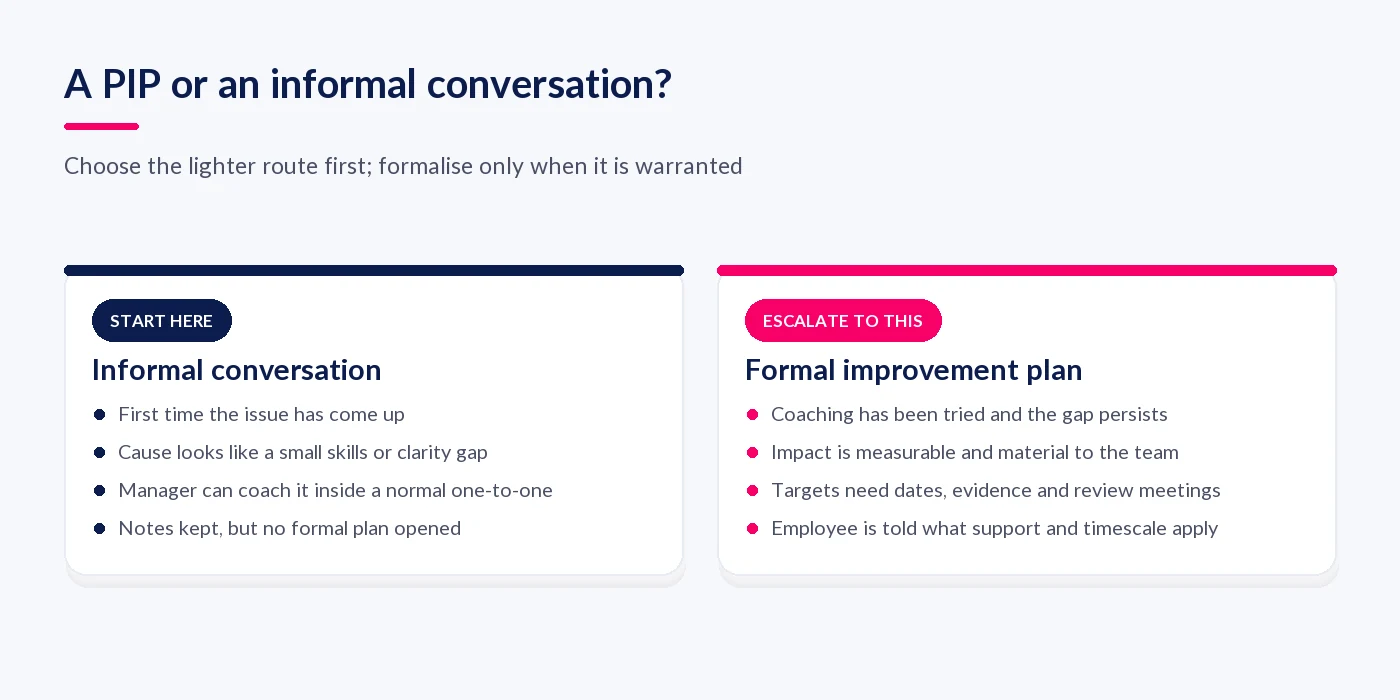
Reaching for a formal plan too early costs you the cheapest fix available. Most performance conversations are resolved by making the expectation specific, which is the same discipline that makes a personal development review useful rather than ceremonial. Reaching for it too late is also expensive: the employee loses months of unclear feedback, and the manager ends up with no evidence trail at the point one is needed.
What should a performance improvement plan include?
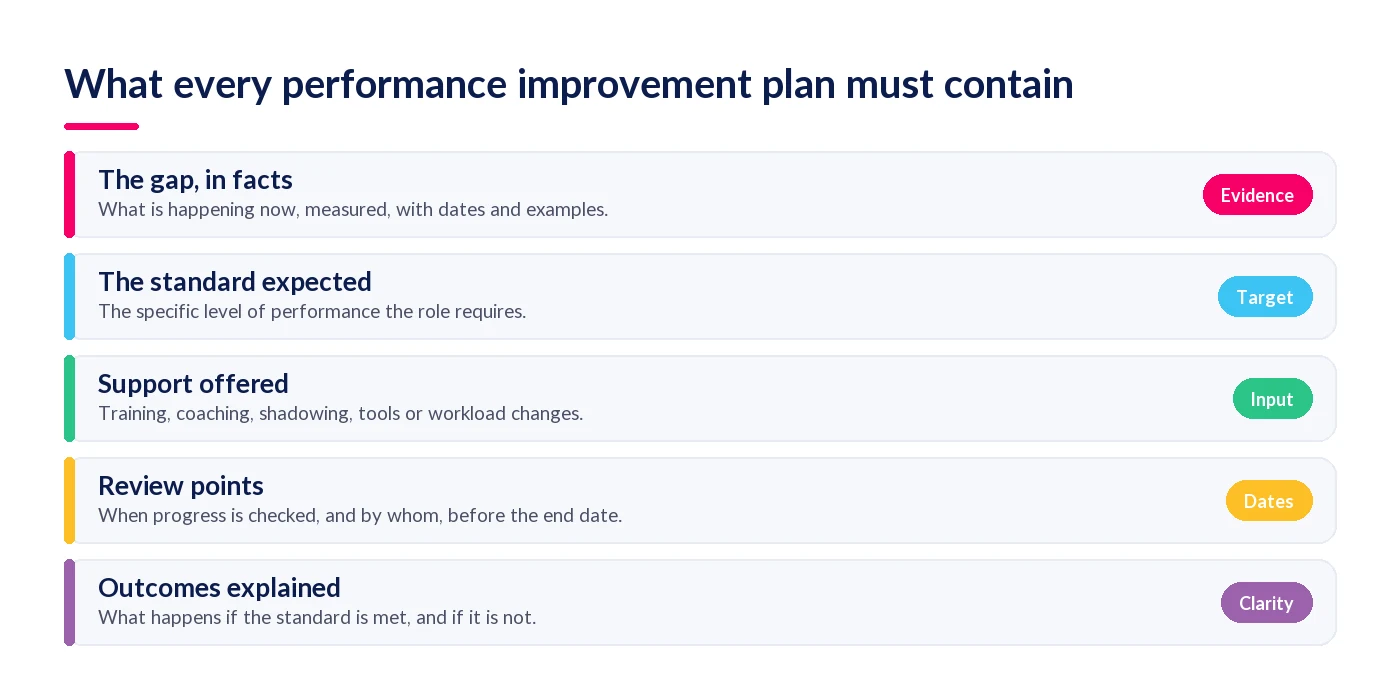
A usable plan contains five things: the gap stated as fact, the standard the role requires, the support the employer will provide, the dates on which progress is reviewed, and a plain explanation of what happens at the end. Anything else is optional. Anything missing from that list will be argued about later.
- The gap, in facts. Measured output, named examples and dates. Not adjectives about attitude.
- The standard expected. The figure or behaviour the role requires, and where that requirement comes from.
- The support offered. Named training, coaching, shadowing, tools or a workload change, with owners and dates.
- Review points. Scheduled meetings, not "we'll catch up when we can."
- Outcomes explained. What happens if the standard is met, and what happens if it is not.
If you want the field-by-field structure with worked numbers in it, our guide to writing a performance improvement plan gives you a template you can copy. For a fuller picture of where plans sit alongside objectives, reviews and one-to-ones, the performance management system hub maps the whole cycle.
Worth a read alongside this: The Ultimate Guide to Performance Reviews covers how to write feedback that is specific enough to act on, which is the skill most plans stand or fall on.
Is a performance improvement plan a disciplinary process?
No. A performance improvement plan is a capability and support process, and it should be run separately from conduct or disciplinary matters. Poor performance usually reflects capability, clarity or circumstance. Misconduct is a different thing with a different route. Mixing the two makes both harder to handle fairly, and it tells the employee the plan was never really about improvement.
That said, a formal plan can be the stage that precedes a capability process if performance does not improve, so the process behind it needs to be sound. UK employers should read the ACAS Code of Practice on disciplinary and grievance procedures, which sets the expectations for fair handling: investigate the facts, tell the employee the concern in writing, hold a meeting, allow them to be accompanied at formal meetings, and give a right of appeal. The Code also notes that an employment tribunal can adjust a compensation award by up to 25% where an employer or employee has unreasonably failed to follow it.
This article describes good process, not the law. Employment law is fact-specific and changes, so take advice from a qualified employment law adviser before you rely on any plan as a step towards dismissal.
What makes a performance improvement plan actually work?
Plans work when the evidence is already in one place, the review meetings actually happen, and the employee can see the same picture as their manager. Plans fail when the evidence lives in a manager's memory, reviews slip, and the first written record appears at the end. That is an admin problem far more often than it is a people problem.
StaffCircle's performance management and development module keeps objectives, one-to-one notes, feedback and review dates on one record, so a plan is assembled from evidence that already exists rather than reconstructed at the deadline. Customers on the platform report 96% on-time review completion; how that figure is measured is documented on our customer outcomes page. Automated reminders matter here for a simple reason: a missed mid-plan review is the single most common reason a plan cannot be relied on later.
Two related questions come up immediately once you decide to open one: how long a performance improvement plan should last, and how the plan works week by week once it starts.
If you would like to see how a plan looks when the evidence behind it is already in one place, take a look at StaffCircle's performance management and development module.
Frequently asked questions
What are performance improvement plans?
Performance improvement plans are formal, time-bound documents used when someone's measured performance is below the standard a role requires. Each plan records the gap, the standard, the support the employer will provide and the review dates. They are used to give a fair, structured chance to improve, with help attached.
What is a performance improvement plan (PIP)?
PIP is simply the common abbreviation for performance improvement plan. Some organisations call the same document a performance action plan, a capability plan or a support plan. The name matters far less than the content: a measured gap, a clear standard, named support, scheduled reviews and a stated end date.
Is being put on a performance improvement plan a bad sign?
Not necessarily, and a well-run plan should not feel like a verdict. It means a gap has been named and support has been attached to closing it, with dates. A plan used properly gives you specifics to work to. A plan used as a formality before an exit is a badly run process.
Can you refuse to sign a performance improvement plan?
An employee can decline to sign, and the plan can still proceed. A signature usually records that the plan was received and discussed, not that the employee agrees with every point. The better response to disagreement is to record it in writing on the plan itself, so the difference of view is visible.
Who writes a performance improvement plan?
The line manager writes it, because they hold the evidence and the standard. HR usually reviews the wording for fairness, consistency and process before it is issued. The employee should shape the support section during the first meeting, since they often know which help would make the most difference.
Related articles


See StaffCircle in action
Book a personalised demo and see how StaffCircle drives performance, engagement and development.