How long does a performance improvement plan last?
A performance improvement plan usually lasts between four and twelve weeks, and is most often set at 30, 60 or 90 days. The right length is the shortest period that can generate enough evidence of sustained improvement in that role, which depends on how quickly the work produces measurable results.
Key facts
- Four to twelve weeks covers most plans; 30, 60 and 90 days are the common settings.
- Length should follow the evidence needed, not a fixed company default.
- Sales and long-cycle roles need at least one complete sales cycle.
- A plan with no end date is not a plan, and is hard to defend.
- This article is general guidance on process, not legal advice.
How long do performance improvement plans last?
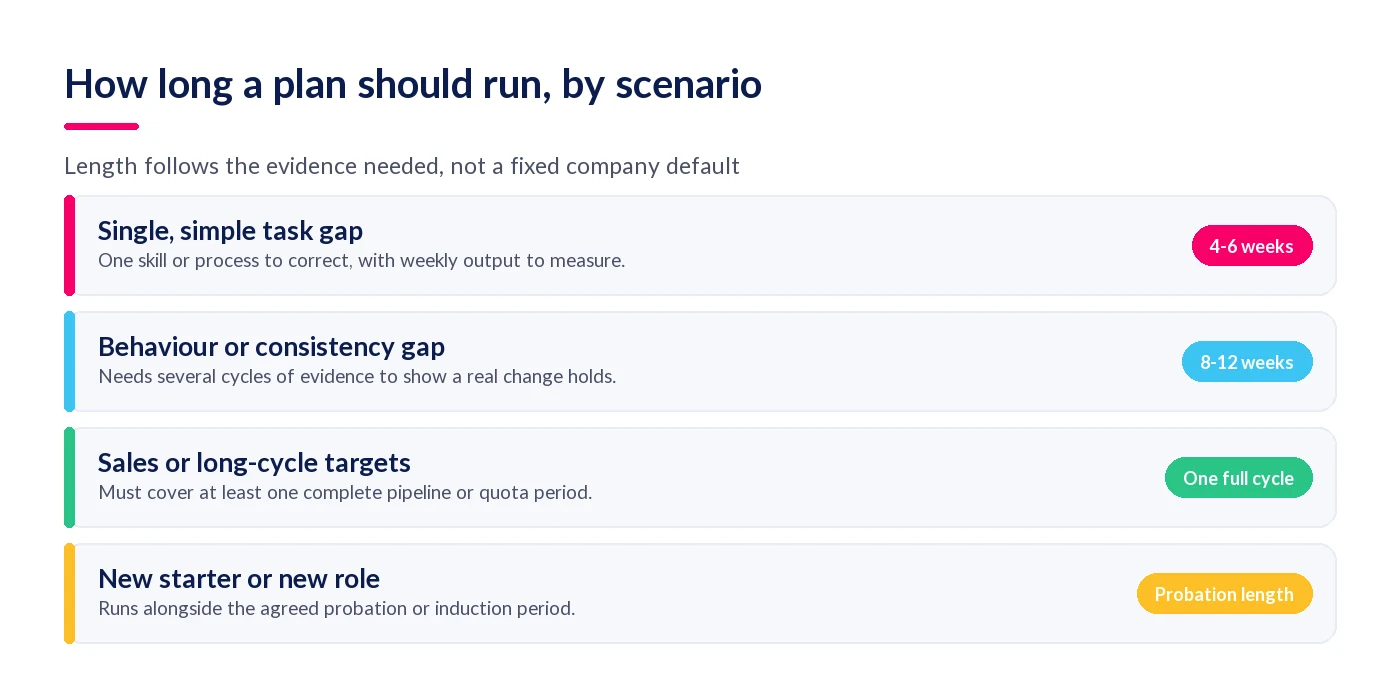
Most performance improvement plans run for four to twelve weeks, with 30, 60 and 90 days the three settings you will see most often. Shorter plans suit a single, simple task gap that produces weekly output you can measure. Longer plans suit behaviour, consistency or long sales cycles, where one good week proves nothing and you need several cycles of evidence before a judgement is fair.
The question behind the question is usually "how long before I have to make a decision?" A better way to frame it: how long will it take to see enough evidence that the change is real and sustained? Answer that, and the length picks itself. If you cannot answer it, you have a measurement problem rather than a duration problem, and the plan is not ready to issue.
What determines the length of a performance improvement plan?
Three things set the length: how quickly the role produces measurable output, how much of the gap is behaviour rather than task, and how long the agreed support takes to land. A plan cannot be shorter than the training inside it. If a course runs in week five, a four-week plan has judged someone before the help arrived.
| Situation | Typical length | Why that length |
|---|---|---|
| Single task or process gap | 4–6 weeks | Output is weekly, so four to six cycles of evidence is enough to show a change has held. |
| Behaviour or consistency gap | 8–12 weeks | One good fortnight proves little. Consistency can only be judged across several cycles. |
| Sales or other quota role | One full sales cycle, often 90 days | Anything shorter measures activity, not results, and is unfair to a long-cycle pipeline. |
| New starter still in probation | Aligned to the remaining probation period | Running a plan past the probation date creates two competing processes with different rules. |
| Seasonal or project-based work | To the end of the project or peak period | The work only exists in that window, so evidence gathered outside it is not comparable. |
| Senior or strategic role | 12 weeks or more | Outcomes lag decisions, so the plan has to be long enough for decisions to show results. |
| Support takes time to arrive | Training completion date, plus 4 weeks | The employee needs a fair run at applying the help, not a deadline that arrives first. |
One more factor: how much evidence you already hold. If objectives, one-to-one notes and feedback are in one place, a shorter plan can still be evidenced properly. If everything has to be reconstructed from memory, the plan drags because the paperwork does. The performance management system hub covers how that evidence trail gets built in normal running, before anyone needs it.
How often should progress reviews happen during the plan?
Schedule a formal review at least every two to four weeks, and put the dates in the plan before it starts. A 12-week plan with reviews at weeks four, eight and twelve gives two chances to correct course before the closing meeting. Reviews that are arranged "when we both have time" are the ones that quietly do not happen.
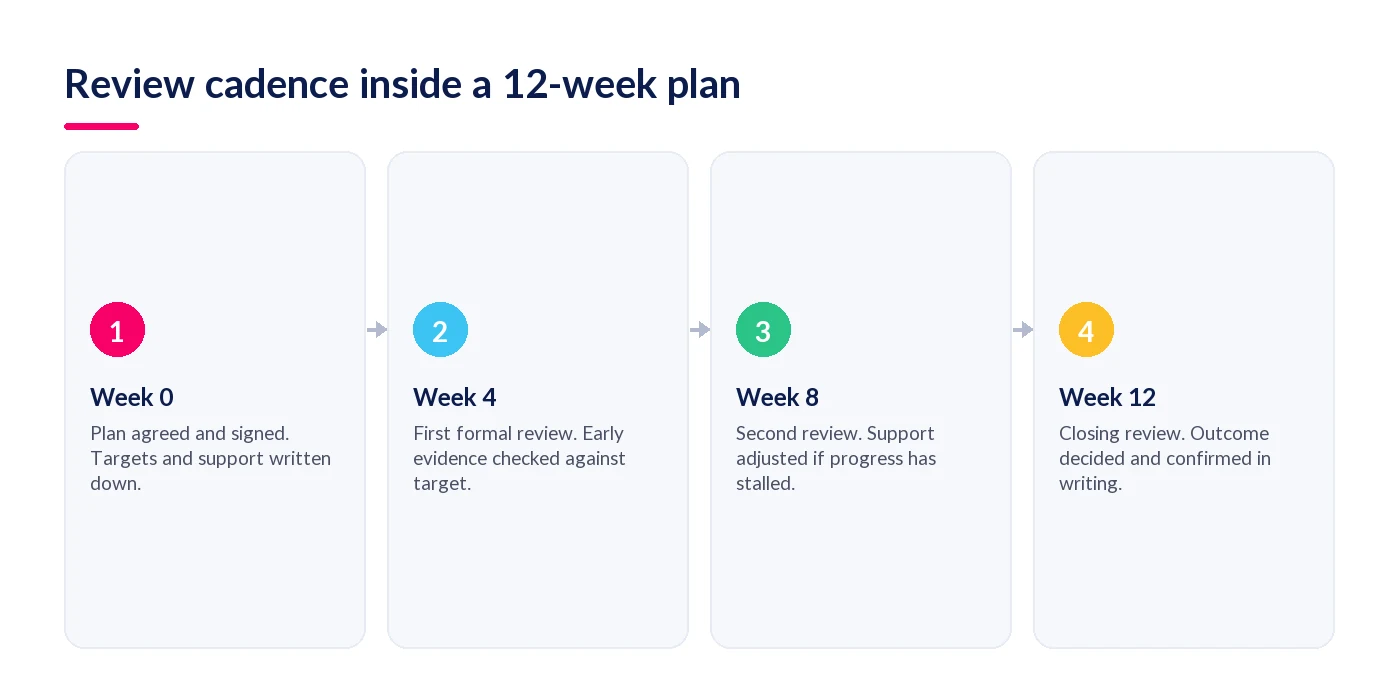
Each review should compare evidence against the target, record what was said, and confirm whether the agreed support has actually been delivered. That last point catches the most common unfairness in a badly run plan: the employee missed the target, and so did the employer. Our guide to writing a performance improvement plan sets out the fields that make those reviews quick to run.
Worth a read alongside this: The Ultimate Guide to Performance Reviews covers how to structure a review conversation so it produces something specific to act on.
Can a performance improvement plan be extended?
Yes, and a short extension is often the fairest outcome. Extend when progress is real but incomplete, when agreed support arrived late, or when something outside the employee's control disrupted the period, such as long-term sickness, a team restructure or a change of role. Put the extension in writing with a new end date and revised review dates, rather than letting the original plan drift on.
What an extension should not be is a way of avoiding a decision. Rolling a plan on repeatedly is hard on the employee, who stays in limbo, and it weakens the process. If two extensions have passed and nothing has changed, the honest conclusion is that the plan is not working, and the next step belongs in a formal capability conversation instead. What happens at the end of a performance improvement plan covers both routes.
What should UK employers keep in mind about timescales?
Give a timescale that is genuinely achievable, tell the employee what it is in writing, and hold the reviews you promised. UK employers should also read the ACAS Code of Practice on disciplinary and grievance procedures before a plan becomes a step towards any formal capability decision, because it sets out the expectations for fair notice, meetings, accompaniment and appeal.
Two practical points follow from that. First, a plan whose end date lands during the employee's booked annual leave or a period of certified sickness should move, not be judged on partial evidence. Second, keep the plan document and the review notes together, since an outcome is only as defensible as the record behind it. If you are still deciding whether a formal plan is the right route at all, start with what a performance improvement plan is and when an informal conversation does the job better.
This article describes good process, not the law. Employment law is fact-specific and changes, so take advice from a qualified employment law adviser before relying on a plan as a step towards dismissal.
To see how review dates, evidence and objectives stay on one record instead of scattered across inboxes, take a look at StaffCircle's performance management and development module.
Frequently asked questions
How long is a typical performance improvement plan?
A typical performance improvement plan runs between 30 and 90 days. Task-based gaps often sit at the shorter end, because output is weekly and easy to measure. Behaviour, consistency and quota-based roles usually need 60 to 90 days, since improvement has to be shown across several cycles before it counts.
Is a 30-day performance improvement plan too short?
Thirty days works where the gap is a single, well-defined task and output is measurable every week. It is too short when the plan includes training that has not happened yet, or when the role's results take longer than a month to appear. In those cases the deadline arrives before the support does.
How many review meetings should a performance improvement plan have?
Plan a formal review every two to four weeks, so a 12-week plan has three or four. Each one compares evidence against the target, records what was discussed, and checks that the agreed support was actually delivered. Fewer than two reviews leaves no opportunity to correct course before the closing meeting.
Can a performance improvement plan be shortened?
It can be closed early if the standard has clearly been met and held for long enough to be credible. Closing early is a positive signal and should be confirmed in writing. What should not happen is shortening the timescale mid-plan, which removes the fair opportunity the employee was originally given.
Does a performance improvement plan have a maximum length?
There is no fixed maximum, but plans running beyond about six months stop being credible. The employee sits in limbo, evidence gets stale, and managers change. If two review cycles and one extension have produced no movement, the fair step is a decision, not another extension of the same plan.
Related articles

See StaffCircle in action
Book a personalised demo and see how StaffCircle drives performance, engagement and development.