How to write a performance improvement plan
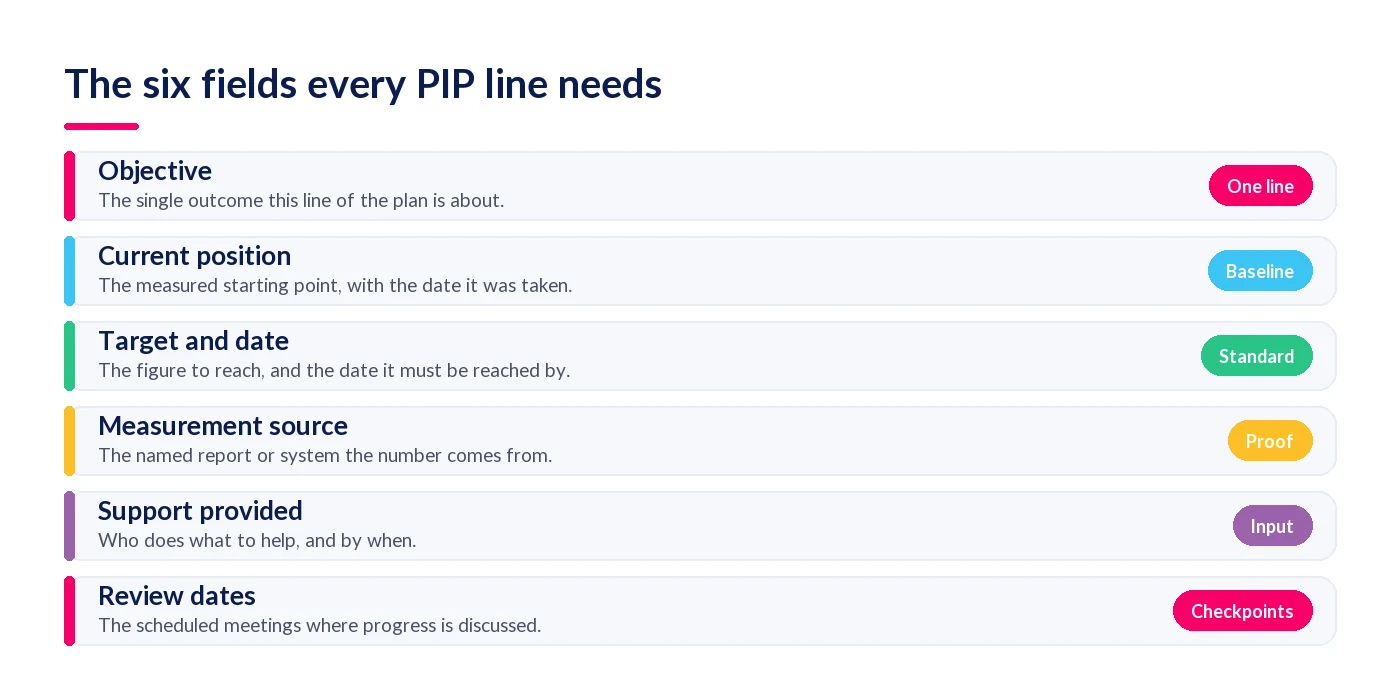
A performance improvement plan is written in six fields for every objective it contains: the objective, the measured current position, the target and its date, the measurement source, the support the employer will provide, and the review dates. Write each field so two people reading it would agree whether the target was met.
Key facts
- Six fields per objective: objective, baseline, target and date, source, support, reviews.
- Three objectives is the practical ceiling for one plan.
- Every target needs a named measurement source, not a manager's recollection.
- Support items need an owner and a date, or they do not happen.
- This article is general guidance on process, not legal advice.
What does a performance improvement plan template look like?
A working template is a header block plus one row per objective, with six fields in each row. The header records who the plan is for, who owns it, when it starts and ends, and the review dates. Each objective row then carries the baseline, the target, the source, the support and the checkpoints. Below is the template with a worked example filled in, so you can see the level of detail each field needs.
Plan header — worked example
- Employee: A. Patel, Customer Support Advisor, Support Team 2
- Plan owner: line manager, with HR review before issue
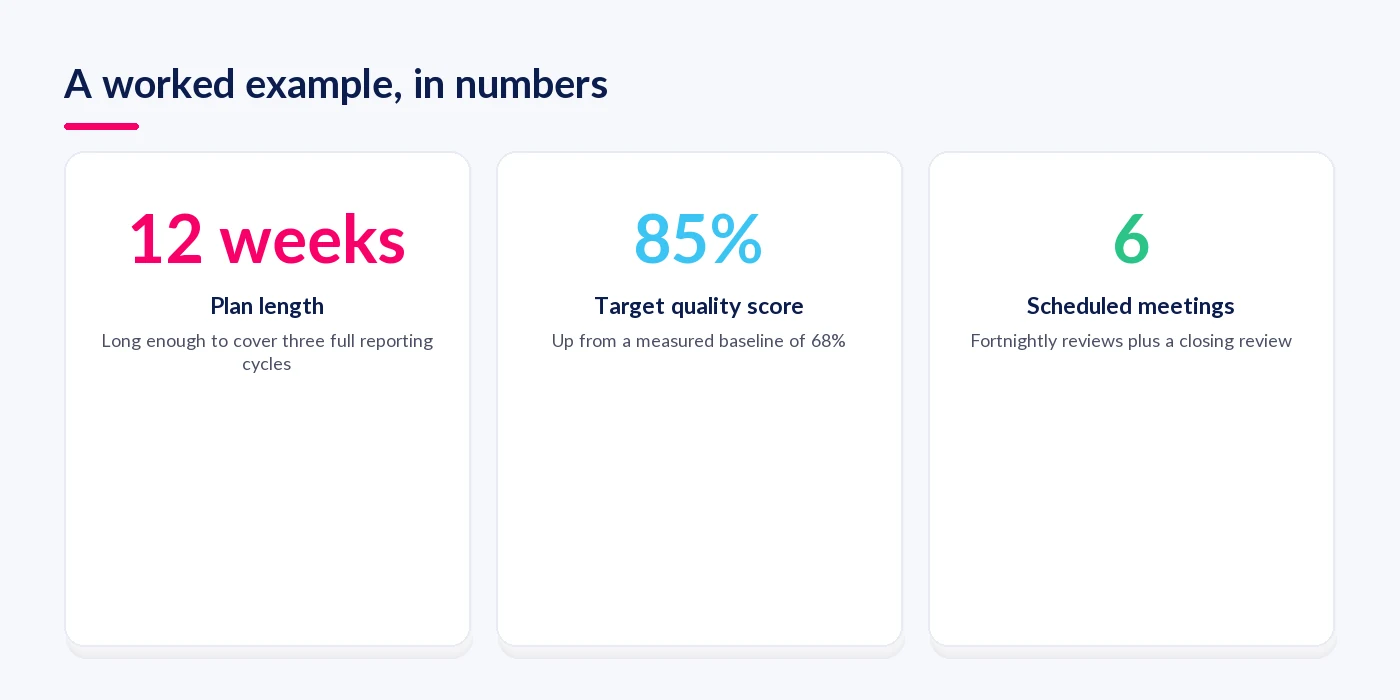
- Plan starts: Monday 24 August 2026 · Plan ends: Monday 16 November 2026 (12 weeks)
- Review dates: 7 September, 21 September, 5 October, 19 October, 2 November, closing review 16 November 2026
- Outcome if met: plan closed in writing, normal review cycle resumes
- Outcome if not met: short extension considered, or the matter moves to a formal capability process
| Field | What to write | Worked example |
|---|---|---|
| Objective | One separable gap, written as an outcome the role requires | Case quality: handle support cases to the team quality standard |
| Current position (baseline) | The measured starting point, with the period it covers | 68% average quality score across the July 2026 audit sample (20 cases) |
| Target and date | The figure required, and the date it must be reached by | 85% or above, sustained across two consecutive monthly samples, by 16 November 2026 |
| Measurement source | The named report, system field or sample the number comes from | Monthly quality audit report, 20-case random sample drawn by the team leader |
| Support provided | Each item of help, with an owner and a date | Half-day refresher on the case handling standard (booked 28 August); 30 minutes' coaching each Tuesday with the team leader; two shadowing sessions with a senior advisor in week two; ticket volume reduced by 15% for the first four weeks |
| Review dates | The scheduled meetings, fixed before the plan is issued | Fortnightly reviews from 7 September, plus the closing review on 16 November 2026 |
Copy the structure, not the numbers. Your baseline, target and source will come from your own reporting, and the length should match the evidence your role produces — see how long a performance improvement plan should last for the duration bands and the reasoning behind each.
How do you write a performance improvement plan, step by step?
Work in the order the document is read: evidence first, then objectives, then targets, then how they will be measured, then the support, then the dates. Writing the support before the target is the most common mistake, because it produces help that is not aimed at anything. Six steps, and the whole document should take under an hour once the evidence is to hand.
- Gather the evidence and fix the baseline. Pull the actual numbers before you write a word: the report, the sample, the dates. Write the baseline as a figure with the period it covers, for example 68% quality score across the July 2026 audit sample. A plan with no baseline cannot show improvement, because there is nothing to improve from.
- Write one objective per gap, and no more than three. Each objective covers a single, separable gap and is written as an outcome rather than an activity. Three is the practical ceiling. Beyond that, the employee is being asked to change everything at once, and the plan starts measuring the manager's frustration rather than the role's requirements.
- Set the target figure and the date it applies to. Give the number the role requires and the date it must be met by, not a direction of travel. A quality score of 85% or above by 16 November 2026 is checkable; a general instruction to improve quality is not. Where a target is a range, say which end of it counts as met.
- Name the measurement source for every target. State exactly where the number will come from: a named report, a system field, a defined sample size, or a specified observation method. If the source is a sample, say how large it is and who draws it. This is the field that stops the closing meeting turning into an argument about the data.
- Write down the support the employer will provide. List each item of support with an owner and a date: a booked training course, weekly coaching for 30 minutes, two shadowing sessions, a temporary reduction in ticket volume. Support without an owner and a date is an intention. Include what the employee asked for in the opening meeting.
- Book the review dates and explain both outcomes. Put the review dates in the document before it is issued, and say plainly what happens if the standard is met and what happens if it is not. Then check the wording once more for anything that reads as a decision already taken, and issue it with a copy for the employee.
Targets written this way are simply SMART objectives applied to a harder conversation — our guide to writing SMART objectives covers the wording patterns, and personal development reviews use the same discipline in a routine setting. If you want the process around the document rather than the document itself, how a performance improvement plan works sets out the five stages from first conversation to outcome.
Worth a read alongside this: The Ultimate Guide to Performance Reviews covers writing feedback specific enough to act on, which is the skill every field above depends on.
How do you create a sales performance improvement plan?
A sales plan follows the same six fields, with two changes. First, it must cover at least one full sales cycle, or you are measuring activity rather than results. Second, it should pair leading measures the person controls — qualified meetings booked, pipeline coverage, discovery calls completed — with the lagging revenue number, so early progress is visible before the quota date arrives.
Check territory and account quality before you write it. If the pipeline handed over was thin, or a major account moved out of the patch, the gap may not be a capability gap at all, and a plan aimed at the wrong cause will not close it. A worked sales example might read: qualified meetings from a baseline of 4 per month to 9 per month by the end of week six, measured from the CRM meetings report, with pipeline coverage of 3x quota by the closing review.
What wording should you avoid in a performance improvement plan?
Avoid three kinds of wording: character judgements, comparisons to named colleagues, and anything that reads as a decision already taken. "Poor attitude", "not a team player" and "lacks urgency" are not measurable and cannot be improved against. Rewrite each as the observable behaviour you actually need, with a frequency or a standard attached.
- Instead of "needs to show more ownership", write "responds to assigned tickets within four working hours and updates the case notes before closing".
- Instead of "not performing at the level of the rest of the team", write "quality score of 85% or above, against the team standard of 85%".
- Instead of "final opportunity before dismissal", write "if the standard is not met by the closing review, the matter may move to a formal capability process".
- Instead of "improve communication", write "sends a written handover at the end of each shift covering open cases and blockers".
The last of those matters most. A plan that opens by naming dismissal tells the employee the outcome is already decided, which makes the support section look like theatre and the whole process harder to defend.
What should UK employers check before issuing the plan?
Check four things: that the standard was communicated before the plan, that the targets are genuinely achievable in the time given, that the support is booked rather than merely listed, and that HR has reviewed the wording for consistency with how other teams are treated. Then check the timescale does not fall over booked leave or certified sickness.
UK employers should also read the ACAS Code of Practice on disciplinary and grievance procedures, which sets out fair handling — written notice of concerns, a meeting, accompaniment at formal hearings, and a right of appeal — and notes that a tribunal can adjust a compensation award by up to 25% where either party unreasonably fails to follow it. A plan is a support document, but it can become the first step in a longer process, so the record behind it needs to stand on its own.
This article describes good process, not the law. Employment law is fact-specific and changes, so take advice from a qualified employment law adviser before relying on a plan as a step towards dismissal. For where plans sit in the wider cycle of objectives, one-to-ones and reviews, see the performance management system hub, and for when a formal plan is the right route at all, what a performance improvement plan is.
If you would rather build the plan from evidence you already hold than reconstruct it at the deadline, see StaffCircle's performance management and development module.
Frequently asked questions
What should be included in a performance improvement plan template?
A header block naming the employee, the manager, the start and end dates and the review dates, then one row per objective containing the baseline, the target and its date, the measurement source, the support provided and the checkpoints. It should also state plainly what happens if the standard is met and if it is not.
How many objectives should a performance improvement plan have?
One to three. Each objective should cover a separable gap that can be measured on its own. Beyond three, the employee is being asked to change too much at once and the plan becomes impossible to evidence fairly at review. If you have listed six, most of them are probably symptoms of one gap.
Should a performance improvement plan mention dismissal?
It should state honestly what happens if the standard is not met, which may include moving to a formal capability process. What it should not do is lead with dismissal or imply the outcome is already decided. A plan written as a warning rather than a support document undermines both the improvement and the process.
How do you write a measurable target for a performance improvement plan?
Give the figure, the date and the source together: "85% quality score or above, sustained across two consecutive monthly samples, by 16 November 2026, measured from the monthly audit report." If two people could read the target and disagree about whether it was achieved, it needs rewriting before the plan is issued.
Does an employee have to agree the plan before it is issued?
Agreement is not required, but the employee should be heard before the plan is finalised and should shape the support section, since they often know which help matters most. Where they disagree with a target or the evidence, record that disagreement on the plan itself so the difference of view is visible later.
Related articles

See StaffCircle in action
Book a personalised demo and see how StaffCircle drives performance, engagement and development.