What happens at the end of a PIP?
The end of a performance improvement plan is a formal review meeting with one of three outcomes: the standard has been met and the plan is closed in writing, progress is real but incomplete and the plan is extended, or the standard has not been met and the matter moves to a formal capability process.
Key facts
- Three outcomes are possible: met and closed, extended, or escalated.
- Successful completion must be confirmed in writing, not left implied.
- Check whether the promised support was delivered before judging the outcome.
- The ACAS Code of Practice should shape any formal capability step in the UK.
- This article is general guidance on process, not legal advice.
What happens at the end of a performance improvement plan?
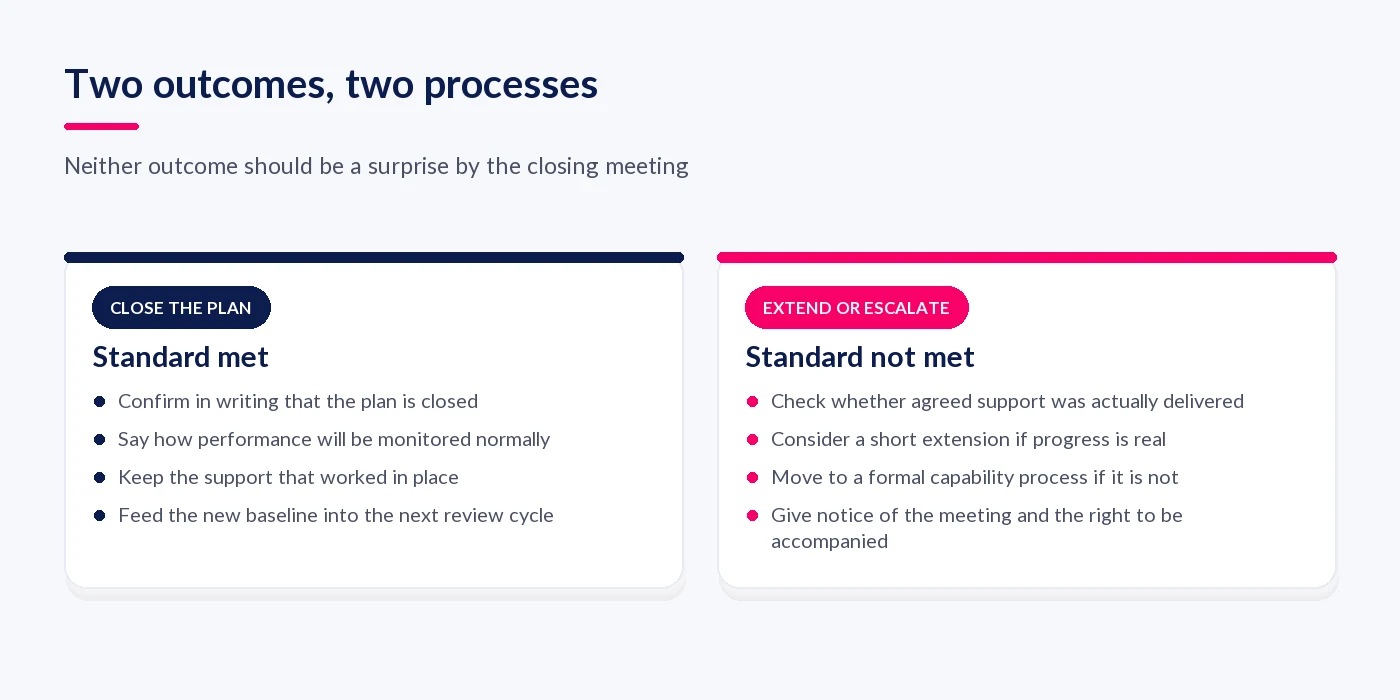
A closing review meeting is held on the date set at the start. The manager compares the evidence against each target, the employee gives their account, and one of three outcomes is confirmed in writing: the plan is closed because the standard was met, the plan is extended because progress is real but incomplete, or the matter moves to a formal capability process. Nothing at that meeting should come as a surprise.
| Outcome | What it means | What the employer does next | Confirmed in writing |
|---|---|---|---|
| Standard met | Targets achieved and held long enough to be credible | Close the plan, keep the support that worked, return to the normal review cycle | Letter or email confirming the plan is closed and the date it closed |
| Partly met | Clear movement, but the target has not been reached or sustained | Agree a short extension with a new end date and revised review dates | Revised plan with the new dates, reasons for the extension, and what still has to change |
| Not met | No material improvement despite the support being delivered | Move to a formal capability process under your own policy | Outcome letter setting out the evidence, the decision, the next stage and any appeal right |
| Not assessable | Long-term sickness, restructure or role change disrupted the period | Pause or reset the plan rather than judge it on partial evidence | Note of the disruption, the revised dates, and any advice taken |
What happens when someone passes their performance improvement plan?
The plan is closed and that closure is confirmed in writing, with the date it took effect. The manager says what will now be monitored in the normal review cycle, keeps in place whatever support actually worked, and resets the baseline so the next objectives start from the new level. Recognition matters here too: sustained improvement under a formal plan is hard, and saying so is not a weakness.
Three things are worth doing in the fortnight after a successful close. First, write the new baseline into the employee's objectives so the improvement is what is now expected rather than a one-off. Second, keep the support that made the difference, since removing coaching the week a plan closes is how performance slides back. Third, record what worked, because the same gap will appear in another team.
Closure should also be genuinely clean. If the plan is closed but the employee still feels they are under suspicion, the process has only half worked. Regular one-to-ones and a normal review cycle are what make the difference, and that habit is also what keeps people: StaffCircle customers report 57% lower employee turnover, with the measurement behind that figure documented on our customer outcomes page. The performance management system hub covers how that ordinary cycle should run.
What happens if performance has not improved by the end date?
First, check the employer's side of the plan. Was every item of agreed support delivered, on the dates promised? Did each scheduled review happen? If not, the fair step is to extend rather than escalate. If the support was delivered, the reviews were held and the evidence shows no material improvement, the matter moves to a formal capability process under your own policy.
That escalation is a separate process with its own requirements, not a continuation of the plan. It needs written notice of the concern, a meeting the employee can prepare for, the opportunity to be accompanied at a formal hearing, a decision with reasons, and a right of appeal. Dismissal is a possible eventual outcome of a capability process, but it is not an outcome of the improvement plan itself, and treating it as one is what makes plans feel like paperwork before an exit.
An extension is often the honest middle answer. Use it where progress is genuine but incomplete, where support arrived late, or where something outside the employee's control disrupted the period. Set a new end date and new review dates in writing — how long a performance improvement plan should last covers sensible extension lengths and why open-ended plans fail.
How should the closing review meeting be run?
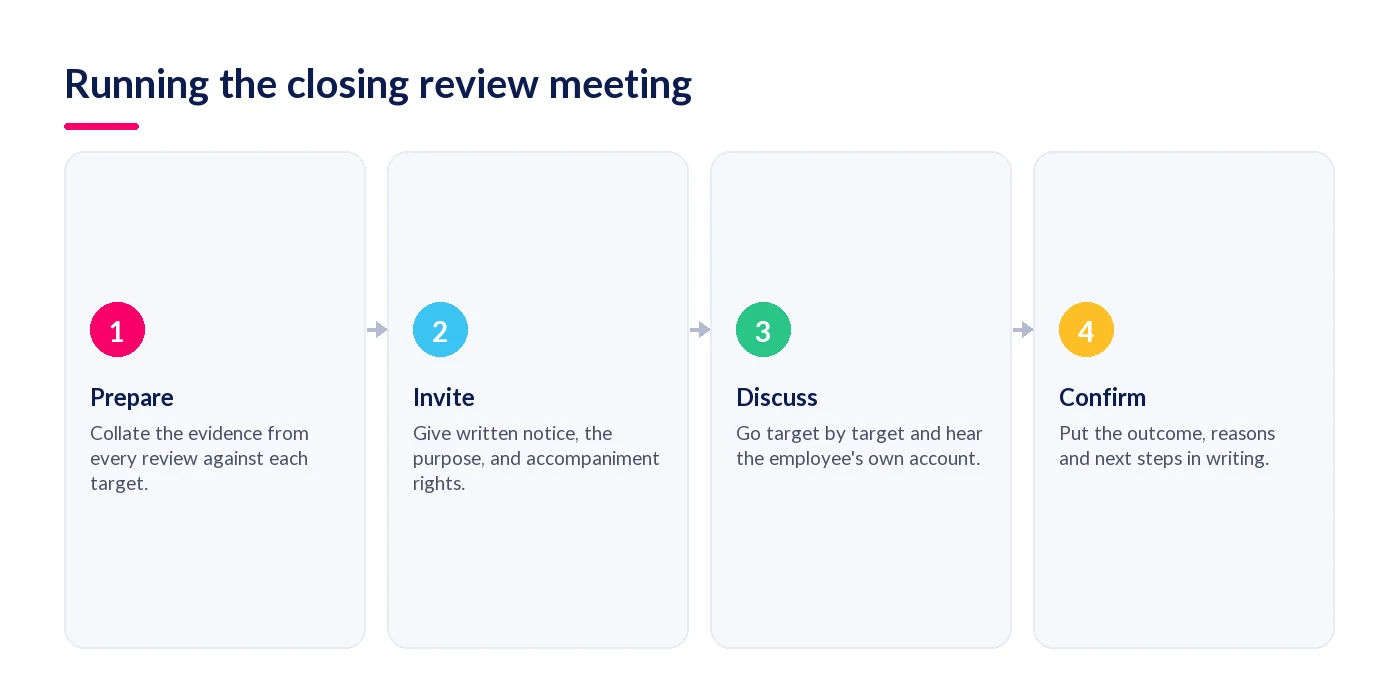
Run it as a structured, evidenced conversation with five steps: prepare the evidence, invite the employee properly, discuss each target in turn, decide and give reasons, then confirm in writing. Send the evidence before the meeting rather than producing it in the room. A closing meeting where the employee sees the data for the first time is not a review, it is an announcement.
- Prepare the evidence. Collate the measurement source for every target, plus the notes from each interim review and a record of the support that was delivered. Compare like with like: the same report and the same sample method used to set the baseline. If a target cannot be evidenced either way, say so rather than guessing.
- Invite the employee properly. Give written notice of the meeting, its purpose and who will attend, with enough time to prepare. Send the evidence in advance so nothing in the meeting is new. Confirm whether they may be accompanied under your policy, and offer to rearrange if they are unwell or on booked leave.
- Discuss each target in turn. Go through the plan target by target, state what the evidence shows, and hear the employee's account before drawing any conclusion. Ask specifically whether the promised support arrived. Where a target was missed because the employer did not deliver, that belongs in the record.
- Decide, and say why. Reach one of the three outcomes: met, extended, or moving to a formal capability process. Give the reason against the evidence, not a general impression. If the decision is an extension, agree the new end date and review dates in the meeting rather than confirming them later.
- Confirm in writing and set what comes next. Put the outcome, the reasons, the effective date and the next steps in writing within a few days. For a closed plan, say how performance will be monitored in the normal cycle. For an escalation, explain the next stage and any right of appeal that applies under your policy.
UK employers should read the ACAS Code of Practice on disciplinary and grievance procedures before any plan becomes a step towards a formal capability decision. It sets out fair handling — establishing the facts, written notice, a meeting, accompaniment at formal hearings, and a right of appeal — and notes that a tribunal can adjust a compensation award by up to 25% where either party unreasonably fails to follow it.
This article describes good process, not the law. Employment law is fact-specific and changes, so take advice from a qualified employment law adviser before relying on a plan as a step towards dismissal.
Worth a read alongside this: The Ultimate Guide to Performance Reviews covers how to run an evidenced review conversation, which is exactly the skill a closing meeting needs.
What records should you keep after the plan ends?
Keep the plan as issued, the notes from every review, the evidence used against each target, a record of the support delivered, and the written outcome. Store them together, with dates, and keep them for as long as your data retention policy allows. Six months later, nobody remembers which version of the plan was the live one unless the record says so.
This is where scattered evidence hurts most. When targets, notes, feedback and review dates live on one record, the outcome letter almost writes itself; when they live across inboxes and spreadsheets, the record gets rebuilt at the worst possible moment. How a performance improvement plan works covers building that trail as you go, and what a performance improvement plan is covers deciding whether a formal plan was the right route in the first place.
To see how plan evidence, review dates and objectives stay on a single record from start to close, take a look at StaffCircle's performance management and development module.
Frequently asked questions
Can you be dismissed at the end of a performance improvement plan?
Dismissal is not an outcome of the plan itself. Where the standard has not been met, the matter normally moves into a formal capability process, which has its own requirements for notice, meetings, accompaniment and appeal. Any decision of that kind is fact-specific, so take advice from a qualified employment law adviser before acting.
Should a successful performance improvement plan be confirmed in writing?
Yes. Confirm in writing that the plan is closed, the date it closed, and what will be monitored in the normal review cycle. Without that letter the employee is left unsure whether the plan is still live, and the closure cannot be evidenced later if the same concern is ever raised again.
Does a completed performance improvement plan stay on your record?
The plan and its outcome are usually retained as part of the employment record, for as long as the employer's data retention policy specifies. A closed plan with a successful outcome is not a live sanction, and should not be treated as one in later decisions about pay, promotion or selection unless your policy says otherwise.
Can a performance improvement plan be extended at the end?
Yes, and an extension is often the fairest outcome where progress is real but incomplete, or where agreed support arrived late. Confirm the new end date and review dates in writing, along with what still has to change. What to avoid is repeated extensions, which leave the employee in limbo and weaken the process.
What if the employee disagrees with the outcome?
Record the disagreement in the outcome letter, including their account and any evidence they put forward. Where the outcome moves into a formal capability process, your policy should give a right of appeal to a different manager. Handling disagreement in writing at the time is far better than discovering it months afterwards.
Related articles
See StaffCircle in action
Book a personalised demo and see how StaffCircle drives performance, engagement and development.