What Are SMART Objectives? Definition and Examples
A SMART objective is a goal written to pass five tests: Specific, Measurable, Achievable, Relevant and Time-bound. It is drafted so that two people reading it would agree on what success looks like and when it falls due. The acronym is a drafting check, not a target-setting philosophy.
Key facts
- SMART first appeared in George Doran's 1981 Management Review paper on writing management goals.
- The acronym is a quality test for wording, not a method for choosing which goals matter.
- SMART suits individual accountability; OKRs suit company-wide focus, and the two can coexist.
- An objective with no named owner and no checkpoint has failed the Time-bound test.
What are SMART objectives?
SMART objectives are goals written so that the wording itself removes ambiguity. The acronym stands for Specific, Measurable, Achievable, Relevant and Time-bound, and each letter is a test the sentence has to pass before anyone agrees to it. If an objective cannot survive all five tests, the problem is almost always that nobody has decided what result they actually want.
The idea is older than most of the frameworks built on top of it. It was set out by George T. Doran in a November 1981 article for Management Review, There's a S.M.A.R.T. way to write management's goals and objectives. Doran's point was narrow and worth holding on to: the acronym is a discipline for writing goals down clearly, not a claim that clearly written goals are automatically the right ones.
That distinction matters because it explains what SMART cannot do for you. It will not tell you which three things your team should care about this year, it will not stop a manager setting a target that is easy to hit, and it will not make a badly chosen goal worthwhile. What it will do is stop the far more common failure: an objective so vague that at review time the employee and the manager have completely different views on whether it was met.
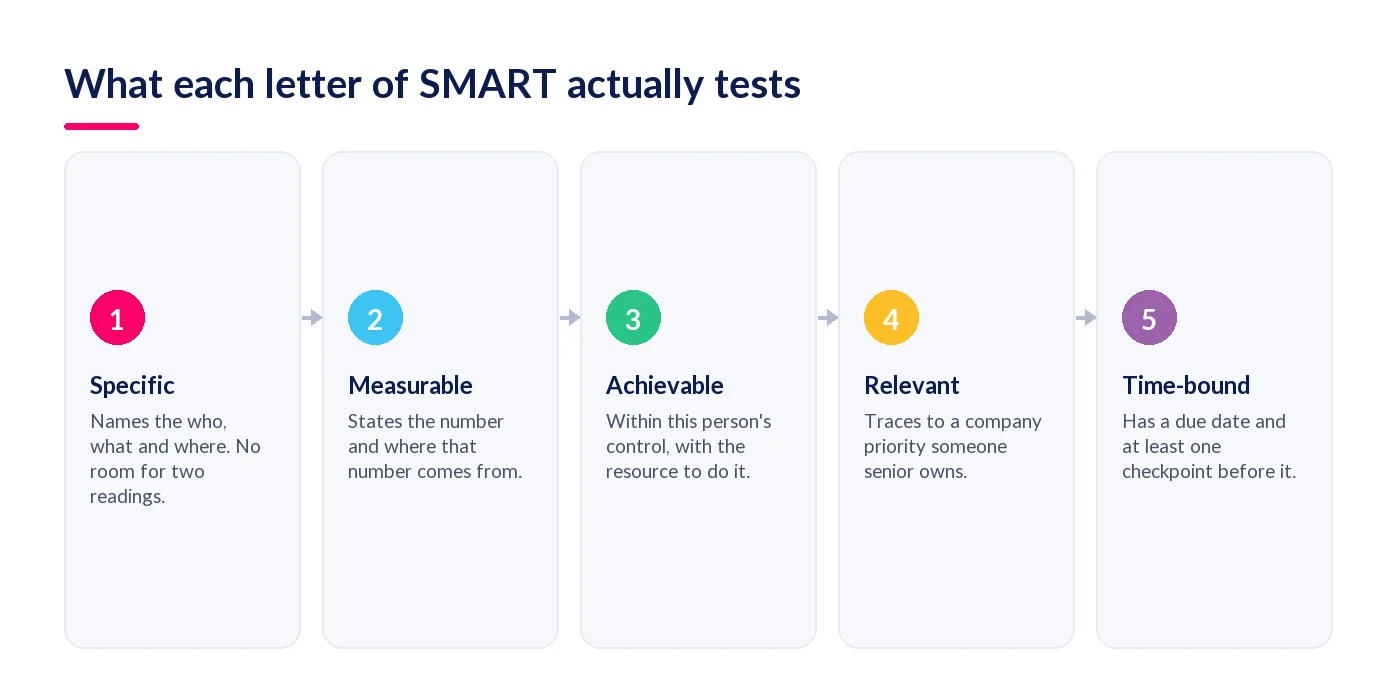
What does each letter of SMART actually test?
Each letter tests something different about the sentence in front of you, and an objective can pass four tests and still be useless. Read the objective once per letter rather than trying to judge all five at the same time. The failures below are the ones that show up most often in real objective libraries.
Specific
Specific means the objective names who does what, and where. The test: could two people read this and describe two different pieces of work? "Improve customer satisfaction" fails, because it does not say whose satisfaction, measured how, in which part of the business. "Raise the support team's CSAT score" passes.
Measurable
Measurable means the objective names both the number and the source of the number. Half-measured objectives are the most common defect of all: a target is stated, but nobody has agreed where the figure comes from or who reads it. If the answer to "what is today's value?" is "we would have to work that out", the objective is not measurable yet.
Achievable
Achievable means the result sits inside this person's control and they have the resource to deliver it. An objective that depends on a budget nobody has signed off, or on another team's roadmap, is not achievable by the person holding it. This is also where sandbagging hides, so read it in both directions: is it genuinely within reach, and would hitting it actually represent a good year?
Relevant
Relevant means the objective traces upward to a company priority that somebody senior owns. The test is a single question: if this is delivered in full and nothing else changes, what does the business get? An objective nobody can answer that question for is busywork with a deadline attached.
Time-bound
Time-bound means there is a due date and at least one checkpoint before it. A due date on its own turns the objective into a surprise: everyone discovers in month eleven that it was never going to land. Adding one or two review points converts the objective from a verdict into something a manager can actually steer.
What does a weak objective look like rewritten?
The clearest way to see the five tests working is to put a real before and after side by side. Below is a typical objective as it usually arrives, and the same intent rewritten so that the numbers, the mechanism and the checkpoints are all on the page.
Before: "Improve customer satisfaction this year."
After: "Raise the support team's CSAT score from 78 to 85 by 31 December, by cutting first-response time on priority-1 tickets from six working hours to two. Progress reviewed at the end of each month using the CSAT report in the service desk."
Nothing about the ambition changed. What changed is that the second version can be steered: at the end of March you can see whether first-response time has moved, and if it has not, you have nine months to do something about it rather than one awkward conversation in December. Notice too that the rewritten version names its own evidence source, which is what stops the review turning into an argument about whose numbers are right.
What is the difference between SMART objectives and OKRs?
SMART is a test for how a single objective is written; OKRs are a system for deciding what a whole organisation focuses on this quarter. That is the whole difference, and it is why the "SMART versus OKR" framing is usually a false choice. SMART governs wording quality. OKRs govern focus, cadence and alignment. You can apply the SMART tests to every Key Result in an OKR and lose nothing.
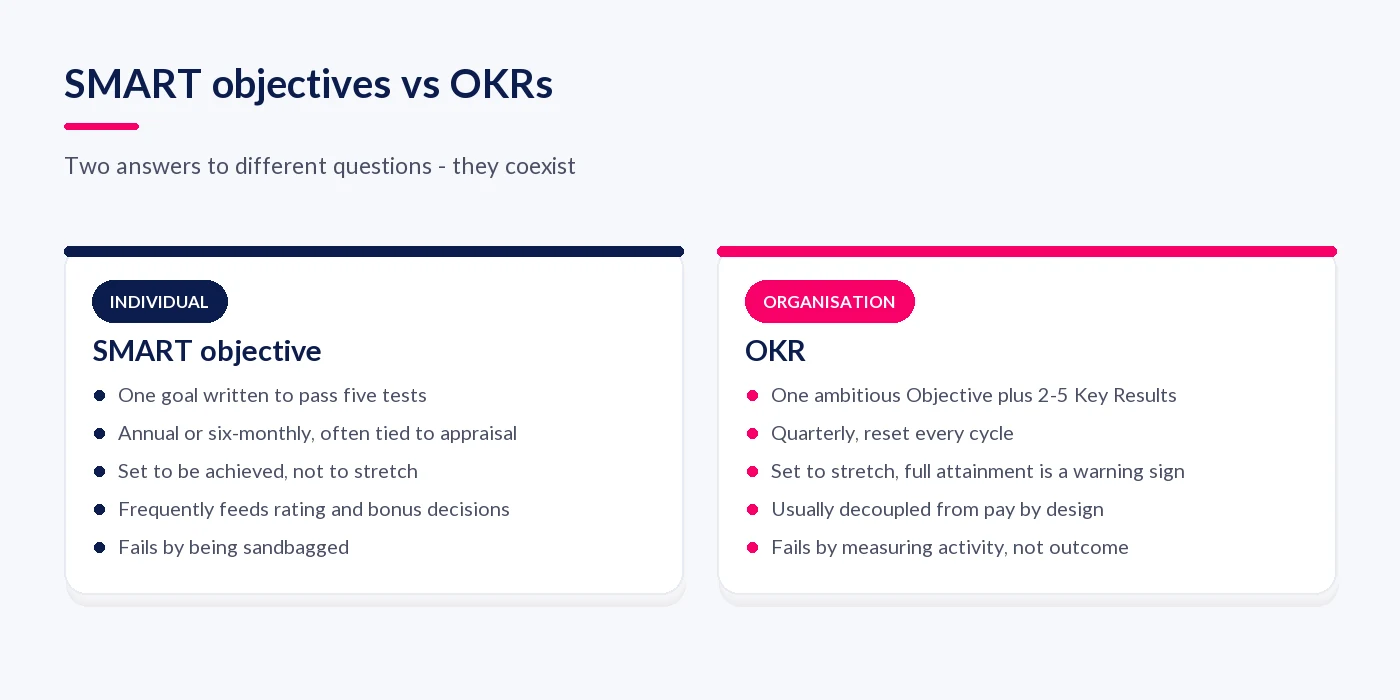
| SMART objective | OKR | |
|---|---|---|
| What it is | A single goal written to pass five wording tests | An ambitious Objective plus two to five measurable Key Results |
| Usual scope | One person, or one team, covering the role | Company, then department, then team |
| Typical cycle | Annual or six-monthly, often tied to appraisal | Quarterly, deliberately reset every cycle |
| Target-setting intent | Achievable. You are expected to hit it | Stretching. Hitting every Key Result every quarter suggests the targets were too soft |
| Link to pay | Frequently feeds rating and bonus decisions | Usually decoupled from pay by design |
| Number per person | Three to five, covering the whole job | One to three Objectives, focused on change rather than the whole job |
| Characteristic failure | Sandbagged targets that everyone hits comfortably | Key Results that measure activity rather than outcome |
| Best at | Individual accountability and role performance | Cross-team focus and visible alignment |
The practical read for most HR teams: keep SMART as the drafting standard for anything that lands on an individual's record and feeds their personal development review, and use OKRs where you need several teams pulling on the same rope for a quarter. If you are running both, apply the SMART tests to the Key Results and you will find that a surprising number of them fail the Measurable one.
How do you write a SMART objective?
Writing a SMART objective is a five-pass edit, not a single act of drafting. Start from the business outcome rather than the activity, then add the number, then the constraint check, then the date. Working in that order stops you polishing the wording of an objective that should not exist.
- Name the outcome, not the activity. Write the change you want in the business first: a score, a cost, a cycle time, a completion rate. "Run monthly training sessions" is an activity. "Cut onboarding time to competence from twelve weeks to eight" is an outcome. If you cannot name an outcome, you do not yet have an objective, you have a task.
- Attach a number and its source. State today's value, the target value and where both figures come from. Naming the source is the step almost everyone skips, and it is the one that prevents the review conversation collapsing into a dispute about the data.
- Test it against the person's actual control. Ask what the holder would need that they do not currently have: budget, a decision from someone else, another team's time. If the answer is anything at all, either remove the dependency or make it explicit in the objective so it can be escalated early.
- Trace it upward to a company priority. Write the one-line link out loud: this objective supports that priority because. If the sentence does not finish cleanly, the objective is not relevant, however well-written it is.
- Set the due date and at least one checkpoint. Put the checkpoint in the diary at the same time as you agree the objective, not later. An objective with a December deadline and no March conversation is a review-day surprise waiting to happen.
If drafting and tracking objectives is currently a spreadsheet exercise, our free guide covers the mechanics of running the conversations around them: The Ultimate Guide to Performance Reviews.
Why use SMART objectives?
The honest answer is that SMART objectives are cheap insurance against a specific, expensive failure: reaching the end of a review period with no agreed way to tell whether the work landed. Everything else follows from that. Clear wording makes progress visible mid-period, makes coaching possible before the deadline, and makes the eventual rating defensible.
- Fewer disputed reviews. When the number and its source were agreed in January, the December conversation is about what to do next rather than about whether the objective was met.
- Earlier intervention. A measurable objective with a checkpoint tells a manager in month three that something is off, while there is still time to act.
- Real alignment, not a cascade diagram. The Relevant test forces every objective to name the priority it serves, which is a far harder discipline than drawing an org-wide cascade nobody reads.
- Development that connects to the work. Once an objective states the capability required to hit it, the development plan writes itself, and a performance management system can carry both on the same record.
Where do SMART objectives go wrong?
SMART objectives fail in four recognisable ways, and none of them is a flaw in the acronym. They are all failures of the process around it: what gets chosen, who agrees it, and whether anyone looks at it again before the deadline.
Everything measurable, nothing important
The Measurable test is the easiest of the five to satisfy, so objective libraries drift toward whatever is easy to count. Call volumes, sessions delivered, tickets closed. The Relevant test exists precisely to catch this, and it is the test most often waved through.
Targets set to be beaten
When objectives feed pay, the incentive runs toward targets that are comfortable to hit. Achievable then quietly becomes "already achieved". The fix is not to abandon SMART but to have someone other than the objective holder and their direct manager read a sample of targets before they are locked.
Written once, never revisited
An objective set in January and not discussed until December is not being managed. This is the single most common failure mode, and it is the reason the Time-bound test asks for a checkpoint rather than just a deadline.
Frozen while the business moves
Annual objectives assume the priorities that were true in January are still true in September. Sometimes they are not. Retiring an objective because the business changed direction is a legitimate outcome, and recording that decision is far better than quietly marking it as missed.
How StaffCircle keeps SMART objectives alive between reviews
The failures above are administrative, not conceptual, which is where a platform earns its place. StaffCircle holds objectives, evidence, check-in notes and the resulting review on one record, so the checkpoint the Time-bound test asks for is scheduled rather than hoped for. Customers report up to 90% less performance admin and 96% on-time review completion, and that page sets out what each figure measures and how it is calculated.
Objectives sit alongside the capability data on the same profile, so when an objective needs a skill the holder does not yet have, the skills and development record shows the gap rather than leaving it to surface in the year-end conversation. If you are weighing tools up, our comparison of performance management platforms sets out where StaffCircle fits, and the wider performance management and development module covers objectives, check-ins and reviews together. For the goal-setting groundwork that comes before any of this, see our guide to goal setting.
Final thoughts
SMART objectives are a wording discipline, and they are worth the effort for one reason: they make the difference between an objective you can steer and an objective you can only judge. Apply the five tests as five separate reads, be hardest on Relevant and Achievable rather than Measurable, and put the first checkpoint in the diary on the day you agree the objective.
To see how StaffCircle keeps objectives, evidence and reviews on one record, book a demo.
Frequently asked questions
What does SMART stand for?
SMART stands for Specific, Measurable, Achievable, Relevant and Time-bound. Each letter is a test the wording of an objective has to pass before it is agreed. Some versions swap Achievable for Attainable or Relevant for Realistic, but the five checks behind the acronym are unchanged.
What is an example of a SMART objective?
A SMART objective names the number, the deadline and the owner. For example: raise the support team's CSAT score from 78 to 85 by 31 December by cutting first-response time on priority-1 tickets from six working hours to two, reviewed at each month end.
How many SMART objectives should one person have?
Three to five is the working range for most roles. Fewer than three usually means the objectives do not cover the job; more than six and none of them gets weekly attention. If a role genuinely needs more, the objectives are probably written as tasks rather than outcomes.
Are SMART objectives better than OKRs?
Neither is better; they answer different questions. SMART is a wording test for a single objective, usually annual and tied to an individual's role. OKRs are a quarterly focus mechanism for the whole organisation. Many teams run OKRs at company level and apply the SMART tests to each Key Result.
What is the difference between a SMART goal and a SMART objective?
In practice the two terms are used interchangeably. Where organisations do separate them, the goal is the broader intent and the objective is the measurable commitment that moves it forward. The five SMART tests apply to whichever of the two you are actually asking someone to deliver.
Related articles



See StaffCircle in action
Book a personalised demo and see how StaffCircle drives performance, engagement and development.