What is an OKR?
An OKR is a goal-setting format that pairs one qualitative Objective — the outcome you want — with two to five quantitative Key Results that prove it happened. Andy Grove developed the format at Intel; John Doerr introduced it to Google in 1999, and Google now publishes its own scoring rules openly. See how Google manages performance with OKRs.
Key facts
- OKR stands for Objectives and Key Results.
- One objective carries two to five key results, usually set quarterly.
- Google scores OKRs from 0 to 1.0 and targets 0.6–0.7.
- Committed OKRs are expected to reach 1.0; aspirational OKRs average 0.7.
- Andy Grove created OKRs at Intel; John Doerr took them to Google.
What are OKRs?
OKRs are a system for choosing and measuring priorities, not a single goal statement. Each OKR pairs one Objective — a short, qualitative description of what you want to be true — with two to five Key Results, each a number that has to move from a baseline to a target inside a fixed period, usually a quarter. Google's re:Work guide to setting goals with OKRs recommends three to five objectives with about three key results each, on the grounds that more than that over-extends a team.
The split matters. The objective answers where are we going, and it deliberately carries no number, so it can be repeated from memory in a team meeting. The key results answer how will we know we got there, and they carry all the numbers. If you want the acronym taken apart component by component, see our breakdown of what OKR stands for and how each half works.
What is an OKR in business?
In business, an OKR is the mechanism that turns a strategy slide into something a team can be measured against this quarter. A board approves a direction; OKRs decide which three or four things change first, who owns each one, and what number will have moved by the end of the cycle. That is why OKRs sit inside the operating rhythm — quarterly planning, weekly check-ins, a score at the end — rather than inside the annual appraisal.
The reason the format works is not fashion. In their 2002 review of 35 years of goal-setting research in American Psychologist, Edwin Locke and Gary Latham found that specific, difficult goals produced consistently higher performance than telling people to do their best, with goal-difficulty effect sizes across meta-analyses ranging from .52 to .82 (Locke and Latham, 2002). OKRs are a practical way of making goals specific and difficult on purpose. For where OKRs sit alongside reviews, development and one-to-ones, our guide to building a performance management system maps the whole cycle.
What does an OKR look like with real numbers?
Below is one complete OKR for the people team in a 400-person business, written as it would appear in a quarterly plan. The figures are illustrative rather than benchmark data, but the structure is the point: the objective carries no number, and every key result has a starting point, a finishing point and a named place the number comes from.
Objective: make the first 90 days the reason new starters stay.
| Key result | Baseline | Target | Measurement source |
|---|---|---|---|
| 90-day new-starter retention | 84% (rolling four quarters) | 92% | HRIS leaver report |
| New starters with a completed 30-day check-in | 41% | 95% | Check-in completion report |
| Day-45 onboarding experience score (0–10) | 6.8 | 8.5 | Day-45 onboarding pulse survey |
Three things make that OKR scoreable at the end of the quarter. The objective is a sentence, not a metric. Each key result is an outcome rather than a task, so shipping a new onboarding portal would not by itself count. And each one names its source, which removes the argument that eats most quarterly reviews — whose number is right.
What is the difference between an OKR and a SMART objective?
A SMART objective is a quality test applied to how one goal is written: Specific, Measurable, Achievable, Relevant, Time-bound. An OKR is a structure for a whole set of goals, and it separates the qualitative destination from the measures that prove you arrived. They are complements rather than rivals — the SMART test is a good way to check an individual key result, while OKRs decide which goals exist at all. Our guide to what SMART objectives are, with examples covers the test itself in detail.
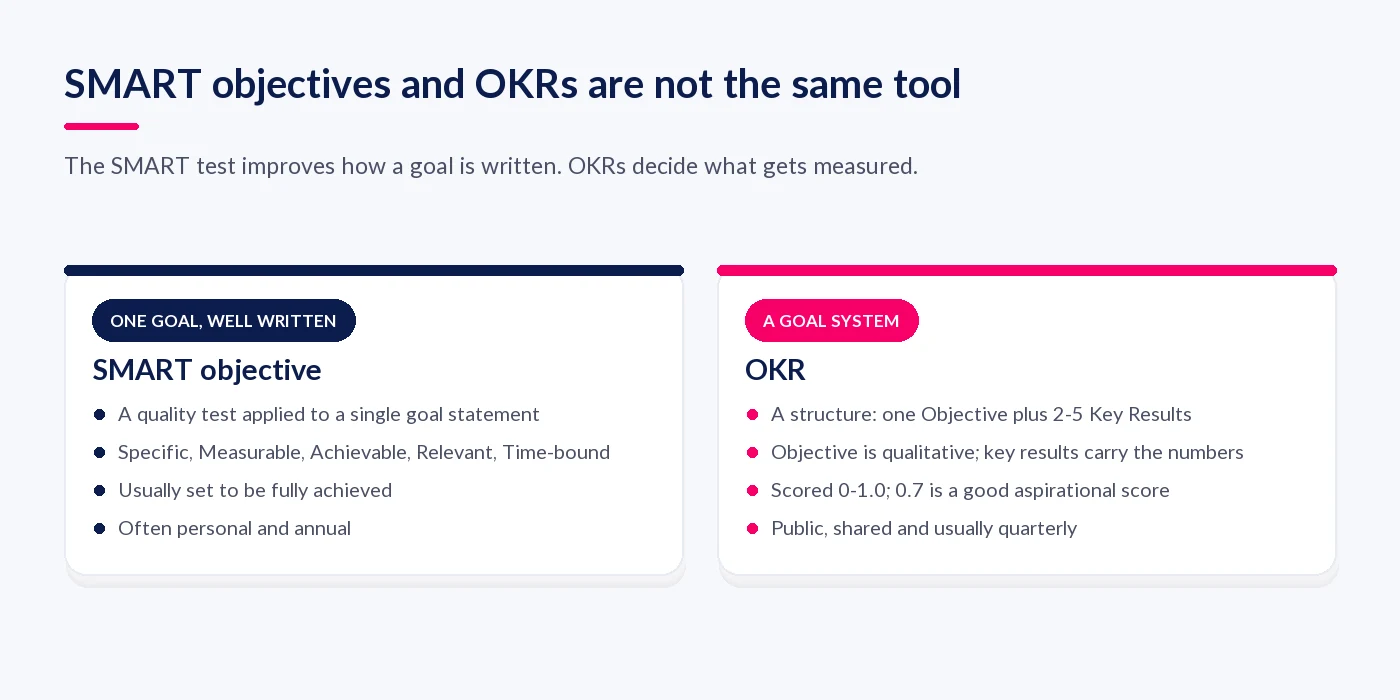
| Dimension | SMART objective | OKR |
|---|---|---|
| What it is | A five-point test for how a goal is written | A structure pairing one objective with its measures |
| Unit | One goal statement | One objective plus two to five key results |
| Where the number lives | Inside the goal statement | Only in the key results |
| Typical horizon | Annual, or one review cycle | Quarterly, under an annual company set |
| Expected attainment | 100% — it is meant to be achievable | 1.0 if committed, about 0.7 if aspirational |
| Visibility | Often private between manager and employee | Normally published across the company |
| Best used for | Making one goal unambiguous | Choosing and aligning company priorities |
How are OKRs scored?
OKRs are scored on a 0 to 1.0 scale at the end of the cycle, one score per key result, averaged into a score for the objective. Google's re:Work guidance puts the sweet spot for those scores in the 60–70% range, and is explicit that consistently full attainment means the objectives were not ambitious enough in the first place.
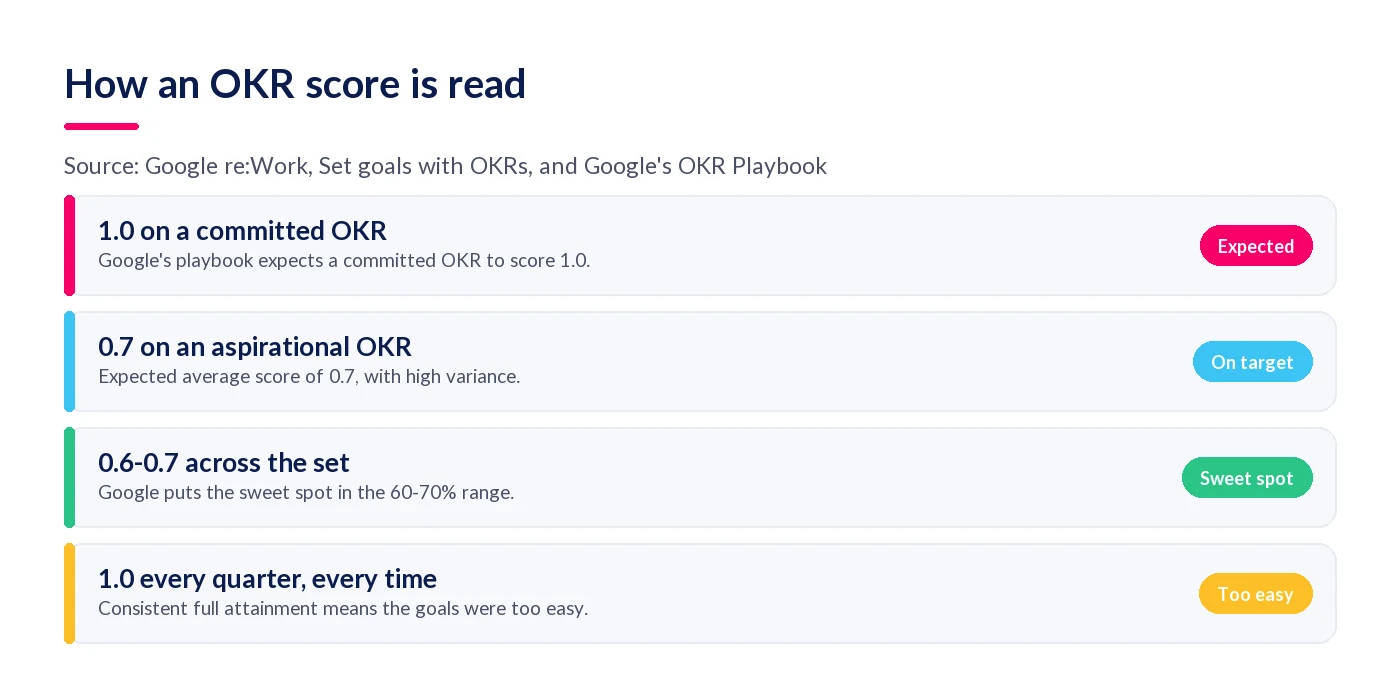
That only makes sense if you label the OKR first. Google's OKR Playbook, published by John Doerr's What Matters, separates committed OKRs — the ones the team has agreed will be delivered, where the expected score is 1.0 and a miss needs explaining — from aspirational OKRs, which describe a world the team has no clear route to yet and carry an expected average score of 0.7 with high variance. Score an aspirational OKR as if it were committed and you have simply punished ambition.
If OKR scores end up feeding your review conversations, The Ultimate Guide to Performance Reviews covers how to keep goal scoring and performance rating separate without losing the evidence trail between them.
How often should OKRs be set?
Most organisations run two cadences at once: an annual set of company OKRs that expresses the strategy, and quarterly sets beneath it that teams actually work to. Between those points sits a weekly or fortnightly check-in where owners update each key result and flag what is stuck. The quarter is the unit that matters, because it is short enough that a stalled key result is still recoverable.
Annual-only OKRs decay into a document nobody opens; monthly OKRs rarely allow enough time for a number to move. If you are ready to draft your first set, our guide to how to write OKRs, with examples by function gives the wording and the process.
OKRs earn their keep when the numbers are visible without anyone chasing them, which is what StaffCircle's performance management and development platform is built to do — objectives, key results and check-ins on one record, so a quarterly score is a report rather than a rebuild.
Frequently asked questions
What does OKR stand for?
OKR stands for Objectives and Key Results. The Objective is a short, qualitative statement of what you want to achieve; each Key Result is a number that has to move from a stated baseline to a stated target inside the cycle, usually a quarter.
How many OKRs should a team have?
Google's re:Work guide recommends three to five objectives with about three key results each, and warns that more leaves teams over-extended. In practice, most mid-sized teams manage one or two objectives per quarter well and lose track of anything beyond three, so start lower than feels comfortable.
Are OKRs the same as KPIs?
No. A KPI is a continuing health measure with a threshold — first response time under two hours, for example — that runs quarter after quarter. A key result is a change you are trying to make this cycle, moving a number from a baseline to a target, then retiring or resetting.
Should OKRs be linked to pay or bonuses?
Generally not. Google's OKR guidance treats aspirational OKRs as stretch goals with an expected average score of 0.7, which only works if a 0.7 is safe to report. Attach a bonus to the score and people write objectives they already know they can hit.
Who invented OKRs?
Andy Grove developed OKRs at Intel, building on the Management by Objectives approach Peter Drucker introduced in the 1950s. John Doerr, who learned the method in Grove's seminars at Intel, introduced it to Google's founders in 1999 and later wrote it up in Measure What Matters.
Related articles
See StaffCircle in action
Book a personalised demo and see how StaffCircle drives performance, engagement and development.