Best UK Continuous Feedback Software for Frontline Teams
Here is a small experiment. Search for the best continuous feedback software, open the eight pages that rank, and count how many times the word shift appears. When we did it in September 2026 the answer was once, on a page written by a rota-scheduling vendor. Seven of the eight never mention frontline, deskless, shared devices or people who have no company email. They compare tools by their Slack integration.
That would be fine if the workforce sat at desks. It does not. In the ONS's most recent look at who works where, half of private-sector employees only ever travelled to work, and in elementary occupations and among process, plant and machine operatives, homeworking barely registers. If you run a manufacturer, a care group, a contractor, a retailer or a logistics business, most of the people you want to give feedback to will read it, if they read it at all, on a phone in a break room.

Continuous feedback performance management software is a platform that lets managers and employees exchange feedback, run check-ins and record objectives and reviews throughout the year, in place of a single annual appraisal. For frontline teams the buying question is narrower and harder: can a supervisor give a dated, shareable piece of feedback to someone on a shared device, mid-shift, without an Office 365 licence, and does that feedback land on the same record as the person's objectives and review? Below are the tests we used, the tools that pass them, and the legal clock that makes this matter more from January 2027.
Start With Who Is Not at a Desk
The number usually quoted is that 80% of the world's workers are deskless. It comes from a venture-capital report and Microsoft repeats a version of it in its Work Trend Index frontline report: two billion frontline workers, roughly 80% of the global workforce. Treat it as an order of magnitude rather than a census figure. The UK picture from the ONS is more useful: around half of private-sector employees have no option to work from home, and in the occupations that fill factories, sites, wards and shop floors, almost nobody does.
The same Microsoft survey found that 63% of frontline workers say messages from leadership do not make it to them, and just over half of those in non-management frontline roles do not feel valued. That is the engagement problem a feedback tool is supposed to solve. It cannot solve it if it lives on a laptop the team never touches.
There is also a manager problem. Gallup's long-running finding is that managers account for at least 70% of the variance in team engagement, and that employees whose managers hold regular meetings with them are almost three times as likely to be engaged. In a 2022 Gallup study of 13,490 US employees, 80% of those who had received meaningful feedback in the past week were fully engaged. A shift supervisor with forty reports and no desk is the manager that finding is about, and the tool has to be built for them.
Six Tests a Frontline Feedback Tool Has to Pass
These are the criteria we scored the shortlist against. They are deliberately operational. Feature lists are long everywhere; what differs is whether the feature survives contact with a loading bay.
1. It works without an Office 365 licence or an app-store install
Many organisations do not buy a Microsoft 365 licence for every operative, and shared devices make personal app-store accounts impractical. Microsoft's own frontline device guidance notes that shared and bring-your-own devices are the most common set-ups on the frontline, and that dedicated devices are rare because of cost and turnover. A tool that needs a corporate identity and a Play Store download fails at the door.
2. A supervisor can complete a check-in on a phone in under ten minutes
Not view one. Complete one: open the person's record, log the feedback, tick the objective, add the note, share it. If any step needs a desktop, it will be deferred to the end of the week and then not done.
3. Every piece of feedback is dated, attributed and shared with the employee
Acas is plain about this: "It's important to keep a written record of what is discussed. This should be shared with the employee afterwards." A comment in a chat thread is not a record. A dated entry on the person's timeline, visible to both parties, is.
4. Feedback lands on the same record as objectives and reviews
Continuous feedback that sits in a separate app from the review is the annual appraisal with extra steps. The point is that the review writes itself from twelve months of small, dated observations, as we set out in the continuous performance management cycle.
5. Pricing is published, in pounds, with the minimums stated
Most of the market prices in US dollars or does not price at all. That matters for a 600-person contractor budgeting per head, and it is a reasonable proxy for how seriously a vendor takes UK buyers.
6. It reaches the people who never see the leadership message
Recognition, a newsfeed and pulse surveys on the same phone as the check-in, so that the 63% who say leadership messages do not reach them are inside the loop rather than outside it.
Performance Platform or Comms App? Most Lists Confuse the Two
The single biggest source of buyer's remorse in this category is choosing a frontline communications app and expecting it to run performance. Blink, Flip, Beekeeper, Speakap, Workvivo and Staffbase are good at what they do: newsfeeds, chat, shift swaps, forms, recognition badges, all on a native app that does not need a company email. None of them, on their own product pages, offers performance reviews, objectives or a one-to-one record. Connecteam gets closest by building an evaluation out of a form template. Microsoft Viva sits in the same camp and retired Viva Goals at the end of 2025.
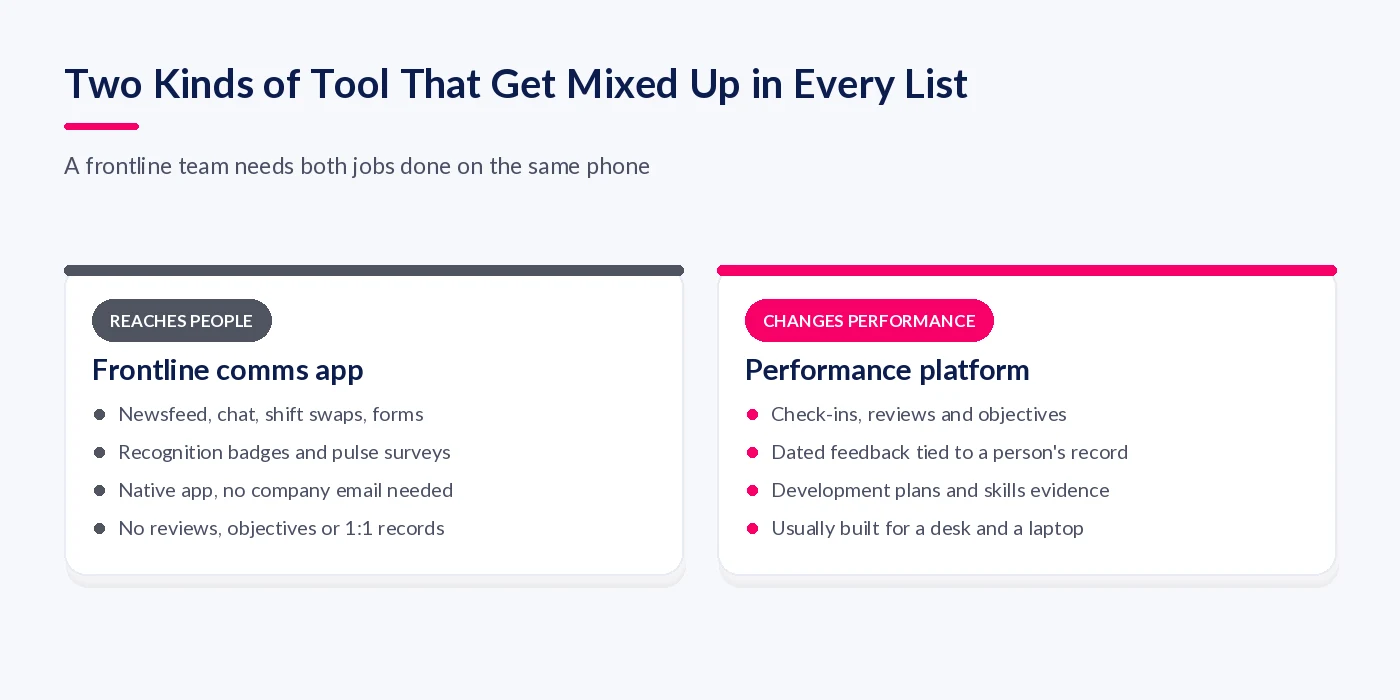
The reverse mistake is just as common: buying a performance platform designed around a laptop and wondering why adoption on the floor stalls. Read the user reviews of several well-known platforms and the recurring complaint is that the mobile app does a fraction of what the desktop does. We have not found an independent study that measures this properly, so treat it as a consistent pattern in reviews rather than a proven number. The tools that suit frontline teams are the ones that do the performance job and behave like a comms app on a phone.
The Shortlist: Nine Tools Scored Against the Tests
Every fact below comes from the vendor's own product or pricing page as read in September 2026, with the link so you can check it has not moved. Prices change; minimums and architecture change more slowly.
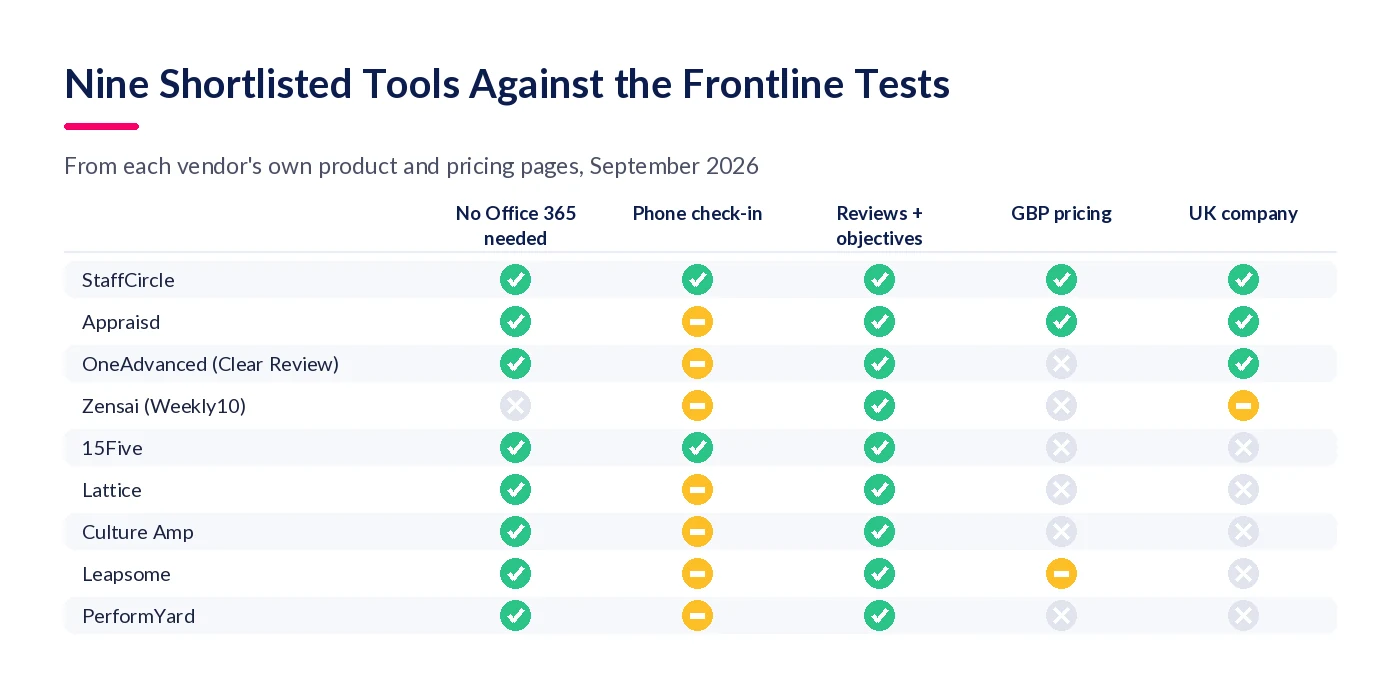
StaffCircle (UK)
A performance and development platform with an engagement layer, built for mixed desk and frontline workforces of roughly 50 to 1,000 people. It installs as a web app straight to the phone's home screen with nothing to download from an app store, uses single sign-on and does not require an Office 365 licence, and also runs inside Microsoft Teams for the people who have it. Check-ins, objectives, real-time feedback, reviews, 360s, development plans and competency evidence sit on one record per person; the Engagement module adds newsfeed, recognition, eNPS and pulse surveys on the same app. Pricing is published in pounds, from £3.85 per employee per month billed annually with a minimum annual charge and a one-off set-up fee. Certified to ISO/IEC 27001:2022 and ISO/IEC 42001:2023. Full disclosure: this is our product, so read the frontline page and the customer stories rather than taking our word for it.
Appraisd (UK)
A performance platform from Talos360 with regular check-ins, instant feedback, recognition and shout-outs, objectives, 360s and development plans. Its pricing page is the most transparent in the UK market: UK hosting as standard, a £3,600 a year minimum for teams up to 50, then £6, £4 and £3 per employee per month at 51 to 100, 101 to 200 and 201 plus. Access is web-based; the pricing and product pages do not mention a mobile app, so test the phone experience on a shared device before you commit.
OneAdvanced Performance & Talent, formerly Clear Review (UK)
Clear Review pioneered monthly check-ins in the UK and now sits inside OneAdvanced as Performance & Talent: real-time feedback, check-ins, one-to-ones, goals, 360s, recognition, surveys and succession, with UK-based support. It works in any modern browser on any device rather than as a native app. Pricing is quote-only, based on users and features.
Zensai, formerly Weekly10 (UK origin)
Weekly10 was a Wrexham company whose weekly check-in product became Engage365 and Perform365 after it joined LMS365, now Zensai. It runs natively inside Microsoft 365 and Teams, which is its strength and its constraint: if every frontline worker has an M365 identity it is seamless, and if they do not, they are outside it. Pricing is quote-only.
15Five (US)
Weekly check-ins, one-to-ones, high fives, 360 feedback and OKRs, with native iOS and Android apps that cover check-ins, one-to-ones and surveys. Published pricing is in US dollars: Engage at $4, Perform at $11 and the full platform at $16 per user per month billed annually, with the Kona meeting assistant at a further $2 per employee and $19 per manager per month. We have written a fuller 15Five comparison for UK buyers.
Lattice (US)
The mid-market benchmark for performance, goals and engagement, with a native mobile app for feedback, praise, goals and one-to-ones (one-to-one relationships themselves are set up on desktop). Pricing is in US dollars only, Performance at $10 per seat per month, with a $4,000 minimum annual agreement. Excellent for desk-based teams; the frontline case rests on whether every operative can hold a Lattice login.
Culture Amp (AU/US)
An engagement-first platform whose Perform module adds continuous feedback, one-to-ones, shout-outs, goals and calibrated reviews. Pricing is quote-only and billed annually. The pricing page says nothing about a mobile app; third-party listings describe one for Performance customers, but we could not confirm it from the vendor, so ask.
Leapsome (DE)
Reviews, goals, surveys, learning and compensation in one European platform, available in 38 languages, which matters on multilingual sites. It has no native app; the help centre describes adding a browser shortcut to the home screen. Pricing starts at 199 a month in your chosen currency, with a one-year minimum contract in the €6,000 range for full support.
PerformYard (US)
Reviews, one-to-ones, goals, feedback and engagement, priced at $5 to $15 per person per month on annual terms. PerformYard has no native app by design and runs in the browser on any device. Strong review workflow; the frontline test is whether your supervisors will open a browser tab on a shared handset.
| Tool | Frontline access | Feedback, check-ins, reviews | Published UK pricing | Best suited to |
|---|---|---|---|---|
| StaffCircle | Home-screen web app, SSO, no Office 365 licence; also in Teams | Yes, on one record with objectives and development | From £3.85 per employee per month, annual, minimum applies | Mixed desk and frontline, 50 to 1,000 staff |
| Appraisd | Web-based; mobile not stated | Yes | £3,600 a year minimum; £6, £4, £3 per employee per month by band | UK mid-market wanting UK hosting |
| OneAdvanced Performance & Talent | Any browser, any device | Yes | Quote only | UK organisations already on OneAdvanced |
| Zensai (Weekly10) | Inside Microsoft 365 and Teams only | Yes | Quote only | Every worker already licensed for M365 |
| 15Five | Native iOS and Android apps | Yes | USD: $4, $11, $16 per user per month plus AI add-ons | Desk-heavy mid-market |
| Lattice | Native app; one-to-one set-up on desktop | Yes | USD only, $10 per seat per month, $4,000 minimum | Desk-based mid-market |
| Culture Amp | Mobile app not confirmed by vendor | Yes (Perform module) | Quote only | Engagement-led enterprises |
| Leapsome | Browser shortcut, no native app | Yes | From 199 a month, one-year minimum | Multilingual European mid-market |
| PerformYard | Browser only, by design | Yes | USD $5 to $15 per person per month | Review-cycle-focused SMEs |
The Legal Clock That Starts in January 2027
None of the ranking pages mention this, and it is the strongest business case for continuous, recorded feedback on the frontline. The Employment Rights Act 2025 received Royal Assent on 18 December 2025. Among its staged changes, Acas confirms that from 1 January 2027 the qualifying period for an unfair dismissal claim falls from two years to six months, and the CIPD notes that the compensation cap is removed at the same time. Frontline roles turn over faster than any other, and the first six months is exactly where informal feedback is most often given verbally and never written down.

Acas already advises that employers should keep a record of any conversations they have with employees about performance, and should try to help someone improve before any formal process. A platform that timestamps every check-in and shares it with the employee produces that record as a by-product of managing well. One caution in the other direction: the ICO's monitoring workers guidance expects any tracking of staff to be proportionate and transparent. Feedback given to a person is not surveillance; productivity scoring they never see may be. Keep the record open to the employee and you stay on the right side of both.
Rolling It Out on a Shop Floor
Frontline deployments fail by launching to everyone at once with a login email nobody receives. Start with the supervisors.
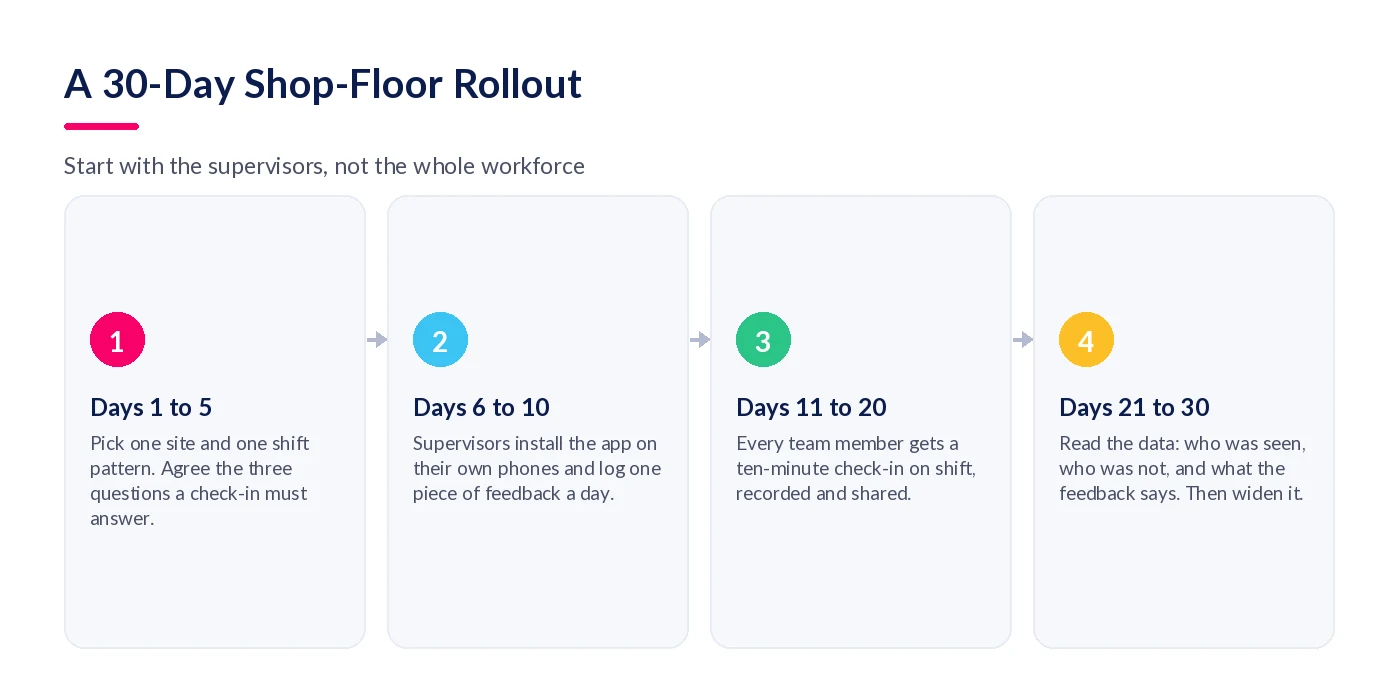
Choose one site and one shift pattern. Agree three things every check-in must capture: what went well, what is getting in the way, and one action. Get the supervisors onto the app on their own phones first and ask each to log one piece of feedback a day for a week; if that is hard, the tool is wrong and you have found out cheaply. Then give every team member a ten-minute check-in on shift, recorded and shared. At day 30 you will have the first data you have ever had on who is being seen and who is not, which is where the engagement work for non-desk teams really starts.
Where StaffCircle Fits
Because we built StaffCircle for organisations where some people have laptops and most do not, the frontline tests above are the design brief rather than a checklist we retrofitted. Four things matter most to the buyers we speak to.
One app, two jobs
The check-in, the objective, the piece of feedback and the review sit on the same record as the newsfeed post and the recognition award. A supervisor recognising a good shift and logging a development point is doing both in one place, and the review at quarter end draws on all of it.
No licence barrier
The app installs from a link, signs in with SSO and does not need an Office 365 licence, so a 30-person office team and a 400-person production team are on the same platform at the same price. It runs inside Teams for the people who live there.
A record that protects everyone
Every conversation is dated and visible to the employee. The optional Notetaker turns a spoken one-to-one into a shared summary and actions, so the record exists even when the manager never sits at a keyboard.
Evidence it works on the factory floor
Siderise, a Welsh manufacturer of passive fire protection, went live in June 2025. Gemma Littlejohns, its Learning and Development Business Partner, said: "We make extensive use of the objectives and performance review features to facilitate ongoing competency management, meaningful development conversations, and the continuous growth of our people." The full Siderise story covers how competency management and continuous conversations were joined up. If you want to model the numbers for your own workforce first, the ROI calculator takes headcount, turnover and admin time and shows what a change in engagement is worth.
Final Thoughts
The best continuous feedback software for a frontline team is not the one with the longest feature list or the biggest Slack community. It is the one a shift supervisor will actually open on a shared phone at 2pm on a Tuesday, that writes a dated record both parties can see, and that feeds the review rather than sitting beside it. Score the shortlist against the six tests, ignore any tool that needs a laptop, and remember that from January 2027 the written record is not just good practice. Book a demo to see how StaffCircle runs feedback, check-ins and reviews for people who never sit down.
FAQ
What is continuous feedback software?
Software that lets managers and employees give and receive feedback, run check-ins and track objectives throughout the year, so that performance conversations happen continuously rather than in a single annual appraisal. The best tools tie each piece of feedback to the person's record so reviews draw on it.
How is continuous performance management different from an annual review?
An annual review assesses twelve months in one meeting, usually from memory. Continuous performance management replaces that with regular check-ins, real-time feedback and objectives that are updated as work happens, so the end-of-year conversation summarises what has already been discussed. The CIPD's performance management guidance describes it as a continuous cycle rather than an isolated event.
How often should frontline managers give feedback?
Gallup's research found that 80% of employees who received meaningful feedback in the past week were fully engaged, and that employees whose managers hold regular meetings with them are almost three times as likely to be engaged. For shift teams a practical target is one recorded check-in per person per month and informal feedback weekly.
Can frontline staff use performance software without a company email or Office 365 licence?
It depends on the tool. Platforms built inside Microsoft 365, such as Zensai and Viva, need an M365 identity. Others, including StaffCircle, use single sign-on and a home-screen web app that does not require an Office 365 licence or an app-store download. Check whether every operative can hold a login before buying.
Does performance review software work on a phone or shared device?
Some tools have native iOS and Android apps (15Five, Lattice), some install as a web app to the home screen (StaffCircle), and some run only in a browser tab (PerformYard, Leapsome). On shared devices, avoid anything that needs a personal app-store account, and test whether a supervisor can complete a full check-in on the phone rather than just read one.
What is the best performance management software in the UK for frontline teams?
For mixed desk and frontline workforces of 50 to 1,000 people, StaffCircle, Appraisd and OneAdvanced Performance & Talent are the UK-based platforms that publish or explain their pricing and run on any device. 15Five and Lattice are strong for desk-based teams but price in US dollars. The right choice depends on whether every worker can hold a login and on whether you need engagement features on the same app.
What is the difference between an employee engagement app and performance management software?
Engagement or comms apps such as Blink, Flip, Beekeeper, Speakap, Workvivo and Staffbase deliver news, chat, recognition and surveys to frontline phones but do not run reviews, objectives or one-to-one records. Performance management software does those things but is often designed for a desk. Frontline teams need a tool that does the performance job on a phone.
How do you engage deskless workers who never check email?
Put the feedback, recognition and check-in on the device they already carry, make login possible without a corporate mailbox, keep each interaction short enough to complete on shift, and make sure supervisors are using it first. Microsoft's frontline research found 63% of frontline workers say leadership messages do not reach them, so the channel matters as much as the content.
How do you give feedback to shift workers you rarely see?
Give it close to the moment it applies to, keep it specific to an observable action, and record it on the person's timeline so it is there when you next meet. A monthly ten-minute check-in on shift, plus feedback logged in the app between meetings, works better than saving everything for a quarterly review.
Do UK employers have to keep records of performance conversations?
There is no single statutory duty to record every conversation, but Acas guidance says it is important to keep a written record of what is discussed and to share it with the employee, and to keep a record of any conversations about performance problems. Records also become evidence if a dismissal is challenged.
How does the Employment Rights Act 2025 change performance management for new hires?
The Act received Royal Assent on 18 December 2025. From 1 January 2027 the qualifying period for unfair dismissal claims drops from two years to six months and, according to the CIPD, the compensation cap is removed. Employers will need documented, dated performance conversations from the first weeks of employment, which is where frontline feedback is most often verbal.
Does UK GDPR restrict how employers track employee performance?
Feedback and review records are personal data and must be handled under UK GDPR, and the ICO's monitoring workers guidance expects any monitoring to be proportionate, transparent and, where risk is high, assessed through a DPIA. Feedback given openly to an employee is not monitoring in that sense; covert productivity scoring may be.
How much does continuous feedback software cost per employee in the UK?
As published in September 2026: StaffCircle from £3.85 per employee per month billed annually with a minimum annual charge; Appraisd from £3 to £6 per employee per month by band with a £3,600 minimum; 15Five $4 to $16 per user per month; Lattice $10 per seat per month with a $4,000 minimum; PerformYard $5 to $15 per person per month. Culture Amp, OneAdvanced and Zensai quote individually.
Which UK-based performance management vendors offer UK data hosting?
Appraisd states UK hosting as standard on its pricing page. StaffCircle, OneAdvanced and OpenBlend are UK companies; ask each for its current hosting region and certifications (StaffCircle holds ISO/IEC 27001:2022 and ISO/IEC 42001:2023). US vendors typically host in the US or EU, so check the data processing agreement.
Related articles
See StaffCircle in action
Book a personalised demo and see how StaffCircle drives performance, engagement and development.