How to Improve Employee Engagement
The fastest way to improve employee engagement is to fix the weekly conversation between managers and their teams, then make expectations, recognition and follow-through visible. Those four moves cost little, show a signal within a quarter, and account for most of the gap between an engaged team and a disengaged one.
Key facts
- Manager quality is the largest single lever; most other drivers are delivered through it.
- Gallup measured 10% of UK employees as engaged in 2025, against 20% globally.
- Low-effort interventions are the ones that can show a signal within a quarter.
- Acting on the last survey raises engagement more than running a better new one.
- Frontline, retail and manufacturing teams need the same drivers, delivered on mobile (see using technology to reach non-desk workers).
Which engagement interventions should you do first?
Start with the ones that cost a manager's time rather than a budget cycle, and that produce a visible signal inside one quarter. The table below scores the common interventions on effort against expected impact so you can choose two or three rather than attempting fifteen. The ordering is the useful part: everything above the line is deliverable this quarter.
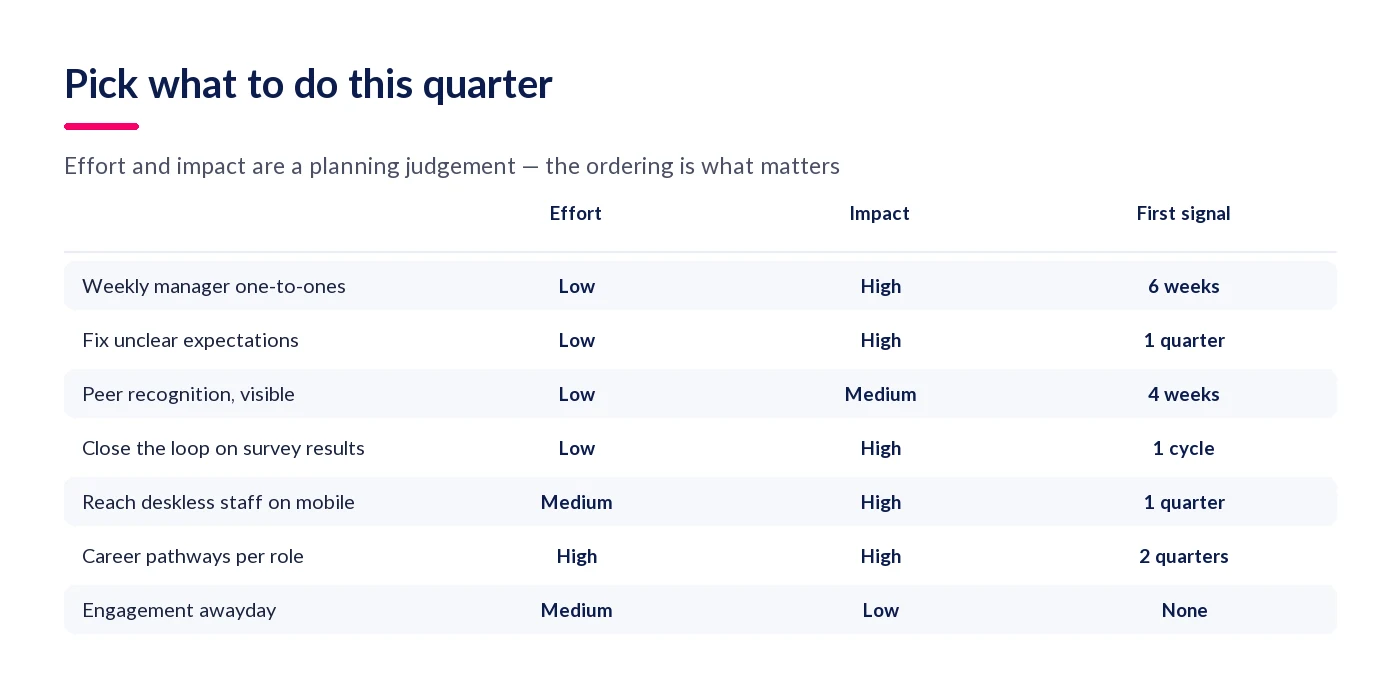
| Intervention | Effort | Expected impact | Time to first signal | Do it when |
|---|---|---|---|---|
| Weekly or fortnightly one-to-ones, never cancelled twice | Low | High | 6 weeks | Always. This is the floor, not an intervention. |
| Rewrite unclear expectations as agreed objectives | Low | High | 1 quarter | People cannot describe what a good quarter looks like. |
| Close the loop on the last survey, publicly | Low | High | 1 cycle | You have asked before and not visibly answered. |
| Make peer recognition visible company-wide | Low | Medium | 4 weeks | Good work is noticed privately or not at all. |
| Reach deskless staff on mobile, same day as head office | Medium | High | 1 quarter | Part of the workforce has no desk or company email. |
| Train managers to run a feedback conversation | Medium | High | 2 quarters | One-to-ones happen but produce nothing. |
| Publish career pathways for each role family | High | High | 2 quarters | Your exit interviews cite "nowhere to go" more than pay. |
| Reward and benefits review | High | Medium | 2 quarters | Pay is genuinely below market, not merely mentioned. |
| Engagement awayday or morale event | Medium | Low | None measurable | Rarely. It changes the week, not the year. |
Two rules make the table work. Pick no more than three rows in a quarter, because a fourth means none of them get followed through. And never pick a high-effort row while a low-effort row above it is still unaddressed — a career pathway framework lands badly on top of a manager who has not spoken to anyone in a month.
How to boost employee engagement
Concentrate on the four low-effort rows above, and treat the one-to-one as the delivery mechanism for all of them. A conversation that happens on schedule, asks rather than reports, ends in one action the manager owns, and opens next time by showing that action happened is the single highest-return change available to most organisations.
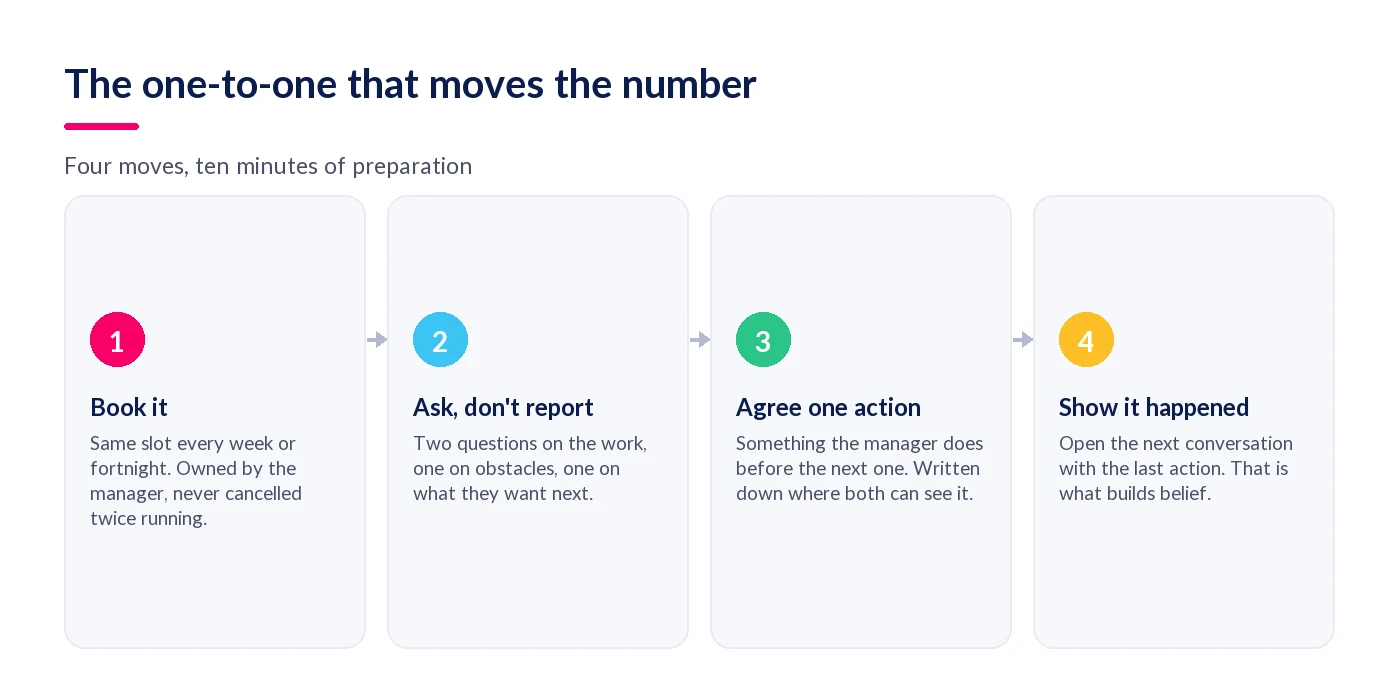
The mechanics matter more than the sentiment:
- Book it and protect it. Same slot, every week or fortnight. A one-to-one cancelled twice running tells the employee exactly where they rank.
- Ask, do not report. Two questions on the work, one on obstacles, one on what they want next. Status updates belong in writing.
- End with one action the manager owns. Not a list. One thing, written where both people can see it.
- Open the next conversation with the last action. This is what converts listening into credibility. Skip it and the whole cadence becomes theatre.
Recognition works on the same principle. Specific, prompt and visible beats generous and annual: a public note naming what somebody actually did, within a week of them doing it, and connected to your company core values so it reads as a standard rather than a favour.
How can HR improve employee engagement
HR improves engagement by building the system managers deliver it through, not by running engagement initiatives directly. That means four things: making the expectation on managers explicit, giving them prompts and a place to record conversations, surfacing where conversations have stopped, and making sure the engagement number is reported to the executive team alongside revenue and headcount.
The failure mode is well documented and easy to spot in your own calendar. HR runs a survey, produces a deck, presents it, and the interventions that follow are things HR can do alone — an awayday, a benefits tweak, a values poster — because those do not require 40 managers to change their behaviour. Engagement then does not move, and the survey becomes evidence that surveys do not work.
The alternative is unglamorous. Publish which teams have had a documented one-to-one in the last month and which have not. Give every manager the two or three items from their own team's results, not the company average. Ask each of them for one commitment, and check it at the next cycle. A structured performance management system is what makes this possible without a spreadsheet chase, and the connection to output is covered in employee productivity.
Frontline-heavy organisations have a harder version of this problem, because the manager population is large, dispersed and rarely at a screen. Our ebook Deskless Not Voiceless: How to Engage Frontline Employees sets out what changes when most of your managers run a shift rather than a diary.
How to engage remote employees
Remote engagement fails on visibility, not on effort. People working away from an office lose the incidental signals that tell them they are doing well and that they still belong, so both have to be made deliberate: scheduled one-to-ones that do not get displaced by travel, written expectations they can re-read, and recognition that appears somewhere the whole company can see. Our guide to internal communications for a remote workforce covers the channels.
Three specifics that consistently matter:
- Write things down. Remote teams run on the written record. Objectives, decisions and the outcome of a one-to-one need to exist in text, or a remote employee is guessing about their own standing.
- Separate the social from the operational. A weekly team call that carries both ends up carrying neither. Keep a short standing slot for the work and a genuinely optional one for the rest.
- Watch the promotion gap. If internal moves and promotions skew towards the people who are physically present, remote engagement will fall regardless of how good the calls are. Check the split annually.
Hybrid arrangements need the same discipline applied to meeting design: if half the room is in the room, the remote half is in a worse meeting. Either everybody dials in individually or the agenda is written so nothing important happens in the corridor afterwards.
How to improve employee engagement in manufacturing
In manufacturing, engagement work has to fit round a shift pattern, a production line and often no company email address. The drivers do not change — manager quality, clarity, recognition, growth — but the delivery does: brief the same information at shift handover, run surveys on mobile in under three minutes, and give shift supervisors the same conversation tools an office manager gets.
What tends to move the number on a production site:
- Supervisor capability. Line supervisors are usually promoted for technical skill and given no conversation training. They are also the single biggest engagement variable on site.
- Safety voice taken seriously. Whether raising a safety concern leads to a visible change is read by the whole shift as the answer to "does speaking up matter here". Gallup's Q12 meta-analysis found 63% fewer safety incidents in top-quartile engaged teams than bottom-quartile ones.
- Absence read as a signal, not a discipline problem. UK sickness absence ran at 2.0% of working hours in 2024, or 4.4 days per worker, according to ONS sickness absence data. A team well above that is usually telling you something before anybody resigns.
- Progression that exists on paper. Operator to team leader to supervisor, with the requirements for each step written down. Without that, progression is a conversation nobody on site can actually have.
How to improve employee engagement in retail
Retail engagement is dominated by two structural facts: high turnover is normal, and most colleagues work part-time hours under a store manager who is also serving customers. That means engagement has to be delivered in very short units — a two-minute recognition at the start of a shift, a three-question pulse on a phone — and the store manager has to be the focus of investment.
Three retail-specific adjustments:
- Measure by store, act by store. A company-level engagement score in a 60-store estate hides everything useful. The variance between stores is the finding.
- Design for part-time hours. If your survey or your one-to-one only reaches people who work full weeks, you are measuring a minority of your workforce and mistaking it for the whole.
- Accept the turnover baseline, then look at the first 90 days. Most retail attrition is early. Whether a new colleague had a proper induction and a named person to ask is a bigger lever than anything you do at month nine.
The reason to bother is that the effect compounds where turnover is high. Gallup's meta-analysis found 21% lower turnover in top-quartile engaged teams even within high-turnover organisations. The CIPD Good Work Index 2025, based on a survey of 5,017 UK employees, reports that positive feelings of engagement link to reduced intention to quit, better reported performance and a greater willingness to go beyond the job description.
StaffCircle was built for exactly this shape of workforce: pulse surveys, real-time eNPS and recognition that reach frontline, desk-based and remote staff on the same day, on mobile. Customers see 57% lower employee turnover, and how that figure is calculated is documented on our customer outcomes page.
To see the whole picture in one place — where you sit now, which drivers are weak, and what changed after you acted — take a look at StaffCircle's employee engagement software, or start with the definitions in what employee engagement is and the measurement guide in how to measure employee engagement.
Frequently asked questions
How long does it take to improve employee engagement?
Low-effort changes such as restarting one-to-ones or closing the loop on a previous survey usually show a signal within four to eight weeks. Structural work — career pathways, manager training, reward redesign — takes two quarters or more before it appears in a score, and longer before it appears in turnover.
What is the single most effective way to improve employee engagement?
Improving the quality and consistency of the conversation between managers and their teams. Manager quality is the largest driver, and almost every other driver — clarity, recognition, growth, voice — is delivered through that relationship. No company-level initiative can compensate for a manager who never speaks to anyone.
How do you improve engagement without a budget?
Every low-effort intervention costs time rather than money: reinstating one-to-ones, rewriting vague expectations as agreed objectives, making recognition visible, and publishing what changed after the last survey. Those four account for most of the achievable improvement in a quarter, and none of them require a budget line.
Do engagement surveys actually improve engagement?
Only if something visible follows them. A survey with no published result and no committed action lowers engagement, because you have asked people to name problems and then demonstrated that naming them changes nothing. The survey is the cheap part; the follow-through is what produces the improvement.
How can managers improve employee engagement in their own team?
Hold the one-to-one on schedule, ask about the work and the obstacles rather than delivering a status review, finish with one action you own, and open the next conversation by showing that action happened. Add specific, prompt recognition when someone does something well.
Related articles

See StaffCircle in action
Book a personalised demo and see how StaffCircle drives performance, engagement and development.