Stay Interview Questions: 30 questions and a conversation guide
An exit interview tells you why someone left. A stay interview asks the same questions while you can still do something about the answers. This guide gives managers the questions, the words to open and close the conversation, and a simple way to record risk and act within 30 days.
- 30 stay interview questions in six themes, with what to listen for
- An opening and closing script, plus what to say if they are already looking
- A priority list and flight-risk signals so you know who to talk to first
- A retention risk record and a 30-day action plan with sign-off
- Questions to leave out under UK law, and how to keep notes safely
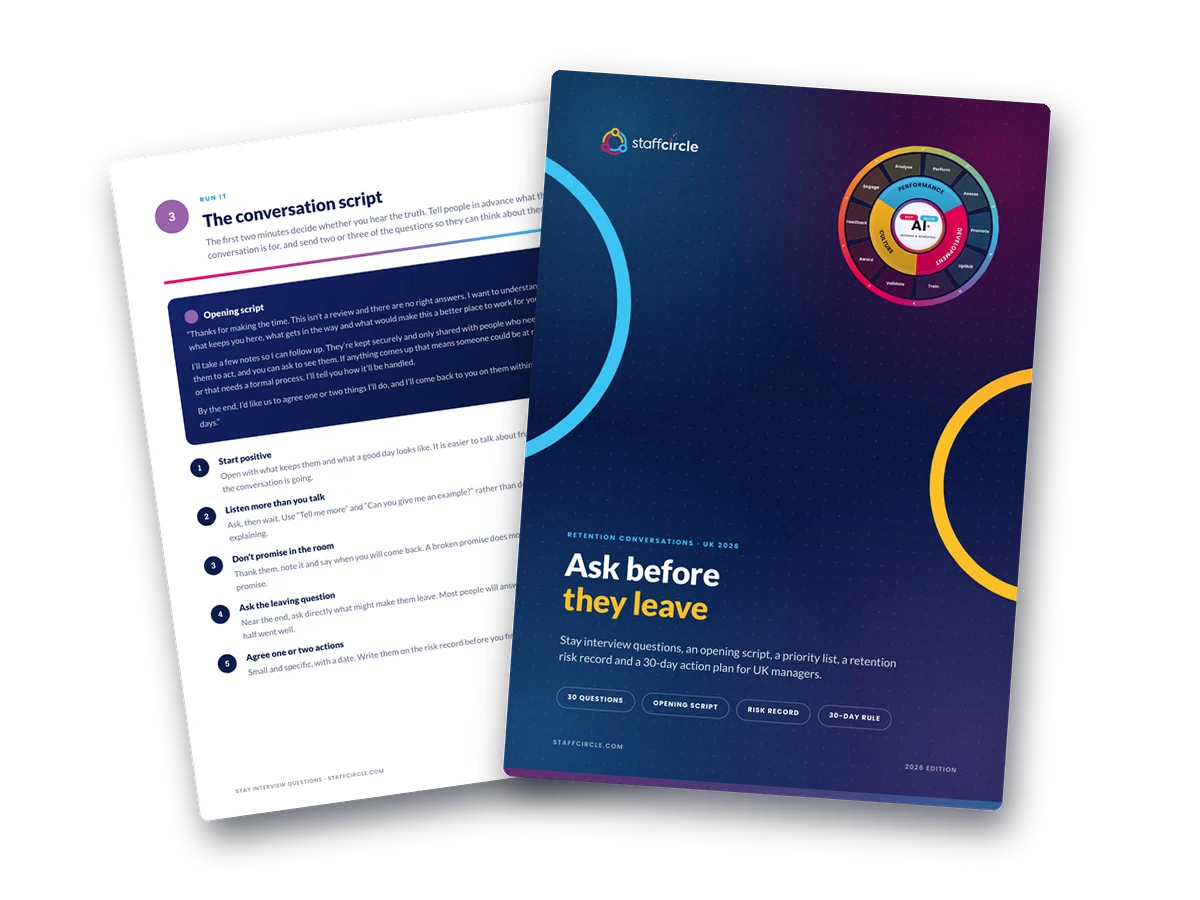
Get your free question bank
Fill in your details to get the PDF and the editable Word version. We’ll email you the PDF too.
We’ll only use your details to send the question bank and relevant StaffCircle content. See our privacy policy.
Trusted by teams at leading organisations


People leave more often than most managers think
Ready to print or edit
Stay, not exit
What a stay interview is, who should run it and how it differs from an exit interview.
Who to talk to first
Flight-risk signals and a priority list so the first conversations go where they matter.
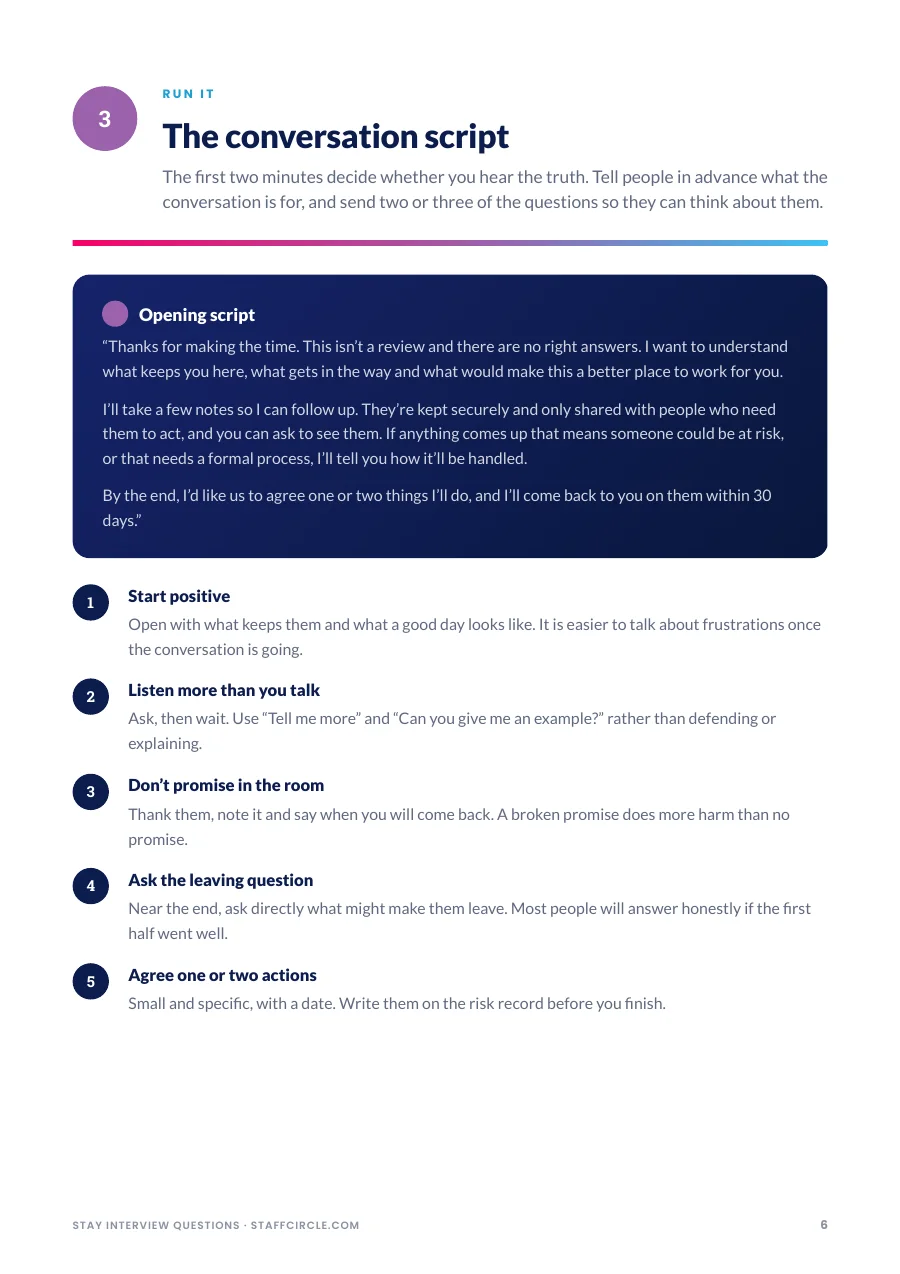
The conversation script
How to open, how to listen, what to say if they are already looking, and how to close.
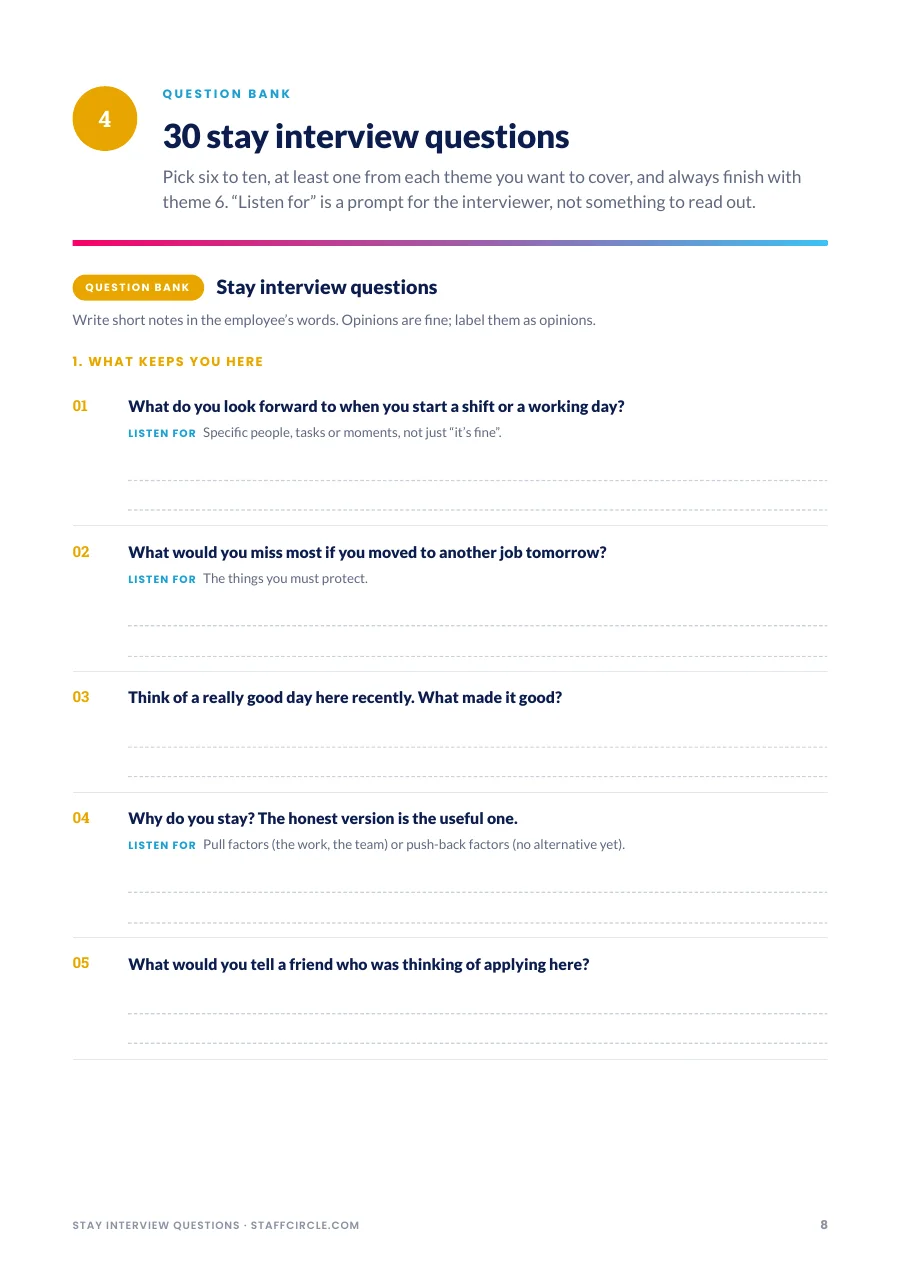
30 stay interview questions
Six themes, from what keeps people here to what would tempt them away.
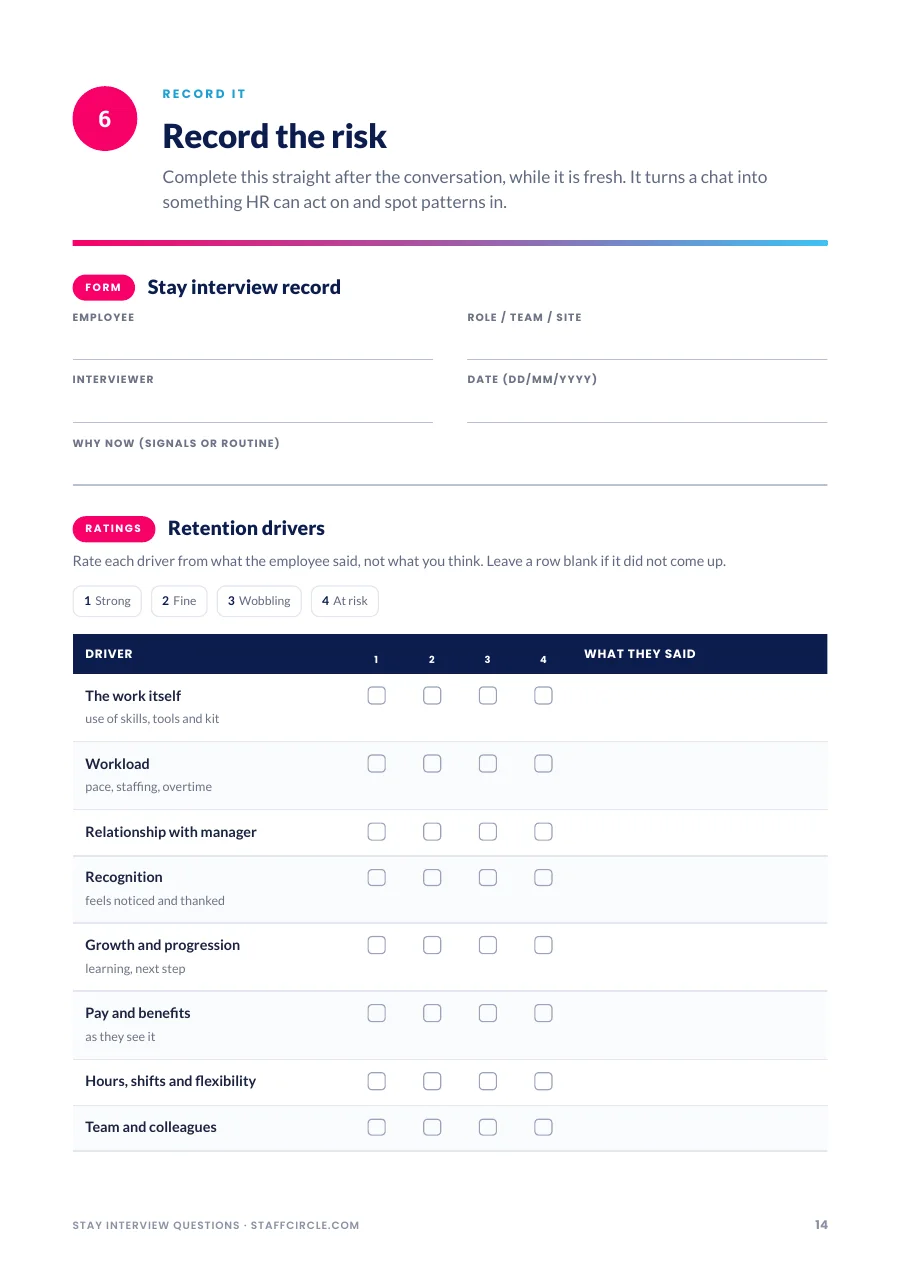
Record the risk
A driver-by-driver rating grid, an overall risk level and note-taking rules under UK GDPR.
Act within 30 days
A dated action plan, what to do with things you cannot fix, and how to spot team themes.
Have the conversation before the resignation letter
Much of what an exit interview tells you could have been learned months earlier. A stay interview asks while you can still act, and the 30-day follow-up is what makes it count.
When someone resigns, Acas suggests the employer talks to them, because a conversation might help you find out if there are problems that can be resolved (Acas). The trouble is timing. By the time the letter is on your desk, the new job has often been offered and accepted. A stay interview has the same conversation earlier, with people who have not decided to go.
It matters because people move often. The CIPD puts average annual turnover for UK workers at 34%, based on ONS data for 2022–23 (CIPD), and notes that high turnover can be costly in recruitment, training and lost knowledge (CIPD).
What most stay interview templates miss
Many stay interview templates are long lists of similar questions. Fewer cover what goes around them:
- Who to talk to first. “High performers” is not a plan. Signals such as a new manager, a missed promotion or a refused request tell you where risk is building.
- The words to open with. If the employee thinks it is a disguised performance review, you will hear nothing useful.
- A way to record risk. A few lines of notes do not tell HR which teams are wobbling or why.
- A deadline. The conversation only builds trust if something happens afterwards. This guide uses a 30-day rule.
- Frontline and shift staff. Hold it in paid time, on their shift, somewhere they can talk.
- UK law. Some well-meant questions, about retirement for example, carry real discrimination risk.
Who should run the interview?
Most guides say the line manager, because they can act on what they hear. Some UK organisations prefer someone who is not the employee’s manager, so people feel able to speak freely; the IPA recommends that approach in its own guidance (IPA). The template works for either. If the relationship with the manager is part of the problem, use someone else.
Questions to leave out
A stay interview asks about the future, and that is where the legal risk sits. Acas says that, unless there is a good business reason, employers should not ask directly about retirement plans (Acas). Ask everyone the same open question about where they would like to be in one to three years instead, and let them raise anything personal. The guide includes a table of questions to avoid and what to ask instead.
Five steps from conversation to action
- Pick who to talk to first using the priority list
- Book it in paid time and explain the purpose in advance
- Open with the script, ask six to ten questions and listen
- Record the risk and agree one or two actions before you finish
- Close every action, or explain why you cannot, within 30 days
Notes from these conversations are personal information. The ICO says employers must respond to a worker’s subject access request without delay and within one month (ICO), so write every note as if the employee will read it.
The template comes as a printable PDF and an editable Word file. For the bigger picture, read our guide to improving employee retention and our free engagement survey template. Stay interviews work best alongside regular check-ins, so pair this with our one-to-one meeting template.
Stay interviews: common questions
What is a stay interview?
A stay interview is a planned one-to-one conversation with an employee who is not leaving, to find out what keeps them, what frustrates them and what might make them leave, while there is still time to act.
What is the difference between a stay interview and an exit interview?
An exit interview happens after someone has resigned and asks why they are leaving. A stay interview asks similar questions of people who are staying, so you can fix problems before they lead to a resignation.
Who should conduct a stay interview?
Usually the line manager, because they can act on what they hear. If the manager relationship is part of the problem, or people are unlikely to speak freely, use another manager or someone from HR. Some UK organisations, such as the IPA, recommend that it is not the line manager.
How long should a stay interview take?
Allow 30 to 45 minutes. Published guidance varies, from about 15–20 minutes in the IPA’s UK guidance to an hour in some templates. Ask six to ten questions rather than working through all 30.
How often should you hold stay interviews?
There is no legal rule. Once a year for everyone is a sensible start, with extra conversations for people showing flight-risk signals, new starters around their first few months and anyone whose role has changed.
Are stay interviews confidential?
They should be treated as confidential within limits. Explain at the start that notes are kept securely and shared only as needed to act, and that anything suggesting someone is at risk of harm, or a serious complaint, will be passed on through the proper route.
Can an employee ask to see stay interview notes?
Yes. Notes about an employee are their personal information and they can ask for a copy through a subject access request. The ICO says employers must respond without delay and within one month. Write notes factually and label opinions as opinions.
What questions should you not ask in a stay interview?
Avoid questions linked to protected characteristics under the Equality Act 2010, such as when someone plans to retire, whether they plan to have children, or about their health, which may relate to disability. Acas says employers should not ask directly about retirement plans unless there is a good business reason. Ask everyone the same open question about their future plans instead.
What should a manager do after a stay interview?
Agree one or two actions before the meeting ends, record them with an owner and a date, and report back within 30 days, including on anything you cannot change and why. Share anonymised themes with HR so patterns across teams can be spotted.
Ask the questions before the resignation
30 stay interview questions, a conversation script, a retention risk record and a 30-day action plan, as PDF and Word.