Employee Engagement Survey Template: Questions, Results and Action Plan
Most engagement survey templates stop at the questions. This one covers the whole cycle: what to ask, how to protect anonymity under UK GDPR, how to reach shift and frontline staff, how to read the results, and how to show people what changed.
- 50 survey statements across 9 themes, plus an eNPS item and open questions
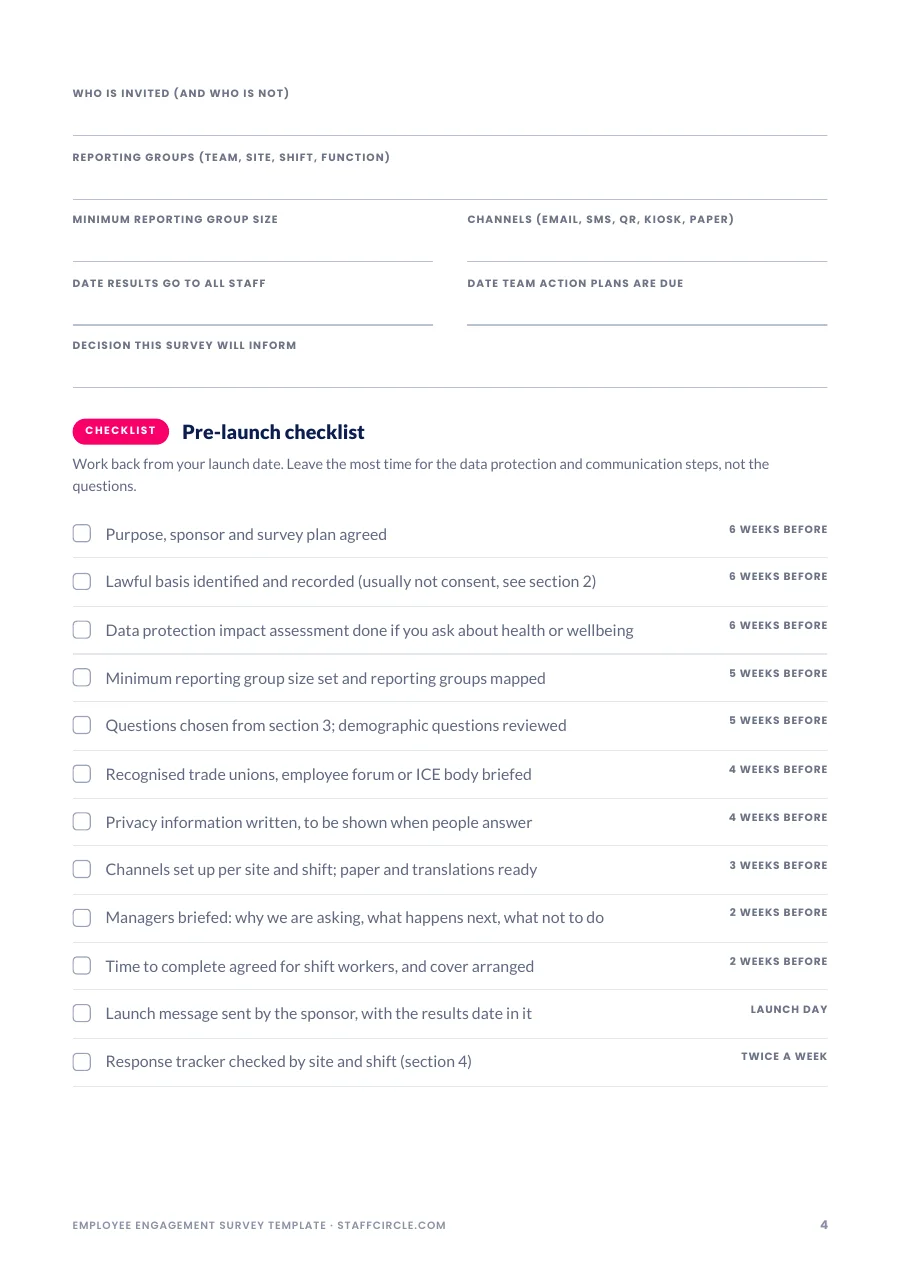
- A survey plan on a page and a six-week pre-launch checklist
- Minimum group sizes, demographic questions and UK GDPR checks
- Channels and a response tracker for frontline and shift teams
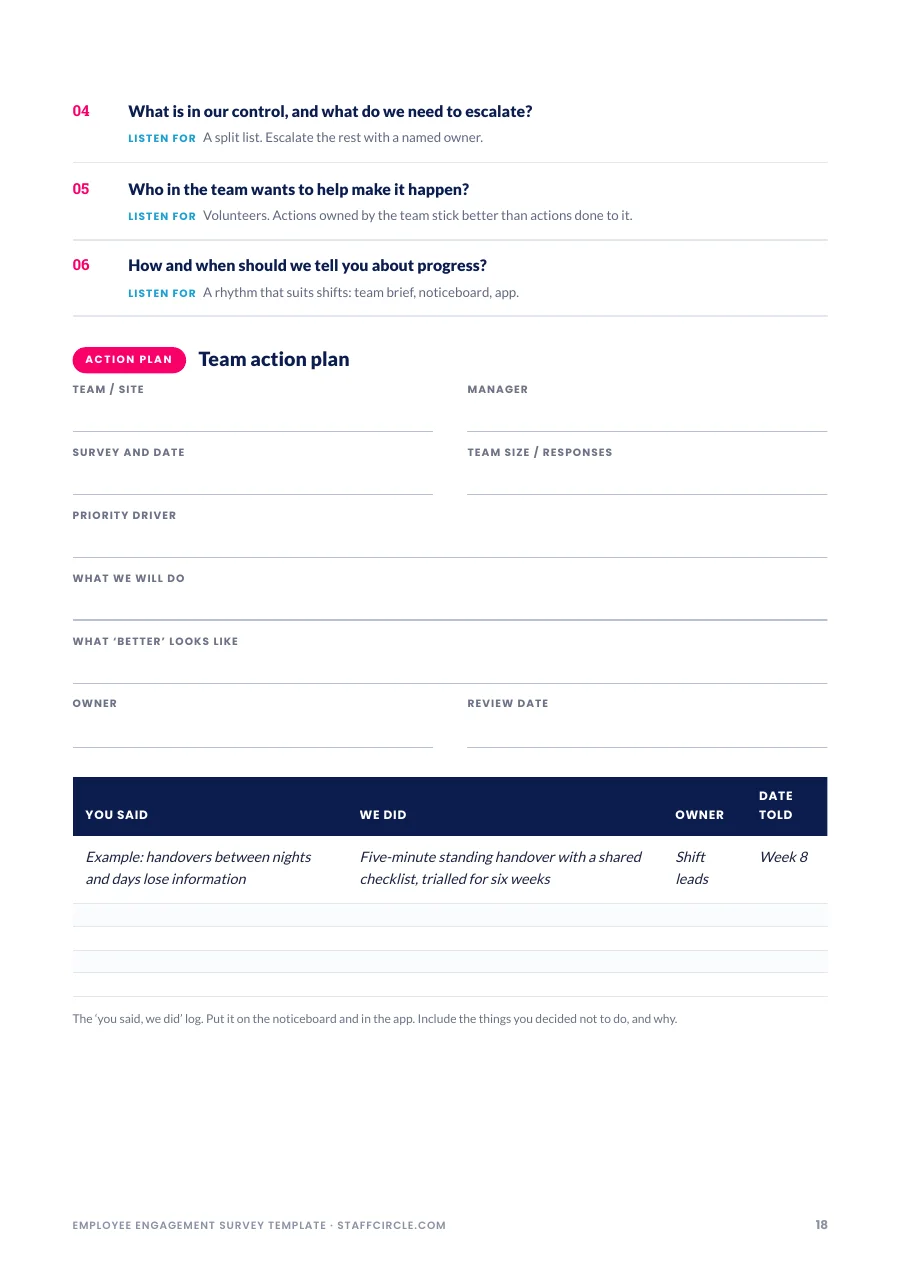
- A results sheet, team conversation guide and ‘you said, we did’ log
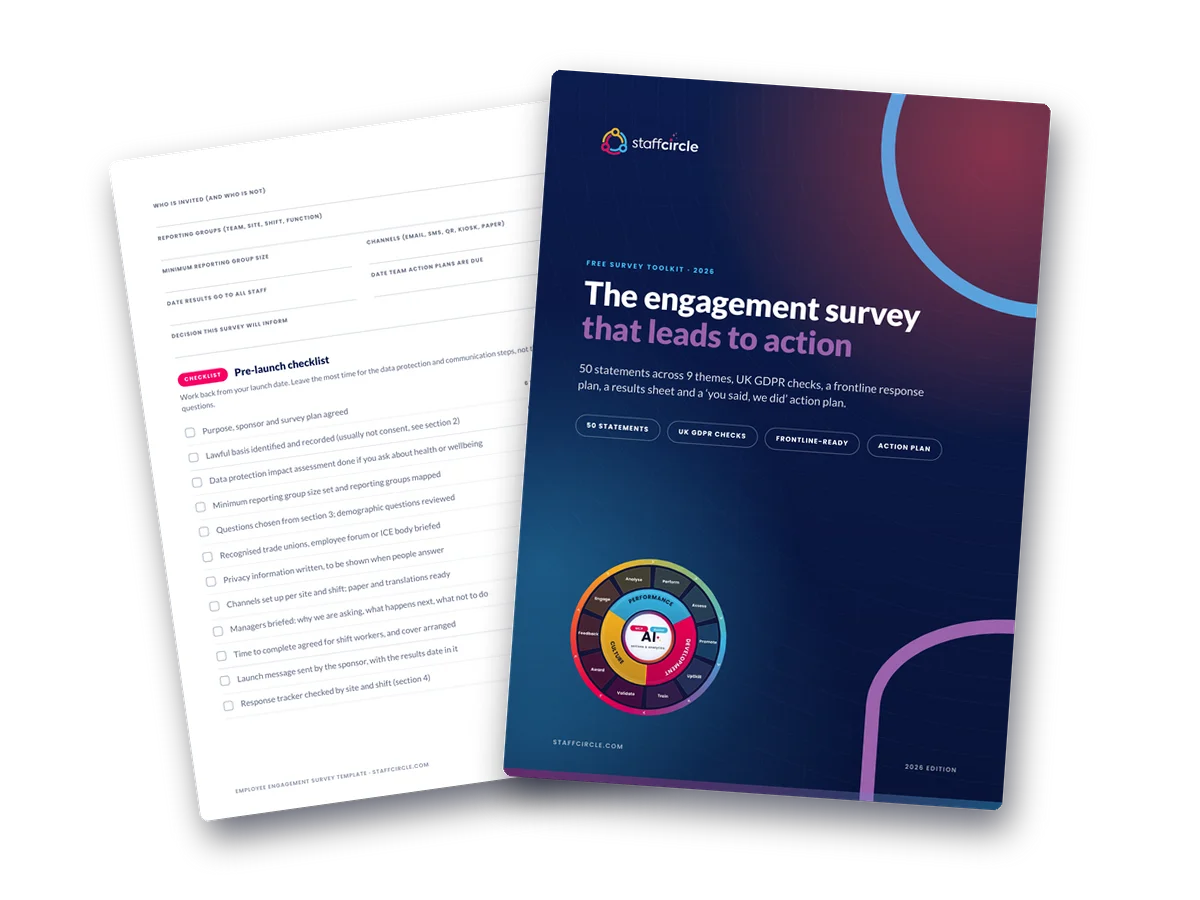
Get your free template
Fill in your details to get the PDF and the editable Word version. We’ll email you the PDF too.
We’ll only use your details to send the template and relevant StaffCircle content. See our privacy policy.
Trusted by teams at leading organisations


Listening only counts if people can be heard
Six sections, from plan to follow-through
Decide what the survey is for
A one-page survey plan and a pre-launch checklist that starts six weeks out.
Anonymity, data and trust
Anonymous vs confidential, minimum group sizes, demographic questions and UK GDPR checks.
The question set
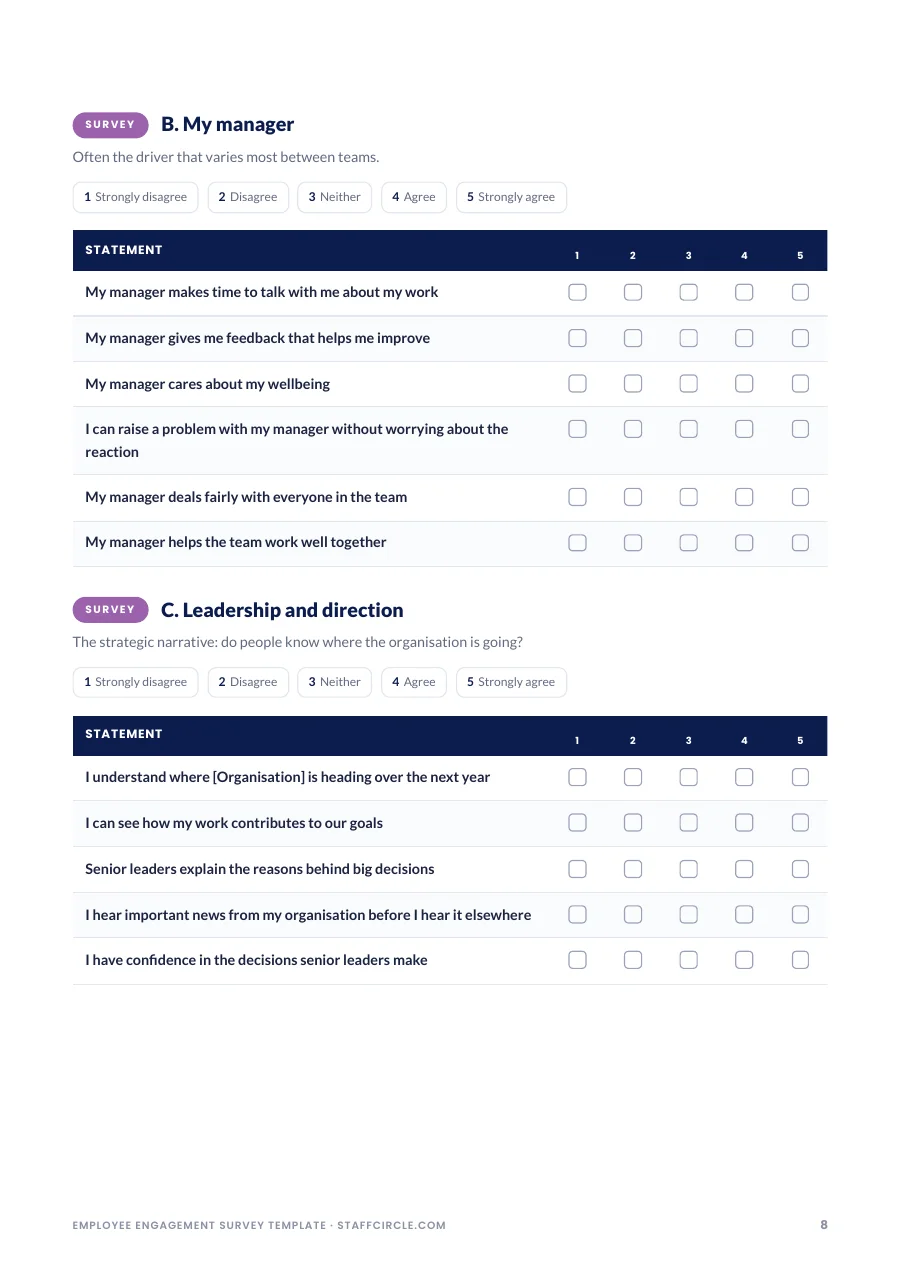
50 statements across 9 themes on a five-point scale, plus eNPS and open questions.
Reaching frontline staff
Channels for people without a desk or work email, and a tracker by site and shift.
Reading the results
A six-step reading order and a results sheet that ends in three priorities.
You said, we did
A 90-day loop, a team conversation guide, an action plan and a log to publish.
What makes an engagement survey worth running
The questions matter, but people judge a survey by what happens afterwards. Plan the follow-through before you plan the questions.
Search for employee engagement survey questions and you will find long lists of statements and very little about what happens next. Many of the lists assume everyone has a desk, a work email and a US benefits package. Few explain how to keep answers confidential in a team of eight, or how to show people their feedback led somewhere.
This template covers the whole cycle. The questions are in it (50 statements across nine themes, on one five-point scale), with everything around them that decides whether the survey is worth running.
Start with the decision, not the questions
The 2009 MacLeod review for government warned that simply doing a survey and publishing the results is not the same as an engagement strategy (Engaging for Success). Before you launch, agree what decision the results will inform, who will see which results, and when staff will hear back. The CIPD advises using engagement measures that are well established and specific (CIPD), so keep a small, stable set of outcome statements and repeat them each time.
Be precise about anonymity
Many engagement surveys are confidential rather than truly anonymous. The ICO says pseudonymised information is still personal data (ICO), and the Civil Service treats all People Survey data as personal data and only reports results where at least 10 people answered (Cabinet Office). Set a minimum reporting group, apply it to every filter, and tell people what it is. Watch demographic questions too: ethnicity, health, religion and sexual orientation are special category data under UK GDPR.
What a good engagement survey covers
- Outcomes. Pride, recommendation, intention to stay, effort and worthwhile work. Your headline measure.
- Manager and leadership. Time, feedback, fairness, direction and trust in decisions.
- Voice. A way to be heard that fits the job and the hours, and a sense that the survey will lead to action.
- Recognition, growth and tools. The everyday drivers, including handovers and kit for frontline roles.
- Workload and wellbeing. Drawing on the six areas of HSE’s Management Standards.
- Respect and speaking up. Whether people would feel safe raising a concern.
Five steps to close the loop
- Share headline results with everyone within two weeks
- Give each manager a team report, if the team is above the minimum group size
- Hold a 30-minute results conversation with every team
- Agree no more than three priorities and publish the plan
- Post a ‘you said, we did’ update, and pulse the drivers you are working on at 90 days
The template comes as a printable PDF and an editable Word file. If you want a quick read on advocacy first, try our free eNPS calculator. For more on survey design, read how to design an employee engagement survey, and for frontline teams, see nine ways to boost engagement among non-desk-based workers. StaffCircle’s engagement and culture tools run pulse surveys and eNPS on mobile, so frontline staff can answer too.
Employee engagement surveys: common questions
What questions should be in an employee engagement survey?
Start with a few outcome statements you repeat every time, such as pride, recommendation and intention to stay. Then add driver statements people can act on: manager, leadership and direction, voice, recognition and fairness, growth, tools and information, workload and wellbeing, and respect. Finish with a 0–10 recommendation item and two to four open questions. This template has 50 statements across nine themes.
How many questions should an engagement survey have?
There is no official number. Long surveys lose people part-way through, especially on a phone. As a rule of thumb, we suggest 40 to 55 statements for an annual survey and 5 to 15 for a pulse. For frontline teams answering on a phone, shorter is better: keep the outcome statements and a few drivers.
Should employee engagement surveys be anonymous?
Many are confidential rather than truly anonymous, because a provider or HR team could link answers to people. The ICO says pseudonymised information is still personal data. Be precise in what you promise, set a minimum reporting group (the Civil Service uses 10), and explain who can see raw answers.
Do we need employees’ consent to run an engagement survey?
Usually consent is not the right lawful basis. The ICO says consent will not usually be appropriate where there is a clear imbalance of power, and that this is a particular issue for employers. Agree a lawful basis with your data protection lead, give privacy information when people answer, and check ico.org.uk because its employment guidance is under review.
What is a good response rate for an employee survey?
We know of no official UK benchmark; most published figures come from survey vendors. For reference, the 2024 Civil Service People Survey reported a response rate of 61%. An even spread across sites and shifts matters more than the overall number.
How often should you run an engagement survey?
Many organisations run a full survey once a year and short pulse surveys in between. NHS England’s Listening Well guidance notes that an annual survey only reflects a single point in the cycle. Only survey as often as you can act and report back.
How do you get frontline and shift workers to respond?
Use channels that do not depend on work email, such as text links, QR codes, shared tablets with automatic log-out, or paper with a sealed box. Give paid time on shift to answer, keep it short on a phone, leave it open long enough to cover the whole rota (we suggest two cycles) and track responses by site and shift.
What should happen after an engagement survey?
Share headline results with everyone quickly, give managers their team results where the group is large enough, hold a short results conversation with each team, agree no more than three priorities, and publish a ‘you said, we did’ update. Then pulse the drivers you are working on after about 90 days.
How do you calculate eNPS?
Ask how likely people are to recommend the organisation as a place to work on a 0 to 10 scale. Subtract the percentage scoring 0 to 6 from the percentage scoring 9 or 10. The result runs from −100 to +100. Use it as a trend alongside the driver scores, not as a target on its own.
Run a survey people believe in
50 statements, a data checklist, a frontline response plan and a ‘you said, we did’ action plan, as PDF and Word.