Performance Improvement Plan Template: a fair UK process, start to finish
Many PIP templates online are written for US employers, or are just a memo with a signature box. This one follows the Acas approach from the first informal conversation to the final review, and works for people on a rota or a site as well as at a desk.
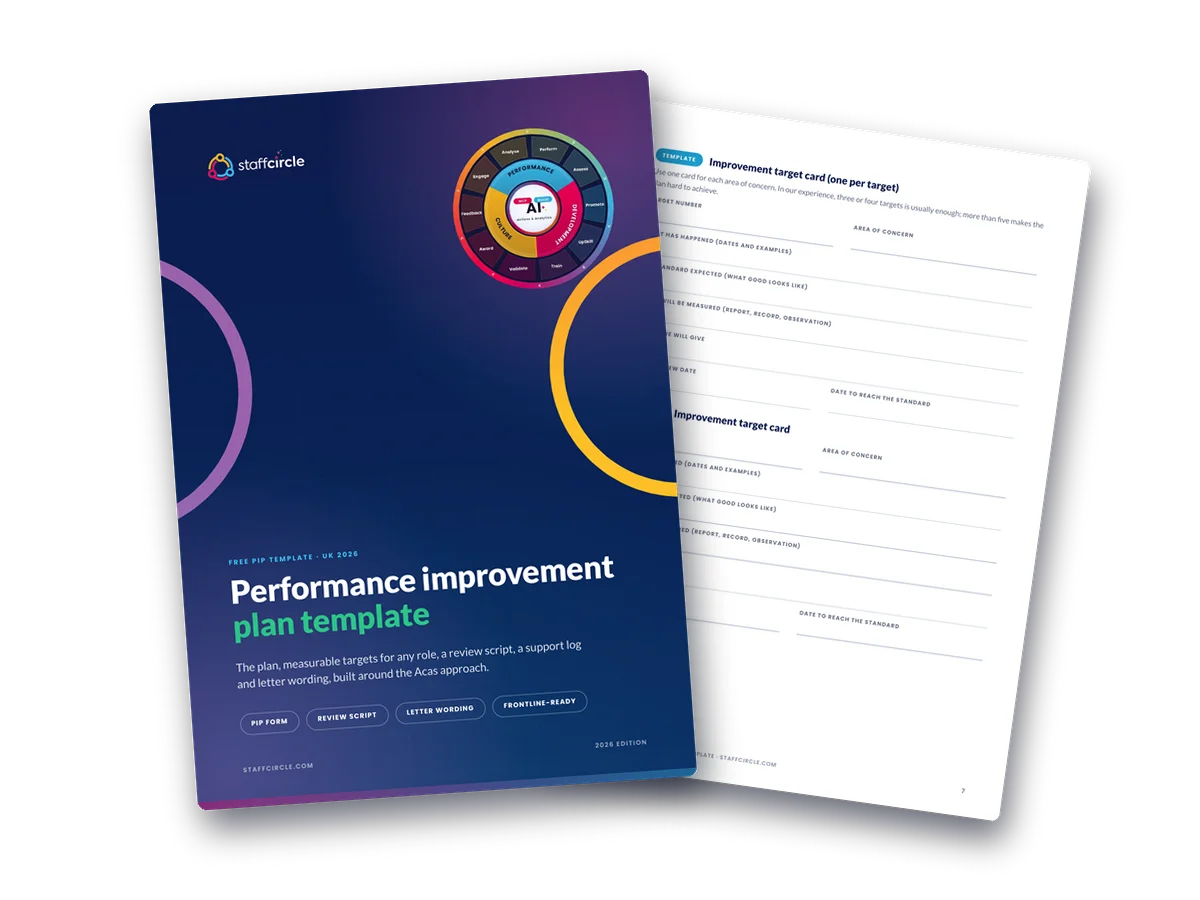
- A complete PIP form with targets, support, review dates and acknowledgement
- Measurable targets for seven roles that don’t have a sales number
- A review meeting script, progress grid and support log
- A frontline checklist for shift, site and field workers
- Letter wording to close, extend or move to a formal meeting
Get your free template
Fill in your details to get the PDF and the editable Word version. We’ll email you the PDF too.
We’ll only use your details to send the template and relevant StaffCircle content. See our privacy policy.
Trusted by teams at leading organisations


Six sections, ready to print or edit
Is a PIP the right tool?
Capability, conduct or health, the pre-issue checklist, and where the PIP sits in an Acas-aligned procedure.
Targets someone can hit
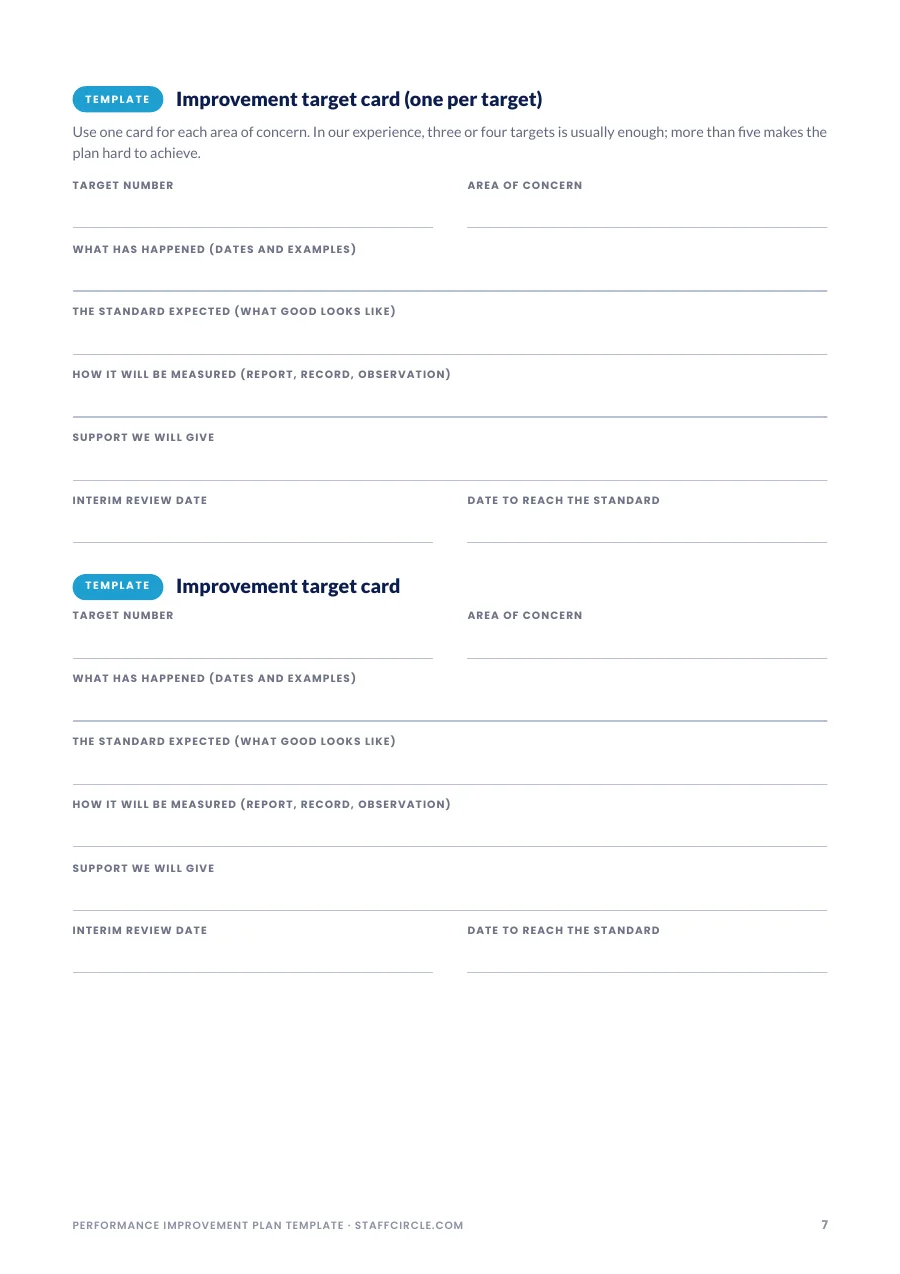
SMART targets for warehouse, care, retail, contact centre, engineering and finance roles, plus a target card.
The plan
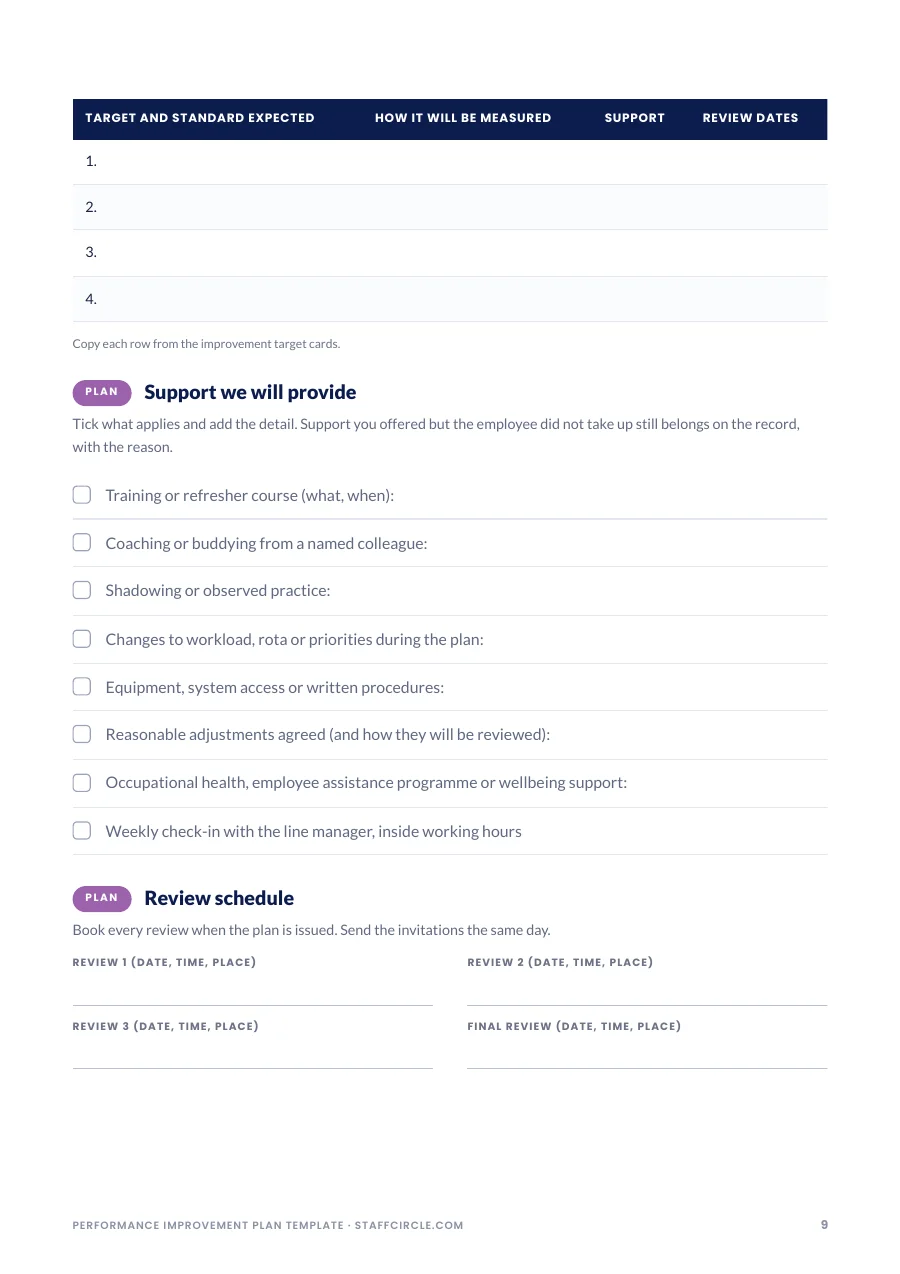
Details, concerns, targets, support, review schedule, consequences and an acknowledgement that isn’t a forced agreement.
Review meetings
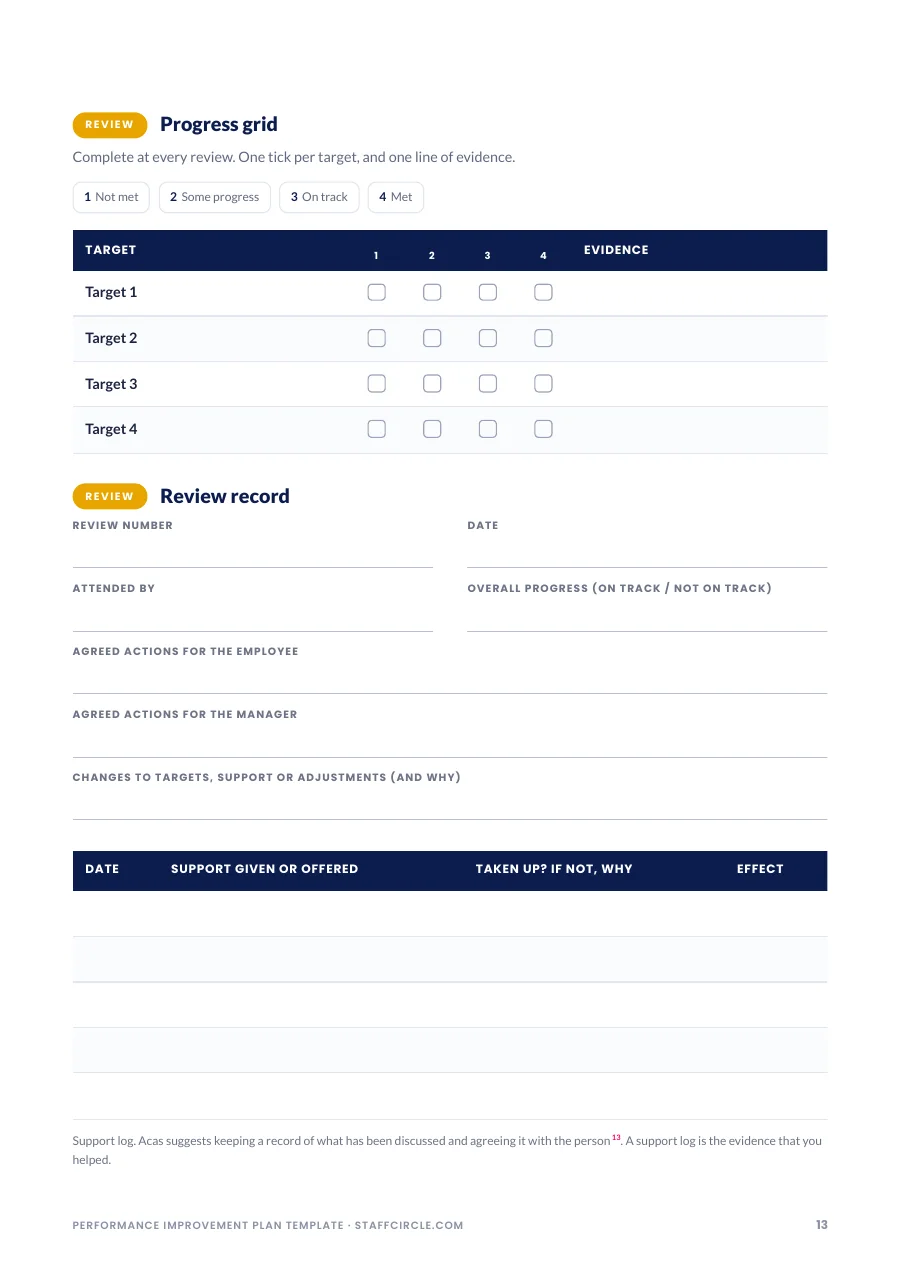
A review script with what to listen for, a progress grid, a review record and a support log.
Frontline PIPs
Rotas, private space, evidence across shifts and a supervisor input card.
Outcomes and letters
Three outcomes, the right to be accompanied, letter wording, appeals and records.
A performance improvement plan should be a genuine chance to improve
If you could not tell, at the start, what would count as success, the plan is not finished yet.
Search for a performance improvement plan template and much of what you find is either behind a form, written for US employers, or built for someone who answers emails for a living. UK employers need something different: a plan that follows the Acas approach, works for people on a rota or a site, and creates a fair record as you go.
Acas says a performance improvement plan should set out specific objectives for the employee, a reasonable timeline to meet them and any further support or training they need, and should make clear what will happen if the improvements are not made (Acas). That is a short list. Doing each part well is harder.
Start with the right diagnosis
A PIP is a capability tool. It is for someone who is trying but not yet meeting the standard. If the problem is that they won’t follow a reasonable instruction, that is conduct. If it could be linked to a health condition, disability or pregnancy, consider medical advice and reasonable adjustments first. For disabled employees, Acas lists medical evidence, for example an occupational health report, as evidence to gather (Acas).
Why process matters more from 2027
The Acas Code of Practice covers poor performance as well as misconduct, and a tribunal can increase an award by up to 25% where an employer unreasonably fails to follow it (TULRCA s207A). From 1 January 2027, most employees will be able to claim unfair dismissal after 6 months, instead of usually 2 years now (GOV.UK). More of your workforce will be covered, so a fair, written process matters for newer starters too.
What a good PIP includes
- Dated examples. What happened, when, and the standard expected instead.
- Measurable targets. Named reports, records or observations, agreed at the start.
- Real support. Training, buddying, adjustments, and a log showing it happened.
- Booked reviews. Every date in the diary on day one, inside working hours.
- Clear consequences. What happens if the standard is met, nearly met or not met.
- Acknowledgement, not agreement. A signature that confirms receipt, plus space for their comments.
Six steps to a fair plan
- Have the informal conversation first, and note it
- Check whether health, disability or pregnancy could be involved
- Write three or four measurable targets, with the evidence named
- Agree the support and book every review
- Review honestly, with a progress grid and a support log
- Close, extend or move to a formal meeting, in writing
The template includes all of this, with letter wording you can adapt, as a printable PDF and an editable Word file. For background, read our guides to how long a performance improvement plan should last, what happens at the end of a PIP and performance management for deskless teams. StaffCircle keeps objectives, one-to-ones and development plans in one place, so the record builds as you go.
Performance improvement plans: common questions
What should a performance improvement plan include?
Acas says a PIP should set out specific objectives, a reasonable timeline to meet them and any further support or training needed, and make clear what will happen if the improvements are not made. This template adds dated examples, how each target will be measured, booked review dates, a support log and space for the employee’s comments.
Is a performance improvement plan a disciplinary?
Not necessarily. The Acas Code says disciplinary situations include misconduct and poor performance, and that employers with a separate capability procedure may prefer to use it for performance. Acas describes a PIP as a step to consider if informal steps have not worked. Your own procedure decides whether a PIP is informal or formal, so say which on the plan.
How long should a PIP last?
There is no legal length. Acas says the timeline should be reasonable. Base it on how long it would realistically take to show the standard in that role, and on how often the evidence is produced.
Does an employee have the right to be accompanied at a PIP meeting?
The statutory right applies to disciplinary hearings, including meetings that could result in a formal warning. The Acas guide says informal discussions do not attract the right. You can still allow a companion, and a disabled employee may need one as a reasonable adjustment.
Can you dismiss someone after a PIP?
Capability is a potentially fair reason for dismissal, but the employer must act reasonably and follow a fair procedure. Acas says to support employees to improve first and that dismissal should be a last resort. A PIP is usually followed by formal stages and warnings before dismissal is considered.
What if the employee is off sick during the plan?
The Acas guide says you may arrange another meeting if an employee can’t attend because of illness. We suggest pausing the plan while they are off, checking whether a health condition is affecting performance, and taking advice if absence is long or repeated.
What if the employee refuses to sign the PIP?
No law requires a signature. Word the sign-off as an acknowledgement that the plan has been received and discussed, invite their comments, and note the date it was given to them if they decline to sign.
What changes in 2027?
GOV.UK says that from 1 January 2027 most employees will be able to claim unfair dismissal after 6 months, instead of usually 2 years. Acas has also consulted on a new disciplinary and grievance Code. Check acas.org.uk for the latest guidance.
Can I edit the template?
Yes. The download includes a printable PDF and an editable Word version, so you can add your own procedure stages, targets and company logo.
Run a fair PIP from first conversation to final review
The plan, target cards, a review script, a support log and letter wording, as PDF and Word.