Exit Interview Questions: 35 questions that get honest answers
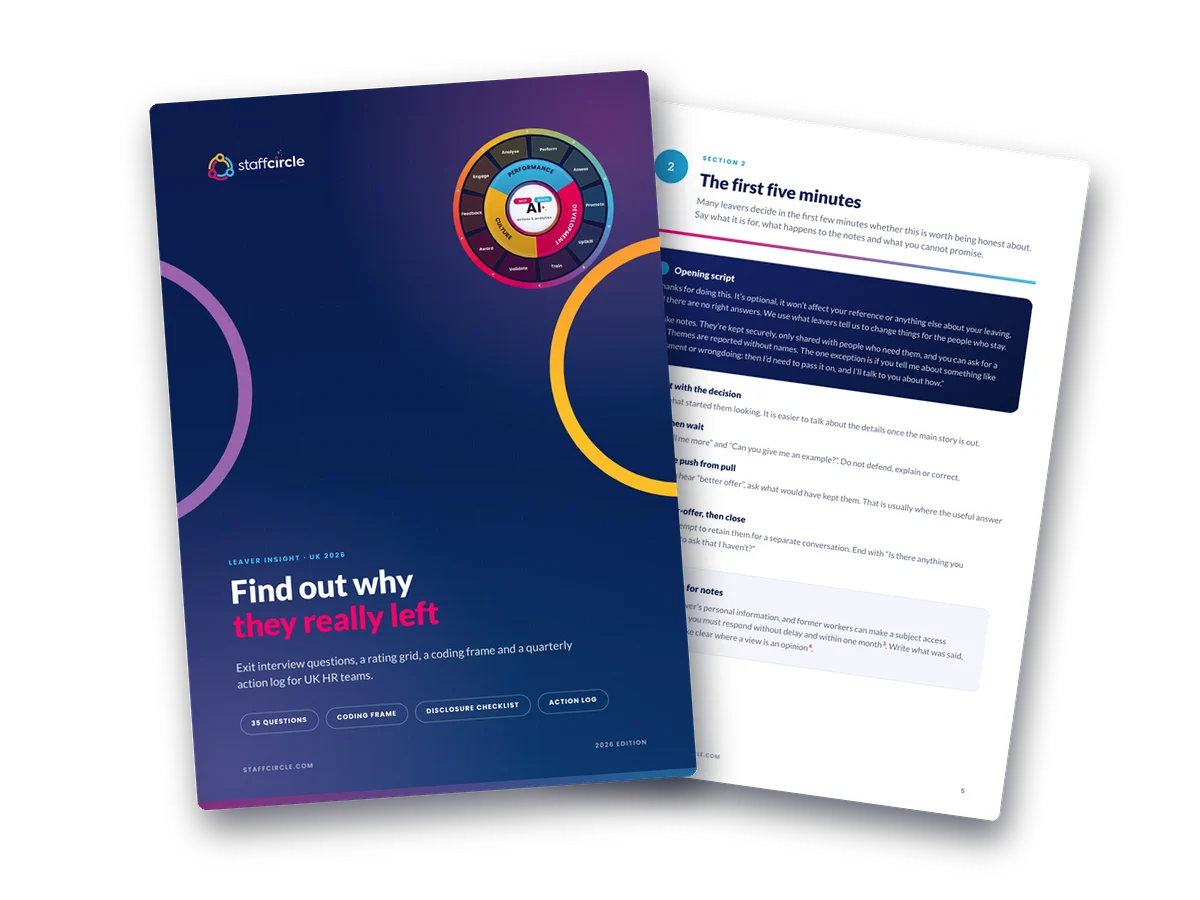
Too many exit interviews end with a form in a drawer. This template covers the whole job: when to hold the conversation and who should run it, 35 questions that get past “better opportunity”, a way to code answers so patterns show up across leavers, and a quarterly log that turns them into action.
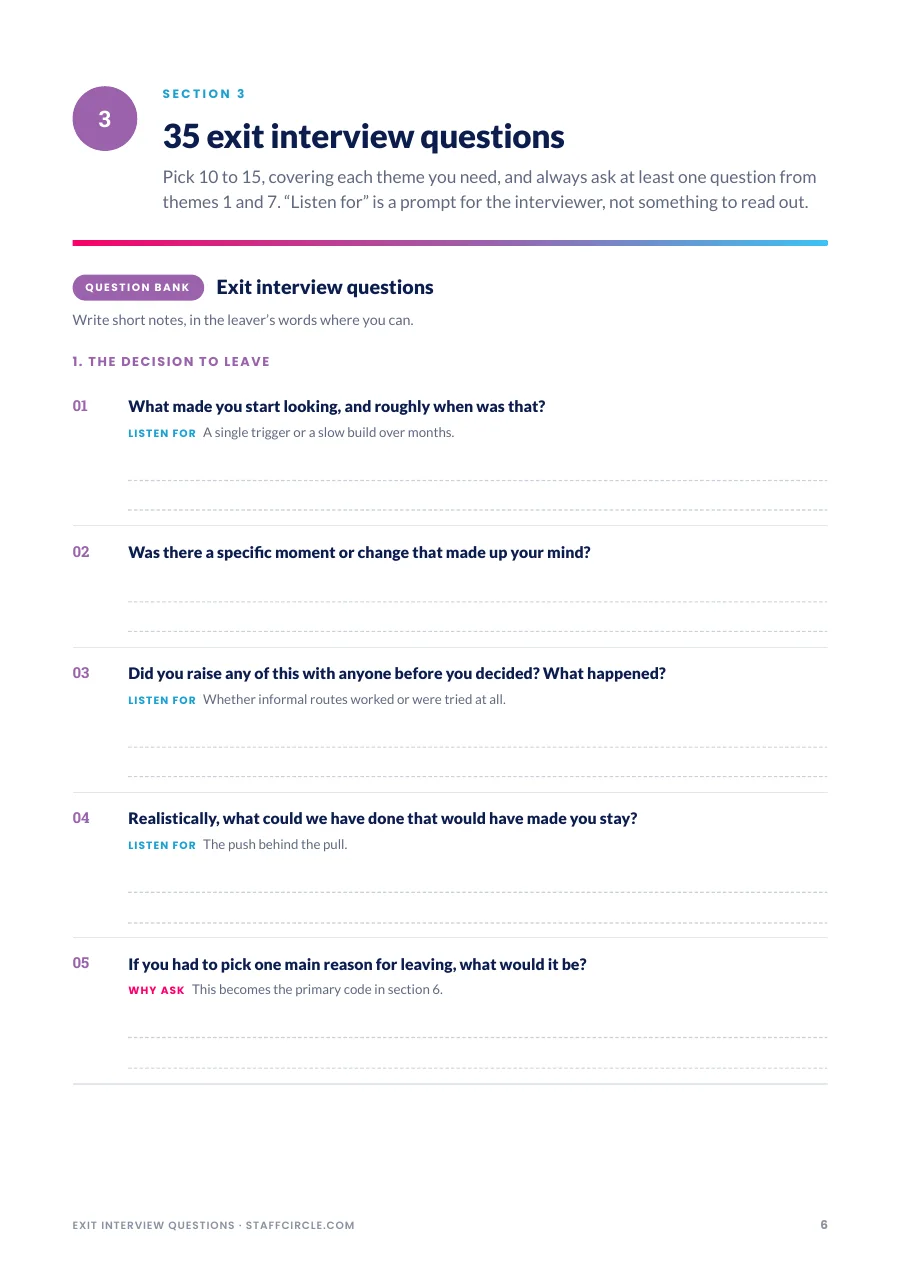
- 35 exit interview questions in seven themes, with what to listen for
- A set-up checklist and formats for shift, remote and no-notice leavers
- A leaver rating grid and exit interview record, ready to print
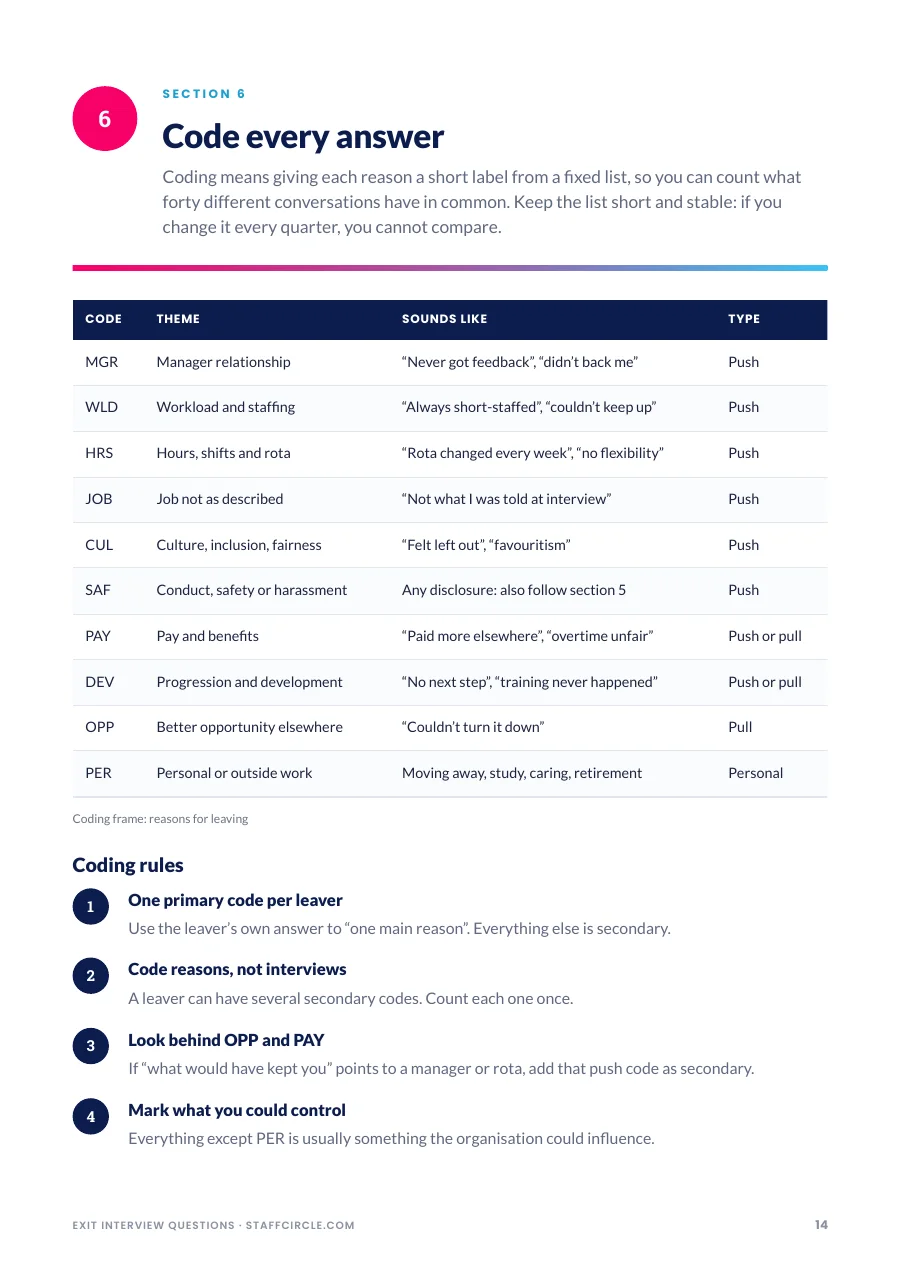
- A ten-code coding frame that separates push, pull and personal reasons
- What to do when a leaver discloses harassment, discrimination or wrongdoing
- A quarterly theme report and action log with sign-off
Get your free template
Fill in your details to get the PDF and the editable Word version. We’ll email you the PDF too.
We’ll only use your details to send the template and relevant StaffCircle content. See our privacy policy.
Trusted by teams at leading organisations


Ready to print or edit
Set it up
When to hold it, who should run it and the right format for each kind of leaver.
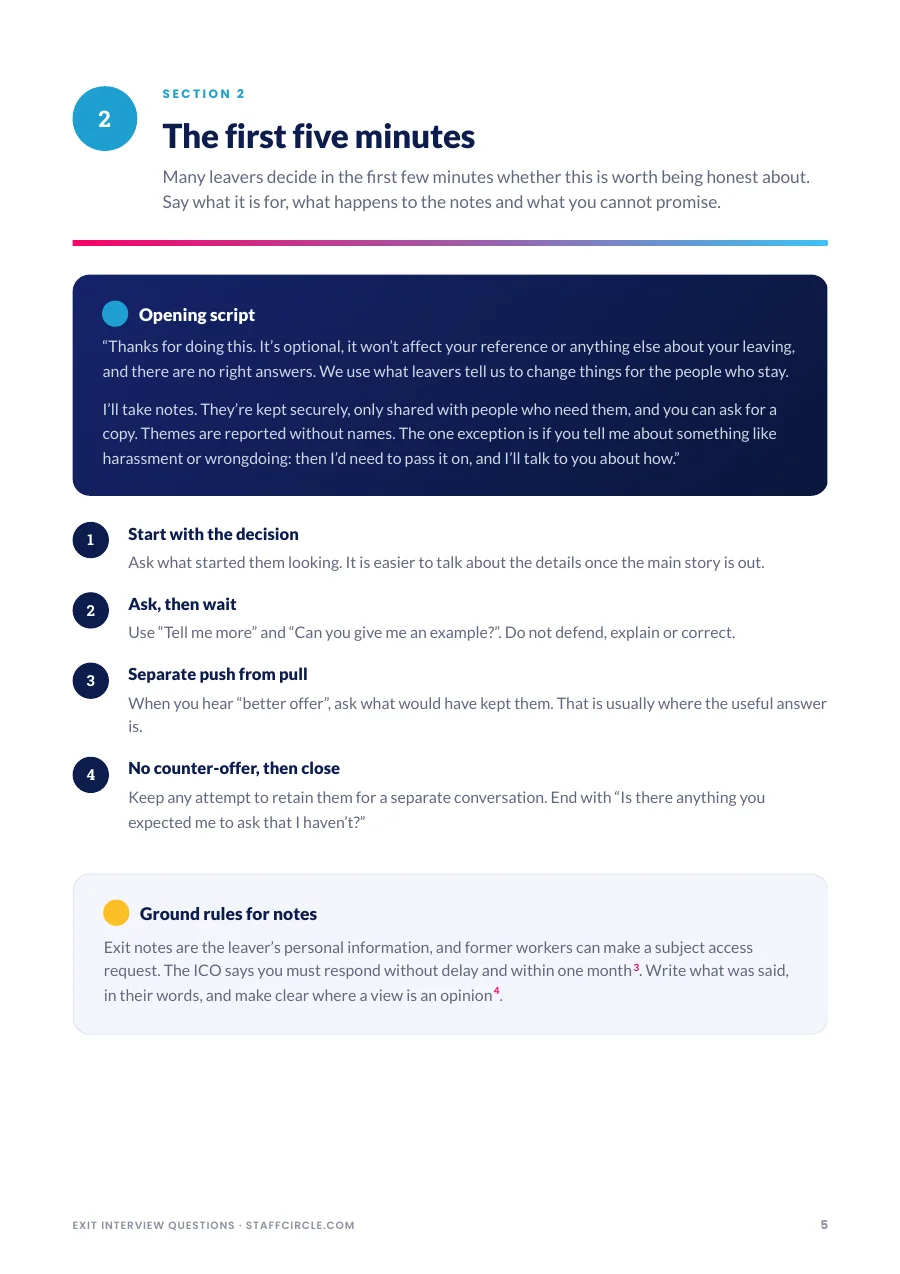
The first five minutes
An opening script and honest ground rules on confidentiality and notes.
35 exit interview questions
Seven themes, from the decision to leave to whether they would come back.
Score and record
A leaver rating grid and an exit interview record form.
Code every answer
A ten-code frame, coding rules and a leaver coding sheet so patterns are comparable.
From themes to action
A quarterly theme report, an action log and rules for small numbers.
An exit interview is only as good as what you do with the answers
One exit interview tells you about one person. Twenty, coded the same way, tell you what to fix. The questions matter less than the coding frame and the action log behind them.
Acas says that arranging an exit interview can be useful to understand why an employee is leaving, and that their reasons can help inform how you recruit or retain staff (Acas). That second part is where most exit interviews fall down. The conversation happens, a form is filled in, and nothing changes, because one leaver’s answer is an anecdote and nobody has added the answers up.
This template is built around that problem. It gives you exit interview questions, but also a rating grid every leaver completes, a short coding frame for free-text answers and a quarterly log that turns themes into actions with owners.
Getting honest answers
Many leavers give a polite reason: a better opportunity, more money, a shorter commute. These are often true, but rarely the whole story. Three things help you hear the rest:
- The right interviewer. If the line manager is part of the reason, they are the wrong person to ask. Use HR, a manager from another team or the manager’s own manager, and let the leaver choose if you can.
- The right moment. Late in the notice period works for most people, but not on the last afternoon. A short call or survey a few weeks after they leave can get franker answers from people who did not want to rock the boat.
- Separating push from pull. Ask why they are going and, separately, what would have kept them. “More pay” is a pull; the rota, the manager or the lack of a next step are often the push behind it.
Frontline and shift leavers
Many exit interview templates assume a desk, an email address and a meeting room. Shift and frontline workers often leave mid-rota, have no work email and are gone before HR is told. Plan for that: offer a short phone call or a mobile form, hold any interview during a paid shift rather than after a night shift, and have a fallback for people who leave without notice.
Coding the answers
Coding means giving every reason a short label from a fixed list, so the reasons from forty conversations can be counted. The template includes ten codes, from manager relationship and workload to personal reasons you cannot control, with rules for primary and secondary reasons. Count reasons, not interviews, and report counts alongside any percentage: “three of five leavers” is honest; “60% of leavers” on its own is not.
When it is more than feedback
Sometimes a leaver tells you about bullying, harassment or wrongdoing. That stops being feedback. Making an allegation that someone has broken the Equality Act is a protected act, and treating someone badly because of it is victimisation (Equality Act 2010, s.27). Employers must also take all reasonable steps to prevent sexual harassment, including by third parties (Acas). The template has a short escalation checklist for this moment.
Notes are personal data
Exit interview notes are the leaver’s personal information, and former workers can ask for a copy. The ICO says employers must respond to a subject access request without delay and within one month (ICO). Record opinions as opinions, keep named notes apart from anonymised themes, and set a retention period.
The template comes as a printable PDF and an editable Word file. It pairs with our stay interview questions, which ask the same things while you can still act, and our guide to calculating employee retention rate. For the wider picture, read how to improve employee retention.
Exit interviews: common questions
What is an exit interview?
An exit interview is a conversation, or sometimes a short survey, with an employee who is leaving, to find out why they are going and what their experience of working for you was like, so you can improve retention and recruitment.
Are exit interviews mandatory in the UK?
No. UK law does not require employers to hold exit interviews or employees to take part. Make it an offer, not a condition, and do not let a refusal affect the leaver’s reference or final pay.
When should an exit interview take place?
Late in the notice period usually works best, but not on the last day. A short follow-up call or survey a few weeks after someone leaves can give franker answers, especially from people who did not want to cause problems while still employed.
Who should conduct an exit interview?
Usually someone other than the leaver’s line manager, such as HR, another manager or the manager’s own manager, because the manager may be part of the reason for leaving. Where possible, let the leaver choose.
How many questions should an exit interview have?
Choose 10 to 15 from the 35 in this template, covering each theme you need, and use the rating grid so every leaver answers the same core items. A focused 30 to 45 minute conversation gets better answers than a rushed long list.
Are exit interviews confidential?
Not completely. Notes are the leaver’s personal information and they can ask to see them through a subject access request, which the ICO says must be answered within one month. You may also need to act on what you hear, such as a harassment disclosure. Promise discretion, not secrecy.
What should you not ask in an exit interview?
Avoid questions about protected characteristics such as age, pregnancy, disability or religion, questions that pressure the leaver to name or gossip about colleagues, and anything that turns into a counter-offer pitch. Ask everyone the same open questions and let them choose what to share.
What if a leaver reports harassment or wrongdoing?
Stop treating it as feedback. Thank them, record what they said in their own words, explain it needs to go through a formal route, and pass it to the right person the same day. Make sure nothing about their reference or final pay changes because they raised it.
How do you analyse exit interview data?
Give every reason a code from a fixed list, separate the main reason from secondary ones, mark whether it was something you could control, and count codes each quarter. Report counts as well as percentages, and combine periods or teams when numbers are small.
Turn leavers into lessons
35 exit interview questions, a leaver rating grid, a coding frame and a quarterly action log, as PDF and Word.