Competency Framework Template: with behavioural indicators at four levels
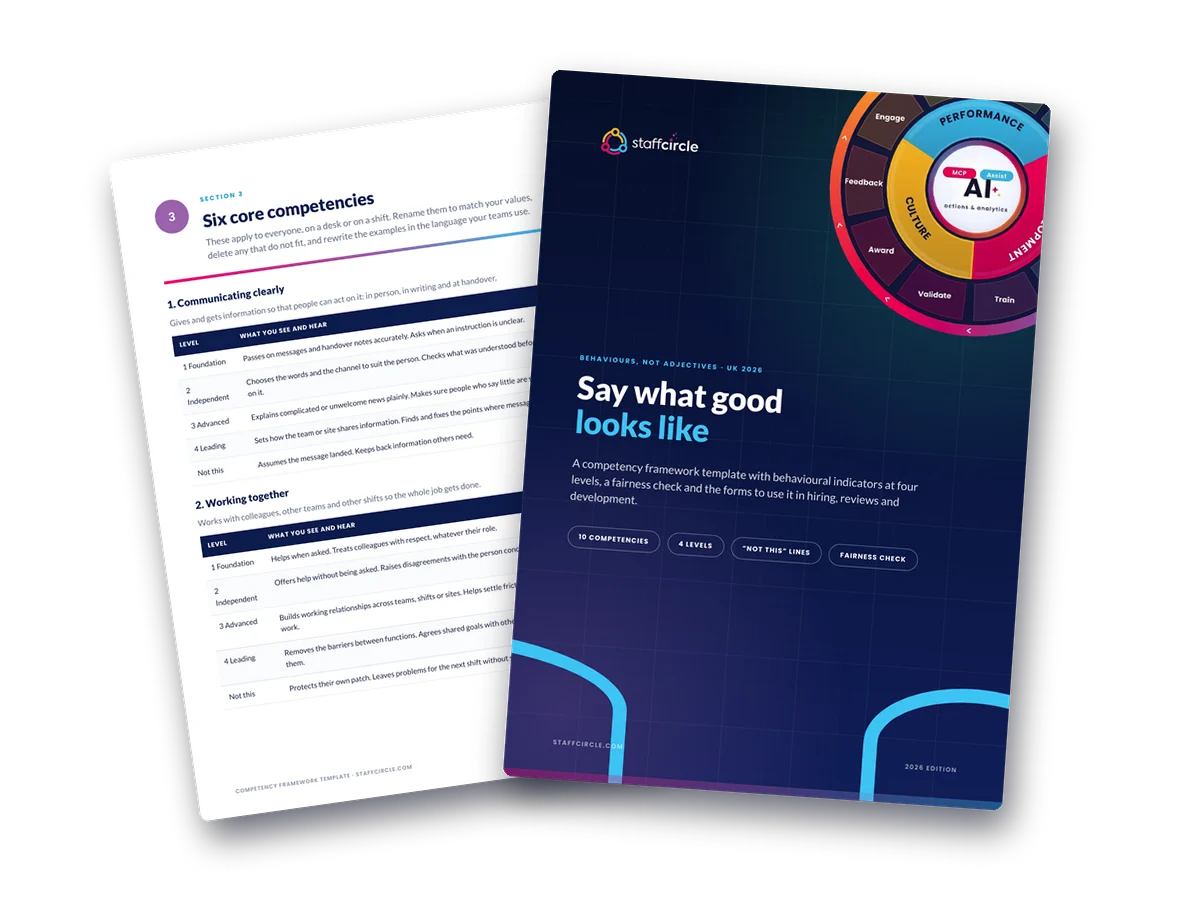
A competency framework only works if people can picture what each line means. This template gives you core, leadership and technical tiers, four levels defined once, and drafted behavioural indicators for ten competencies, with the forms to use them in hiring, reviews and development.
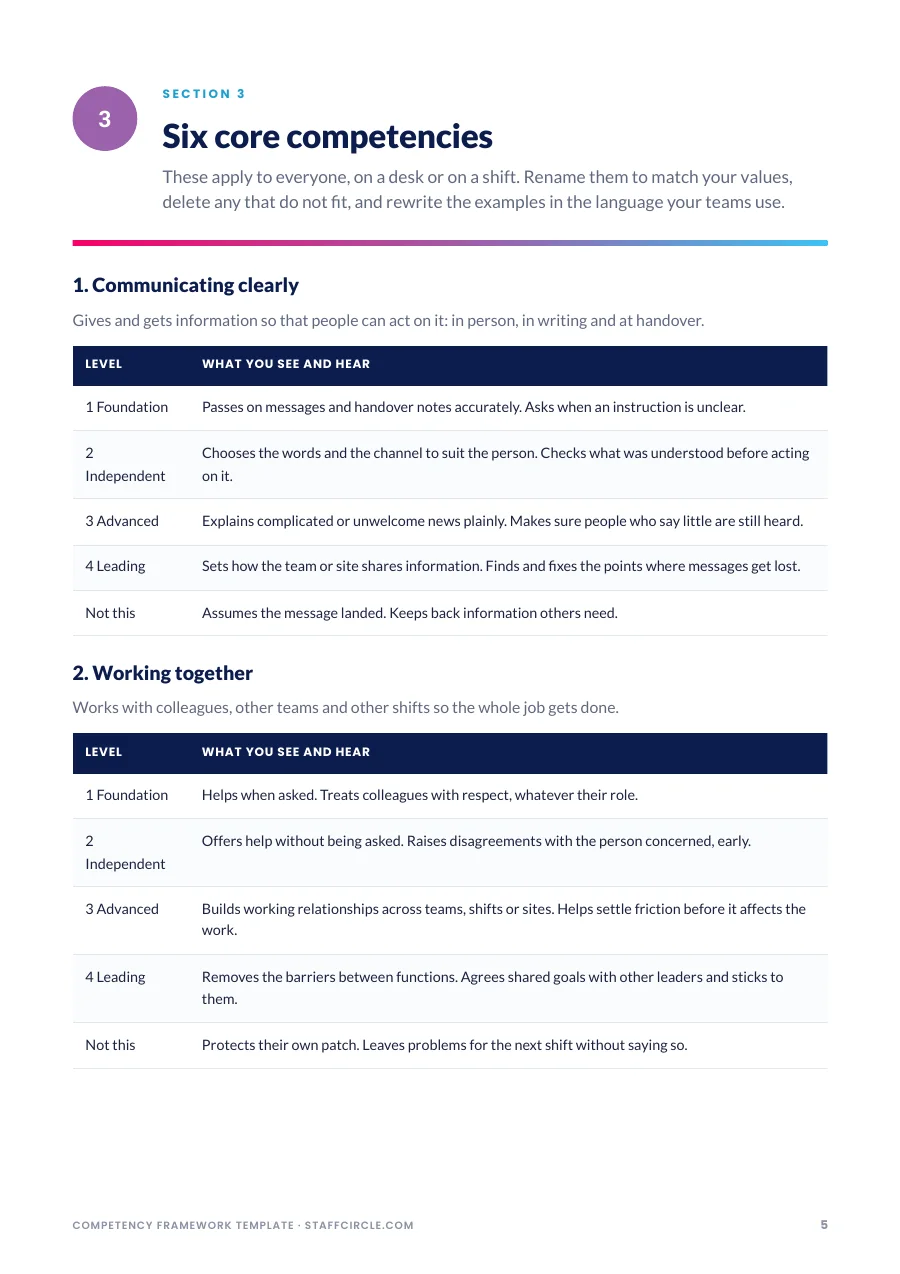
- Six core and four leadership competencies, each with indicators at four levels
- A “not this” line for every competency, so the standard is clear from both sides
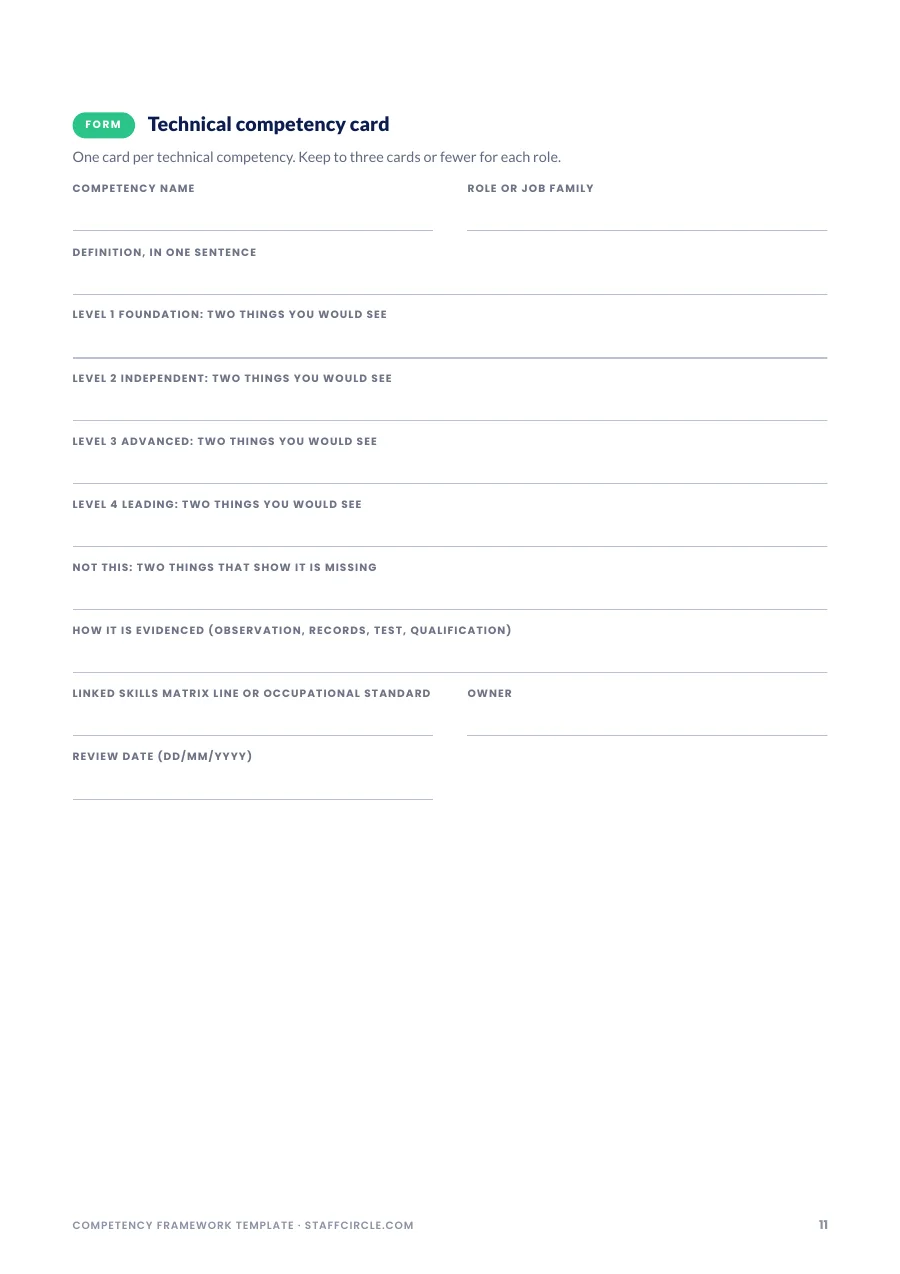
- A blank technical competency card with a worked example
- An indicator quality check and an Equality Act fairness check
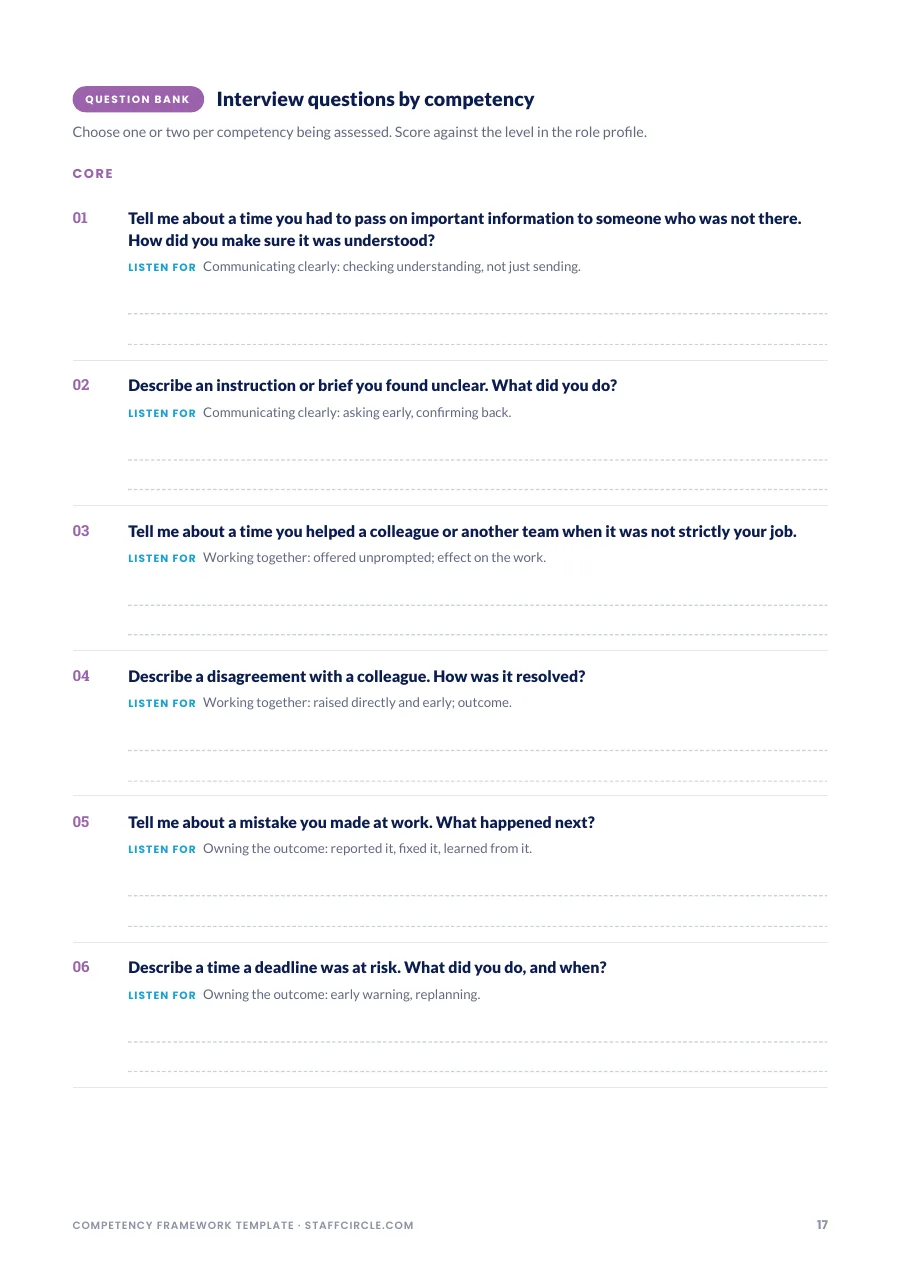
- 20 interview questions mapped to the competencies
- A role profile, a review grid with a “not observed” option and a launch sign-off
Get your free template
Fill in your details to get the PDF and the editable Word version. We’ll email you the PDF too.
We’ll only use your details to send the template and relevant StaffCircle content. See our privacy policy.
Trusted by teams at leading organisations


A framework you can edit, not just read
The shape of a framework
Three tiers, four levels and how many competencies each role should carry.
Ten competencies, four levels
Drafted behavioural indicators for six core and four leadership competencies.
Technical competencies
A blank competency card and a worked example for role-specific skills.
Make it yours
From values to indicators, with a quality check and help for roles you rarely see.
The fairness check
What the Equality Act means for behavioural criteria, in eight checks.
Put it to work
A role profile, interview questions, a review grid and a launch checklist.
A framework people can picture is a framework people use
The test for every line in a competency framework is the same: could two managers watch the same shift and agree whether they saw it?
The CIPD says competency frameworks, when done well, “can increase clarity around performance expectations and establish a clear link between individual and organisational performance” (CIPD). The words “when done well” matter: a framework that reads as a list of adjectives is hard to hire or review against.
This competency framework template is built to be used. It gives you a structure (core, leadership and technical tiers), four levels defined once, behavioural indicators already drafted for ten competencies, and the forms to use them in hiring, reviews and development.
What a competency framework template should contain
- A small set of competencies. The Greater London Authority’s framework gives each role between five and eight behavioural competencies (GLA). The full framework is a menu; each role takes a selection.
- Levels with anchors. “Basic” and “advanced” mean nothing until they are described. This template defines four levels by supervision and scope, and they are not tied to job grades.
- Behavioural indicators. Two short examples per level of what you would see and hear, plus a “not this” line.
- A way to use it. A role profile, interview questions, a review grid and a development table that all point at the same competencies.
Writing behavioural indicators that hold up
The Civil Service describes behaviours as “the actions and activities that people do which result in effective performance in a job”, and says that because they can be observed and measured they can help predict performance (GOV.UK). So the test for an indicator is simple: could two managers watch the same shift and agree whether they saw it?
Start each indicator with a verb, describe one behaviour, and keep personality out of it. “Checks what was understood before acting on it” can be observed. “Is a confident communicator” cannot, and it is a description of style. Our post on behavioural indicators has more examples.
Check it for fairness before launch
Once you hire, rate or promote against a competency, it is a criterion you are applying to people. Under the Equality Act 2010, a criterion that puts people who share a protected characteristic at a particular disadvantage is indirect discrimination unless the employer can show it is a proportionate means of achieving a legitimate aim (Equality Act 2010, s.19). The EHRC Employment Code warns against requirements that are unnecessary or seldom used, and gives the example of requiring staff to be “confident in dealing with external clients” in a job with no client contact (EHRC).
The template includes an eight-point fairness check for this: is each competency needed for the role, can it be shown in more than one way, and have managers been told to consider reasonable adjustments?
Frontline and shift roles
The vendor templates we reviewed while researching this one were built around office job families. This template includes working safely and to standard as a core competency, uses handovers and shifts in its examples, and has a short guide to gathering evidence when a manager rarely sees the work: night shifts, lone workers, multi-site teams. The review grid has a “not observed” option so a gap in evidence does not become a low rating.
Using it in hiring, reviews and development
- Hiring. Choose three to five competencies from the role profile and ask every candidate the same questions. Acas says it is a good idea to ask each applicant the same questions where possible (Acas). The template has 20 questions mapped to the ten competencies; there are more in our guide to competency-based questions.
- Reviews. Acas lists demonstrating the right behaviours among the things a review might be based on (Acas). Rate against the level the role needs and write down the evidence.
- Development. Use the indicators one level up as the description of what better looks like, and pick one or two competencies to work on.
The technical tier is a blank card with a worked example, because technical competencies differ for every job family. If you track role-specific skills separately, pair it with our skills matrix template. For the full build process, read how to build a competency framework.
The template comes as a printable PDF and an editable Word file, so you can rename the competencies to match your values and rewrite the examples in your own words.
Competency frameworks: common questions
What is a competency framework?
A competency framework is an agreed set of competencies, each with a short definition and examples of the behaviour expected at different levels, that an organisation uses to recruit, review and develop people against the same standard.
What should a competency framework template include?
A short list of competencies grouped into tiers, a definition for each, a set of levels that are described rather than just labelled, behavioural indicators for each level, and the forms to apply it: a role profile, interview questions and a review grid.
How many competencies should a framework have?
We have not found a legal or official number. As one public example, the Greater London Authority’s framework gives each role between five and eight behavioural competencies. This template offers ten behavioural competencies as a menu and suggests each role selects from them.
What are behavioural indicators?
Behavioural indicators are short examples of what someone does or says when they are showing a competency at a given level. They are illustrations, not a checklist: nobody is expected to show every one.
How many levels should a competency framework have?
Published frameworks vary. The NHS Healthcare Leadership Model uses a four-part scale and the College of Policing framework uses three levels. This template uses four levels, defined by supervision and scope, so the same scale can run from a new starter to a senior leader.
What is the difference between skills and competencies?
Usage varies, so define your own terms. In this template, core and leadership competencies describe behaviours, meaning how work is done, and technical competencies describe the knowledge and skills needed for a particular role.
Can a competency framework be discriminatory?
It can be if a competency or indicator puts people who share a protected characteristic at a particular disadvantage and cannot be justified for the role. Include only what each role needs, allow more than one way to show a behaviour and consider reasonable adjustments for disabled people.
Can you use a competency framework in interviews and performance reviews?
Yes. Select a few competencies from the role profile, ask every candidate the same questions about them, and in reviews rate each one against the level the role needs with written evidence.
How often should a competency framework be reviewed?
We have not found a UK law or official guidance that sets an interval. This template suggests reviewing the framework and role profiles each year, and sooner when roles, values or structure change.
Get the competency framework template
Download the PDF and the editable Word version, then rename the competencies and rewrite the indicators to fit your organisation.