Skills Matrix Template: Build It and Keep It Current
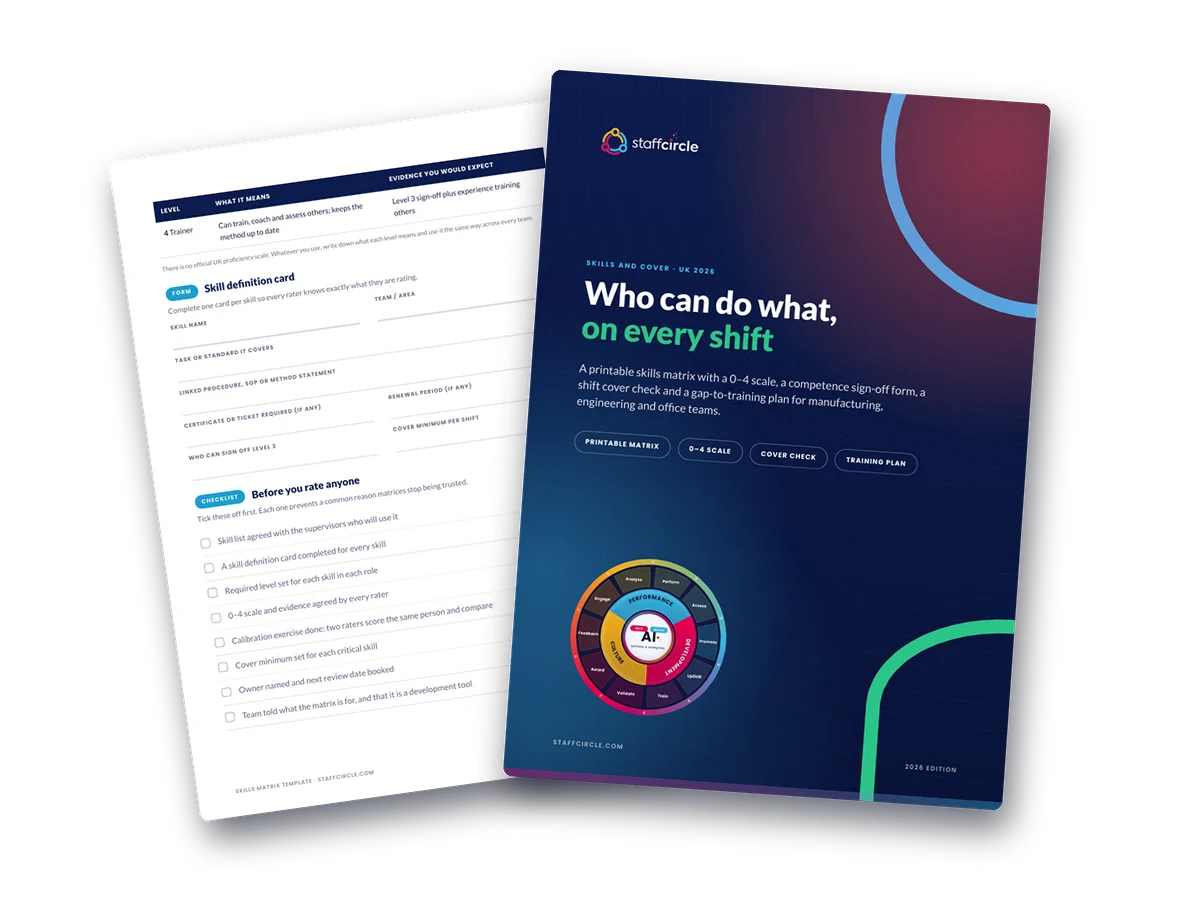
Many skills matrix templates are just a blank grid. This one tells you what each level means, what evidence backs a rating, and how to spot the skill that only one person on a shift can do.
- A printable skills matrix with required levels and a cover count for every skill
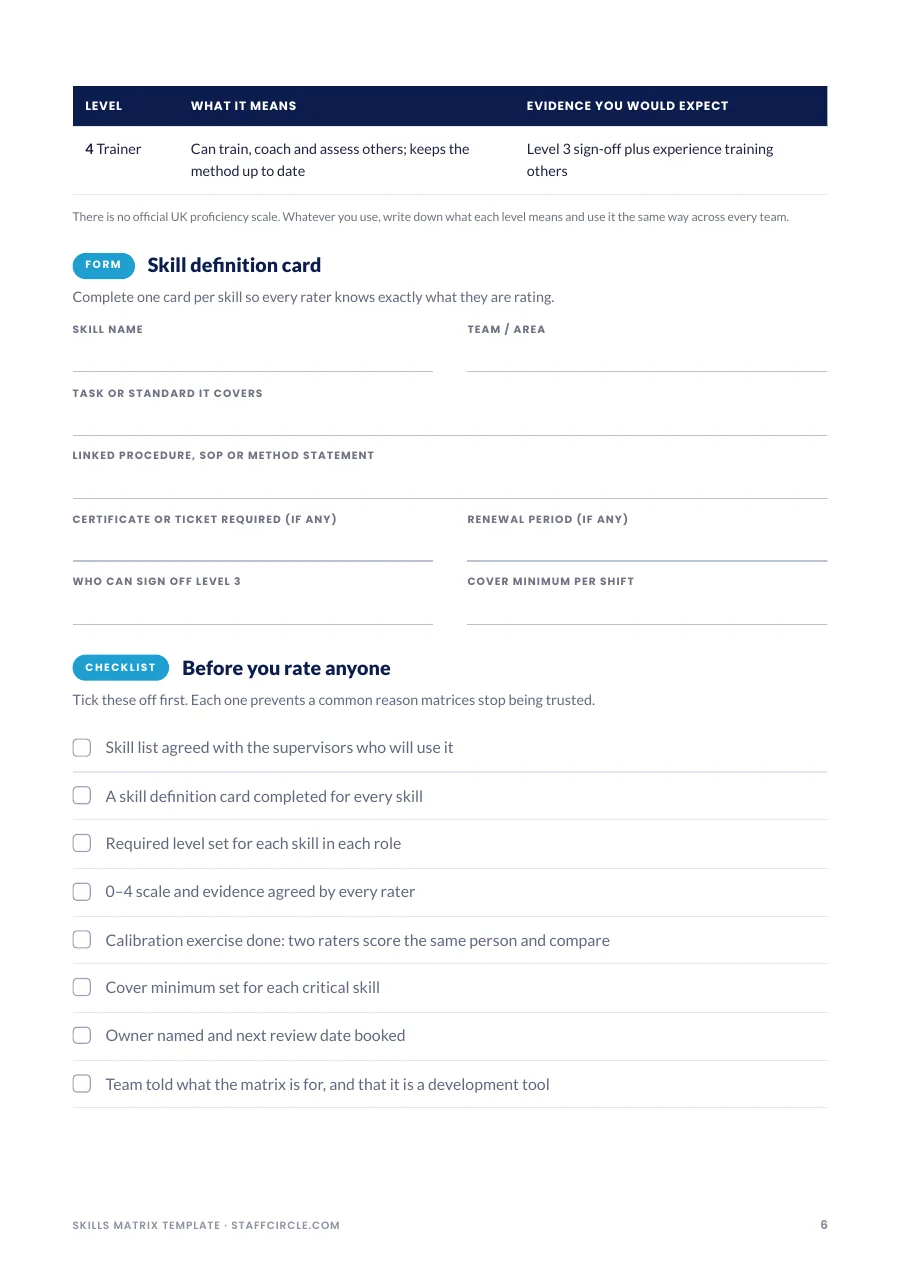
- A 0–4 proficiency scale with the evidence each level needs
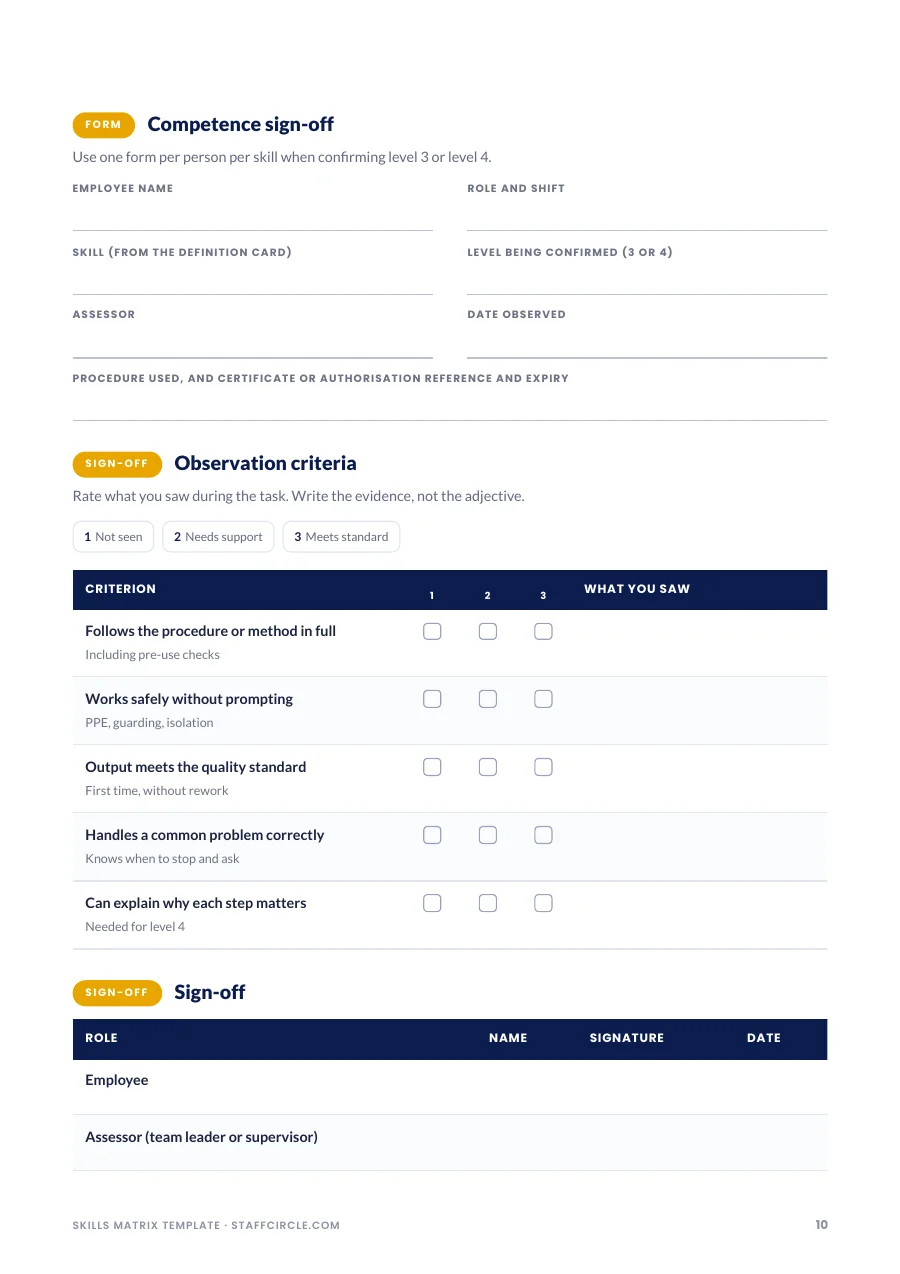
- A competence sign-off form for observed tasks
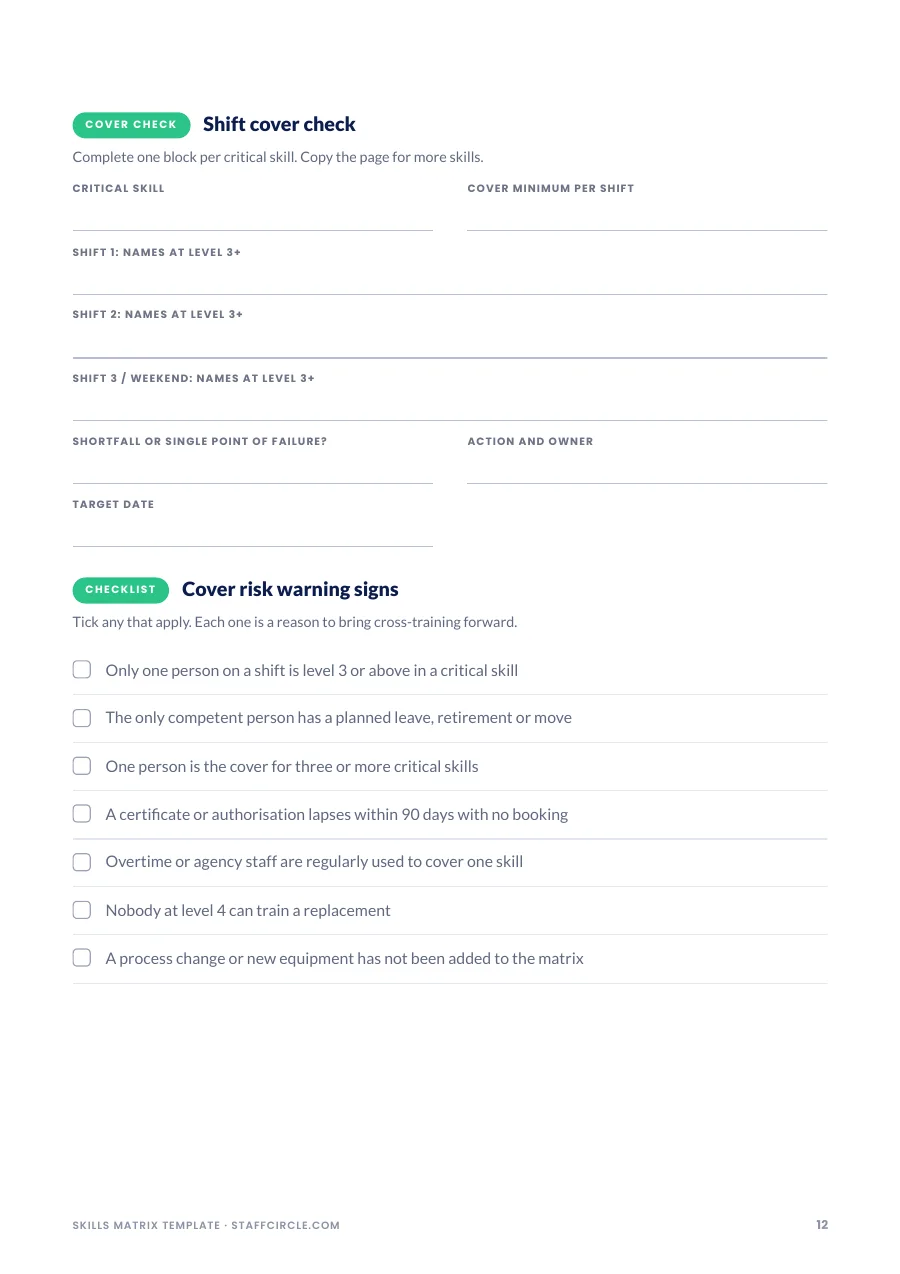
- A shift cover check to find single points of failure
- A gap-to-training plan and a checklist for keeping the matrix current
Get your free template
Fill in your details to get the PDF and the editable Word version. We’ll email you the PDF too.
We’ll only use your details to send the template and relevant StaffCircle content. See our privacy policy.
Trusted by teams at leading organisations


Skills gaps are common, and measurable
Six sections, ready to print or edit
What a skills matrix is for
Skills, training and competency matrices compared, and the UK training duties a matrix helps you evidence.
Build it in five steps
Choosing the skills, setting required levels and a 0–4 scale that means the same thing to every rater.
The printable matrix
A blank grid with required levels and cover counts, plus example skill sets for manufacturing, engineering and office teams.
Evidence every rating
What proof each level needs and a competence sign-off form for observed tasks.
Find single points of failure
A shift-by-shift cover check and the warning signs of a skill only one person holds.
Close gaps and keep it current
A gap-to-training plan, update triggers and the data protection basics.
A skills matrix is only useful if you can trust it
The most useful question a skills matrix answers is not who is good at what. It is: if this person is off tomorrow, who else can do the job safely?
Search for a skills matrix template and you will mostly find a spreadsheet: names down the side, skills across the top, a number in each box. It looks finished. The trouble starts when two supervisors use the same number to mean different things, nobody can say where a rating came from, and the grid was last updated when someone built it.
This template is designed to avoid those three problems. It gives you a scale where each level is tied to evidence, a sign-off form so ratings come from observation rather than opinion, and a cover check that shows which skills depend on one person.
Is a skills matrix a legal requirement?
No UK law requires a document called a skills matrix. But employers must provide the information, instruction, training and supervision needed to keep their employees safe at work, so far as is reasonably practicable (Health and Safety at Work etc. Act 1974, section 2). When giving people tasks, employers must take into account their capabilities as regards health and safety, and provide training when people are recruited and when a transfer, new responsibilities, new equipment, new technology or a new system of work exposes them to new or increased risks (Management of Health and Safety at Work Regulations 1999, regulation 13). Anyone who uses work equipment must have received adequate training (PUWER 1998, regulation 9). A well-kept matrix is one of the simplest ways to show you know who is trained and capable for what.
What makes a matrix trustworthy
- A scale tied to evidence. “Competent” should mean the person has been observed doing the task to the standard and signed off, not that their manager thinks they are fine.
- Required levels for each role. A gap is the difference between the level a role needs and the level the person holds. Without the target, you cannot see the gap.
- Cover counted by shift. HSE asks employers whether they have provided enough competent cover for absences, and what would happen if a key member of staff suddenly left (HSE, HSG65). A matrix that counts competent people per skill per shift answers both.
- Update triggers, not just a calendar. New starters, transfers, new equipment and new processes are all points at which training is required, so they should be points at which the matrix changes too.
How to use the template
- List the skills each role needs, and the level it needs them at.
- Agree the 0–4 scale with every supervisor who will rate people.
- Rate people from evidence, using the sign-off form for anything safety-critical.
- Count competent people per skill per shift and mark any skill with fewer than two.
- Turn the gaps into a training plan with names and dates, then update the matrix as training is completed.
The government’s Employer Skills Survey found that 12% of employers had at least one member of staff who was not fully proficient in their job (Employer Skills Survey 2024). A matrix will not close those gaps on its own, but it makes them visible and gives each one an owner.
If you want to go further, read our guides to running a skills gap analysis and building a mandatory training matrix, or see how StaffCircle handles skills and development for office and frontline teams.
Skills matrix questions, answered
What is a skills matrix?
A skills matrix is a grid that shows which skills each person in a team holds and at what level, usually with people in rows and skills in columns. Adding the level each role requires turns it into a tool for spotting gaps and planning training.
What is the difference between a skills matrix and a training matrix?
There is no official definition, but a skills matrix usually records how well someone can do something, while a training matrix records which courses or certificates they have completed and when they expire. Many teams combine the two, which is what this template does.
Is a skills matrix a legal requirement in the UK?
No law requires a document called a skills matrix. Employers do have legal duties to provide necessary training and supervision, to take people’s capabilities into account when giving them tasks, and to train anyone who uses work equipment. A matrix is a practical way to show you are meeting those duties.
What levels should a skills matrix use?
There is no official UK scale. Many templates use four or five levels, with the top level meaning the person can train others. This template uses 0 to 4, from not trained to can train and assess others, and ties each level to the evidence you would expect to see.
How often should a skills matrix be updated?
Update it whenever something changes: a new starter, a leaver, a transfer, completed training, an expired certificate, new equipment or a new process. Then review the whole matrix on a fixed cycle, such as quarterly, so nothing drifts.
How many people should be competent in each skill?
This template suggests at least two competent people per critical skill on every shift, so one absence does not stop the work. Set your own minimum for each skill based on the risk and the shift pattern.
Can employees see their skills matrix ratings?
Training records are among the employment records the ICO expects employers to keep accurate and up to date, and workers can make a subject access request for their personal information, which you must answer without delay and within one month (extendable by up to two months for complex or numerous requests). It is simpler and fairer to share ratings openly as part of development conversations.
Should employees rate themselves?
Self-assessment is a useful starting point and a good way to open a conversation, but ratings for safety-critical tasks should be confirmed by someone who has observed the work. The sign-off form in this template is designed for that.
Download the free skills matrix template
Get the printable PDF and the editable Word version, with the matrix, the 0–4 scale, the sign-off form, the cover check and the training plan.