What does OKR stand for?
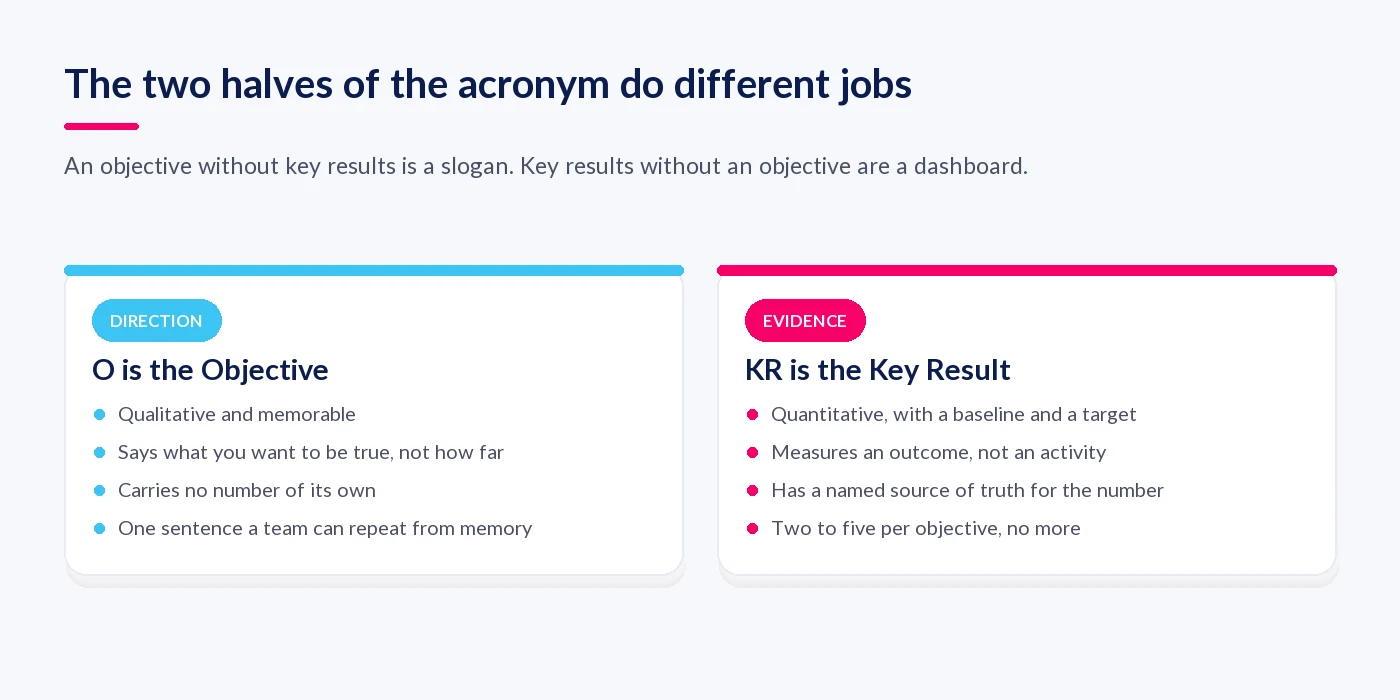
The acronym OKR stands for Objectives and Key Results. The Objective is the qualitative outcome you are aiming at and carries no number of its own; each Key Result is a measure that moves from a stated baseline to a stated target, and two to five of them sit under one objective.
Key facts
- O is the Objective: qualitative, memorable, and carries no number.
- KR is the Key Result: a number with a baseline and a target.
- Two to five key results sit under a single objective.
- Key results measure outcomes, never tasks completed.
- Peter Drucker's Management by Objectives is the format's direct ancestor.
What is OKR?
OKR is a goal-setting method built around that two-part structure. A team agrees a small number of objectives for a cycle — normally a quarter — attaches measurable key results to each one, publishes them so other teams can see them, and scores them at the end of the cycle on a 0 to 1.0 scale. It is used at company, team and sometimes individual level, and it replaces the single annual goal list with something short enough to be revisited every week.
What makes it a method rather than a template is the discipline of scoring. A quarter that ends without a score is a plan, not an OKR cycle. Our explainer on what an OKR is, with a worked example and the scoring scale walks through a full set with real numbers.
What does OKR mean?
In plain English, OKR means: here is what we are trying to achieve, and here are the numbers that will tell us whether we did. The objective supplies the meaning — the reason the work matters, phrased so somebody can repeat it without reading it off a slide. The key results supply the proof, and nothing else in the OKR does that job.
When people say their business runs OKRs, they usually mean four things are in place: a short list of company priorities, team objectives that ladder up to them, key results with owners and numbers, and a fixed rhythm of check-ins and end-of-cycle scores. Any one of those missing and the acronym is being used loosely.
What is the difference between an Objective and a Key Result?
An objective states the outcome; a key result measures it. The objective is qualitative, time-bound by the cycle it belongs to, and written to be motivating — Google's re:Work guide to setting goals with OKRs describes objectives as ambitious enough to feel slightly uncomfortable, and key results as measurable and easy to grade. The two halves fail in opposite directions: an objective with no key results is a slogan, and key results with no objective are just a dashboard.
| Component | Job it does | Test it must pass | Example |
|---|---|---|---|
| Objective | Names the outcome and gives the work its direction | Can somebody repeat it from memory, and does it contain no number? | Make delivery dates something customers can trust |
| Key result 1 | Measures the primary outcome | Baseline, target and a named source | On-time delivery from 82% to 95% (ERP despatch report) |
| Key result 2 | Measures the severity of the remaining failures | Baseline, target and a named source | Average days late on missed orders from 6.2 to 2.0 (ERP despatch report) |
| Key result 3 | Guards against gaming the first two | Baseline, target and a named source | Rescheduled jobs per month from 48 to 15 (planning system) |
That third key result is the one most teams leave out. Any single measure can be moved the wrong way — you can protect on-time delivery by quietly rescheduling every job that looks at risk — so a well-formed OKR usually includes one measure that makes cheating visible.
What does a correctly formed OKR look like?
A correctly formed OKR reads as one qualitative sentence followed by two to five numbers, each with a baseline, a target and a source. Most OKRs that fail in their first quarter fail on the wording rather than the ambition, and the failures repeat. The table below sets a correct pair against the five malformed patterns we see most often, and names what breaks in each.
| Written as | Verdict | What breaks |
|---|---|---|
| O: Become the supplier our sector trusts most. KR: NPS from 31 to 45; escalations from 22 to 8 per month; repeat order rate from 54% to 65% | Correct | Nothing. Qualitative objective, three outcome measures, each with a baseline and a target. |
| O: Increase revenue by 20%. KR: Close £2m of new business | Malformed | The number is in the objective, so the objective is really a key result. It leaves the key results with nothing to add. |
| O: Improve onboarding. KR: Launch the new onboarding portal by 30 September | Malformed | The key result is a task with a yes/no answer. You can ship the portal and change nothing about onboarding. |
| O: Grow faster. KR: Work harder on pipeline generation | Malformed | Neither half is measurable, so there is nothing to score in week 13. |
| O: Make support the reason customers renew. KR: Reduce first response time; improve customer satisfaction | Malformed | The key results have direction but no baseline or target, so any improvement at all scores full marks. |
| O: Reach 95% on-time review completion. KR: 95% of reviews completed on time | Malformed | The objective and the key result are the same sentence. The objective adds no meaning the metric did not already carry. |
The pattern behind all five is the same: something qualitative has been made numeric, or something numeric has been left vague. If you want a scoring method that survives contact with a real quarter, our guide to seven ways to score performance objectives covers the alternatives, and what SMART objectives are, with examples is the best test to apply to an individual key result once it is written.
If those quarterly scores feed into your appraisal conversations, The Ultimate Guide to Performance Reviews covers how to use goal evidence in a review without turning the score into the rating.
Where did the OKR acronym come from?
The lineage is documented and worth knowing, because it explains the shape of the format. Peter Drucker introduced Management by Objectives in the 1950s. Andy Grove, then at Intel, added measurable key results and taught the resulting system inside the company. John Doerr learned it in Grove's Intel seminars and introduced the philosophy to Google's founders in 1999, according to the OKR origin story published by Doerr's What Matters.
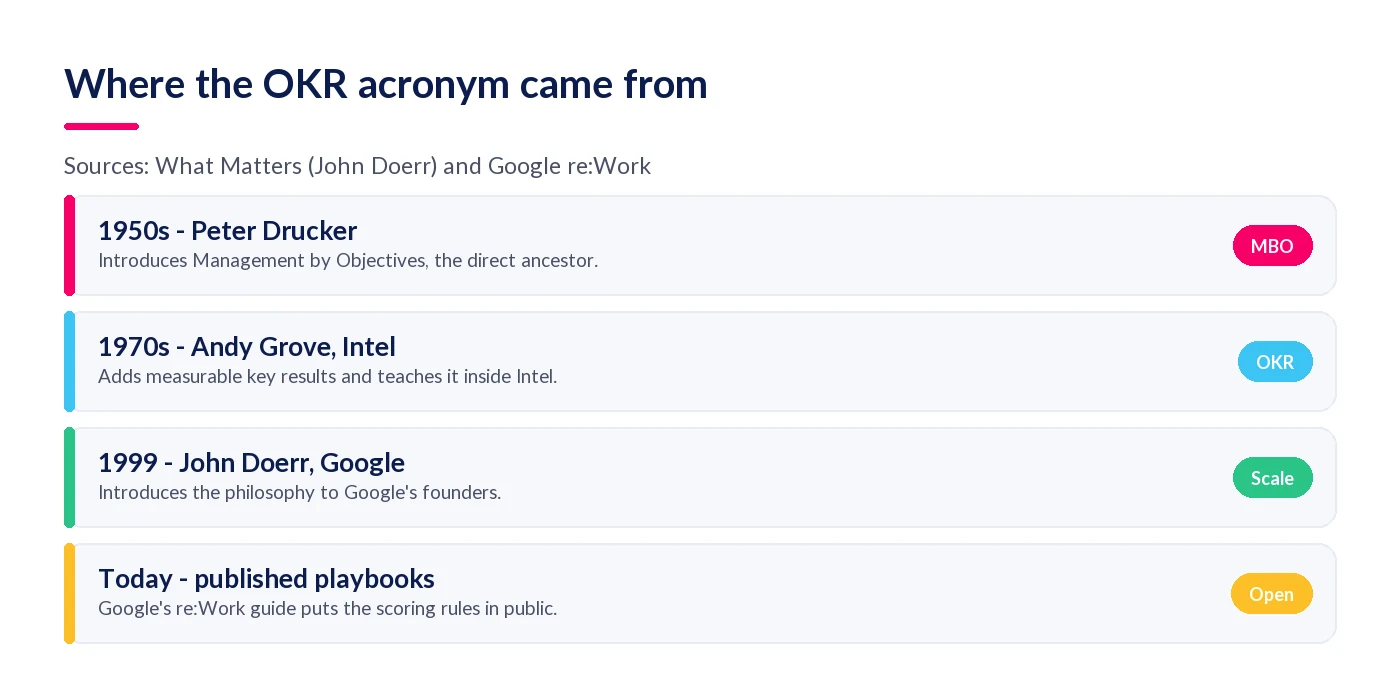
The practical consequence is that OKR is one of the few management formats whose rules are public. Google's re:Work guidance sets out the 0 to 1.0 scoring scale and the recommendation of three to five objectives with about three key results each, which is why an argument about OKR mechanics can usually be settled by reading the source rather than the vendor (more on how to manage performance the Google way). Where OKRs then connect to reviews, development and one-to-ones is covered in our guide to building a performance management system.
Getting the wording right is the cheap half; keeping every key result updated is the expensive half, which is what StaffCircle's performance management and development platform takes off your desk by holding objectives, key results and check-ins on one record.
Frequently asked questions
What is the full form of OKR?
The full form of OKR is Objectives and Key Results. It is written as one objective followed by its key results, so a single OKR is a set: the qualitative outcome plus the two to five measures that will show whether it happened this cycle.
Is OKR a framework or a metric?
A framework. The metrics live inside it, as the key results. An objective on its own is not a metric and should not contain one, which is why writing a target percentage into the objective line is the most common mistake teams make in their first quarter.
What does a key result mean in an OKR?
A key result is the evidence that an objective moved. It is written as a number travelling from a baseline to a target within the cycle — for example, on-time delivery from 82% to 95% — with a named source for the figure so the score cannot be disputed.
How many key results should an objective have?
Two to five, and three is the usual answer. Google's re:Work guide suggests about three key results per objective. One key result normally means the objective is really just that metric; six or more means nobody can say which of them the quarter actually depends on.
What is the difference between OKRs and MBOs?
Management by Objectives, introduced by Peter Drucker in the 1950s, agreed objectives between a manager and an employee, usually annually and often tied to pay. OKRs keep the objective but add graded key results, run quarterly, are published across the company and are normally kept away from compensation.
Related articles
See StaffCircle in action
Book a personalised demo and see how StaffCircle drives performance, engagement and development.