How to implement OKRs in a company
The right way to implement OKRs is to set company objectives first, pilot with two or three teams for one full quarter, score honestly in week 13, then widen a layer at a time. Most failed rollouts launched everywhere at once, with no single place for the numbers to live.
Key facts
- Set company OKRs before asking any team to align to them.
- Pilot with two or three teams for one full quarter.
- Expect two quarters before OKRs feel normal.
- Keep OKR scores out of pay and bonus decisions.
- One system of record; parallel spreadsheets kill the cadence.
How to prioritise strategy with OKRs
OKRs prioritise a strategy by forcing it through a deliberate bottleneck: three to five company objectives per quarter, and nothing else counts as a priority. That is the whole mechanism. A strategy document can carry twelve ambitions without contradiction, but a quarter cannot, so the value of the OKR cycle is in what the executive team agrees to leave out.
The narrowing works in three passes. Start with the strategic themes for the year and ask which of them will visibly move in the next ninety days. Turn each survivor into one qualitative objective. Then attach the two or three measures that would have to change for that objective to be true — and where two candidate objectives share the same measures, they were one objective all along.
Google's re:Work guidance on setting goals with OKRs recommends three to five objectives with about three key results each, on the basis that anything more over-extends the team (see how Google runs OKRs and performance reviews). Treat that as a hard limit for the company set in particular: it is the list every other team will align to, and a company set of nine objectives gives teams permission to pick whichever one suits them.
What are the steps to implement OKRs?
Implementation is six steps spread over two quarters, and the sequencing carries most of the risk. Writing OKRs is a drafting skill that a team can learn in an afternoon — our guide to how to write OKRs, with 13 worked examples covers that part. Implementing them is an operating-rhythm change, which is slower and fails for different reasons.
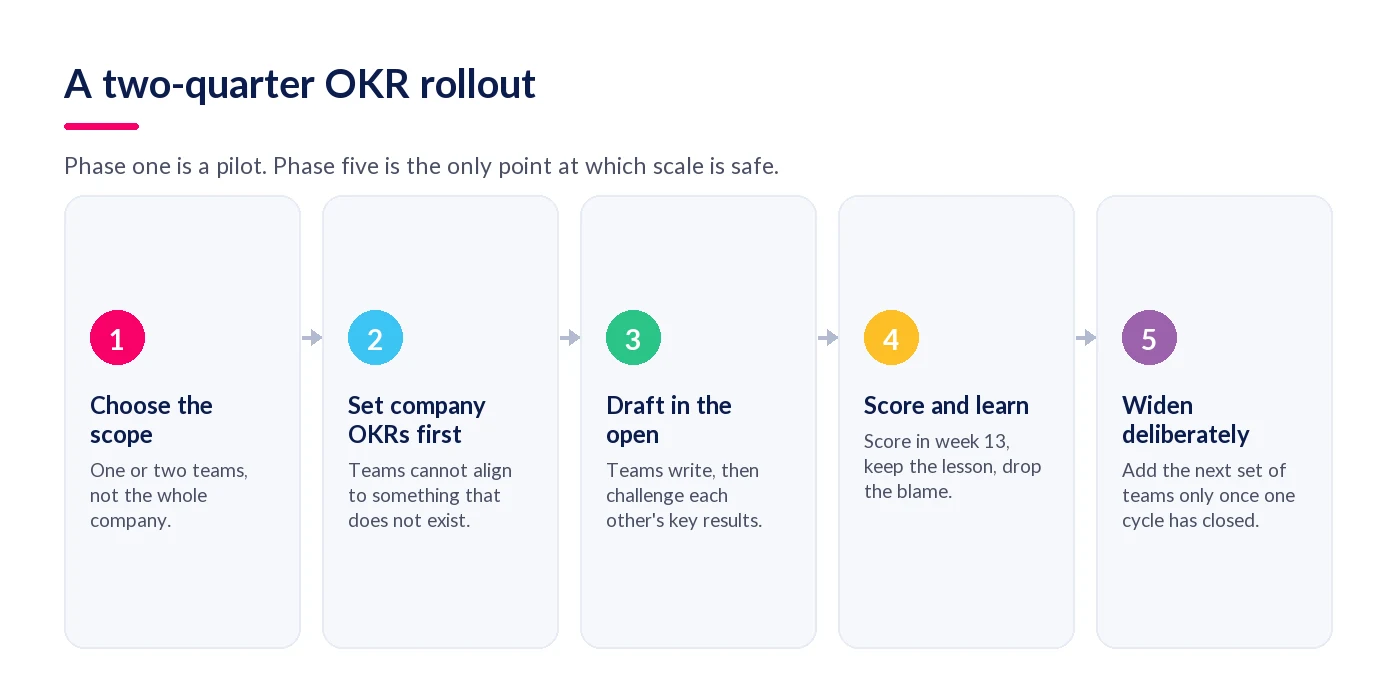
- Agree what problem OKRs are solving. Write down the specific failure you are fixing — priorities that change monthly, teams pulling in different directions, a strategy nobody can recite. Without that sentence, the rollout becomes a process for its own sake and quietly stops at the second quarter.
- Write the company OKRs first. Teams cannot align to something that does not exist. The executive team publishes three to five company objectives with their key results before any team drafts anything, and commits to leaving them alone for the quarter.
- Pick a pilot rather than a launch. Choose two or three teams with a real number to move and a manager who wants to try. A pilot gives you worked examples in your own language, which is worth more than any external template when the rollout widens.
- Choose one place where OKRs live. Decide the single system of record before week one and put every OKR in it, with one named owner per key result. Parallel spreadsheets are the most reliable way to kill a rollout, because two versions of a number means nobody trusts either.
- Run the weekly check-in and score at week 13. A short weekly update on each key result, then a score at the end of the quarter on the 0 to 1.0 scale. The check-in is the mechanism; the score is the learning. Skip either and OKRs become an annual document again.
- Score, hold a retrospective, then widen. Before adding teams, review what the wording got wrong and what the cadence got wrong, and rewrite your internal guidance using the pilot's own examples. Widen one layer at a time, never to the whole company at once.
What does a realistic OKR rollout timeline look like?
A realistic rollout runs across four quarters, with the first two doing most of the work. Anyone promising company-wide OKRs inside a month is describing a launch, not an implementation — the cadence has to survive one full cycle before it can be copied. The plan below is the version we see work in mid-sized organisations, with the exit test that tells you a phase is genuinely finished.
| Phase | When | What happens | Who is involved | Done when |
|---|---|---|---|---|
| Phase 0 · Prepare | 4–6 weeks before the quarter starts | Agree the problem OKRs are solving, pick the pilot teams, choose the system of record, brief the owners | Exec sponsor, HR, pilot leads | Company OKRs drafted and one system of record chosen |
| Phase 1 · Pilot | Quarter 1 | Company OKRs published; two or three teams draft, publish and run their own; weekly check-ins | Exec team, pilot teams | Every pilot OKR scored in week 13 |
| Phase 2 · Learn | 2 weeks between Q1 and Q2 | Score, run a retrospective on wording and cadence, rewrite the internal guidance with real examples | Pilot leads, HR | Guidance updated using your own OKRs, not a vendor template |
| Phase 3 · Widen | Quarter 2 | Every team under the pilot's leadership drafts OKRs; managers coach drafting rather than approve it | Managers, HR, pilot leads | All teams in scope have published OKRs with named owners |
| Phase 4 · Embed | Quarter 3 | Remaining functions join; OKRs are read in the monthly business review; check-ins attach to one-to-ones | Exec team, all managers | OKR review is a standing agenda item, not a project |
| Phase 5 · Steady state | Quarter 4 onwards | Annual company set with quarterly team sets beneath it; OKR evidence feeds development conversations | Everyone | A new starter can find and understand the current OKRs unaided |
Two details in that table are load-bearing. Phase 2 is the one organisations delete when the calendar gets tight, and it is the phase that turns a pilot into something teachable. And the Phase 5 exit test — a new starter can find and understand the current OKRs unaided — is the only reliable indication that OKRs have stopped being an HR initiative.
The cadence is also where software either helps or gets in the way. StaffCircle customers see 96% on-time review completion, and the mechanism behind that number is exactly the one an OKR rollout needs: the update lands with the owner, in the tool they already use, before the deadline rather than after it. If you are comparing platforms to hold the cycle, our page on how StaffCircle compares with tools like 15Five, Culture Amp and Leapsome sets out the differences in how each handles objectives and check-ins.
Why do most OKR rollouts fail?
OKR rollouts rarely fail because the format is wrong. They fail on focus, on measurement, on incentives, on rhythm and on record-keeping — and usually on more than one at once. The five failure modes below account for almost every abandoned programme we are asked to rescue, and each has a specific fix rather than a general appeal to leadership commitment.
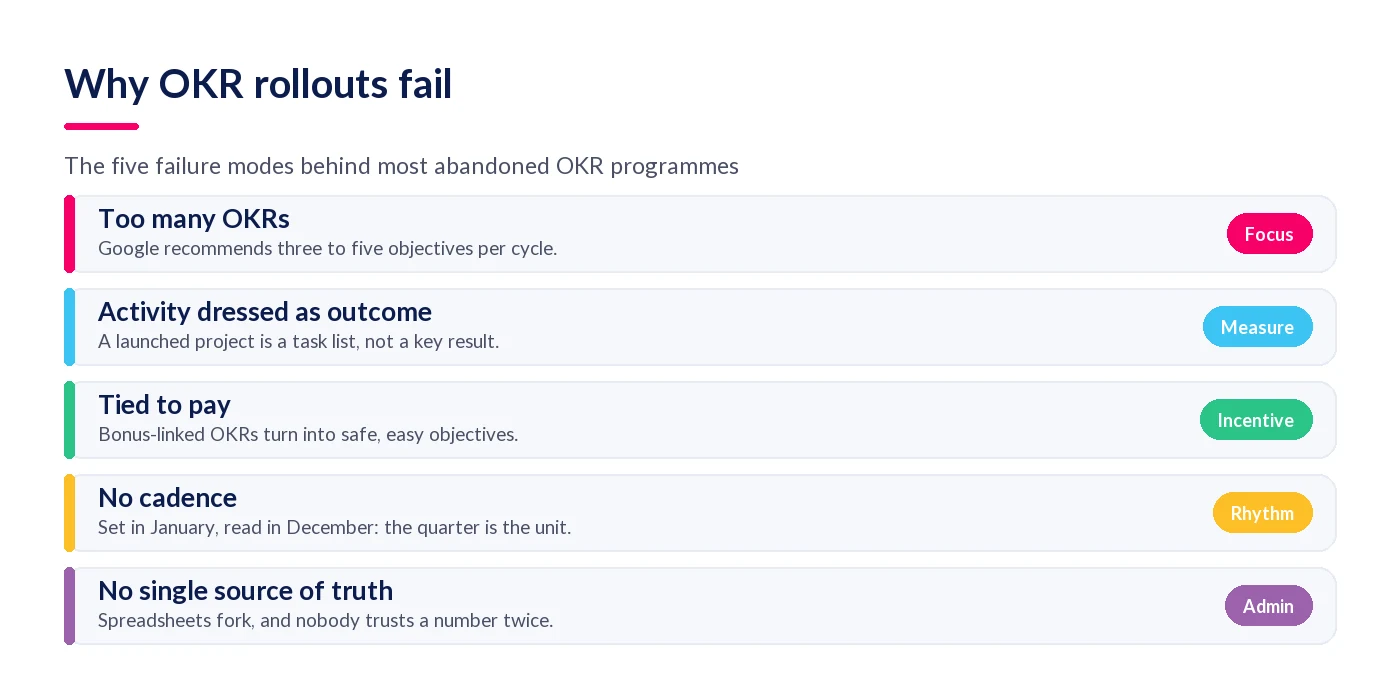
Too many OKRs. A company set of nine objectives, or a team carrying six, is a backlog with new formatting. Cut to three at company level and one or two per team for the first cycle.
Activity dressed up as outcome. Key results that read like a project plan — launch the portal, run the survey, hire the analyst — score full marks while nothing changes. Every key result should be a number moving from a baseline to a target.
Scores wired into pay. Aspirational OKRs carry an expected average score of around 0.7, which only works if reporting a 0.7 is safe. Link the score to a bonus and every objective quietly becomes achievable. Keep OKR scoring in the development conversation and out of the compensation decision.
No cadence. OKRs set in January and read in December are an annual goal list. The quarter is the unit, with a weekly or fortnightly check-in inside it. Progress that is visible without being chased is the point — our post on how visualising OKR progress supports performance management makes the case for real-time views over quarterly reporting.
Nobody knows what is expected. This is the underlying condition OKRs are meant to treat, and it is more common than most leadership teams assume: Gallup found that in the first half of 2026 just 49% of US employees strongly agreed they know what is expected of them at work (Gallup, 2026). A rollout that adds a quarterly ceremony without making expectations clearer has missed the point.
Who should own OKRs in a company?
Three distinct ownership roles need naming, and conflating them is a common early mistake. The executive sponsor owns the company set and the decision to leave it alone for the quarter. One named individual owns each key result — not a team, not a committee, because a shared key result is an unowned key result. And someone in HR or operations owns the process: the calendar, the templates, the system of record and the nagging.
What the process owner must not own is the content. The moment HR is writing other people's key results, the OKRs stop being commitments and become returns filed to head office. The role is to hold the rhythm and coach the drafting, which is the same relationship HR should have with objectives generally — our guide to building a performance management system sets out how that fits alongside reviews, one-to-ones and development.
Individual OKRs are optional, and for most mid-sized organisations they are a phase-4 question rather than a phase-1 one. Team OKRs plus individual objectives written to the SMART test is a lighter combination that still keeps everyone pointed the same way; our guide to what SMART objectives are, with examples covers that side.
An OKR programme lives or dies on whether the update is easier than the excuse, which is what StaffCircle's performance management and development platform is built for — company, team and individual objectives on one record, with check-ins and scores attached to the people who own them.
Frequently asked questions
How long does it take to implement OKRs?
Plan for two quarters before OKRs feel normal and four before they are embedded. The first quarter is a pilot with two or three teams, the second widens to the layer beneath them. Anything faster is usually a launch that quietly reverts to the old goal list.
Should OKRs be rolled out to the whole company at once?
No. Pilot with two or three teams that have a real number to move and a manager who wants to try. A pilot produces worked examples in your own language and exposes cadence problems while they are still cheap to fix, which no company-wide launch can do.
Do individuals need their own OKRs?
Not at first, and often not at all. Team OKRs plus individual objectives written to the SMART test keeps the alignment without doubling the admin. If you do add individual OKRs, wait until the team cadence is reliable, otherwise you have multiplied a process nobody is following yet.
Do OKRs replace annual appraisals?
No. OKRs measure whether the priorities moved; an appraisal assesses how a person is performing and developing. The two connect — OKR evidence is useful input to a review — but scoring an aspirational OKR as if it were a performance rating punishes exactly the ambition you asked for.
What do you need to run OKRs successfully?
Four things: company objectives published before teams draft theirs, one named owner per key result, a single system of record, and a weekly or fortnightly check-in that happens whether or not anything has changed. Miss the last one and the quarterly score becomes an exercise in reconstruction.
Related articles
See StaffCircle in action
Book a personalised demo and see how StaffCircle drives performance, engagement and development.