Fire Safety Training Requirements for Employers: What Article 21 Actually Asks For
Here is a claim that surprises most people I say it to: there is no legal requirement to give your staff fire safety training once a year.
Read Article 21 of the Regulatory Reform (Fire Safety) Order 2005 and you will not find the word "annual" anywhere in it. The Order says training must be "repeated periodically where appropriate". Merseyside Fire and Rescue Service puts it plainly in its guidance on staff training: "There is no specific frequency laid down in legislation".
That is not a loophole. It is a harder standard than a date in a diary. An annual e-learning module ticks a calendar box. The law asks whether the training was adequate for the risks your people face, whether it was given when those risks changed, and whether you can show it.
Fire safety training requirements for UK employers come from Article 21 of the Regulatory Reform (Fire Safety) Order 2005, which applies in England and Wales. The responsible person must give employees adequate safety training when they start and whenever they are exposed to new or increased risks, repeat it periodically where appropriate, match it to the fire risk assessment and deliver it during working hours. People with fire roles, such as fire marshals, need more, and you should be able to prove all of it.
The duty, in the Order's own words
Article 21(1) says the responsible person "must ensure that his employees are provided with adequate safety training" at two points: when they are first employed, and when they are exposed to new or increased risks. Article 21(2) then sets five conditions. The training must:
- cover the right content: "suitable and sufficient instruction and training on the appropriate precautions and actions to be taken by the employee in order to safeguard himself and other relevant persons on the premises";
- be repeated: "periodically where appropriate";
- keep up with change: be adapted to take account of any new or changed risks;
- fit the risk: be provided "in a manner appropriate to the risk identified by the risk assessment";
- happen on the clock: "take place during working hours".
The responsible person is usually the employer, but GOV.UK is clear it can also be the owner, landlord, occupier or anyone else with control of the premises, such as a facilities manager. GOV.UK also notes that Scotland and Northern Ireland have different rules, so everything below is about England and Wales.
Three neighbouring articles matter just as much. Article 19 requires "comprehensible and relevant information" on the risks, the procedures and the identities of the people nominated to carry them out. Article 23 puts a duty on employees to co-operate. And Article 40 says no employer may charge an employee for anything done to meet the Order, which rules out passing the cost of training on.
The stakes are real. Under Article 32 it is an offence to fail to comply with the fire safety duties in Articles 8 to 22B, which include Article 21, where that failure places one or more people at risk of death or serious injury in case of fire. On conviction on indictment the penalty is a fine, imprisonment for up to two years, or both, and the article extends liability to directors and managers of a company in some circumstances.
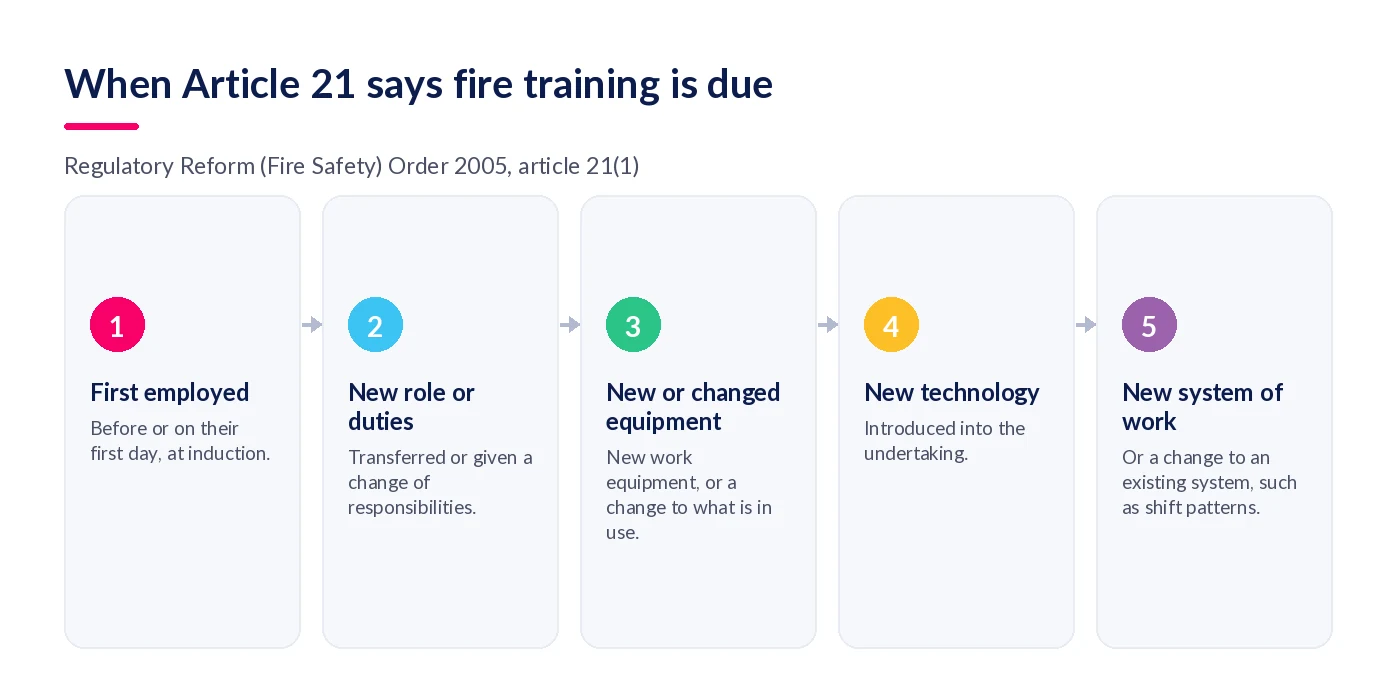
Training is due on events, not just on dates
Most of the pages that rank for this subject talk about refresher intervals. Very few quote the list in Article 21(1)(b), and it is the most useful part of the duty. Training is due when an employee is exposed to new or increased risks because of:
- being transferred or given a change of responsibilities;
- new work equipment, or a change to equipment already in use;
- new technology; or
- a new system of work, or a change to an existing one.
Think about what that means in a normal year. A receptionist covers the evening security desk. A warehouse installs new access-controlled doors on an escape route, which changes how those exits open. A site moves to a 24-hour shift pattern, so the people on duty at 3am are a different group with no duty manager on site. None of those changes appears on a training calendar, and each one triggers the duty.
The government's guide to fire safety risk assessment for offices and shops adds a few more occasions in the same spirit: when the emergency plan or the preventive measures change, where staff are expected to assist disabled people, and if a member of staff may take on the role of duty manager.
So how often should fire safety training be repeated?
The law leaves it to your risk assessment. Merseyside Fire and Rescue Service says recognised practice is that refresher training "should be no less frequent than annually or where equipment changes". The same government guide recommends induction training and "refresher sessions at pre-determined intervals". So annual refreshers are a sensible default for most workplaces. Just do not mistake the default for the duty, which is to keep the training adequate as things change.
Fire drills have a clearer benchmark. GOV.UK says "You should carry out at least one fire drill per year and record the results." The guide says a drill should be held at least annually or as determined by your risk assessment, and more often if you have a high staff turnover.
Three tiers of people, three depths of training
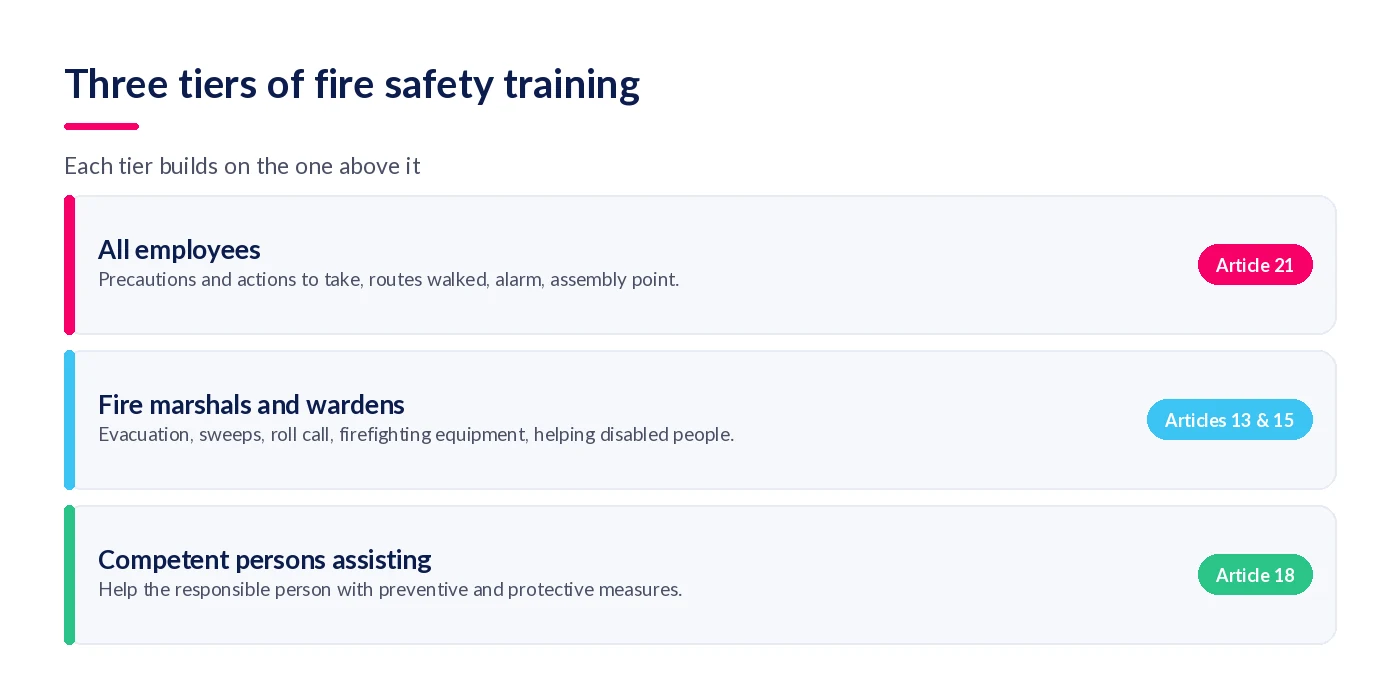
Article 21 sets the floor for everyone. Other articles create roles that need more.
Everyone
The guide lists what all staff training should cover, including what to do on discovering a fire, how to raise the alarm, what to do on hearing it, how to call the fire and rescue service, the evacuation route to the assembly point, how to open the emergency exit doors, why fire doors must stay closed, why not to use lifts, and good housekeeping. In small, low-risk premises it may be little more than showing new starters the exits and explaining the procedure. In a supermarket with high turnover and many shift patterns, the guide says the training "will need to be planned".
Nominated people: fire marshals and wardens
Article 15(1)(b) requires the responsible person to "nominate a sufficient number of competent persons" to implement evacuation procedures. Article 13(3)(b) requires competent people for firefighting measures, with their number, training and equipment adequate to the premises. Both articles define competent the same way: "sufficient training and experience or knowledge and other qualities" to do the job properly.
The guide says fire marshals "would require more comprehensive training", covering the fire safety strategy of the premises, human behaviour in fires, how to search safely and recognise unsafe areas, the difficulties disabled people may have in escaping, and additional training on firefighting equipment.
Competent assistance
Article 18 requires one or more competent persons to help the responsible person with the preventive and protective measures, and prefers someone in your own employment where you have one. This is usually your fire safety lead or the person who coordinates the risk assessment. Their competence needs the same evidence as anyone else's.

How to build fire training that stands up to an inspection
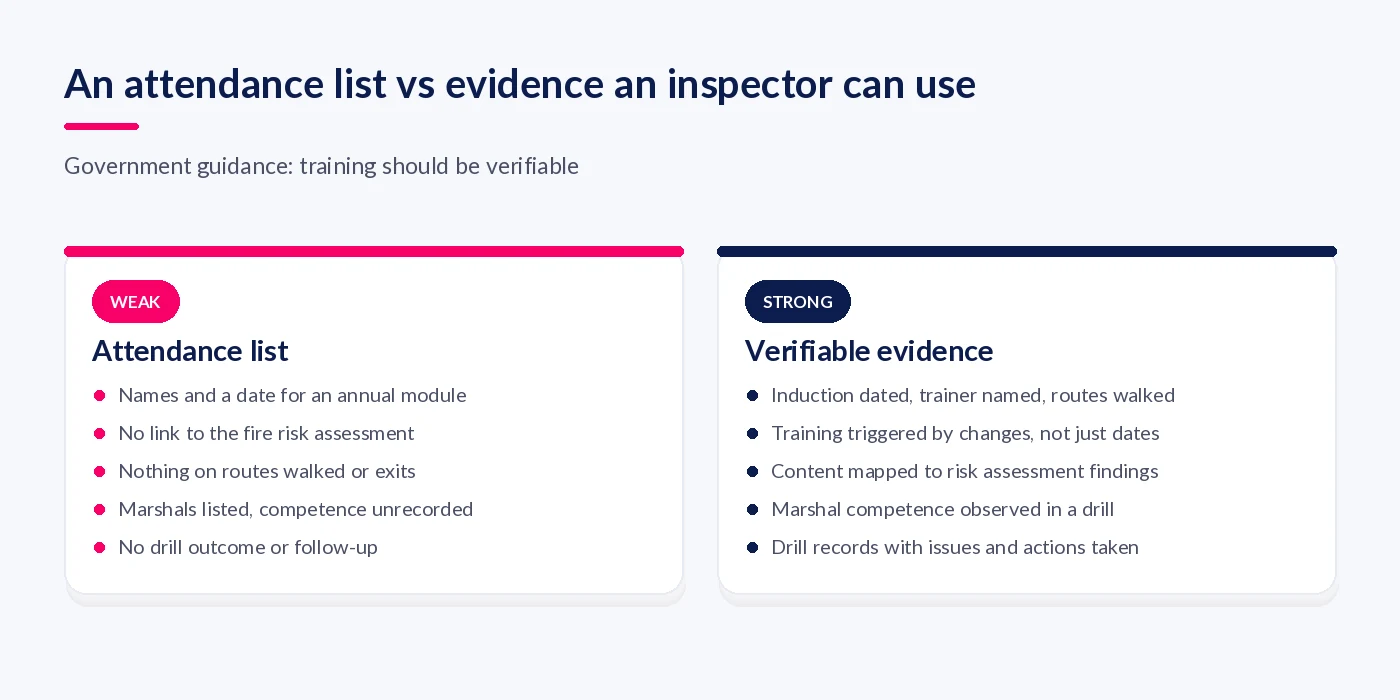
The guide makes two points that should shape everything you do. The training "should be verifiable", and "Enforcing authorities may want to examine records as evidence that adequate training has been given." These six steps are built around that.
1. Start from the fire risk assessment
Article 21(2)(d) ties the training to the risks your assessment identifies. Pull out its significant findings: specific hazards, areas with restricted access, people who would need help to escape, and the evacuation strategy. Those findings are the syllabus. A generic course that ignores them is hard to defend as adequate.
2. Map who needs what, by role, site and shift
List every group: day and night shifts, part-time staff, agency workers, contract cleaners and maintenance teams. The guide specifically reminds you to include staff who work outside normal hours. Note anyone who needs the information adapted, such as people with hearing or sight impairments, learning difficulties, or who do not use English as their first language.
3. Induct on day one, and walk the routes
Training is due "at the time when they are first employed". The guide lists exit routes and the operation of exit devices, "including physically walking these routes". A slide of the floor plan is not the same thing. Record the date, who gave it and which routes were walked.
4. Train the nominated people properly, and name them
Decide how many marshals you need per area and per shift, give them the deeper training the role needs, and check they can actually do it, for example by observing their sweep during a drill. Article 19 requires you to tell employees who these people are, so keep the list current.
5. Drill, observe and debrief
Hold at least one drill a year and record it. The guide suggests nominated observers, assuming one exit is unavailable so people use routes they would not normally use, and an on-the-spot debrief. It also warns that surprise drills may not be beneficial because the risks they introduce can outweigh the benefits. Record what went wrong and what you changed.
6. Set triggers as well as intervals, then keep the record
Put the Article 21(1)(b) triggers into the processes that cause them: transfers, new equipment, new technology and changes to systems of work. Set a refresher interval from the risk assessment. Since 1 October 2023 Article 11 requires every responsible person to record their fire safety arrangements, following amendments made by section 156 of the Building Safety Act 2022 that removed the old five-employee threshold.

Where fire training quietly fails
The night shift never sees a drill
Drills are easy to run at 11am on a Tuesday. The people at most risk are often the ones on duty when there are fewer staff, no duty manager and nobody who remembers where the second exit is. If your drill record only shows daytime evacuations, the risk assessment should explain why that is enough.
Agency and contract staff fall through the gap
The guide says you must give clear information and instructions to your staff and to the employers of other people working in your premises, such as contractors, and its checklist asks whether you have arrangements for informing temporary or agency staff. An induction that lives in the HR onboarding flow will never reach a contract cleaner who starts at 6am.
The marshal list is two years out of date
Marshals leave, change shifts or move site. If the list on the noticeboard names someone who left last spring, you have a gap in the evacuation plan and an inaccurate Article 19 record at the same time.
An online module is the whole programme
E-learning is a good way to deliver the knowledge part consistently. It cannot walk someone along their escape route, show them how the exit device on their door works, or tell you whether they would actually leave their desk. Use it for what it is good at and pair it with the practical parts.
Shared buildings with no joint drills
In multi-occupied buildings each responsible person has to co-operate and co-ordinate with the others. The guide's checklist asks directly whether you carry out joint training and fire drills. Your perfect evacuation means little if the tenant upstairs uses the same stair and has never practised.
A worked example: one two-shift distribution site
Here is how the requirements translate into a plan for an illustrative site with 140 staff across a day and a night shift, a high proportion of agency workers, and a battery charging area for lift trucks.
| Who | What they need | When | Evidence kept |
|---|---|---|---|
| Everyone, including agency staff | Fire induction from the risk assessment findings, route walk, exit devices, assembly point | Before their first shift | Dated record: trainer, routes walked, sign-off |
| Night shift | As above, plus a drill on their own shift | At least annually, per shift | Drill record: time, roll-call result, issues, actions |
| Fire marshals (two per zone per shift) | Marshal training, sweep and roll-call practice | On appointment; refresher set by the risk assessment | Course record plus an observed sweep in a drill |
| Charging area team | Hazard-specific briefing on the charging area | When the area is introduced or changed | Briefing record linked to the risk assessment finding |
| Night duty managers | Calling the fire service, roll call, liaising on arrival | On taking the role | Sign-off by the site manager |
Every row answers three questions an inspector would ask: who, when, and how do you know. If you cannot fill in the last column for a group, start there.
Where StaffCircle fits
StaffCircle does not replace your fire risk assessor or the person who runs the drill. It holds the evidence the steps above produce, against the person, the role and the site.
Fire roles defined as competencies
Using the competency framework tools you can describe what competent looks like for a fire marshal or duty manager, so assessments, such as an observed sweep, are made against a written standard.
Training records with refresher dates
Training compliance tracking keeps each person's fire induction, marshal training and certificates with their dates, so the refresher intervals you set from your risk assessment are tracked rather than remembered.
Coverage you can see by site and shift
A matrix view of people against requirements shows where a shift is short of trained marshals or where agency starters are missing an induction. Our mandatory training matrix guide shows the structure, and preparing for a skills compliance audit covers how to present it.
The short version
Article 21 does not ask for an annual certificate. It asks for adequate training at the start, whenever risks change, and as often as your risk assessment says, given in working hours and backed by records an inspector can check. Train the marshals more deeply, walk the routes, drill every shift and write down what you learnt. For the wider picture, see our guides to skills compliance and PUWER training requirements. If you would like to see how StaffCircle keeps that evidence in one place, book a demo.
FAQ
What are the fire safety training requirements for employers?
Under Article 21 of the Regulatory Reform (Fire Safety) Order 2005, the responsible person must give employees adequate fire safety training when they start and when they are exposed to new or increased risks. It must cover the precautions and actions to take, be repeated periodically where appropriate, reflect the fire risk assessment and take place during working hours.
Is fire safety training a legal requirement in the UK?
Yes. In England and Wales it is required by Article 21 of the Regulatory Reform (Fire Safety) Order 2005. Scotland and Northern Ireland have their own fire safety legislation with different rules, so check the regime that applies to your premises.
How often should fire safety training be done?
The law sets no fixed frequency. Article 21 says training must be repeated periodically where appropriate and whenever risks change. Fire and rescue services describe at least annual refresher training as recognised practice, but your fire risk assessment should set the interval.
How often should we hold a fire drill?
GOV.UK says you should carry out at least one fire drill per year and record the results. Government guidance adds that you may need drills more often if you have high staff turnover, and every shift should take part.
Does fire safety training have to be done in working hours?
Yes. Article 21(2)(e) of the Fire Safety Order says the training must take place during working hours.
Can an employer charge staff for fire safety training?
No. Article 40 of the Fire Safety Order says no employer may charge an employee for anything done or provided to meet the requirements of the Order.
Who needs fire marshal or fire warden training?
Anyone nominated to help evacuate people or to carry out firefighting measures. Articles 13 and 15 require these people to be competent, meaning they have sufficient training and experience or knowledge and other qualities to do the role properly.
How many fire marshals do we need?
There is no fixed ratio in law. Article 15 requires a sufficient number of competent people to implement evacuation procedures. Base the number on your fire risk assessment, the size and layout of the premises, the number of people present and every shift you operate.
Is online fire safety training enough?
Rarely on its own. Online training can cover the knowledge consistently, but government guidance expects staff to walk their escape routes and learn how exit devices work, and drills test whether the training worked. Most workplaces need a practical element as well.
What fire safety training records should we keep?
Keep who was trained, when, by whom, what it covered and, for practical elements, which routes were walked. Keep drill records with the outcome and actions. Government guidance says enforcing authorities may want to examine records as evidence that adequate training has been given.
Do agency workers and contractors need fire safety training?
Agency workers in your premises need to know what to do in a fire, and government guidance says you must give clear information and instructions to the employers of other people working on your premises, such as contractors. Build them into your induction process rather than relying on the agency.
Who is the responsible person for fire safety?
Usually the employer. GOV.UK says it can also be the owner, landlord, occupier or anyone else with control of the premises, such as a facilities or building manager. Where several people share responsibility, they must co-operate and co-ordinate.
Does the Regulatory Reform (Fire Safety) Order apply in Scotland?
No. The Order applies in England and Wales. Scotland and Northern Ireland have separate fire safety legislation, and GOV.UK points to different rules for each.
Related articles


See StaffCircle in action
Book a personalised demo and see how StaffCircle drives performance, engagement and development.