Competence Management for Fire Protection Companies: A Practical Guide
Executive summary
- Certificates show course completion, not proven competence. Regulation 11F expects skills, knowledge, experience, and behaviours.
- Spreadsheets and separate training systems cannot show who is competent for which task.
- StaffCircle's AI Competency Framework builds a role-based framework in under 40 minutes and links it to reviews, training and skills-gap reporting.
Fire protection companies need more than training certificates to demonstrate workforce competence. They need clear records of what employees can do, which tasks they are qualified to perform, where skills gaps exist, and when assessments or certifications need review.
When records sit across spreadsheets, emails, and separate training systems, that view is hard to maintain. Competence management software brings records, assessments and development plans into one system. StaffCircle's AI Competency Framework builds a role-based framework in under 40 minutes, then links it to reviews, training and skills-gap reporting.
Why Do Fire Protection Companies Need a Competence Management System?
Fire protection companies need a competence management system to know who can perform specific tasks, identify gaps before assigning work, and retrieve supporting evidence when clients or auditors request it. Managing this information manually gets harder as teams grow and employees work across different sites, projects, and service lines.
Recent industry research shows why better evidence matters. A 2026 study by the British Woodworking Federation's Fire Door Alliance found that 42% of respondents would accept a diploma or certificate of achievement as sufficient evidence of fire door installer competence, and 29% would accept an online or e-learning course on its own. Training completion is not the same as demonstrated competence.
A dedicated system helps with five operational needs:
- Know who can perform each task: Review employee competence against specific job requirements before allocating work.
- Identify skills gaps: A central view of assessments and required competencies shows where employees need further training or supervision.
- Keep records accessible: Retrieve qualifications, assessment results and development records without searching through separate files.
- Plan employee development: Link development plans to current roles and future responsibilities.
- Prepare for audits and client checks: Consistent records show what checks were completed and what evidence supports each decision.
A competence management system does not replace technical assessments or management judgement. It gives managers the information they need to make and document those decisions. StaffCircle is built for this problem: an AI competency framework, a skills-gap dashboard and mobile access for site teams, in one platform.
Which Regulations and Standards Should Fire Protection Companies Consider?
Consider the requirements that apply to your work, location, service type and contractual responsibilities. Software can help organise evidence, but it cannot guarantee compliance.
For relevant building work in England, Regulation 11F of the Building Regulations 2010 requires individuals undertaking building or design work to have the necessary skills, knowledge, experience and behaviours.
Organisations must have the organisational capability to carry out the work, and people in training must receive adequate supervision.
Other standards and schemes may apply depending on the work:
| Regulation, standard or scheme | What companies should understand |
|---|---|
| BSI, BS 8670-1:2024 | Sets core criteria for developing competence frameworks for roles and activities that affect building safety. |
| BS 8674:2025 | Covers competence requirements for individual fire risk assessors. It should not be treated as a universal qualification for all fire protection roles. |
| BAFE SP203-1 | Provides third-party certification for organisations carrying out specified fire detection and fire alarm system activities, including design, installation, commissioning and maintenance. |
| Relevant role-specific frameworks | Help define the technical competence expected for specialist work, such as fire door installation. |
Check the scope of each standard or certification before applying it to an employee or service. For example, BAFE SP203-1 is an organisation-level scheme with specific modules. This does not mean every employee holds an individual BAFE certification.
Spreadsheets, HRIS Modules or a Dedicated Competence Platform?
Most fire protection firms start with spreadsheets, then consider a bolt-on module in their HR system or a dedicated platform. Building a competency framework for development by hand typically takes 9 to 12 months for a 200-role organisation, which is why many firms never finish one.
| Criterion | Spreadsheets and Word files | HRIS bolt-on module | StaffCircle |
|---|---|---|---|
| Framework build time | Manual. Often months of work. | Varies by vendor. Ask for a live demo. | AI Competency Framework builds a role-based framework in under 40 minutes |
| Task-level competence view | Manual cross-referencing across files | Varies by vendor. Check role-level depth. | Role-based competencies linked to reviews, training and a skills-gap dashboard |
| Frontline and site access | Limited. Files sit on office systems. | Varies by vendor. | Mobile app for frontline and deskless staff, plus desktop |
| AI governance | Not applicable | Varies by vendor. Ask for certification evidence. | ISO/IEC 42001:2023 certified AI governance, plus ISO/IEC 27001:2022 and Cyber Essentials |
| Pricing visibility | Free, but costs time | Often quoted per suite | Published per-employee pricing from £3.85, with AI included |
| Audit evidence | Scattered and hard to retrieve | Varies by vendor. | Records, assessments and development plans in one system |
StaffCircle works with your existing HRIS rather than replacing it, with 30+ HRIS integrations plus Microsoft 365 and Teams.
How to Choose the Right Competence Management Software
The right platform gives managers a clear view of employee capability, supports development and keeps relevant records in one accessible place. Assess it against these requirements:
| What to evaluate | What the software should help you do |
|---|---|
| Competency framework | Define competencies for different roles, responsibilities, and levels of experience. |
| Framework build time | Create a role-based framework in hours, not months. |
| Skills gap visibility | Identify missing competencies and compare current capability with role requirements. |
| Training records | Record learning activity, completed courses, and relevant qualifications. |
| Employee development | Set development objectives and assign learning activities to address identified gaps. |
| Reviews and assessments | Record regular discussions, progress and assessment outcomes. |
| Reporting | Give managers an overview of employee development, competency status and outstanding actions. |
| Frontline access | Let site-based employees review objectives and development activities without office-based access. |
| AI governance and security | Show independent certification, such as ISO/IEC 42001 for AI and ISO/IEC 27001 for information security. |
| Scalability and integrations | Support different teams, locations and roles, and connect to your existing HRIS. |
Questions to ask during a software demonstration
A demonstration should show how the platform handles your actual competence process. Ask the provider:
- Can we define different competency requirements for fire alarm engineers, fire door installers and other specialist roles?
- Can managers identify gaps between required and current competencies?
- Can we record training, qualifications, assessments and development activities together?
- Can employees and managers review progress and update development objectives?
- Can we access relevant employee information when teams work across different sites?
- Can we generate reports that help us review workforce capability?
- How long does it take to build a role-based framework, and how is the AI governed?
Ask the provider to demonstrate these workflows using a sample employee and role. A feature list alone will not show whether the platform fits your process.
What Should a Fire Protection Competence Matrix Include?
A competence matrix connects each job role with the skills, knowledge, experience and behaviours required to perform its tasks. It should also show each employee's current status against those requirements.
| Job role | Competencies to assess | Evidence to record |
|---|---|---|
| Fire alarm engineer | System design or installation knowledge, testing, commissioning and maintenance skills | Relevant qualifications, practical assessments and work experience |
| Fire door installer | Product knowledge, installation methods, inspection of components and correct documentation | Role-specific training, practical assessment and relevant experience |
| Fire risk assessor | Risk assessment knowledge, inspection skills, reporting and professional judgement | Relevant qualifications, experience and assessment records |
| Fire sprinkler technician | System components, installation, testing and maintenance procedures | Technical training, practical assessment and work history |
| Site supervisor | Work allocation, safety procedures, quality checks and team supervision | Management training, observed performance and review records |
The exact requirements should reflect the services you provide and the standards or schemes relevant to each role.
A digital matrix should also make employee status easy to understand:
- Competent: Evidence supports the employee's ability to perform the defined tasks.
- In development: The employee needs further training, experience, or supervision.
- Assessment due: A review or reassessment is required.
- Not assessed: The company has not yet completed the required assessment.
These labels should reflect your assessment process. Software can display and track the status, but an authorised manager or qualified assessor must make the competence decision.
What Competence Records Should Your System Maintain?
Your system should hold the records needed to show how an employee meets the requirements of their role:
- Qualifications and certificates relevant to the employee's work.
- Training courses and learning completion records.
- Practical assessment results and assessor feedback.
- Relevant work experience and role history.
- Supervision records for employees who are still developing their skills.
- Continuing professional development activities.
- Development objectives and completed actions.
- Certification expiry dates and planned review dates, where applicable.
Centralised records matter most when you need to check supplier credentials or show how you assess competence.
In November 2026, research commissioned by BAFE and NSI and conducted by Sapio Research found that 73% of surveyed UK decision-makers did not know who their fire safety supplier was certified by, whether the supplier held certification, or whether they were using an uncertified provider (Fire Industry Association, 2 November 2026).
For this reason, also record subcontractor checks, supplier certification and the scope of work covered. Keep organisation-level certification separate from individual employee competence records.
How StaffCircle Supports Employee Competence Management
StaffCircle is an AI-powered performance management and employee development platform. Its AI Competency Framework builds a role-based framework in under 40 minutes, then puts it to work across reviews, objectives, 1:1s, development plans, and skills-gap analysis. Customers report 94% less time to build and manage a competency framework.
- AI Competency Framework: Generates a role-based competency and skills framework in under 40 minutes, so managers see who is ready for which task.
- Skills gap dashboard: Shows capability gaps and uses them to plan learning and development.
- Training records and development plans: Track learning activity and completed development against each role.
- Objectives and performance reviews: Support regular conversations about progress, role expectations, and development needs.
- Career pathways: Show employees the development opportunities linked to future roles.
- Frontline mobile app: Site-based engineers and installers can review objectives and development actions without office access.
- Certified AI: ISO/IEC 42001:2023 certified AI governance, plus ISO/IEC 27001:2022, Cyber Essentials and HMG G-Cloud.
- Works with your HRIS: 30+ HRIS integrations, plus Microsoft 365 and Teams, so it adds an intelligence layer rather than replacing your systems.
How Siderise uses StaffCircle for competency management
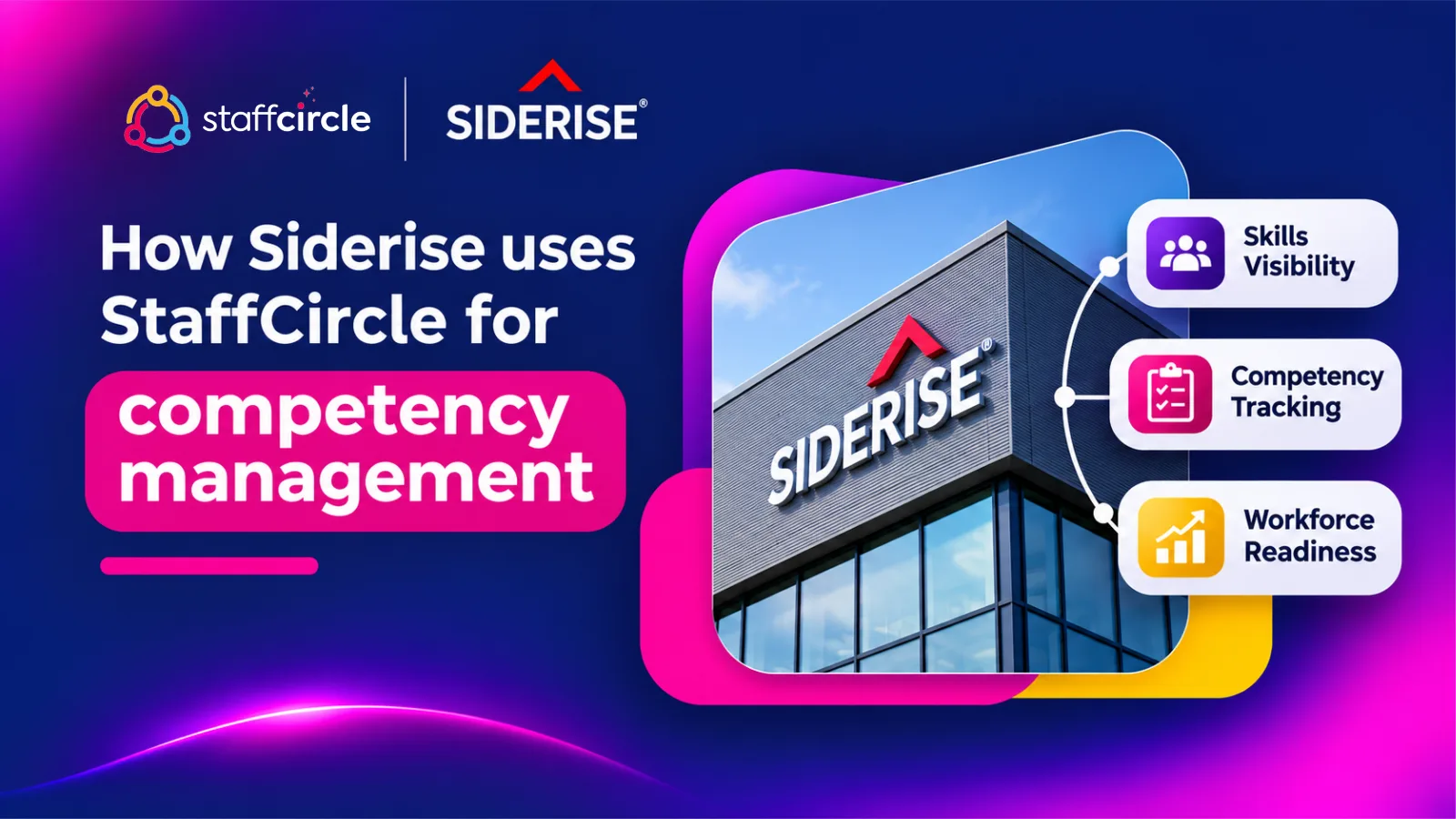
Siderise, a specialist manufacturer of passive fire protection and acoustic insulation products, adopted StaffCircle in June 2025 to bring competency, development and succession planning into one system.
Before adopting the platform, competency and development information sat across multiple systems. Managers had limited visibility into development needs, and the business had no central place to track progress. StaffCircle brought together:
- Competency requirements and employee records.
- Skills gap visibility through a dashboard.
- Individual development plans and career pathways.
- Training records and reporting.
- Objectives and ongoing performance reviews.
Siderise brought competency, development and training into one system, giving managers better visibility into skills gaps, employee progress and future development needs.
Gemma Littlejohns, Learning and Development Business Partner at Siderise, highlighted the value of the skills gap dashboard and career pathway features in identifying capability gaps and supporting employee development.
Read the Siderise customer story.
StaffCircle does not replace technical assessments, professional qualifications, or third-party certification. It helps companies manage the employee information and development processes that support their competence framework.
What Does Competence Management Software Cost?
StaffCircle publishes per-employee pricing from £3.85, with AI included for the whole workforce and no per-user AI licensing. Use the pricing calculator to estimate your cost, and the ROI calculator to build a business case for your finance director.
Conclusion
Fire protection companies need a clear record of who can perform each task, what evidence supports that decision, and where employees need further development. Disconnected spreadsheets and training records make this harder as teams and service requirements grow.
A competence management platform gives managers one place to review skills, track development, maintain training records and identify capability gaps. StaffCircle brings these together through its AI Competency Framework, skills-gap dashboard, objectives, reviews, and career pathways, with certified AI and published pricing.
See how StaffCircle builds your fire protection competence framework in under 40 minutes. Book a StaffCircle demo.
Frequently Asked Questions
What is fire protection competence management?
Fire protection competence management is the process of defining, assessing, recording and reviewing the skills, knowledge, experience and behaviours employees need to perform their roles safely and effectively.
What is BAFE accreditation?
BAFE registration is third-party certification that confirms a fire safety company meets the requirements of a specific BAFE scheme. It covers services such as fire alarms, fire risk assessments, and fire extinguishers.
What is FIRAS accreditation?
FIRAS is a third-party certification scheme for companies installing or maintaining passive fire protection systems. It assesses company processes, installation quality, and workforce competence.
How much does FIRAS certification cost?
FIRAS certification costs vary based on the certification scope and assessment requirements. Contact Warringtonfire for a quotation based on your company's services.
What are the competency criteria for fire risk assessors?
Fire risk assessors need the right skills, knowledge, experience, and behaviours for the buildings they assess. BS 8674:2025 defines three competence levels: Foundation, Intermediate and Advanced.
How do you become a certified fire door installer?
Complete relevant fire door training, gain practical experience, and demonstrate installation competence. You can also work through a company certification scheme such as FIRAS, which assesses the company and its installation staff.
How does the Building Safety Act affect fire protection contractors?
The Building Safety Act strengthens competence requirements for relevant building work in England. Under Regulation 11F, individuals must have the required skills, knowledge, experience and behaviours, while organisations must demonstrate their capability.
How much does competence management software cost?
StaffCircle publishes per-employee pricing from £3.85, with AI included for the whole workforce and no per-user AI licensing. Use the pricing calculator to estimate your cost and the ROI calculator to build a business case before booking a demo.
Related articles


See StaffCircle in action
Book a personalised demo and see how StaffCircle drives performance, engagement and development.