Competency Frameworks for Care Workers: Meeting CQC Regulation 18 in Practice
Here is a claim some registered managers will push back on: a completed Care Certificate does not tell you a care worker is competent to work in your service.
It tells you they met 16 national standards written for people new to care. That matters, and it is a good start. But the assessor and employer guide published with the 2025 standards says much the same thing. It calls the Care Certificate "only one element of the training and education" that makes staff ready to practise in a specific workplace. It adds that it "does not replace employer induction specific to the workplace".
So the certificate in the personnel file is a floor. What shows CQC that your staff are competent is everything you build on top of it. That is your competency framework.
A care worker competency framework is the written set of skills, knowledge and behaviours each care role in your service needs, with how each one is assessed, who signs it off, what evidence is kept and when it is checked again. Under CQC Regulation 18 it is how you show staff are suitably qualified, competent, skilled and experienced, supervised until they can work alone, and supervised afterwards so that competence is maintained.
What Regulation 18 actually says
Regulation 18 of the Health and Social Care Act 2008 (Regulated Activities) Regulations 2014 is short. Paragraph (1) requires "sufficient numbers of suitably qualified, competent, skilled and experienced persons" to be deployed. Paragraph (2)(a) says people employed in a regulated activity must "receive such appropriate support, training, professional development, supervision and appraisal as is necessary to enable them to carry out the duties they are employed to perform".
Notice the last phrase. The test is the duties a person is employed to perform, not a generic list. A night care assistant in a nursing home and a domiciliary carer working alone in someone's kitchen are not employed to do the same things.
CQC's guidance on Regulation 18 fills in what providers must have regard to. Among other things:
- Providers "must ensure that they have an induction programme that prepares staff for their role".
- Training and development needs must be assessed at the start of employment and reviewed at appropriate intervals.
- Where appropriate, staff "must be supervised until they can demonstrate required/acceptable levels of competence to carry out their role unsupervised".
- Staff "should receive appropriate ongoing or periodic supervision in their role to make sure competence is maintained".
- All staff must receive training in how to interact appropriately with people with a learning disability and autistic people, at a level appropriate to their role.
- Training completed should be monitored, with action taken quickly when requirements are not being met.
- Staff should receive regular appraisal "from an appropriately skilled and experienced person".
CQC is clear that it "cannot prosecute for a breach of this regulation or any of its parts", but it can take regulatory action, and it must refuse registration if a provider cannot satisfy it that they will comply. Regulation 19 adds the recruitment end: people employed must "have the qualifications, competence, skills and experience which are necessary for the work to be performed by them".
Put together, your framework has to answer five questions for every care role:
- What must someone in this role be able to do, know and show?
- How is each item assessed, and by whom?
- What level of supervision applies until it is signed off?
- What evidence proves it, and where is it kept?
- When, and on what trigger, is it checked again?
The 16 standards are a floor, not a framework
The Care Certificate standards were updated in March 2025 and developed jointly by Skills for Care, NHS England and Skills for Health. A sixteenth standard was added to cover awareness of learning disability and autism. The 2025 standards are:
- Understand your role
- Your personal development
- Duty of care
- Equality, diversity, inclusion and human rights
- Work in a person-centred way
- Communication
- Privacy and dignity
- Fluids and nutrition
- Awareness of mental health and dementia
- Adult safeguarding
- Safeguarding children
- Basic life support
- Health and safety
- Handling information
- Infection prevention and control
- Awareness of learning disability and autism
Three things about them are easy to miss. They were designed "with the non-regulated workforce in mind", so nurses and other regulated professionals do not need to complete them. They are not accredited, and there is no requirement for external quality assurance. And the accredited, Ofqual-regulated Level 2 Adult Social Care Certificate is, in the guide's words, "a separate product to the Care Certificate standards".
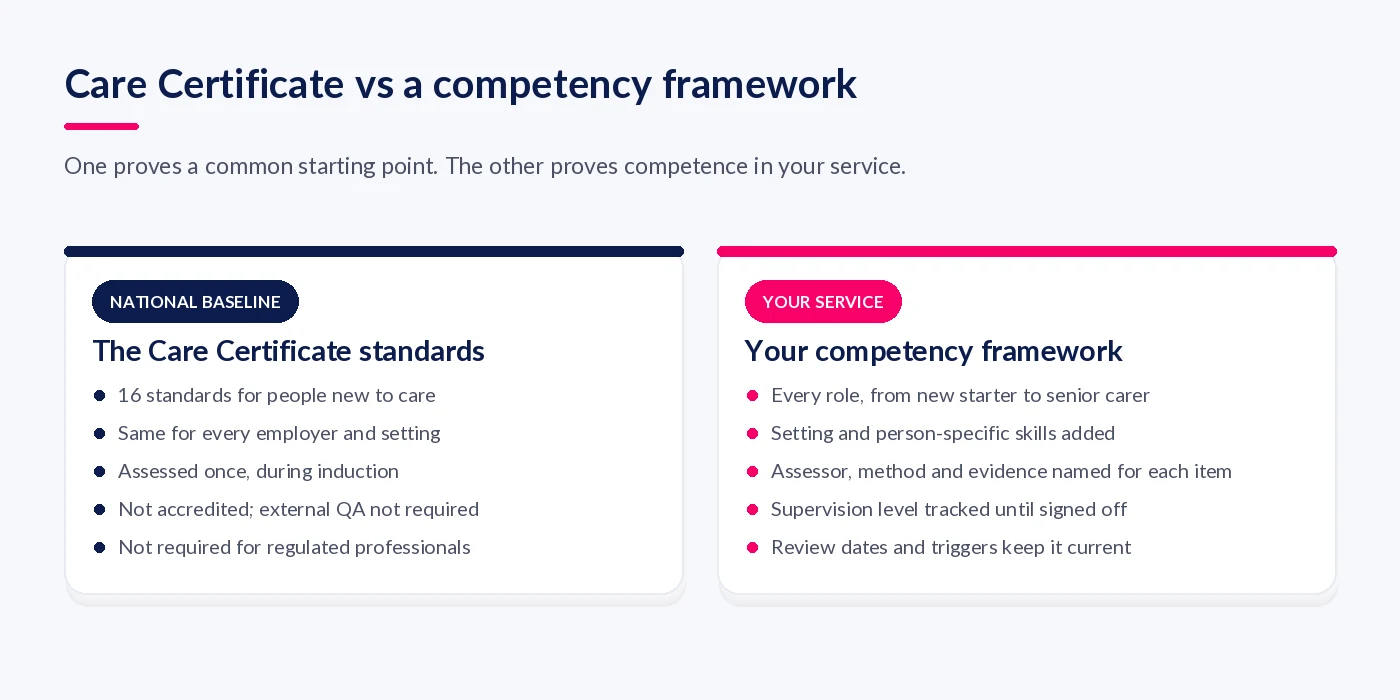
The government's Care Workforce Pathway points the same way. Its "care or support worker" role category sets out values, behaviours, knowledge and skills, and asks people to show the baseline from the "new to care" category. On setting-specific training it says: "We expect organisations to define their own setting-specific training based on the needs of the people drawing on care and support." In other words, the national material deliberately stops where your service starts.
Four layers that make it yours
The frameworks I have seen hold up best at inspection share a simple structure. Each layer answers a different version of "competent at what?".
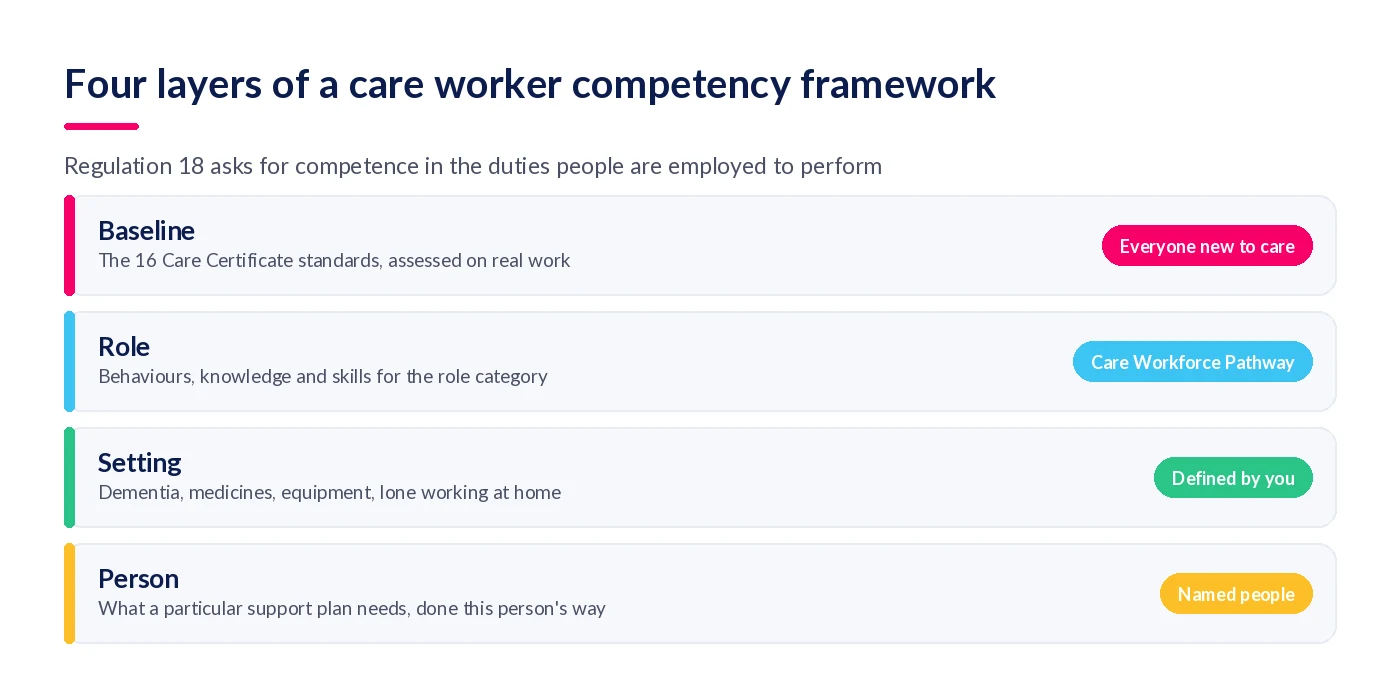
- Baseline. The 16 standards, assessed on real work for anyone new to care.
- Role. What a care or support worker, senior carer or team leader must do, drawn from the pathway's role categories.
- Setting. Dementia care, medicines, the hoists and slings you use, lone working in people's homes. This is the layer the pathway leaves to you.
- Person. What a specific support plan needs: a particular communication approach, a specific piece of equipment, how this person likes things done.
Medicines shows why the setting layer cannot be optional. NICE guideline SC1, Managing medicines in care homes, says care home providers "must ensure that designated staff administer medicines only when they have had the necessary training and are assessed as competent". It also says staff who lack the skills "despite completing the required training" must not be allowed to administer medicines. Training and competence are treated as two separate gates.
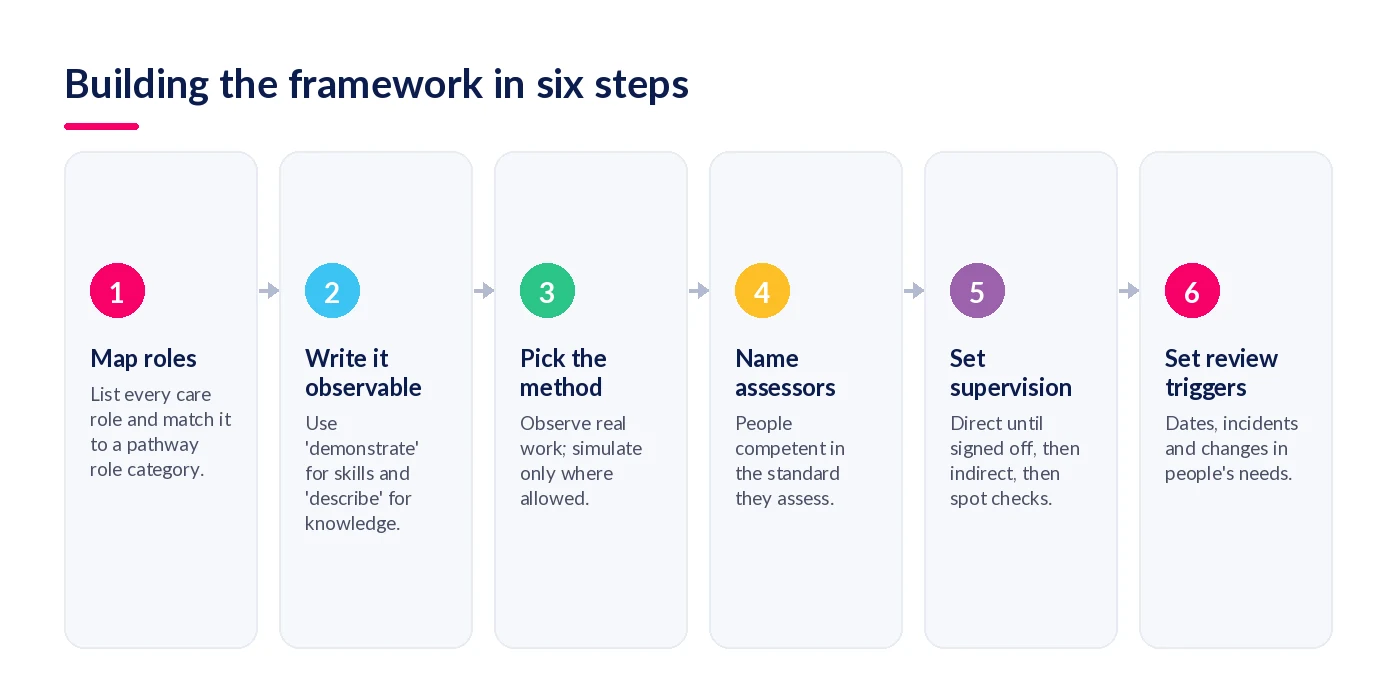
Building the framework, step by step
1. Map every care role
List the care roles you actually employ, not the job titles on the org chart. Match each to a Care Workforce Pathway role category so the baseline expectations are borrowed rather than invented. Agency and bank staff need a route too.
2. Write competencies as things you can observe
The Care Certificate guide separates the two kinds of outcome by their verbs. Outcomes starting "demonstrate", "take steps to", "use" or "show" need performance evidence. Outcomes starting "describe", "explain", "define", "list" or "identify" are knowledge, and can be evidenced by written or verbal answers, case studies or sound files. Write your own items the same way and the assessment method almost chooses itself.
3. Choose the assessment method for each item
Performance evidence, the guide says, "must be undertaken in the workplace during the learner's real work activity and observed by the assessor unless the use of simulation is expressly allowed". Simulation is for things that could not reasonably be assessed in real work or are unlikely to happen during induction, with basic life support as the example. The guide also rules out remote video or live recordings where they would compromise people's dignity and confidentiality.
4. Name your assessors
An assessor "must be competent in the standard they are assessing". There is no requirement for an assessor qualification, but the employer must be confident the person is competent to assess, and the guide suggests unqualified assessors work to the National Occupational Standard for assessing learner achievement. The same senior carer may be right for privacy and dignity and wrong for basic life support. Record who can sign off what.
5. Set supervision levels and phased sign-off
The guide describes direct supervision, where the worker is "in the line of sight of the supervisor", and indirect or remote supervision for those assessed as competent to work without it. The Care Certificate standards "must be completed and assessed, before new support workers can practice without direct supervision", and this can be phased standard by standard. Your framework should show, for each person, which tasks they can do alone today.
6. Set review dates and triggers
Competence decays and needs change. NICE SC1 recommends care home staff have "an annual review of their knowledge, skills and competencies relating to managing and administering medicines", and says this may need to be more often after a medicines-related safety incident. Use that pattern everywhere: a date, plus triggers such as an incident, new equipment, or a change in a person's needs.
Evidence that would survive an inspection
The guide sets the bar high: assessment "should be as rigorous as the assessment of any formal qualification", and evidence must be valid, authentic, current, reliable and sufficient. Acceptable evidence includes observation and competency check records, witness testimony, discussion, written or oral answers, small projects, multiple-choice questions and records of simulated activity.
One line is worth pinning above every training manager's desk: "Certificates of attendance, attendance on study days or eLearning without summative assessment of what has been learnt is not evidence" toward the standards. The guide adds that eLearning "alone cannot provide full achievement".
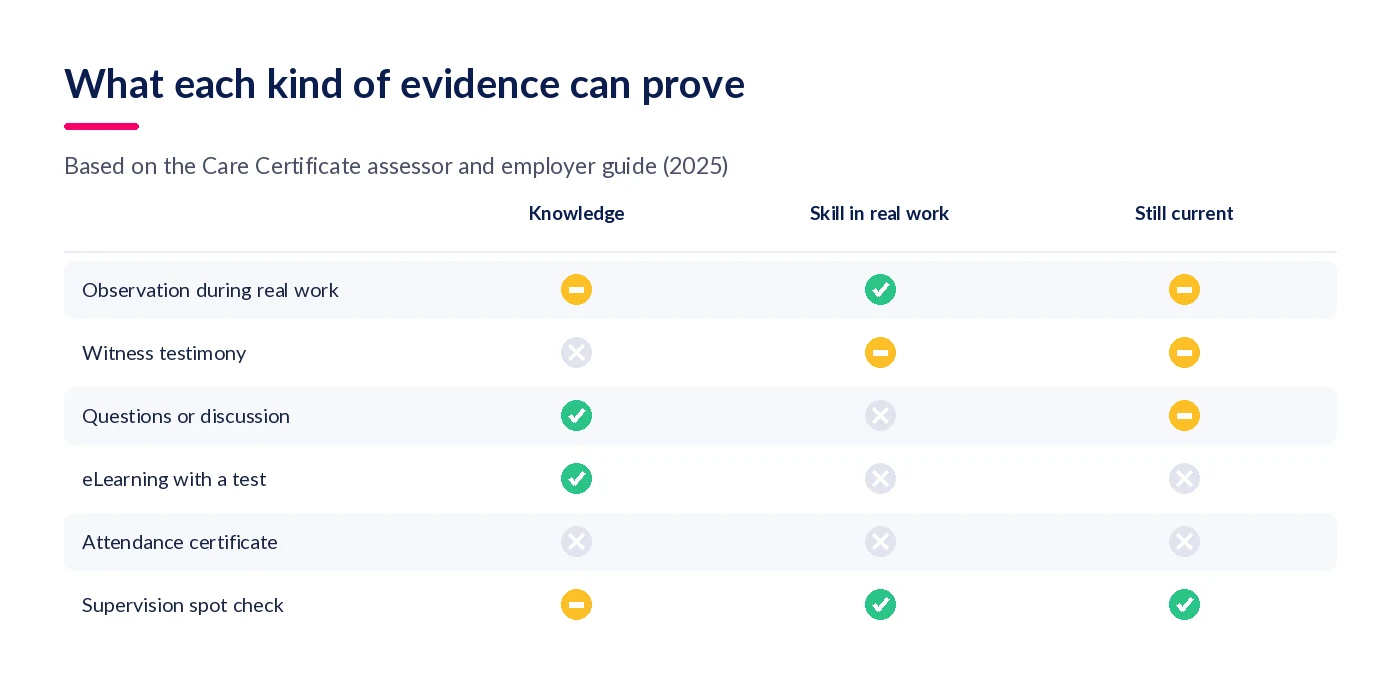
Assess holistically where you can. One observed morning of personal care can evidence communication, privacy and dignity, infection control and duty of care at once. The guide notes an assessor may be satisfied after observing someone "across one span of duty", or may need further observations.
Where care competency frameworks go wrong
Training completion is reported as competence
A dashboard that shows 100% of staff "complete" on safeguarding eLearning says nothing about whether anyone has been seen doing the work well. If your framework cannot tell knowledge and performance apart, it is a training matrix with a new name. Our guide to the mandatory training matrix covers that layer properly.
Sign-off happens once
The guide says that even after certification, supervisors should "check and re-check periodically" whether supervision and delegation remain appropriate, using techniques such as unannounced visits and spot checks. Its conclusion is blunt: "no support worker should be working totally unsupervised."
One framework for every setting
A group running residential, nursing and home care services under one generic framework will miss the setting layer every time. Keep the baseline shared and let each service add its own.
Supervision that never mentions competence
Supervision meetings often drift into rotas and sickness. CQC's guidance links supervision directly to maintaining competence, so each supervision record should say which competencies were discussed, observed or due.

Evidence sits in a folder nobody can find
The guide expects the record to be maintained locally and made available to the worker so they can evidence their achievement to others, and in adult social care points to the Adult Social Care Workforce Data Set as somewhere it can be recorded. Paper folders in a manager's office meet neither need well.
What one role looks like on paper
Here is a short, illustrative extract for a care or support worker in a residential service. Your own items will differ; the shape is the point.
| Competency | How it is assessed | Evidence kept | Checked again |
|---|---|---|---|
| Maintains privacy and dignity during personal care (standard 7) | Observed during real personal care | Signed observation record | Supervision spot checks |
| Administers medicines safely (setting layer) | Training, then observed administration before working alone | Training record plus competency assessment | At least annually; sooner after an incident |
| Basic life support (standard 12) | Simulation, as the guide allows | Assessor record of simulated activity | On your refresher cycle |
| Supports autistic people and people with a learning disability (standard 16) | Discussion plus observation with people the worker supports | Answers and observation notes | Supervision; when support plans change |
| Uses the hoist and slings for a named resident (person layer) | Observed with that resident's equipment | Observation record linked to the support plan | When equipment or needs change |
For more on choosing methods, see our guide to competency assessment methods, and for writing the descriptors themselves, behavioural indicators and proficiency levels.
Running it in StaffCircle
One framework, layered by role and service
StaffCircle's competency framework tools let you hold a shared baseline and add role and setting competencies for each service, so a home care team and a nursing home team can share the Care Certificate layer without sharing everything else.
Assessments with evidence and review dates
Competency assessments can record the assessor, the method and the evidence, with review dates that raise alerts before they lapse. That gives you the "checked again" column without a spreadsheet, and the same records feed your skills compliance reporting.
Supervision and appraisal in the same place
One-to-ones and reviews sit alongside the competency record, so a supervision conversation can pick up the competencies that are due or were observed. When an inspector asks how you know someone is still competent, the answer is one screen, not three folders.
The bottom line
The Care Certificate gives everyone new to care the same starting point. Regulation 18 asks for something more specific: competence in the duties each person is actually employed to perform, supervision until that is shown, and supervision afterwards to keep it. A care worker competency framework is how you prove both, role by role and person by person. If you are getting ready for an inspection, our audit preparation guide is a useful next read.
If your competence records still live in binders and spreadsheets, book a StaffCircle demo to see how frameworks, assessments, evidence and supervision can sit in one place.
FAQ
What is a care worker competency framework?
It is the written set of skills, knowledge and behaviours each care role needs, with how each item is assessed, who signs it off, what evidence is kept and when it is reviewed. It builds on the Care Certificate standards with role, setting and person-specific competencies.
Is the Care Certificate a legal requirement?
The Care Certificate standards are not themselves law. Regulation 18 and CQC's guidance require an induction programme and appropriate training and supervision, and the assessor and employer guide describes the standards as a component that can support the induction employers must provide.
Does completing the Care Certificate mean a care worker is competent?
It shows they met the 16 national standards for people new to care. The assessor and employer guide says it does not replace workplace-specific induction and is only one element of what makes someone ready to practise in a specific workplace.
What does CQC Regulation 18 say about training and competence?
Regulation 18 requires sufficient suitably qualified, competent, skilled and experienced staff, and says staff must receive the support, training, professional development, supervision and appraisal necessary to carry out the duties they are employed to perform.
Can a care worker work unsupervised before finishing the Care Certificate?
The assessor and employer guide says the standards must be completed and assessed before new support workers practise without direct supervision. This can be phased, so a supervisor may allow indirect supervision for each standard once it has been met.
Who can assess the Care Certificate?
Someone competent in the standard they are assessing. No assessor qualification is required, but the employer must be confident the person is competent to assess. Different assessors may be needed for different standards, such as basic life support.
Does eLearning count as evidence of competence?
Only for knowledge, and only with summative assessment such as questions. The guide says eLearning alone cannot provide full achievement, and attendance certificates or eLearning without assessment are not evidence toward the standards. Skills must be assessed in real work.
How often should care worker competency be reassessed?
There is no single national interval for every task. NICE SC1 recommends an annual review of medicines competencies for care home staff, sooner after a medicines incident. CQC's guidance expects ongoing or periodic supervision to make sure competence is maintained.
What happens if a provider breaches Regulation 18?
CQC says it cannot prosecute for a breach of Regulation 18, but it can take regulatory action. It must also refuse registration if a provider cannot satisfy it that they can and will continue to comply.
What is the difference between the Care Certificate and the Level 2 Adult Social Care Certificate?
The Care Certificate standards are not accredited and are signed off by the employer. The Level 2 Adult Social Care Certificate is an accredited, Ofqual-regulated qualification based on the same 16 standards, and the guide describes it as a separate product.
What is the Care Workforce Pathway?
It is a government framework for adult social care careers in England that sets out values, behaviours, knowledge and skills by role category, such as new to care and care or support worker. It expects organisations to define their own setting-specific training.
Do nurses need to complete the Care Certificate?
No. The standards were designed with the non-regulated workforce in mind, and regulated professionals such as nurses gain similar skills and knowledge within their professional training, so they do not need to achieve it.
How many Care Certificate standards are there?
There are 16 standards in the 2025 version. The sixteenth, awareness of learning disability and autism, was added when the standards were updated in March 2025.
Related articles

See StaffCircle in action
Book a personalised demo and see how StaffCircle drives performance, engagement and development.