Training Needs Analysis Template: Organisation, Team and Individual
Many TNA templates are a single grid of names and scores. This one works at all three levels, starts from evidence rather than wish lists, puts statutory training first and plans how you will measure the result before any money is spent.
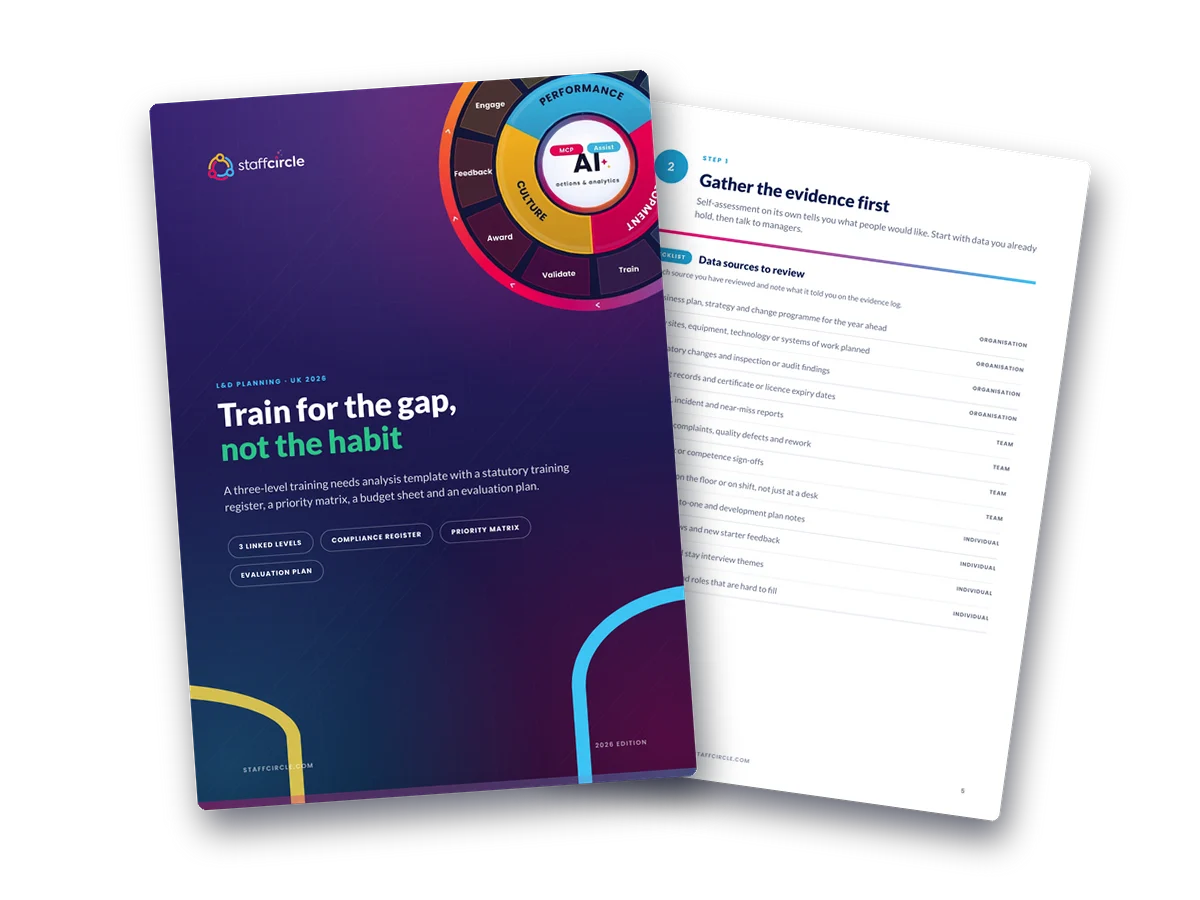
- Organisation, team and individual worksheets that roll up into one plan
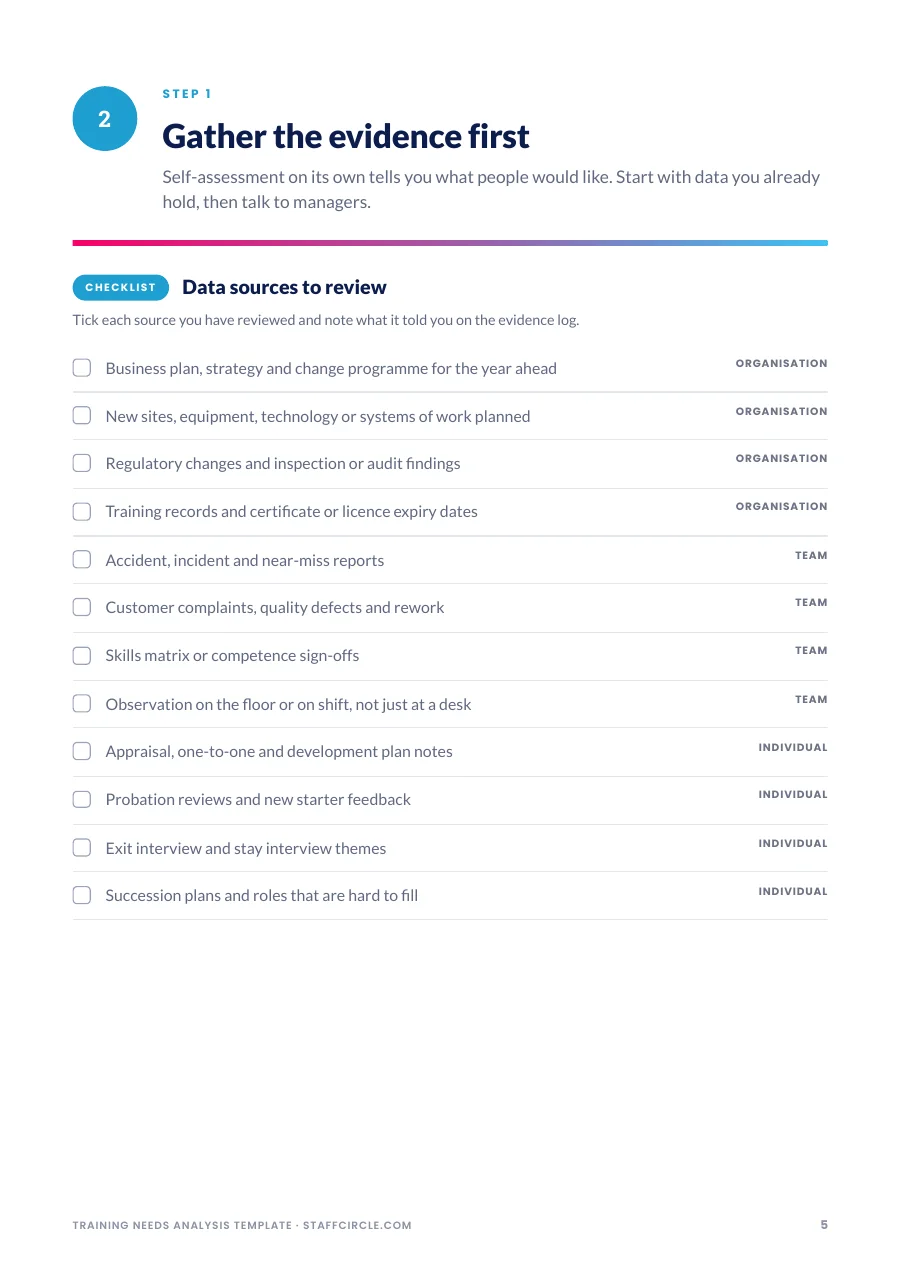
- A data-sources checklist and manager interview questions
- A statutory and compliance training register with the UK legal basis
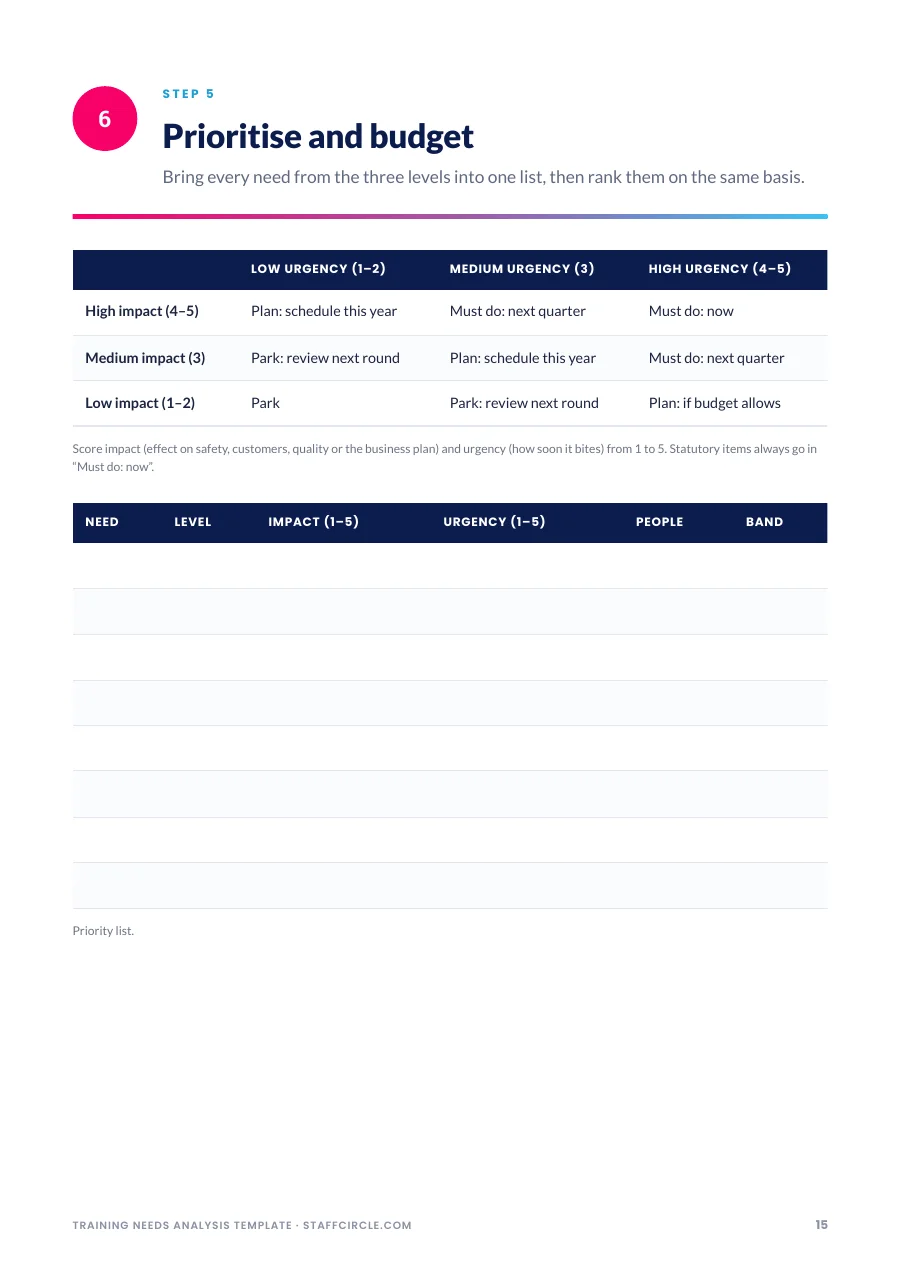
- An impact × urgency priority matrix and a budget sheet with backfill costs
- An evaluation plan with a baseline, a target and a review date for every need
Get your free template
Fill in your details to get the PDF and the editable Word version. We’ll email you the PDF too.
We’ll only use your details to send the template and relevant StaffCircle content. See our privacy policy.
Trusted by teams at leading organisations


The numbers behind it
Seven sections, from evidence to evaluation
What a TNA is for
The three levels, HSE's five steps and the training UK law already requires.
Gather the evidence
A data-sources checklist and manager questions that get past “we'd like more training”.
Organisation and compliance
A strategy worksheet and a statutory training register with the legal basis for each item.
Team and individual
A role worksheet with a five-cause test, and an individual needs record for each person.
Prioritise and budget
An impact × urgency matrix, cost per need including backfill for shift staff, and 2026 levy changes.
Evaluate
Set the baseline, target and review date before you buy, then sign the plan off.
How to run a training needs analysis that changes something
A training needs analysis is not a survey asking people what courses they would like. It is a decision about where training will make a measurable difference, and where it will not.
Ask a team what training they need and you will get a list of courses. Ask what is going wrong, what is about to change and what the law requires, and you will get a plan. That is the difference between a wish list and a training needs analysis (TNA), and it is why this template starts with evidence rather than a questionnaire.
Many TNA templates you will find online are a single grid: names down one side, skills across the top, a score in each box, lowest score first. That is useful for a team, but it misses three things L&D teams are asked about every year: which training is a legal requirement, which needs matter most to the business, and whether the training worked.
The three levels
A complete TNA looks at three levels, and each one feeds the next:
- Organisation. What the business is trying to do, what is changing (new sites, equipment, systems, regulation) and what training is required by law for the roles you employ.
- Team or role. What each role has to do well, where performance falls short and, crucially, whether training is the right fix at all.
- Individual. What each person needs to do their current job safely and well, and what they need to grow into the next one.
HSE describes the same journey in five steps: decide what training your organisation needs, decide your training priorities, choose your training methods and resources, deliver the training, and check that the training has worked (HSE, INDG345). The template follows that order.
Start with what the law already requires
No UK law requires a document called a training needs analysis. But employers must provide the information, instruction, training and supervision needed to keep employees safe, so far as is reasonably practicable (Health and Safety at Work etc. Act 1974, section 2). Health and safety training must be given when people are recruited and when they face new or increased risks, repeated periodically where appropriate, and take place during working hours (Management of Health and Safety at Work Regulations 1999, regulation 13). Sector rules add more: care providers must give staff the training, supervision and appraisal they need to do their jobs, and FCA-regulated firms must review employee competence and training needs regularly.
That is why the template puts a statutory and compliance register at the organisation level. Those items are not weighed against everything else; they go to the top of the plan.
Not every gap is a training gap
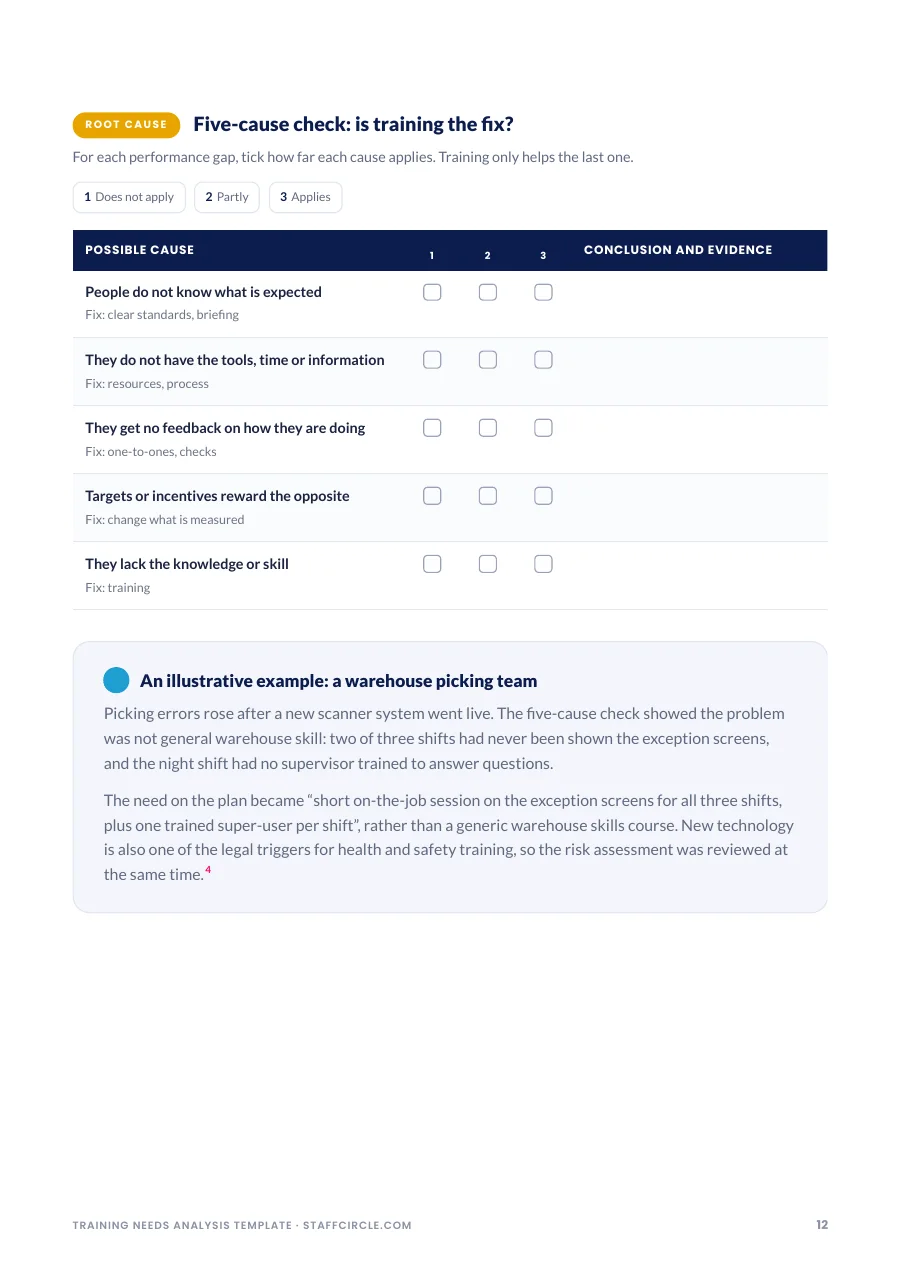
When a task keeps going wrong, the cause is often something training cannot fix: people do not know what is expected, they do not have the right tools or time, nobody tells them how they are doing, or the way they are measured pushes them the other way. The team worksheet includes a five-cause check so you only spend money on training when the gap really is knowledge or skill. HSE makes a similar point about manual handling: training can raise awareness and reduce risk, but it will not ensure safe handling on its own.
Prioritise, cost and plan the evaluation up front
- Score each need on business impact and urgency, and note how many people it affects.
- Cost it properly. Include backfill or overtime for shift workers: relevant training generally counts as working time, and for minimum wage purposes training that replaces normal working hours counts as hours of work.
- Check your funding. Growth and Skills Levy rules changed for new starts from August and September 2026, so check gov.uk before you commit levy funds.
- Write down the baseline and target before you buy anything, and set the review date.
If you already keep a skills matrix, it becomes the main input to the team level; our skills matrix template shows how to build one. For the statutory side, see our guide to building a mandatory training matrix, and for evaluation, our overview of training evaluation models. You can also read more about the training needs analysis process on our blog.
StaffCircle keeps skills, development plans and one-to-one notes in one place, so you can keep the individual level of your TNA up to date after each one-to-one, including for frontline staff on mobile.
Training needs analysis: common questions
What is a training needs analysis?
A training needs analysis (TNA) is a structured review of the gap between the skills and knowledge your organisation needs and what people have now. It decides which gaps training should close, in what order, at what cost, and how you will know it worked.
What are the three levels of a training needs analysis?
Organisation (strategy, change and legal requirements), team or role (what each role must do well and where performance falls short) and individual (what each person needs for their current and next role). This template has a worksheet for each level.
Is a training needs analysis a legal requirement in the UK?
No law requires a document called a TNA. But employers must provide the training needed for health and safety, so far as is reasonably practicable, and give health and safety training on recruitment and when people face new or increased risks. Some sectors, such as care and financial services, have their own training and competence rules.
How often should you do a training needs analysis?
Many organisations run a full TNA once a year to feed the training budget, and update it when something changes: a new site, new equipment or systems, a change in regulation, or a pattern in incidents or complaints. Health and safety training must be repeated periodically where appropriate.
Who is responsible for a training needs analysis?
Typically, L&D or HR owns the process and the organisation-level view, line managers complete the team and individual levels because they see the work, and senior leaders sign off priorities and budget. Employees should be part of the individual conversation, not just the subject of it.
Do employees have to be paid for training time?
Time spent on relevant training (“relevant training” has a specific legal meaning and excludes some courses run by colleges and training providers) counts as working time under the Working Time Regulations, and training hours count towards National Minimum Wage hours where the worker would otherwise be working. Health and safety and fire safety training must take place during working hours.
Can an employee ask for time off for training?
Yes, in some cases. GOV.UK says employees with at least 26 weeks' service in an organisation with at least 250 people can make a statutory request for time off to train, once a year. The employer has 28 days to respond and does not have to pay for the training. Check gov.uk for the latest.
What is the difference between a training needs analysis and a skills gap analysis?
A skills gap analysis compares required and current skill levels. A TNA goes further: it checks whether training is the right fix, adds legal requirements, prioritises needs, costs them and plans evaluation. A skills matrix is often the main input to the team level of a TNA.
Get the training needs analysis template
Download the PDF and the editable Word version. Seven sections, ready to use at your next planning round.