360 Feedback Questions: 80 Questions by Competency
Many 360 templates hand every rater the same list and a scale nobody reads the same way. This one sorts 80 questions into six competencies, says which raters answer each, anchors every score to behaviour you can see, and covers the anonymity and data protection rules that keep a 360 honest.
- 60 rated statements in six competencies, including customer focus and safety
- 20 open questions split by self, manager, peers and direct reports
- A five-point rating scale with behavioural anchors for every competency
- Rater thresholds, a rater notice to copy and the UK data protection rules
- A debrief guide and a one-page development plan
Get your free question bank
Fill in your details to get the PDF and the editable Word version. We’ll email you the PDF too.
We’ll only use your details to send the question bank and relevant StaffCircle content. See our privacy policy.
Trusted by teams at leading organisations


Five sections, from set-up to development plan
What a 360 is for
Why it should stay out of pay decisions, what the evidence says, and the six competencies.
Raters and anonymity
Who to invite, reporting thresholds, data protection, a rater notice and running it on shift.
An anchored scale
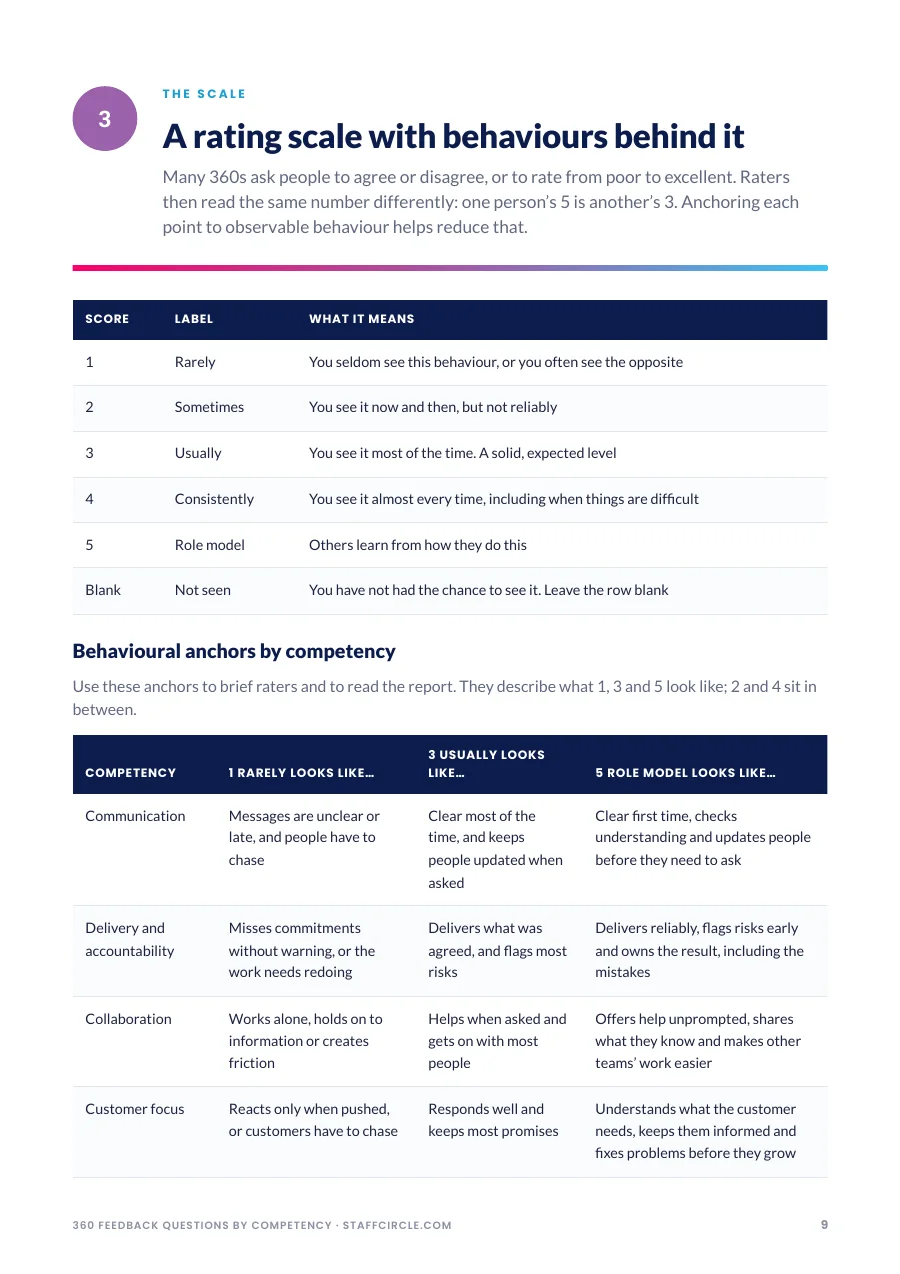
Five points defined by observable behaviour, with anchors for every competency.
The questionnaire
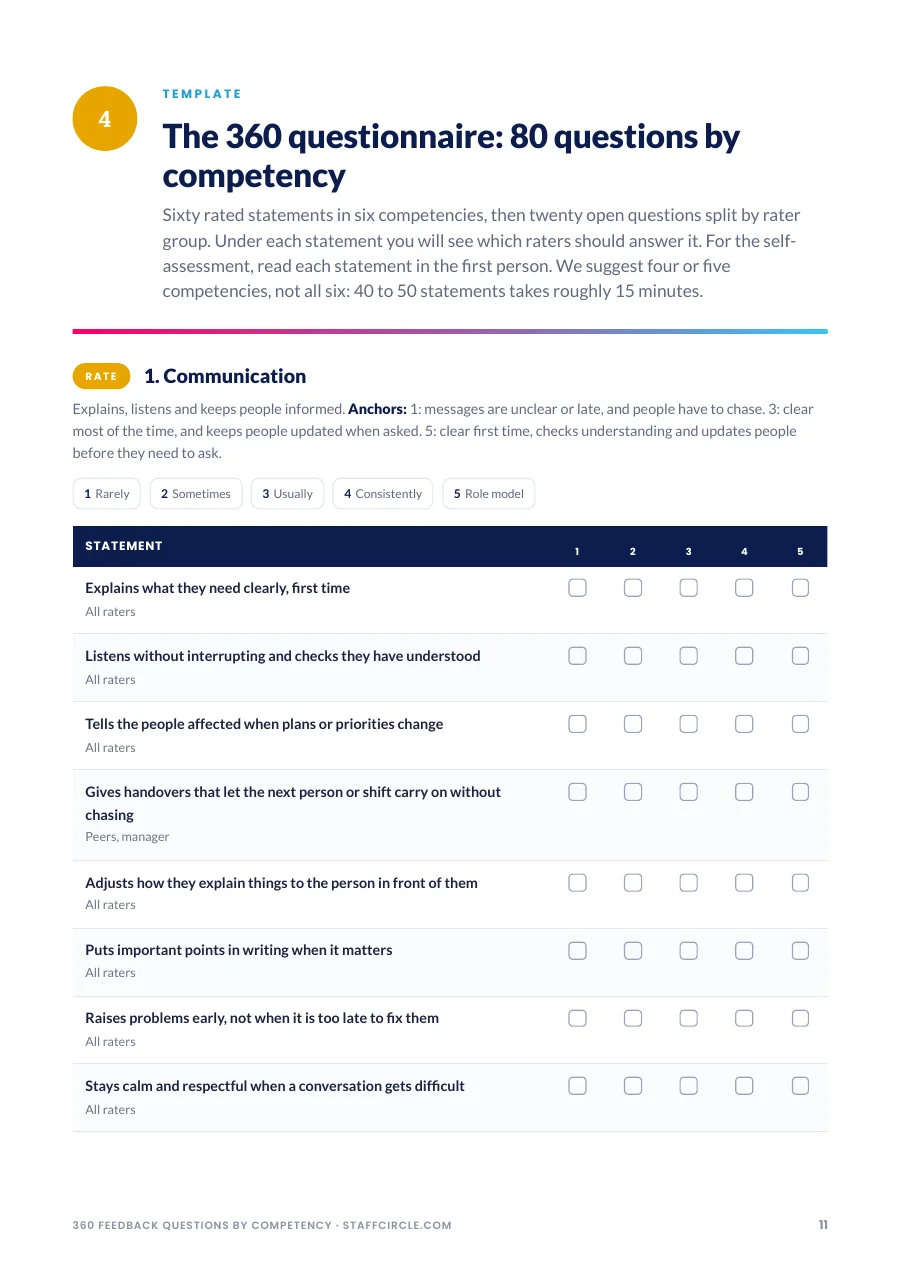
60 rated statements and 20 open questions, each marked with the raters who answer it.
Debrief and plan
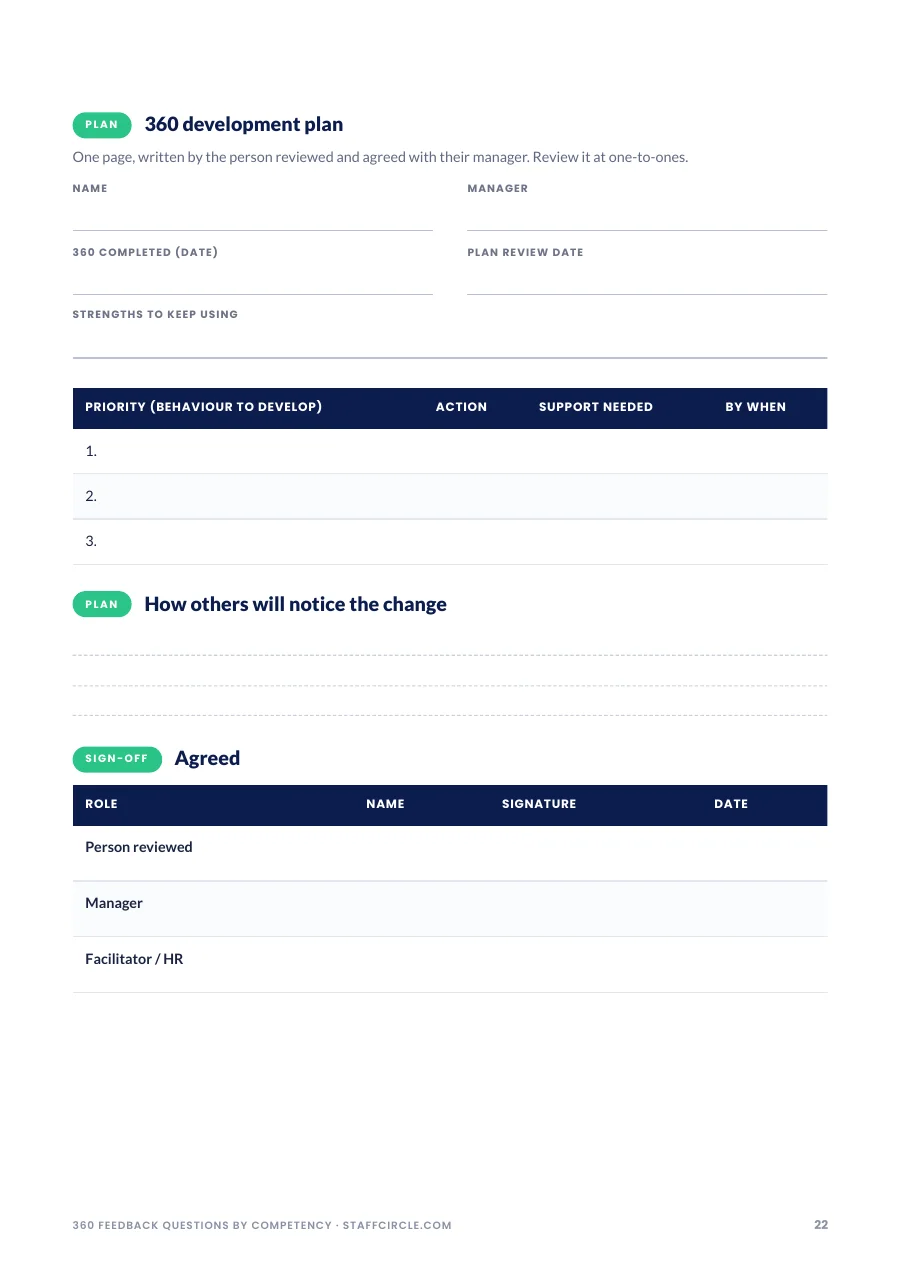
Reading the report, eight debrief prompts and a one-page development plan.
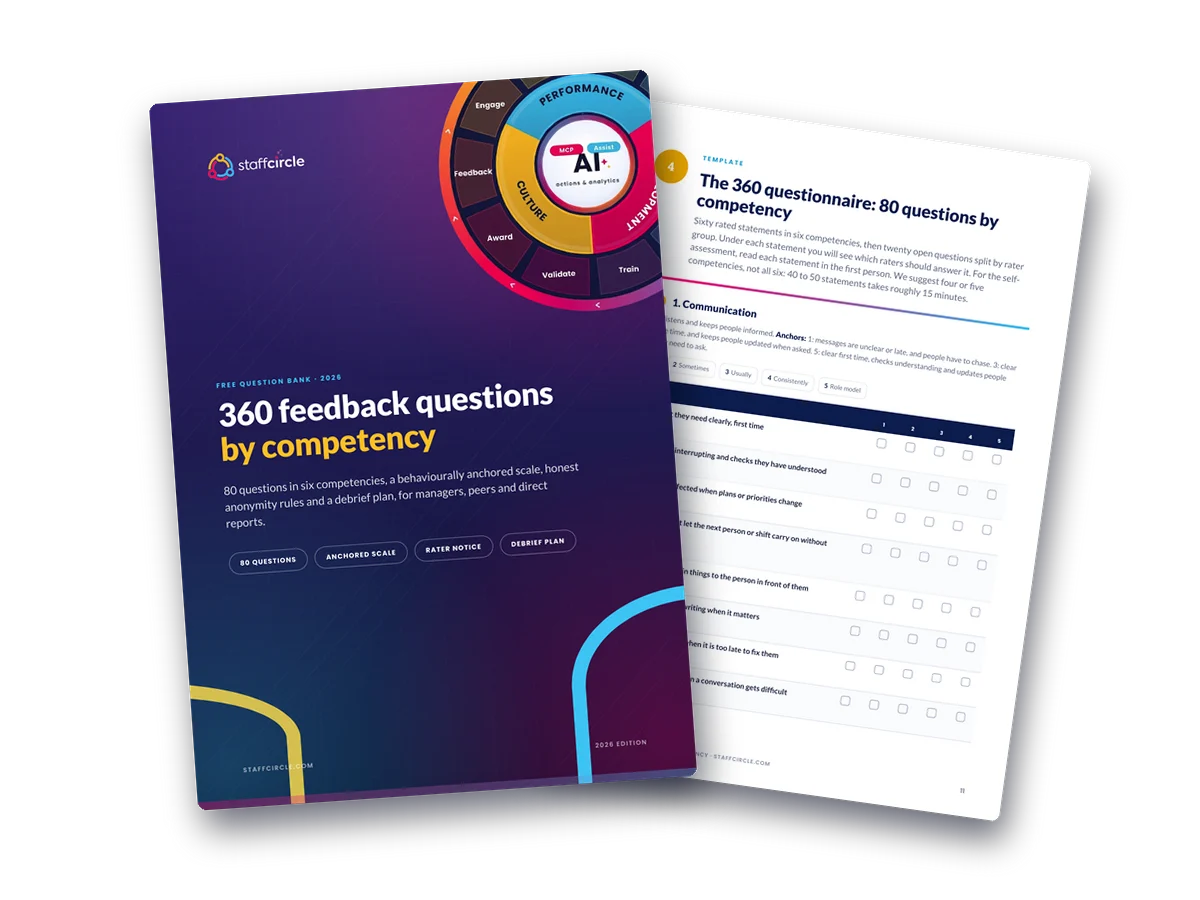
360 feedback questions that lead somewhere
A 360 is only as useful as the conversation that follows it. The questions get people talking; the debrief and the development plan are where behaviour changes.
Search for 360 feedback questions and you will find long lists of statements to agree or disagree with: communicates effectively, works well in a team, shows leadership. Many give every rater the same questions, use a scale that means something different to each person who reads it, and say little about anonymity or what happens after the report lands.
This template starts from the other end. It organises 80 questions by competency, says which rater group should answer each one, anchors every point on the rating scale to behaviour you could actually see, and sets out the rules that keep a 360 honest.
Six competencies, not three
Most 360s cover communication, delivery, collaboration and leadership. This one adds customer focus and safety and wellbeing, because for anyone working on a site, a ward, a shop floor or a customer desk, those are the behaviours colleagues see every day. Every employee already has a legal duty to take reasonable care of themselves and others affected by their work (Health and Safety at Work etc. Act 1974, section 7), and HSE notes that appraisals of senior managers can include their contribution to health and safety performance (HSE INDG417).
A scale everyone reads the same way
Ask five people what a 4 out of 5 means and you will get five answers. Some raters never give a 5; others give one to anyone they like. The template replaces agree-or-disagree labels with five points defined by what you would see: Rarely, Sometimes, Usually, Consistently and Role model. Each competency then has written anchors for 1, 3 and 5. For safety and wellbeing, for example, a 1 is someone who takes shortcuts or stays quiet about hazards, and a 5 is someone who speaks up, looks out for others and leads by example under pressure. Raters who have not seen a behaviour leave the row blank, so a gap in the report means no evidence, not a low score.
Keep it for development
The CIPD’s evidence review says appraisal can serve two purposes, administrative and developmental, and that using the same evaluations for both is likely to be unfair and hard for employees to process (CIPD). A meta-analysis of 24 longitudinal studies found that improvement after 360 feedback is generally small, and likely only for people who take action afterwards (Smither, London and Reilly, 2005). That is why the template ends with a debrief guide and a development plan, not a score.
Be honest about anonymity
- Report groups, not people. Show peer and direct-report results only when three or more people in the group have responded.
- Name the manager. With one manager there is no anonymity, so say so.
- Promise confidential reporting, not secrecy. Comments about someone can be requested through a subject access request. You do not have to reveal another person’s identity unless they consent or it is reasonable to disclose it without their consent, but you must still provide as much as you can (ICO).
- Brief raters. The CIPD recommends training people to minimise bias and use their observations to inform feedback.
Five steps to a 360 that changes something
- Agree that the 360 is for development only, and put it in writing
- Pick four or five competencies and the raters who have actually seen the work
- Send the rater notice and give frontline staff time on shift to respond
- Debrief within two weeks of the report, starting with the person’s own reaction
- Agree two or three priorities in a written development plan and review it at one-to-ones
The download includes the full questionnaire, the anchored scale, a set-up checklist, a rater nomination form, a rater notice you can copy, a debrief guide and a development plan, as a printable PDF and an editable Word file. To run 360s without spreadsheets, see StaffCircle 360 feedback, build your competencies with our competency framework guide, or read about bias controls in 360 reviews.
360 feedback questions: common questions
What are good 360 feedback questions?
Good 360 questions describe one observable behaviour each, such as “says early when a deadline is at risk”, rather than a trait like “reliable”. Group them by competency, give each rater group the statements they can actually see, and add a few open questions such as start, stop and continue. This template has 60 rated statements and 20 open questions.
How many raters do you need for a 360 review?
We suggest inviting the manager, four to six peers and, for people managers, their direct reports, plus a self-assessment. A common approach is to report a peer or direct-report group only when at least three people have responded (the Center for Creative Leadership uses this threshold), so invite more than three to allow for non-responses. Three is not a legal rule.
Is 360 feedback anonymous?
Only partly. Peer and direct-report feedback can be reported in groups so individuals are not identified, but the manager is usually one named person, so their feedback is not anonymous. Comments can also be requested through a subject access request, with identifying details removed. Promise confidential reporting rather than complete anonymity.
Can an employee see 360 feedback comments through a subject access request?
They can ask for them, because comments about the employee are their personal data. The ICO says you do not have to reveal another person’s identity unless they consent or it is reasonable to disclose it without their consent, but you must still provide as much of the information as you can. You normally have one month to respond. Take advice on individual requests.
Should 360 feedback be linked to pay or performance ratings?
We recommend not. The CIPD says using the same evaluations for both pay and development is likely to be unfair and hard for employees to process, and advises keeping those conversations separate. Research on 360s also found more positive gains when the feedback was used only for development, although the authors note few studies used it for pay or ratings.
How often should you run 360 feedback?
We suggest once a year. Acas says it is a good idea to hold performance reviews at least once a year, and people need time to act on their development plan before the same raters are asked again. Check acas.org.uk for the latest guidance.
What rating scale should a 360 use?
A five-point scale where each point is defined by behaviour, plus a way to say “not seen”. This template uses Rarely, Sometimes, Usually, Consistently and Role model, with anchors describing what 1, 3 and 5 look like for each competency, so raters read the numbers the same way.
How do you share 360 results with an employee?
Share the report a day or two before a 45 to 60 minute debrief. Start with the person’s own reaction, then strengths, then the gaps between their self-ratings and others’. Agree two or three priorities and write them into a development plan. For performance reviews, Acas advises keeping a written record and sharing it with the employee afterwards.
Can you run 360 feedback with frontline or shift workers?
Yes. In our experience it works best if you choose raters who have worked the same shift or site recently, give paid time on shift to respond, offer a phone link, a shared tablet and a paper copy, and keep the window open for at least two full shift cycles so nights and weekends are included.
Run a fairer 360 this quarter
80 questions, an anchored rating scale, a rater notice, a debrief guide and a development plan, as PDF and Word.