How to Optimise AI Use in HR: From Access to Real Adoption
AI has moved from experiment to expectation in HR. 93% of Fortune 500 CHROs say they are already using AI in their organisation (Gallup), and across the wider workforce almost half of people now use AI as part of their regular routine. On paper, adoption looks solved.
Look closer and a more interesting picture appears. Usage is climbing, but confidence is falling. Handing people access to AI tools is easy; getting real, measurable value from them is a different discipline — and it’s the one that separates the organisations pulling ahead from the ones quietly stalling.
This article looks at what the latest workforce data tells us about how AI is actually being used in HR, why so many rollouts underdeliver, and the practical steps that turn access into adoption — and adoption into outcomes.
The AI adoption paradox: usage up, confidence down
ManpowerGroup ran one of the largest workforce studies of the year, covering 13,918 workers across 19 countries. They found that 45% of people now use AI as part of their regular work routine, up 13 percentage points year on year. The surprising part: over the same period, how comfortable people feel with the technology fell by 18 percentage points — the first decline in three years.
The drop wasn’t evenly spread. Confidence fell by around 35% for Baby Boomers and 25% for Gen X. And it lines up with a preparation gap: 56% of workers said they hadn’t been through any recent upskilling, and 57% said nobody was guiding their career progression.
In other words, organisations are handing people AI tools without giving them the preparation to use those tools well. The tools underperform, leadership questions the spend, and the next AI proposal becomes harder to fund.
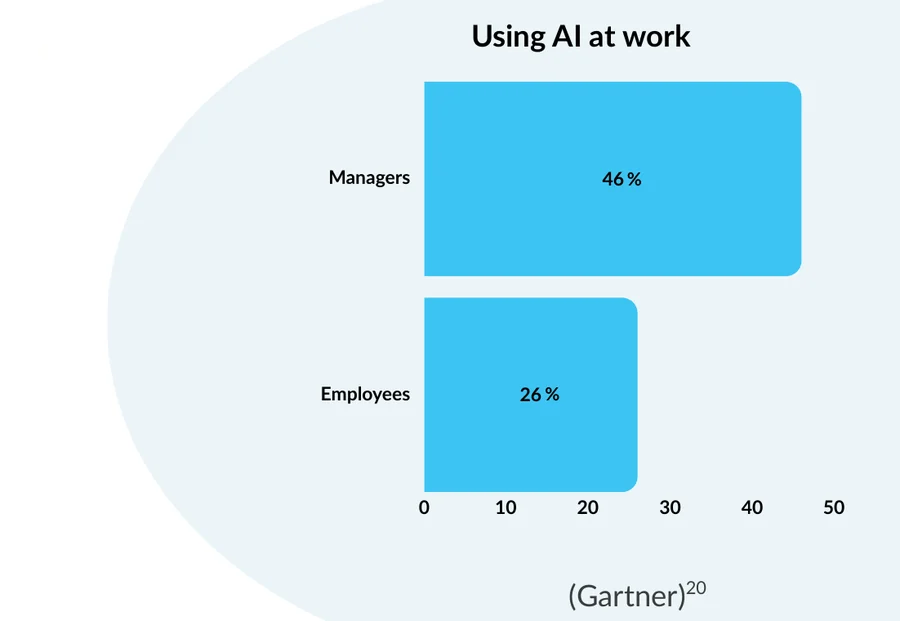
There’s a pattern worth noting: managers are trying AI far faster than employees — 46% versus 26% (Gartner). Managers decide, day to day, whether AI gets used or ignored by their teams. Equip them well and adoption spreads naturally; skip them and it stalls.
Access is not adoption
The single most common mistake we see is confusing access with adoption. Giving employees a login to an AI tool is step one. But if that tool goes untouched between quarterly reviews, you have access without adoption. Real adoption looks different: the tool is woven into the processes people already run, connected to real work, and producing outcomes you can point to in a board meeting.
That distinction changes how you measure success. Counting how many prompts were run or reports generated tells you about activity. It tells you nothing about value.
Five ways to optimise AI use in HR
If the goal is outcomes rather than activity, a handful of moves make the biggest difference.
1. Lower the learning curve
For most people the number one barrier isn’t trust — it’s writing a good prompt. Tools that handle the prompting for you remove that barrier entirely. StaffCircle’s AI Assist builds the prompt from your data, so the user only has to describe what they want in everyday language. When the friction of “how do I ask this?” disappears, so does much of the hesitation behind falling confidence.
2. Build AI literacy into development, not around it
Investing in AI literacy is no longer optional. Gartner polled 12,004 employees across 40 countries and found that people who had learned to apply AI across more than one area of their job were outperforming their peers by a wide margin — 2x more productive and 2.3x stronger on work quality. Build AI skills into your competency frameworks and development plans; it’s directly tied to the quality of output your team produces.
3. Start with one workflow
Organisations that deploy AI across every HR process at once overwhelm their teams and make it impossible to see what’s working. Pick one high-impact workflow — performance reviews, skills reporting or objective setting — prove the value with that group, then expand from a position of evidence.
4. Equip managers first
As the data shows, managers are the pivot point for adoption. HR leaders who focus only on employee-level rollouts miss the group with the most influence. Give managers tools they can genuinely use in their own work — drafting feedback, booking reviews, tracking objectives — and adoption spreads through their teams.
5. Measure outcomes, not activity
To justify AI to a finance team, connect it to a business metric. Four measures work well:
- Time recovered: hours saved across the HR function. If a performance write-up drops from 40 minutes to 5, the saving is measurable from day one.
- Cost avoided: reduced spend on consultants, external hires or manual reporting.
- Speed to insight: a board talent report that took three days now taking ten minutes.
- Employee experience: completion rates, self-serve usage and engagement scores.
Why platform-embedded AI outperforms standalone tools
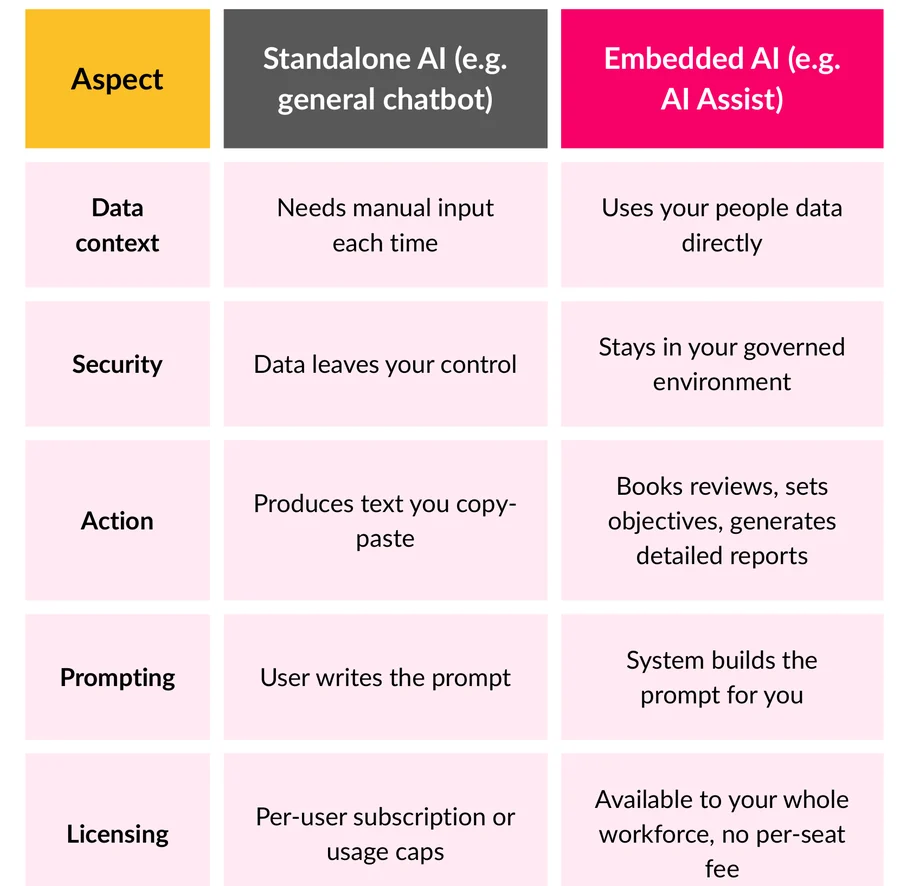
Many HR professionals already use AI at work — pasting review feedback into a general chatbot, drafting a job description in a free tool. These are handy shortcuts, but they aren’t a strategy. Three things separate a general-purpose chatbot from AI built into your HR platform: context, security and action.
A standalone tool doesn’t know your organisation — your competency framework, team structure or performance history — so it can only give generic answers. It also means employee data leaves your controlled environment, a real risk under GDPR, the EU AI Act and UK data protection law. And it stops at text: you copy the output, switch systems, and paste it back in. Embedded AI draws on your specific people data, stays inside your governed environment, and acts in the same place — booking reviews, setting objectives, generating reports linked back to the employee record.
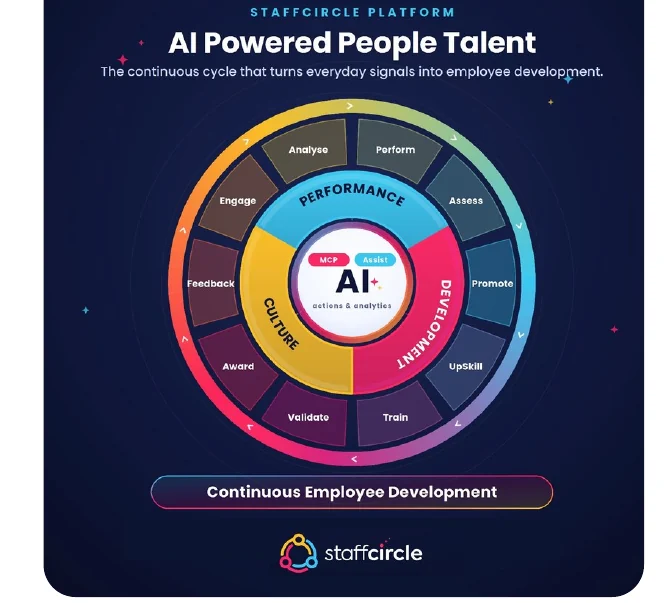
This is exactly where AI Assist sits. It unifies every StaffCircle module — Performance, Development, Engagement, HR Operations, Custom Insights and Notetaker — into one continuous employee-development environment. Ask it a question in plain language and answers stream back in real time; ask it to generate a skills-gap report for engineering and it produces one with KPIs and charts in seconds; ask it to cascade objectives across a team and it does the work — always with a human confirmation before anything changes. Because there is no per-user AI licensing, it’s available to your whole workforce rather than a handful of seats.
Governance is not something to add later
AI in HR touches some of the most sensitive data your organisation holds — performance ratings, salary information, disciplinary history. Using AI on that data without proper safeguards is a compliance risk, so governance belongs in your selection criteria from the start, not bolted on after an incident.
A useful signal is ISO/IEC 42001, the first international standard for AI management systems. Certification shows a vendor has built governance into the product rather than adding it as an afterthought. StaffCircle is ISO/IEC 27001:2022 certified and ISO/IEC 42001:2023 certified, with geo-protected hosting in UK and US data centres — and with AI Assist, nothing is created, updated or deleted without your explicit yes.
From questions to outcomes
HR has always had data; getting it out was the hard part. Running a report meant navigating filters, exporting to a spreadsheet, and formatting everything into something a manager could read. A simple question like “which departments have the most overdue reviews?” could take an hour. Natural language changes that: you type the question and the answer comes back, often with a chart or table, ready to share. When insight no longer requires technical skill, it reaches the people who actually need it — line managers, department heads, the C-suite.
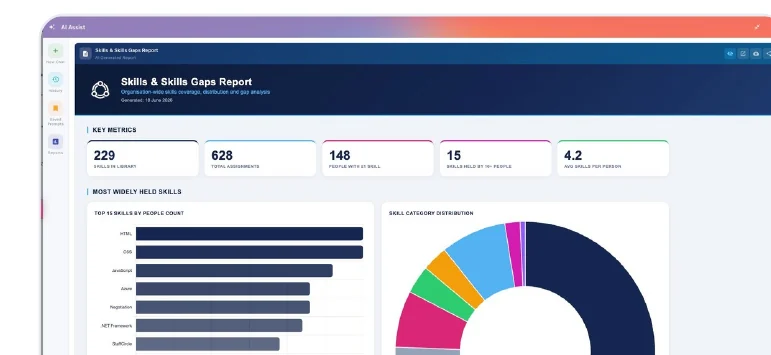
That’s the shift worth optimising for: from AI that answers to AI that gets the work done, safely, on your own data.
The takeaway
The organisations that win with AI in 2026 won’t be the ones with the most logins. They’ll be the ones that optimise adoption: lower the learning curve so nobody needs to be a prompt expert, build AI literacy into development, start with one workflow and prove it, equip managers first, and measure outcomes rather than activity — all on a platform that’s embedded and properly governed.
Access is the easy part. Adoption is where the value is. See how AI Assist brings frontier AI safely into your people platform.
Related articles
Meet AI Assist
The AI layer for your entire people platform — frontier AI that turns everyday people signals into insight and action across performance, development and culture.