Giving Feedback: Scripts and Models for Managers
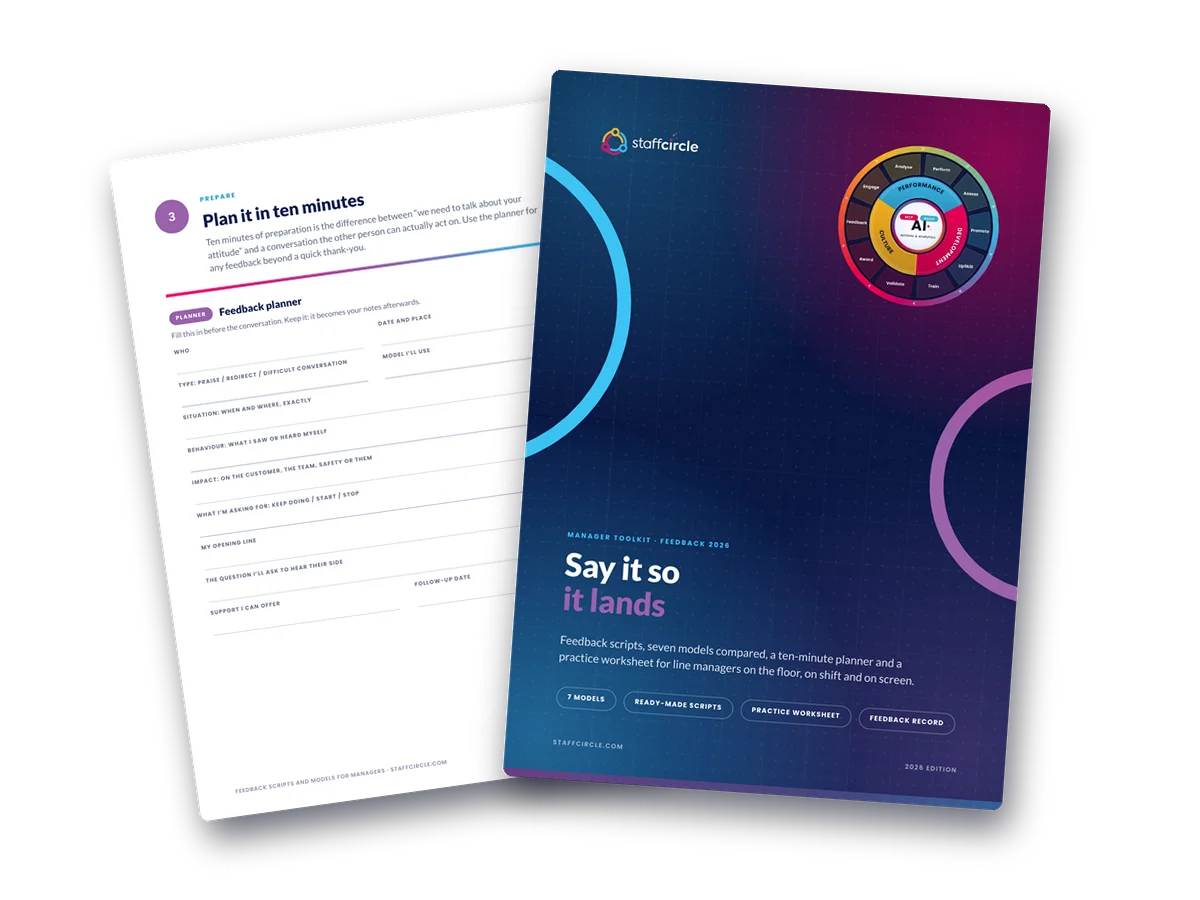
A lot of advice on feedback stops at “be specific”. This template gives you the words: scripts you can adapt for praise, for a quick redirection and for the conversation you have been putting off, plus a planner and a worksheet to practise on.
- Seven feedback models compared, and a chooser for which to use when
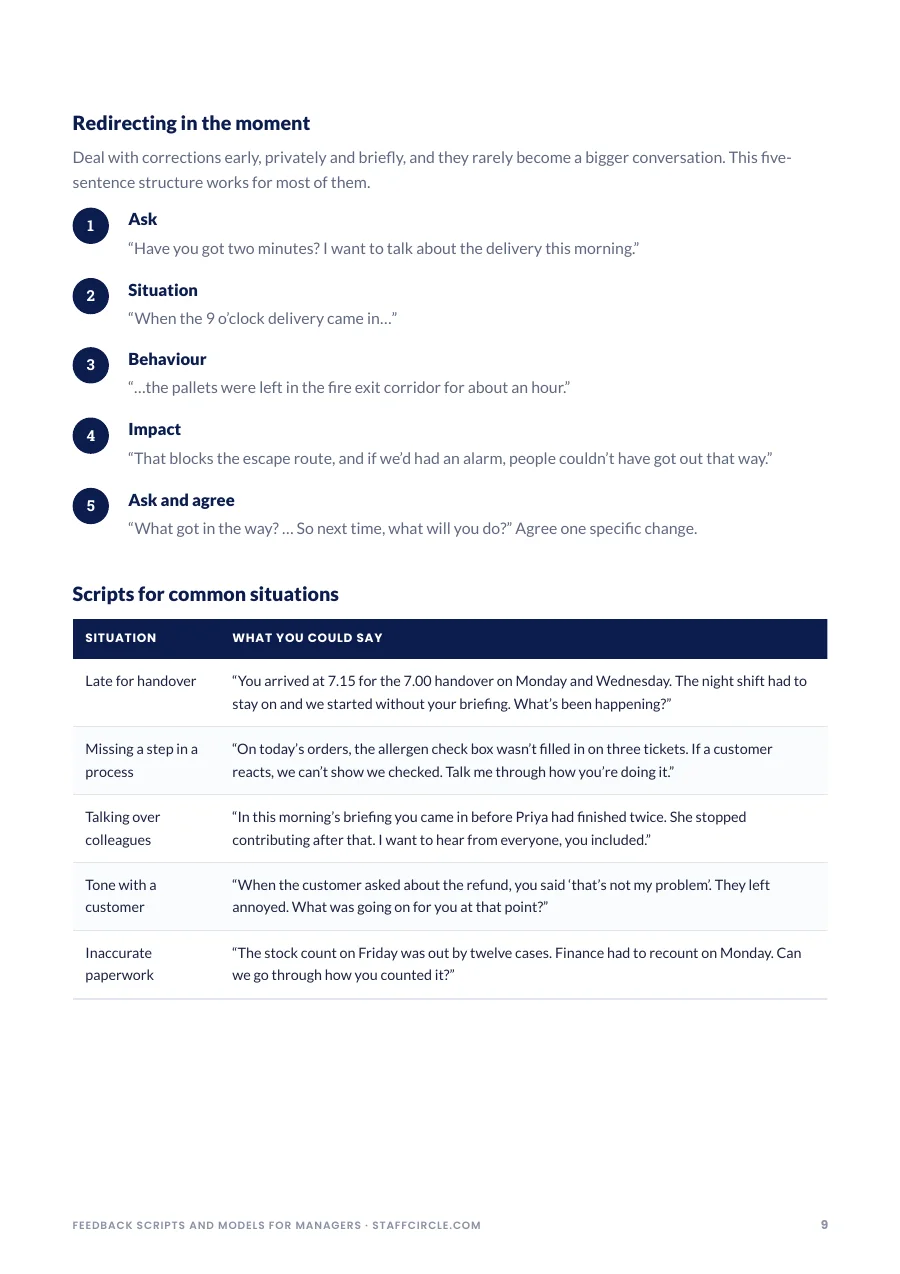
- Scripts for praise, redirection and difficult conversations
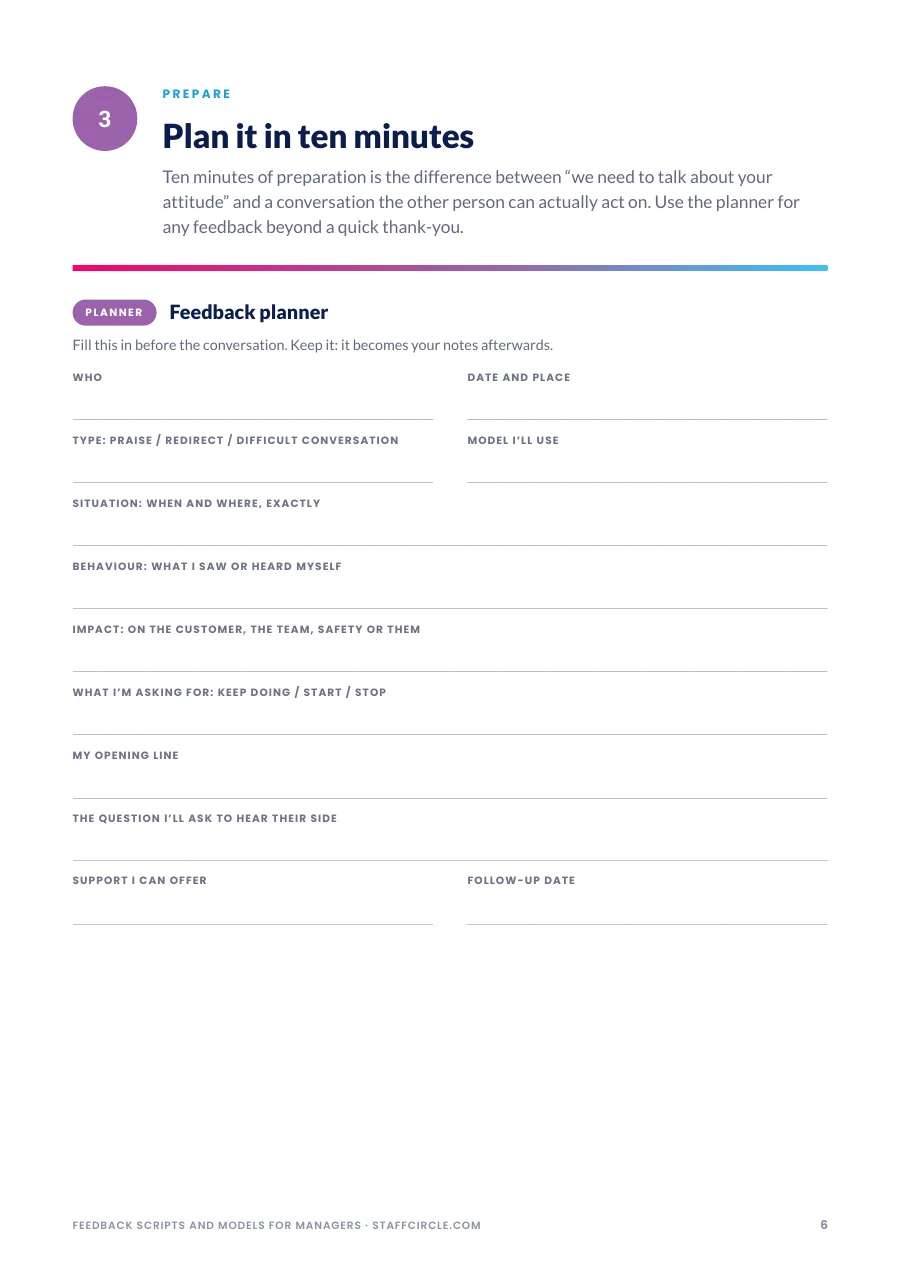
- A ten-minute feedback planner and a pre-conversation checklist
- What changes on the shop floor, at shift handover and on a video call
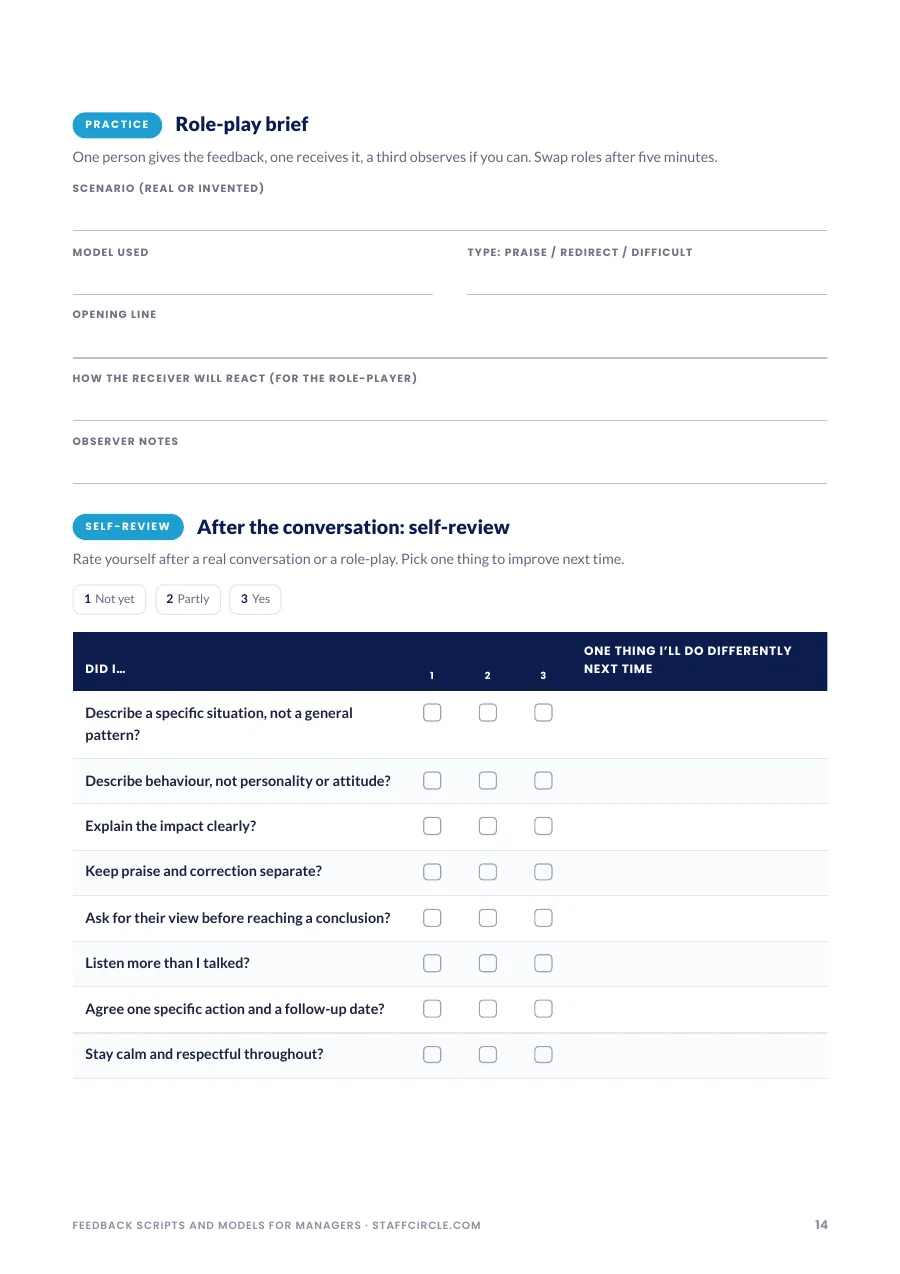
- A practice worksheet, a self-review grid and a feedback record
- Where informal feedback ends and a formal process begins
Get your free template
Fill in your details to get the PDF and the editable Word version. We’ll email you the PDF too.
We’ll only use your details to send the template and relevant StaffCircle content. See our privacy policy.
Trusted by teams at leading organisations


Seven sections, ready to print or edit
What the evidence says
Why some feedback makes performance worse, and the few habits that make it land.
Pick the right model
SBI, SBII, COIN, EEC, DESC and feedforward compared, and why to drop the sandwich.
Plan it in ten minutes
A one-page planner and a checklist to run through before you start.
Scripts for every kind of feedback
Praise people believe, quick redirection, and the hard conversation step by step.
On the floor, on shift, on screen
Adapting feedback for frontline, remote and written settings, and for different needs.
Practise, record, follow up
A rewrite exercise, a self-review grid and a record you can share with the employee.
Feedback that lands, not feedback that stings
Feedback is one of the cheapest things a manager can give, and one of the easiest to get wrong. The difference is rarely the model. It is preparation, specifics and listening.
Ask a group of managers how to give feedback to employees and you will hear the same advice: be specific, be timely, praise in public and correct in private. All true. What many guides leave out is the full wording for each situation, and what to do when the conversation does not go to plan.
The evidence is a useful reality check. The CIPD’s evidence review on performance feedback describes a large analysis of feedback interventions in which, although the overall effect was positive, over a third of the studies found performance got worse after feedback (CIPD). It argues that how feedback lands matters more than what you say, and that quality beats quantity.
What good feedback has in common
- It describes behaviour, not personality. “You missed the 7am handover twice this week” can be discussed. “You’re unreliable” can only be argued with.
- It says why it matters. The impact on the customer, the team, safety or the person themselves is what turns an observation into a reason to change.
- It is a two-way conversation. The CIPD found people are more likely to see feedback as fair when they are actively involved in it.
- The main message is not buried. The CIPD warns that wrapping criticism in praise (the “feedback sandwich”) risks the person missing the main message.
- It is written down when it matters. Acas says it is important to keep a record of conversations about performance and a good idea to share it with the employee (Acas).
Which feedback model should you use?
The Center for Creative Leadership’s Situation–Behaviour–Impact (SBI) model is one of the best known: describe when and where, what you saw or heard, and the result (CCL). It is ideal for quick praise and quick fixes. Adding a question about intent helps when you do not know why something happened. For a planned conversation about a pattern, a structure that ends in agreed next steps, such as COIN, keeps it from drifting. The template compares seven models and gives you a chooser.
Feedback on the shop floor
Most examples online are set in a meeting room. Frontline managers give feedback between jobs, at handover and in noisy, public spaces. Where safety is involved, correct it straight away and save the fuller conversation for later: the CIPD notes that negative feedback works better than positive for tasks focused on precision, risk and prevention. Everything else can wait for a quiet two minutes away from the line.
Five steps for your next conversation
- Write down the situation, the behaviour and the impact before you start
- Open with what you saw, not with a judgement
- Ask for their view, and listen to the answer
- Agree one specific change and the support you will give
- Note what was agreed, share it, and follow up on the date you set
The template includes scripts for all of this, a ten-minute planner, a practice worksheet and a record you can share. It comes as a printable PDF and an editable Word file. For more on making feedback part of everyday management, read our guide on how to give feedback, see how to run better one-to-ones, or look at continuous feedback for frontline teams.
Giving feedback to employees: common questions
What is the best way to give feedback to an employee?
Describe a specific situation, the behaviour you saw or heard yourself, and its impact, then ask for their view and agree what happens next. Keep praise and correction separate, and do it soon after the event. This template has scripts for each step.
What is the SBI feedback model?
SBI stands for Situation, Behaviour, Impact. It comes from the Center for Creative Leadership. You describe when and where something happened, the observable behaviour, and its result. Adding a question about the person’s intent turns it into SBII.
Does the feedback sandwich work?
It is risky. The CIPD’s evidence review on feedback warns that when criticism is wrapped in praise, the person may miss the main message. Whatever you include, make the main message unmistakable; many managers find it clearer to give praise and correction separately.
How often should managers give feedback?
Regularly, but quality matters more than quantity. Acas says managers should talk to employees informally about their performance on a regular basis, for example through check-ins or one-to-ones. The CIPD found that making feedback more frequent does not usually make it more effective on its own.
Should I write feedback down?
For anything about performance, yes. Acas says it is important to keep a record of conversations with employees about performance, and a good idea to share a written record with them. A quick note of praise is worth recording too.
When does informal feedback become a formal process?
Acas says employers should try to help someone improve before starting a formal procedure, and should raise conduct problems informally first unless the issue is more serious misconduct. If informal feedback and support have not worked, follow your capability or disciplinary policy and the Acas Code of Practice. Check acas.org.uk for the latest guidance.
Can an employee bring someone to a feedback conversation?
The Acas Code says employers should allow employees to be accompanied at any formal disciplinary or grievance meeting. Everyday feedback conversations are not formal meetings, but in practice, if a conversation could lead to a warning, handle it under your formal procedure.
What if the employee gets upset during feedback?
Acas suggests staying in control of the meeting, including deciding when to adjourn for a break, and focusing on the behaviour rather than the person. Pause, acknowledge how they feel, and offer to continue later if needed.
Can I edit the template?
Yes. The download includes a printable PDF and an editable Word version, so you can add your own examples, values and company logo.
Have better feedback conversations from tomorrow
Scripts, seven models, a planner, a practice worksheet and a feedback record, as PDF and Word.